Macro vs Micro Fundamental Analysis
Macro fundamental analysis judges whole economies and markets: interest rates, growth, inflation, and the broad forces that move every asset at once. Micro fundamental analysis judges one asset's own numbers, its revenue, its costs, its debts. The difference is the field of view, and the two can disagree for months.

Think of macro as the wide-angle lens and micro as the portrait lens: same camera, different field of view. Both lenses are honest. They simply frame different subjects, and a trader who confuses them ends up answering a question nobody asked.
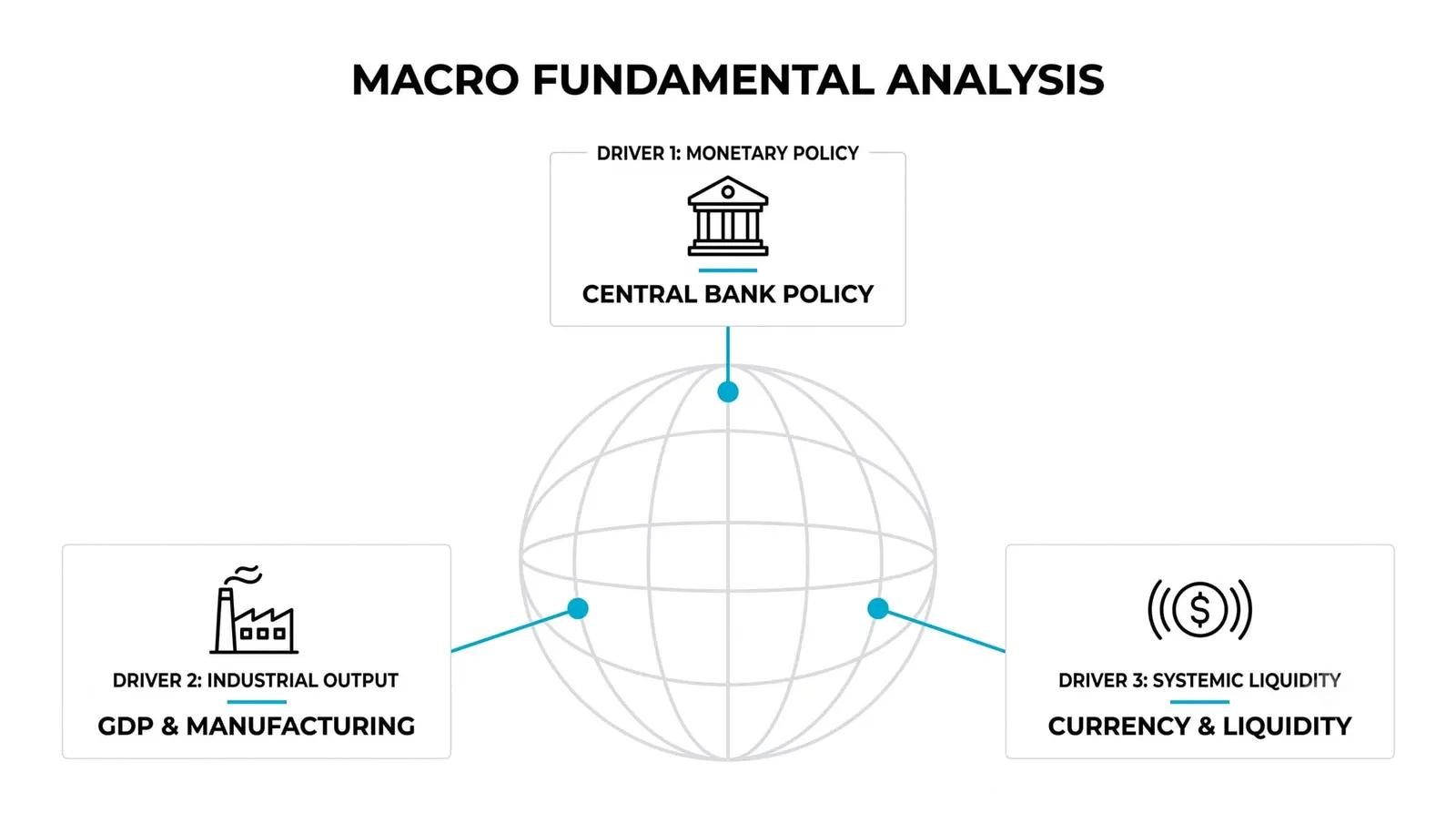
Macro Fundamental Analysis: The Big-Picture View
Macro covers the forces that no single company controls. Central bank interest rates. Economic growth, usually measured through output and employment. Inflation and what it does to purchasing power. Currency strength between economies. Geopolitics, from trade policy to conflict.
The question macro answers is environmental: which regime am I trading in, and which assets does that regime favor? Cheap money and strong growth tend to lift risk assets broadly. Tight money and falling growth tend to punish them. You are reading the environment itself, not any single asset.
Two traits define macro moves. They turn slowly, because economies are large and data arrives in monthly or quarterly batches. And when they turn, they move everything at once, because rates and growth feed into the price of every asset class simultaneously.
That second trait is why macro earns its place at this level of the course. A macro shift can override months of careful chart work in a single repricing.
Micro Fundamental Analysis: The Single-Asset View
Micro zooms into one asset and asks about its own books. For a company, that means earnings, margins, debt load, and cash flow. For a sector, it means order books and capacity. For a currency pair, it can mean the trade flows between two specific economies rather than the world economy as a whole.
The question micro answers is narrower: is this specific asset healthy, regardless of the environment around it? A company can grow revenue in a recession. A company can bleed cash in a boom. Micro analysis is how you find out which one you are holding.
Micro detail has one big advantage. It is checkable. Earnings reports are published. Debt figures are audited. Customer counts can be estimated. You can verify a micro claim in a way you can never verify a claim about where the whole economy is heading.

Why the Two Levels Don't Always Agree
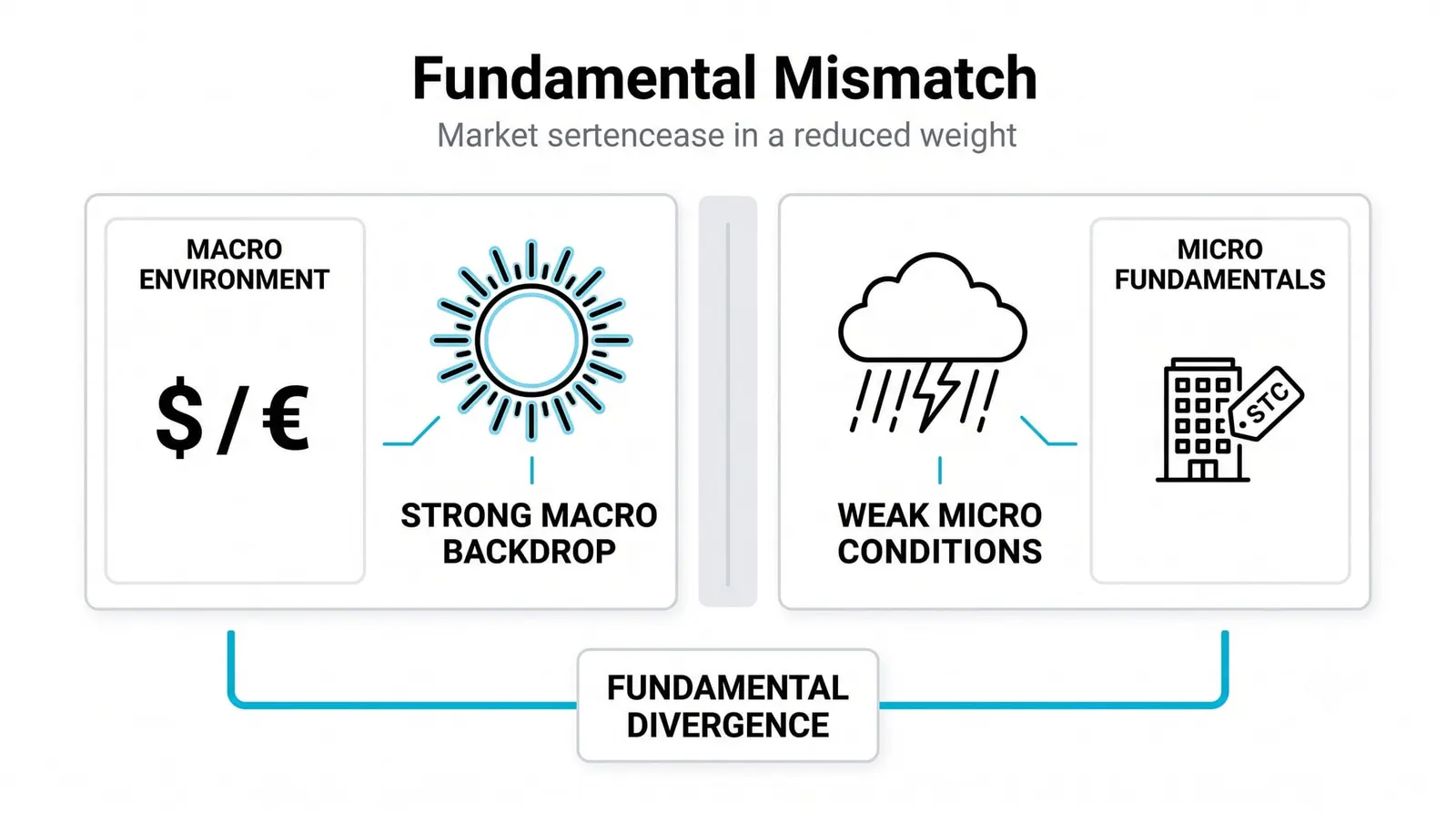
Disagreement between the lenses is normal, and it can persist for quarters. A strong economy can contain a weak company, one losing customers while the aggregate numbers look fine. A weak economy can contain a monopoly whose pricing power lets it thrive while everything around it shrinks.
Neither lens is broken in those moments. Each is accurately describing its own subject. The mistake is assuming one verdict cancels the other.
The resolution is usually time. Macro eventually re-prices everything, because financing costs, demand, and sentiment reach every asset in the end. But eventually can outlast your trade. A position sized for a three-week hold does not get to wait three years for the macro verdict to arrive.
Respect both clocks. The slow one wins in the end, and the fast one decides whether you are still in the trade to see it.
Choosing Which Lens to Use First
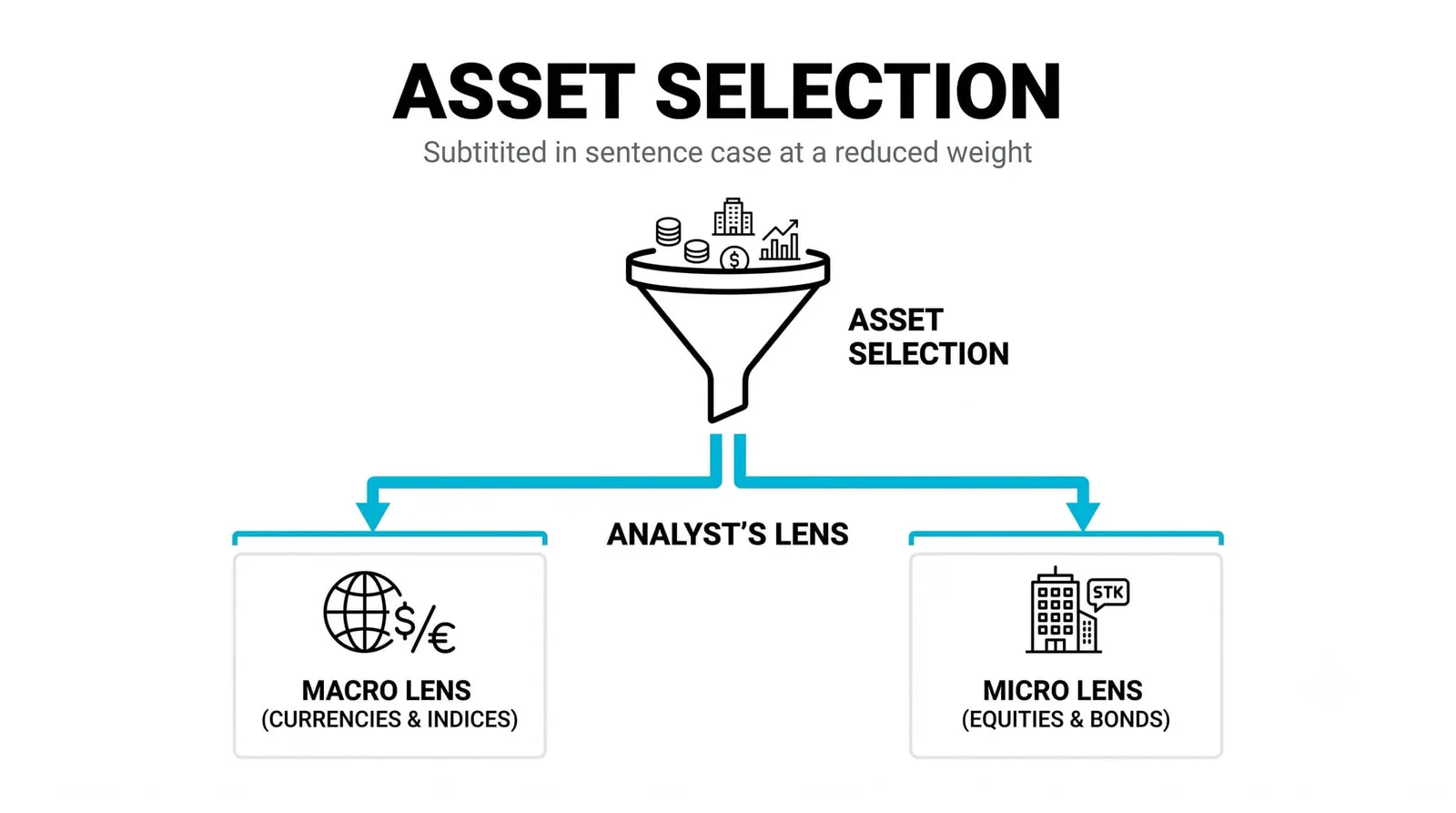
Match the lens to the instrument. Whole-market instruments, like index products, live on macro because they are the economy. Single stocks need micro first, with macro as the backdrop. Currencies sit closer to macro than micro, because a currency is a claim on an entire economy's relative strength.
Then match the lens to your holding period. The longer you intend to hold, the more weight macro deserves, because slow forces have time to arrive. A short holding period leans on micro and on price behavior, since the macro backdrop rarely turns inside a few sessions.
You will see this choice formalized in two sibling lessons in this batch: top-down and bottom-up analysis. Those are the routes, the order in which you walk through the lenses. This lesson is about the two altitudes themselves, what each one sees and what each one misses.
One Stock, Two Verdicts
Here is a hypothetical with round numbers, built only to show the mechanics. Imagine an economy growing at 3 percent a year with unemployment at 4 percent. Rates are stable. The macro lens reads this as a risk-on environment, the kind that historically favors owning equities broadly.
Now look at one company inside that economy through the micro lens. It loses its largest customer, and that customer was worth 30 percent of revenue. Its profit margin falls from 12 percent to 4 percent. Its debt payments stay fixed while the cash coming in shrinks.
Walk both verdicts. The macro lens favors broad ownership, because the environment rewards simply being invested. The micro lens says this particular company is leaking customers, and no macro tailwind patches a broken business.
The honest conclusion is uncomfortable. The lens you trust decides the trade, and the other lens told you the risk. If you buy on macro, you are accepting company-specific damage as your exposure. If you avoid on micro, you are accepting that you may miss a broad rally. Both are defensible. Pretending one verdict does not exist is not.
The Two Lenses Side by Side
| View | Field of view | What it checks | What it decides |
|---|---|---|---|
| Macro | Whole economies and markets | Rates, growth, inflation, currencies, geopolitics | Which environment you are in and which assets it favors |
| Micro | One asset | Earnings, margins, debt, order books, trade flows | Whether this specific asset is healthy |
| The two agreeing | Both levels at once | Environment and asset pointing the same way | The clearest setups, where the trade has two supports |
| The two disagreeing | Both levels at once | A strong economy holding a weak asset, or the reverse | A defined risk, where you know exactly what you are betting against |
Macro vs Micro, Answered
Which lens matters more for day trading?
Neither dominates, but micro and price behavior carry more weight inside a single session, because macro forces rarely turn within hours. The exception is scheduled macro releases, like rate decisions or inflation prints, which can move every market in seconds. Day traders need to know the macro calendar even if they never run a macro analysis.
Can one asset have great micro inside bad macro?
Yes, and it happens regularly. Companies with pricing power, low debt, and essential products can grow through weak economies. The catch is that bad macro usually still drags the asset's price in the short run, because falling markets pull most things down together before quality gets recognized.
Do forex traders use micro analysis?
Mostly no, because a currency is a macro instrument by construction. The closest thing to micro in forex is the flow between two specific economies: trade balances, capital flows, and the relative stance of two central banks. That is still closer to macro than to a single company's earnings report.
How do I know which lens the market is pricing?
Watch correlation. When most assets in a class move together on the same news, the market is pricing macro. When individual assets diverge sharply on their own news, the market is pricing micro. Markets switch between the two modes, and the switch itself is useful information.
Next in this batch come the two routes through these lenses: top-down analysis, which starts at the economy and narrows to the asset, and bottom-up analysis, which starts at the asset and checks the economy afterward. Knowing what each lens sees is the foundation. Learning which order to look through them is the craft.