How to Test a Trading Approach
You test a trading approach by running it many times in conditions as close to live as possible: first on historical charts, then on a demo account, then with small real size. You judge it on a written sample of dozens of trades, not on how three trades felt. Testing an approach is the dress rehearsal before opening night; the mistakes should happen while they are still free.

Most new traders skip this stage. They read about a method, take two trades, and either marry it or abandon it based on the outcome. Two trades tell you nothing. A coin flipped twice tells you nothing about the coin. This lesson walks through the three stages of testing, what each one can and cannot prove, and how to judge the results honestly.
Why Testing Comes Before Trusting
Testing answers two different questions, and traders often confuse them. The first question: does this approach work at all? The second: does it work for me?
An approach can have good numbers and still be wrong for a person. A day-trading style needs morning hours in front of a screen. If your job owns your mornings, the numbers do not matter. A position-trading style needs the patience to sit through a two-week drawdown without touching anything. If watching an open loss makes you physically restless, the numbers do not matter either.
The fit is testable. That is the good news. You do not have to guess whether a style suits your schedule or your temperament. You run it, you record what happens, and the log tells you. But you only get that answer if you test before you commit real size.
Stage One: Backtesting on History
Backtesting means replaying past charts and recording what your rules would have done, trade by trade. You scroll the chart back, hide the right side, advance bar by bar, and write down each signal: entry, stop, target, result.
This gives you something valuable: a fast sample of dozens or hundreds of trades with nothing at risk. In a weekend you can simulate six months of trading. No other stage offers that density.
It cannot give you three things. It cannot give you the fills you would actually have received, because historical bars do not show spread and slippage. It cannot give you the news spikes you would have sat through in real time. And it cannot test your discipline, because clicking through old charts costs you nothing emotionally.
Watch for the hindsight trap. When you replay a chart, some part of you knows how it ended. The trader living through that chart did not. Be strict: write the decision before you advance the bar, and count every ambiguous case against the approach, not for it.
Stage Two: Demo Trading
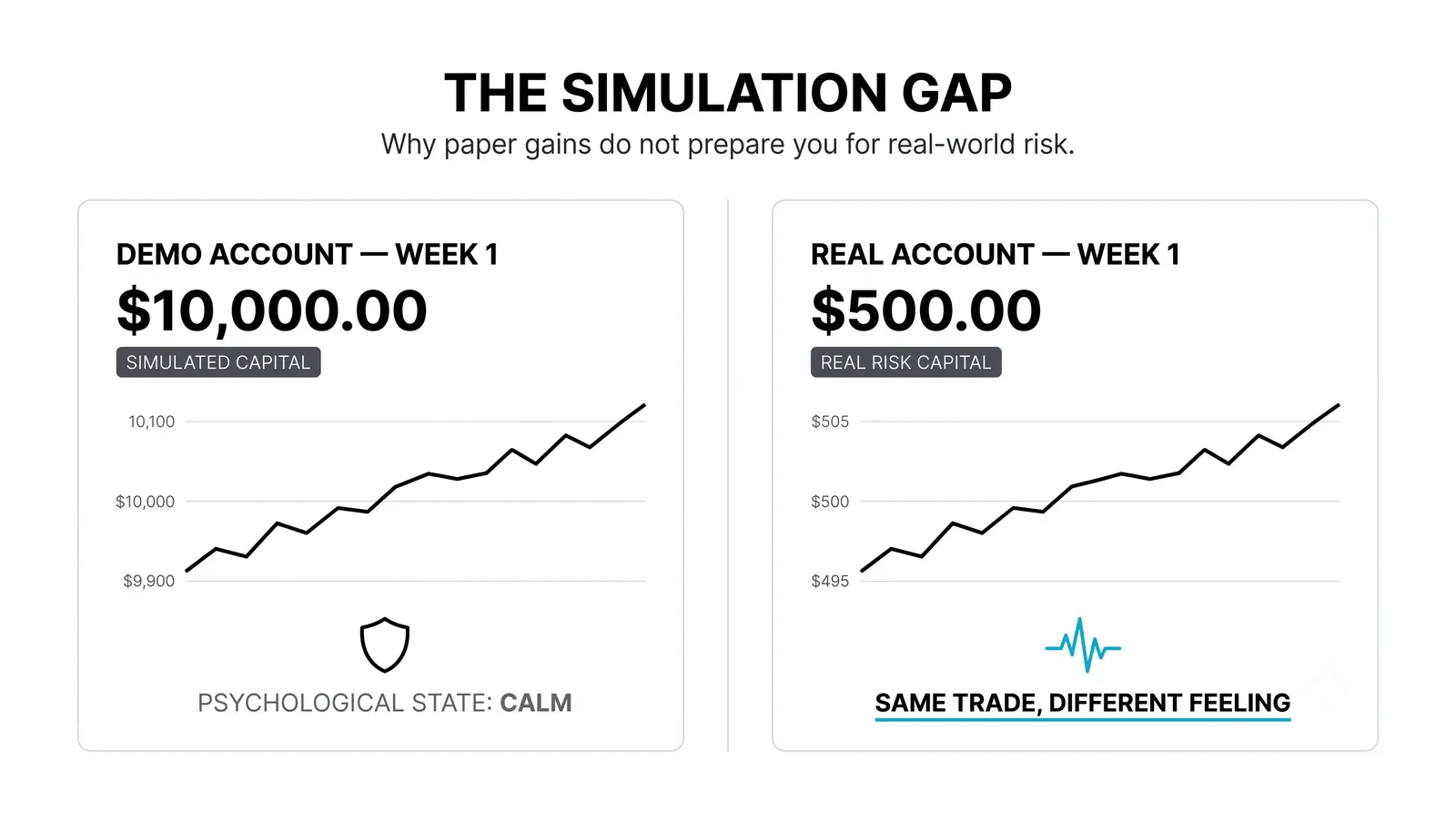
Next, run the approach live on a demo account. Real prices, real clock, fake money.
Demo trading proves execution and timing. You learn whether you can actually place the orders the rules demand, at the hours the rules demand, around the rest of your life. It proves whether the routine fits your week. Many approaches die here, and that is a cheap funeral.
What demo cannot prove is your behavior with real money on the line. That is the hardest variable in the whole business. Filling a demo order while you eat lunch feels nothing like watching a real position go against you while you wonder about the rent. Do not mistake a good demo run for a finished test. Treat it as a pass that earns you the right to the next stage.
Stage Three: Forward Testing Small
The final exam is tiny real positions. Trade the approach at the smallest size your broker allows.
The losses here are tuition paid at the student rate. You are not trying to make money at this stage. You are buying information about the one variable the earlier stages could not measure: you, under real pressure.
The emotions are the actual subject being tested. Do you move your stop when it is about to be hit? Do you skip valid signals after two losses? Do you oversize after a win? Small size exposes all of this at a price you can afford. A trader who breaks rules at minimum size will break them at full size, only louder.
What to Record and How to Judge It
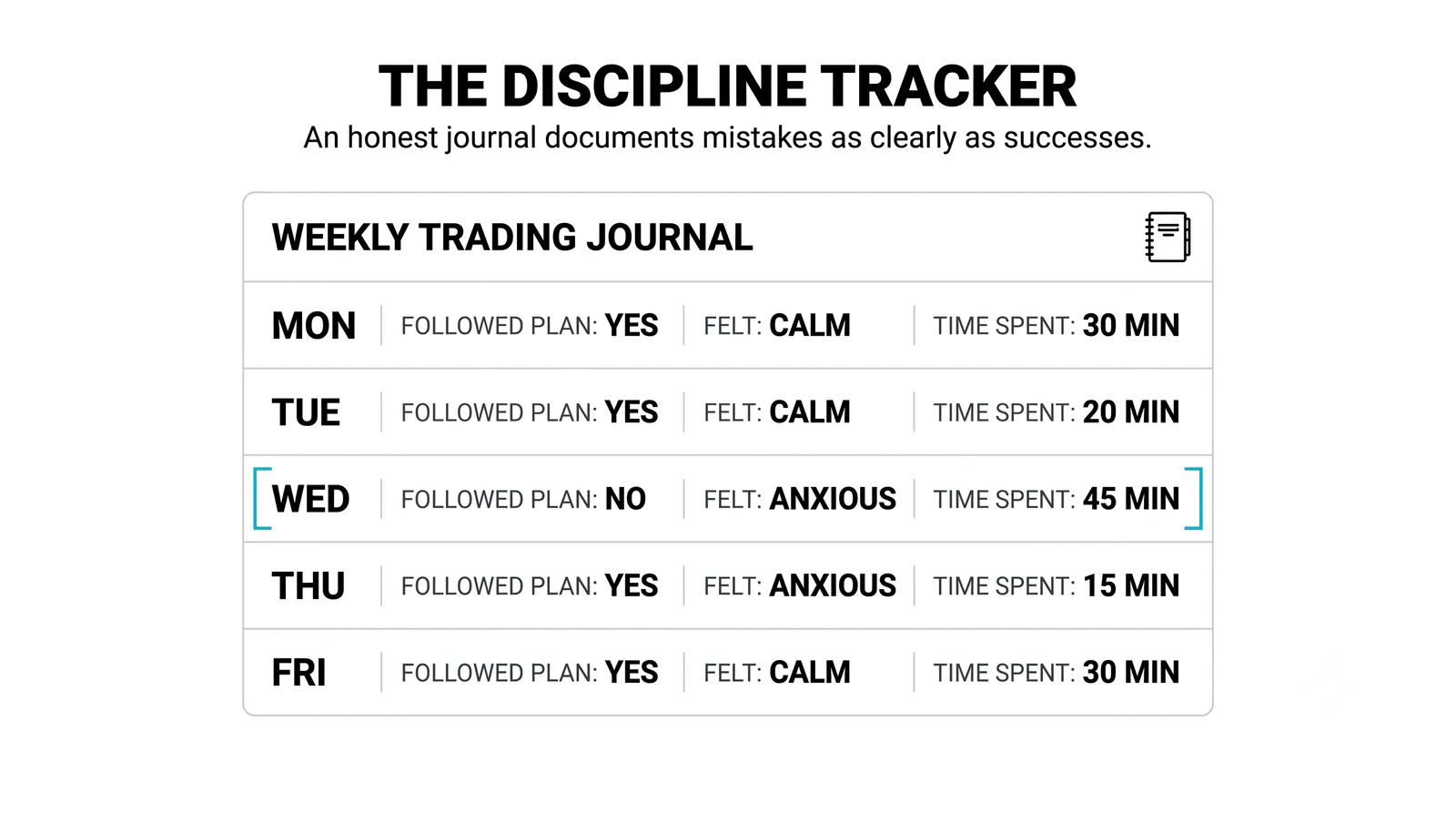
Every test trade, at every stage, gets a written log entry. Keep it simple and keep it complete:
- Date and instrument
- The setup that triggered the trade
- Entry, stop, and planned exit
- The actual result
- A screenshot
- Whether you followed the rules, yes or no
That last line matters more than the profit column. An approach with sloppy execution data is an untested approach, whatever the profit says.
On sample size: 30 trades is the minimum before you draw any conclusion, and 100 is comfortable. Below 30, luck dominates the numbers and you are reading noise.
Judge process numbers, not feelings. Win rate. Average win against average loss. The worst losing streak in the sample, because you will have to live through one like it. And the rule-break count, because a high one means the approach does not fit the trader running it.
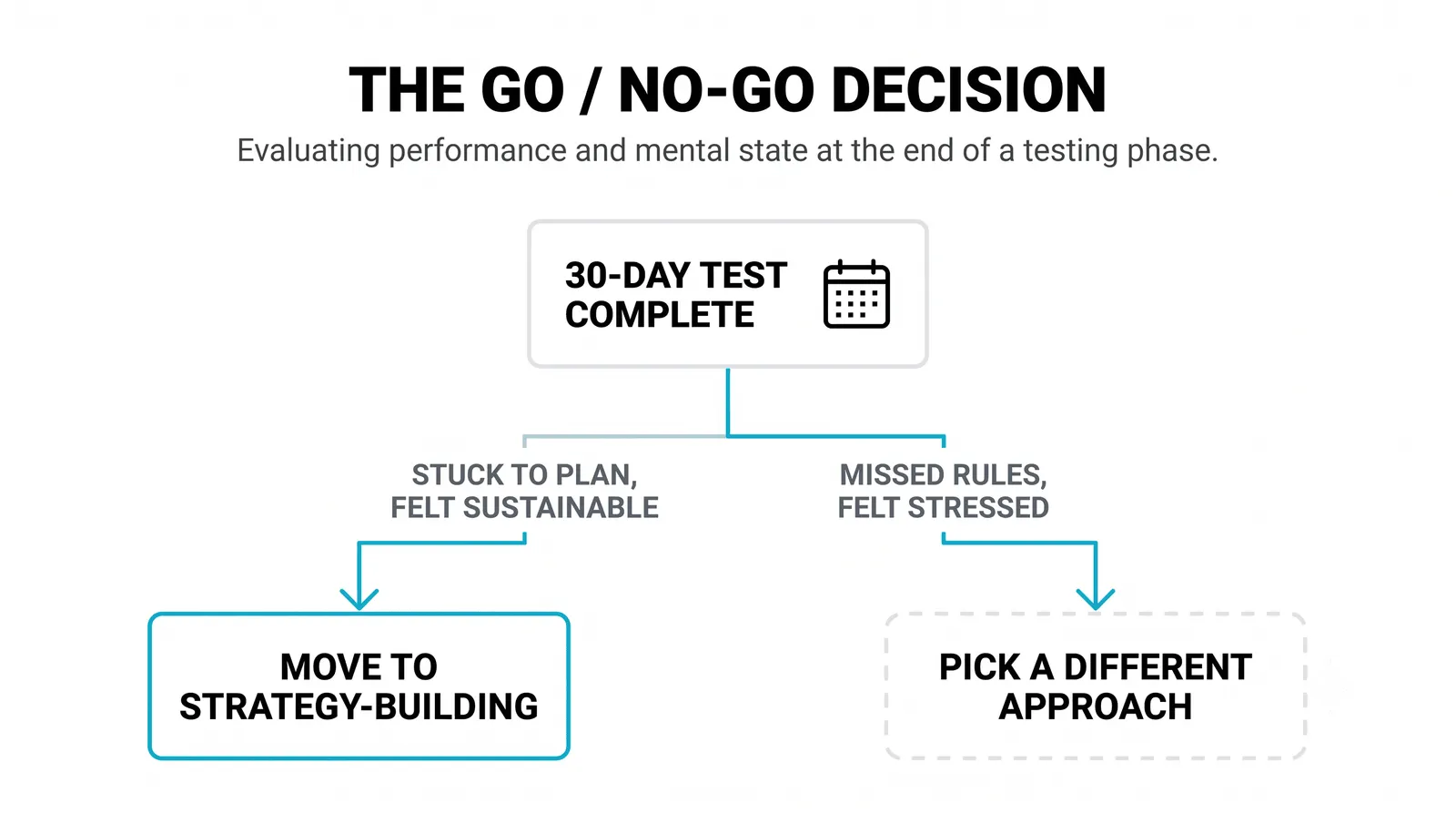
Set the review date in advance. Write it down before trade one. Without a fixed date, you will redesign the approach mid-test out of boredom after a quiet week or fear after a losing one, and the whole sample becomes worthless.
A Worked Example
Here is a hypothetical run with round numbers. You backtest an approach over 100 historical trades. It produces 40 winners paying an average of 300 each, and 60 losers costing an average of 100 each.
The arithmetic: 40 x 300 = 12,000 gained. 60 x 100 = 6,000 lost. Net result: +6,000 over 100 trades, an average of +60 per trade. A 40% win rate that still makes money, because the winners are three times the losers.
Now you demo the same approach live for 30 trades. Slippage on entries costs a little. Two rule breaks cost more. The average drops from +60 to +35 per trade.
Read that gap correctly. The backtest number is the ceiling, not the promise. Real trading shaves the paper figure every time, through costs, timing, and human error. If an approach only looks good in the backtest and falls apart the moment conditions turn real, it was never an approach. It was a story about the past.
The Three Stages Side by Side
| Test stage | What it answers | What it cannot tell you |
|---|---|---|
| Backtest | Did the rules have an edge on past data, across a large sample? | Real fills, live spreads, news spikes, your discipline |
| Demo | Can you execute the rules in real time, and does the routine fit your week? | How you behave with real money at risk |
| Small live size | Can you follow the rules when losses are real? | How the approach performs at full size over years |
Each stage filters out a different kind of failure. Skipping one does not save time. It just moves the failure somewhere more expensive.
Questions About Testing a Trading Approach
How many trades before I trust an approach?
Thirty trades is the floor for any conclusion, and 100 gives you a sample you can lean on. Below 30, a few lucky or unlucky outcomes dominate the numbers. Judge the full sample on the review date you set in advance, not trade by trade.
Is backtesting enough on its own?
No. Backtesting shows the rules had an edge on past data, but it cannot show your real fills, your real timing, or your real behavior under pressure. A backtest is the first filter, never the final verdict. Demo and small live trading exist precisely to test what history cannot.
How long should I demo trade?
Long enough to log at least 30 trades following the rules exactly, which usually means several weeks to a few months depending on how often the approach signals. Calendar time matters less than trade count and rule compliance. When the demo log is clean and the routine fits your week, move to minimum real size.
What if the approach only fails when I trade it?
Then the problem is the fit, not the method, and that is exactly what testing exists to reveal. Check your rule-break count first. If you follow the rules on paper but break them live, the approach demands something your schedule or temperament cannot give. Either adjust the approach to fit you honestly, or test a different one. Both outcomes are successes, because you found out at small size.
Once an approach survives all three stages with a clean log, the remaining question is how much to risk on each trade when you scale up. That is where position sizing stops being theory and starts being the decision that shapes your entire equity curve.