How News Events Affect Price, Explained
News events move price through the gap between what the market expected and what actually arrived. Price sits where it sits because traders already positioned for the expected outcome, so the only thing left to trade is the surprise. Three things decide how far the move runs: how important the event is, how big the surprise is, and how fast the market can reposition.

Think of a scheduled fire drill versus a real alarm: the drill moves nobody, and the real alarm clears the building. Markets live on scheduled drills that occasionally turn real. Most releases land close to expectations and pass quietly. Once in a while the number arrives far from what was priced, and everyone repositions at once.
What a News Event Is in a Market Context
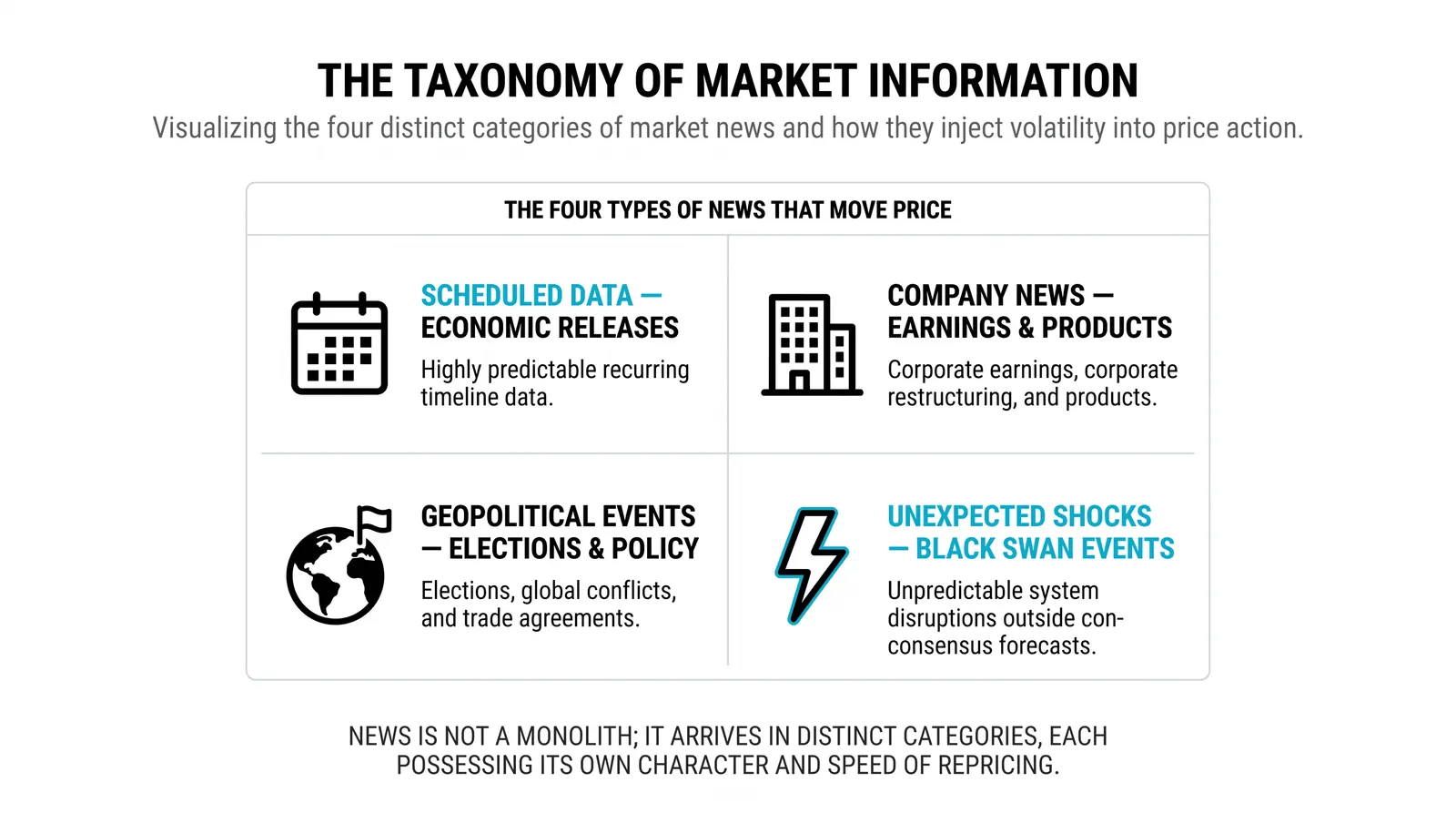
A news event is any moment when new information enters a market that was priced on old information. That definition is broader than headlines. It includes anything that changes what participants know.
Scheduled data releases are the most common type. Employment reports, inflation readings, growth figures, and trade numbers all arrive on fixed dates at fixed times. The market knows they are coming and forms an expectation in advance.
Central bank decisions work the same way. Rate decisions, policy statements, and press conferences are scheduled, telegraphed, and heavily anticipated. The decision itself often matters less than the hints about what comes next.
Company earnings are the equity-market version. A listed company reports results on a known date, analysts publish forecasts beforehand, and the stock reprices on the gap between forecast and reality.
Unscheduled shocks are the fourth category. A sudden political event, a natural disaster, an unexpected announcement. These arrive with no expectation in place, which makes them a different animal entirely.
Why Markets React to News
Expectations are already in the price. Before a major release, traders, funds, and institutions have positioned for the outcome they consider most likely. That positioning is what the current price reflects.
When the actual number matches the expectation, nothing needs to change. Nobody has to adjust. Price barely moves, because the information was already accounted for.
When the number lands away from expectations, positions built on the old assumption are suddenly wrong. Holders of those positions have to exit or reverse, and that forced repositioning is what moves price. The crowd trades the surprise, never the print.
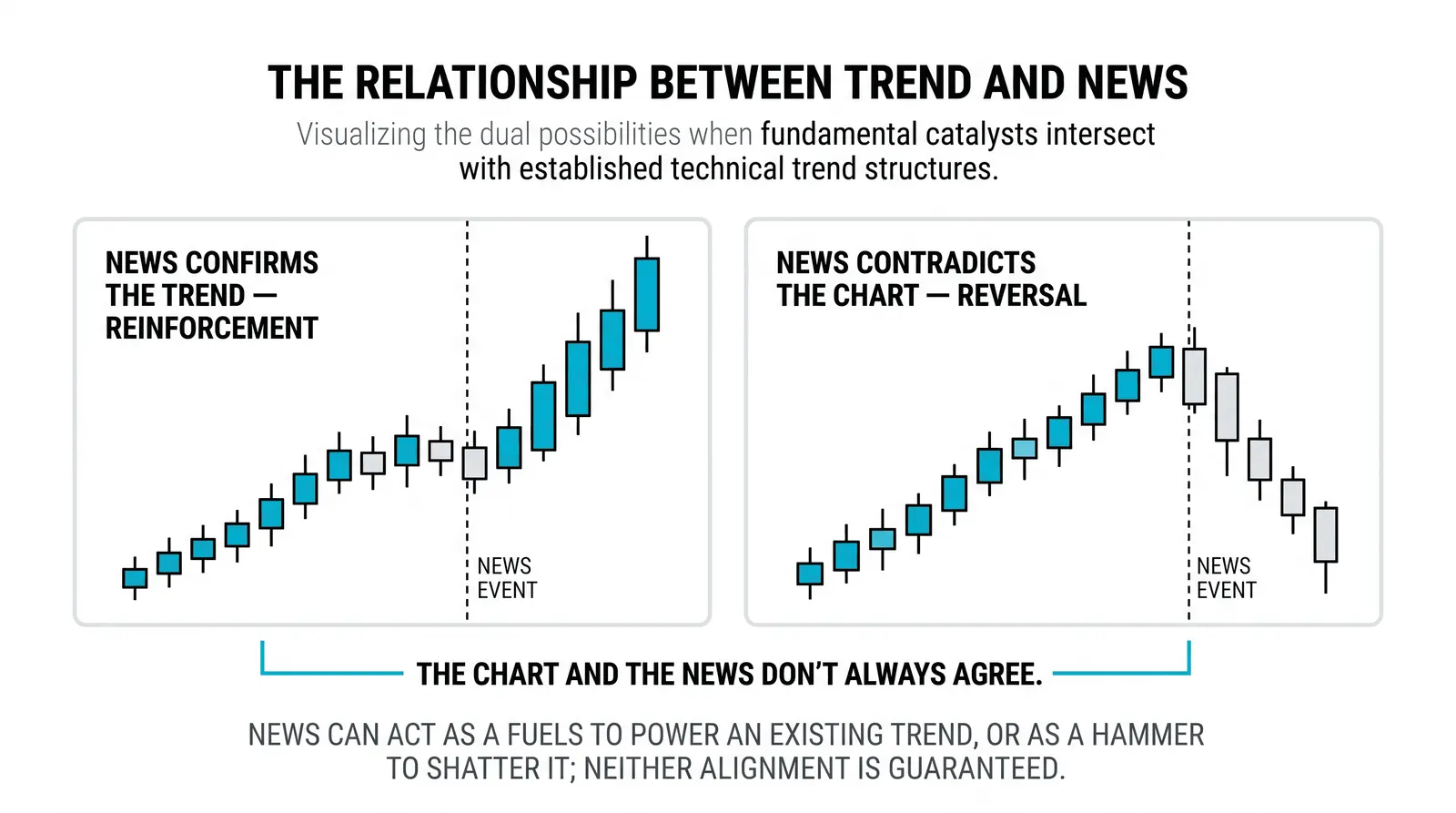
Three levers set the size of the move:
- Importance. A top-tier release like a major employment or inflation report can reprice an entire currency or index. A minor regional survey barely registers.
- Surprise size. A small miss produces a small adjustment. A result nobody saw coming forces a large one.
- Speed of repositioning. If many participants need to adjust at once and liquidity is thin, the move extends further and faster.
A later lesson in this level goes deep on expected versus actual, on beats, misses, and in-line results, and on why the first move is often not the real move. For now, hold the core idea: price reacts to the gap, not the number.
The Types of News That Move Price
Four categories cover most of what moves markets.
Economic data. Scheduled statistics on jobs, inflation, growth, and activity. They reshape expectations about the economy and, through that, about interest rates.
Central bank decisions. Rate announcements and policy guidance. Because interest rates sit underneath the pricing of nearly every asset, these events carry outsized weight.
Earnings. Company results that reprice individual stocks and, when the company is large enough, entire sectors and indices.
Geopolitics. Elections, conflicts, and policy shocks. These are mostly unscheduled, and the previous lesson covered them in detail, including why their market effects often fade faster than the headlines suggest.
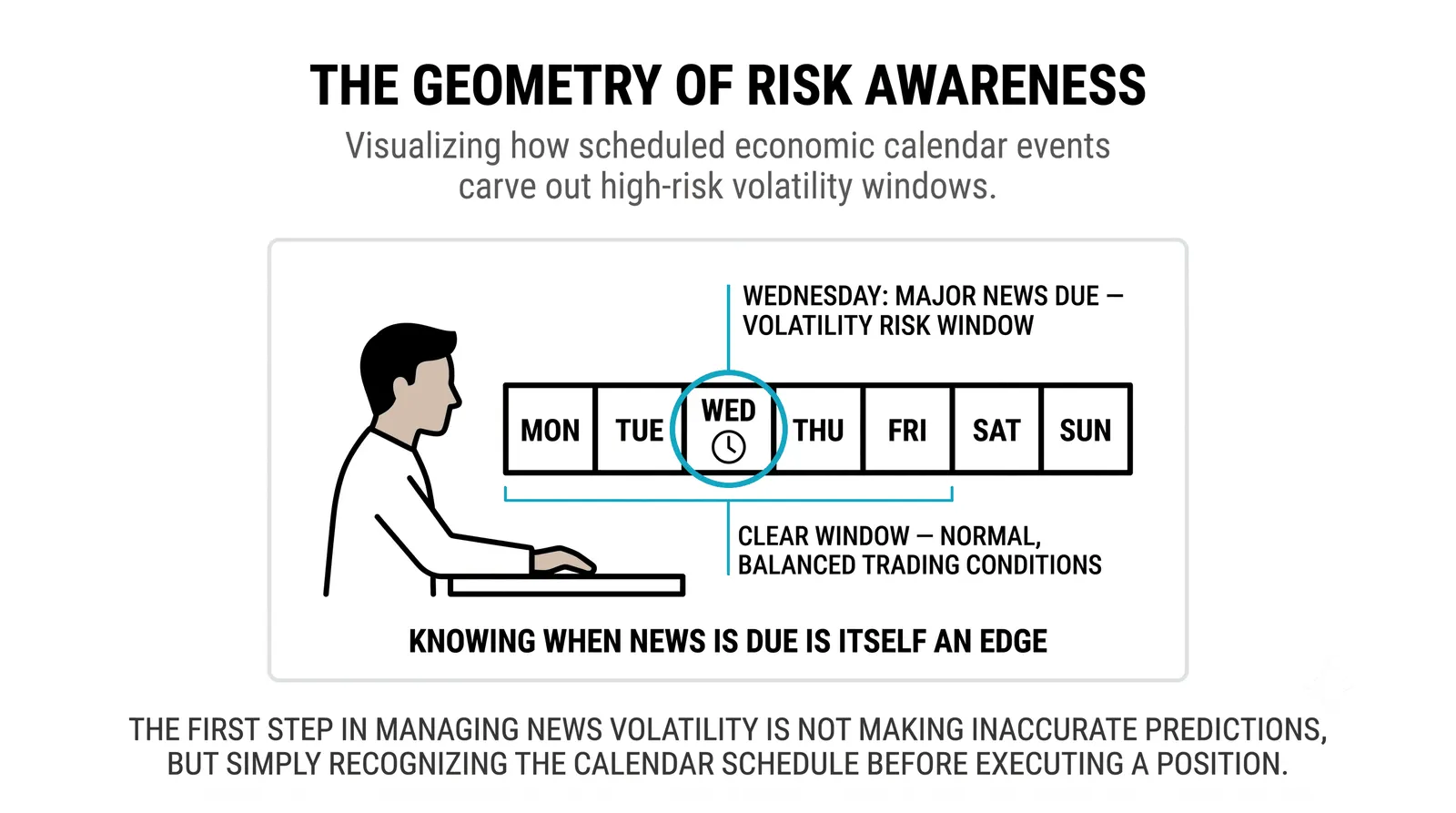
The working tool for tracking the scheduled categories is the economic calendar, which gets its own lesson later in this level. For now, know that one exists and that professionals plan their week around it.
Speed, Surprise, and the First Few Minutes
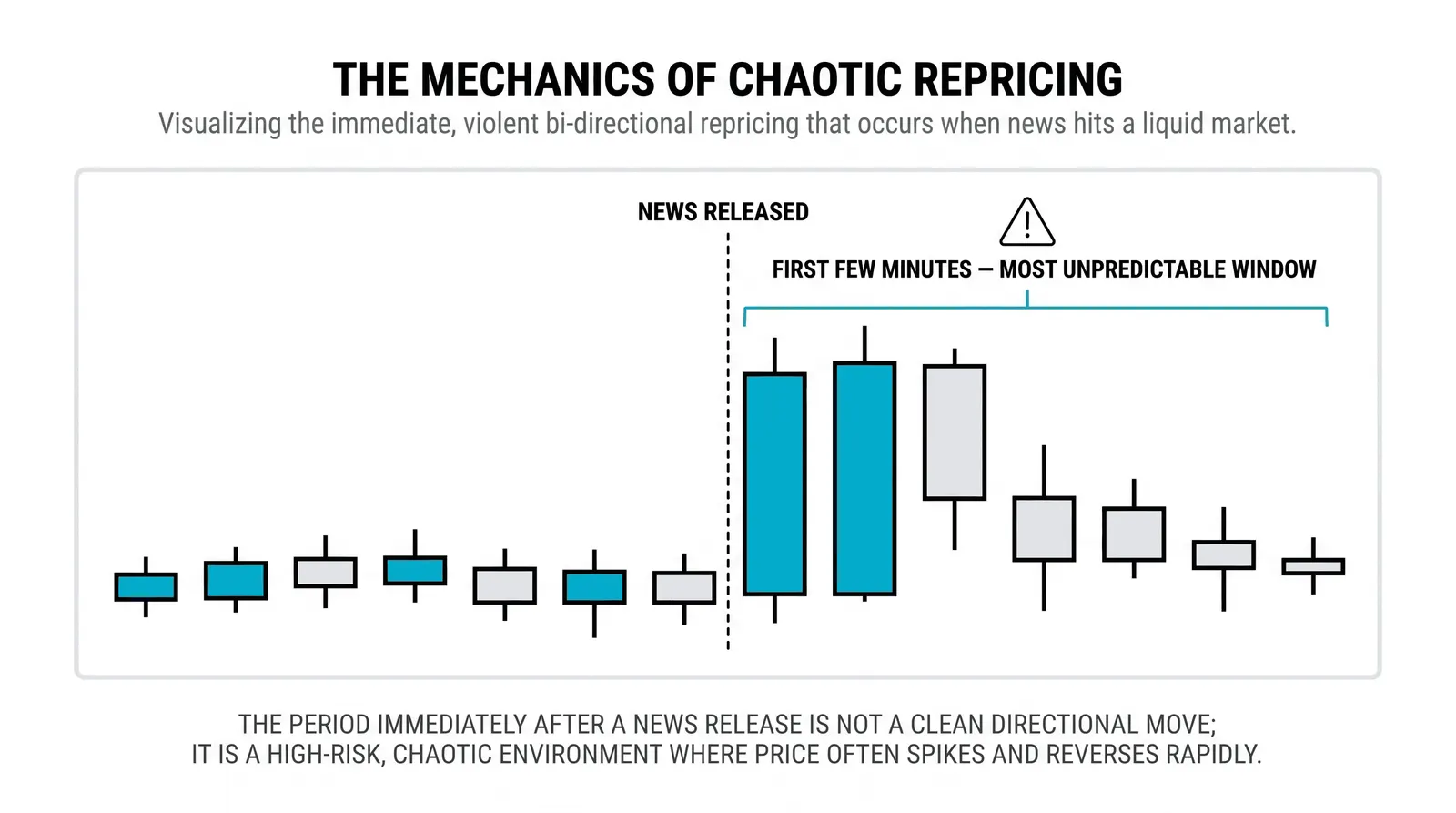
The moments around a major release are the strangest trading conditions you will see. Liquidity thins out. Market makers pull their quotes or widen them, because nobody wants to stand in front of an unknown number. Spreads widen exactly when everyone wants to trade.
This creates a trap for new traders. The move looks dramatic and urgent, and the temptation to jump in is strong. But the price you see on screen may not be the price you can actually get, and the direction of the first spike frequently reverses.
The first move often overshoots. Algorithms react to the headline number in milliseconds, pushing price to an extreme. Then humans read the details, find nuance the machines missed, and price retraces part of the spike. A release can look like a huge beat on the headline and a disappointment in the details.
Treat the first minutes as a show, not a shop. Watch them, learn from them, but do not mistake them for an opportunity built for you. The worst classroom in the market is a fast one with wide spreads and your own money on the line.
One Release, Three Outcomes
Here is a hypothetical illustration with round numbers. Imagine a monthly employment report where the market expects +150,000 new jobs.
Outcome one: the report prints +148,000. Essentially in line. The expectation was already priced, the number confirms it, and price barely twitches. A shrug. Traders who positioned for the consensus keep their positions, and the market moves on to the next event.
Outcome two: the report prints +350,000. A huge beat. Every position built on +150,000 is now wrong in the same direction, and the repositioning is violent. Price spikes hard as the market reprices growth and interest rate expectations. Within the hour, the move gives back a third of the spike as the initial overshoot corrects and traders digest the details.
Outcome three: the report prints -50,000. A miss so large it flips the sign. The move runs the other way with the same speed and force as outcome two, because the surprise is roughly the same size in the opposite direction.
Same report. Same scheduled time. Three different surprises, three different markets. The report itself was never the variable. The gap between expectation and arrival was.
How the Four Types Compare
| News type | How often it lands | What tends to move most |
|---|---|---|
| Economic data | Weekly, on fixed schedules | Currencies, bonds, indices |
| Central bank decisions | Several times a year per bank | Currencies and interest-rate expectations |
| Earnings | Quarterly per company | Individual stocks and their sectors |
| Geopolitical shocks | Unscheduled, irregular | Safe havens, oil, risk sentiment broadly |
News Events, Answered
Why does good news sometimes make price fall?
Because price reacts to the surprise, not the headline quality. If the market expected great news and the news was merely good, the gap is negative, and price falls on good news. The reverse also happens: bad news that is less bad than feared can push price up.
Should I trade the release itself?
New traders should not. Spreads widen, liquidity thins, and the first move frequently reverses, which means the conditions are at their worst exactly when the excitement peaks. Watching releases without trading them is free education.
What does priced in actually mean?
It means the expected outcome is already reflected in the current price through positioning done in advance. When something is fully priced in, its confirmation moves nothing. Only a deviation from it can.
How do I know which events matter this week?
The economic calendar, covered in its own upcoming lesson, lists scheduled releases and typically flags their expected importance. As a rule of thumb, top-tier employment, inflation, and central bank events matter most, and minor regional surveys matter least.
Next in this level, the lesson on expected versus actual takes the idea from this one and pulls it apart: beats, misses, in-line results, and why the first move after a release so often lies about where price is really going.