Geopolitical Events and Market Impact
Geopolitical events are wars, sanctions, elections, and diplomatic ruptures that change the rules an economy runs under. Markets react to them fast because rules are worth money. A tariff decides who may sell what. A sanction decides whose assets can move. A war decides whether a port stays open. When those rules wobble, every price built on top of them wobbles too, and traders reprice first and read the details later.

Most of the time, the macro framework you learned earlier runs on numbers: rates, growth, inflation, liquidity. Geopolitics sits one layer deeper. Think of the economy as a city and geopolitics as its power grid: everything downstream runs normally right up until the grid itself becomes the story. When the grid hums, nobody talks about it. When it flickers, it is the only conversation. That is why a single headline can shove aside a month of careful economic data in one session.
What Counts as a Geopolitical Event
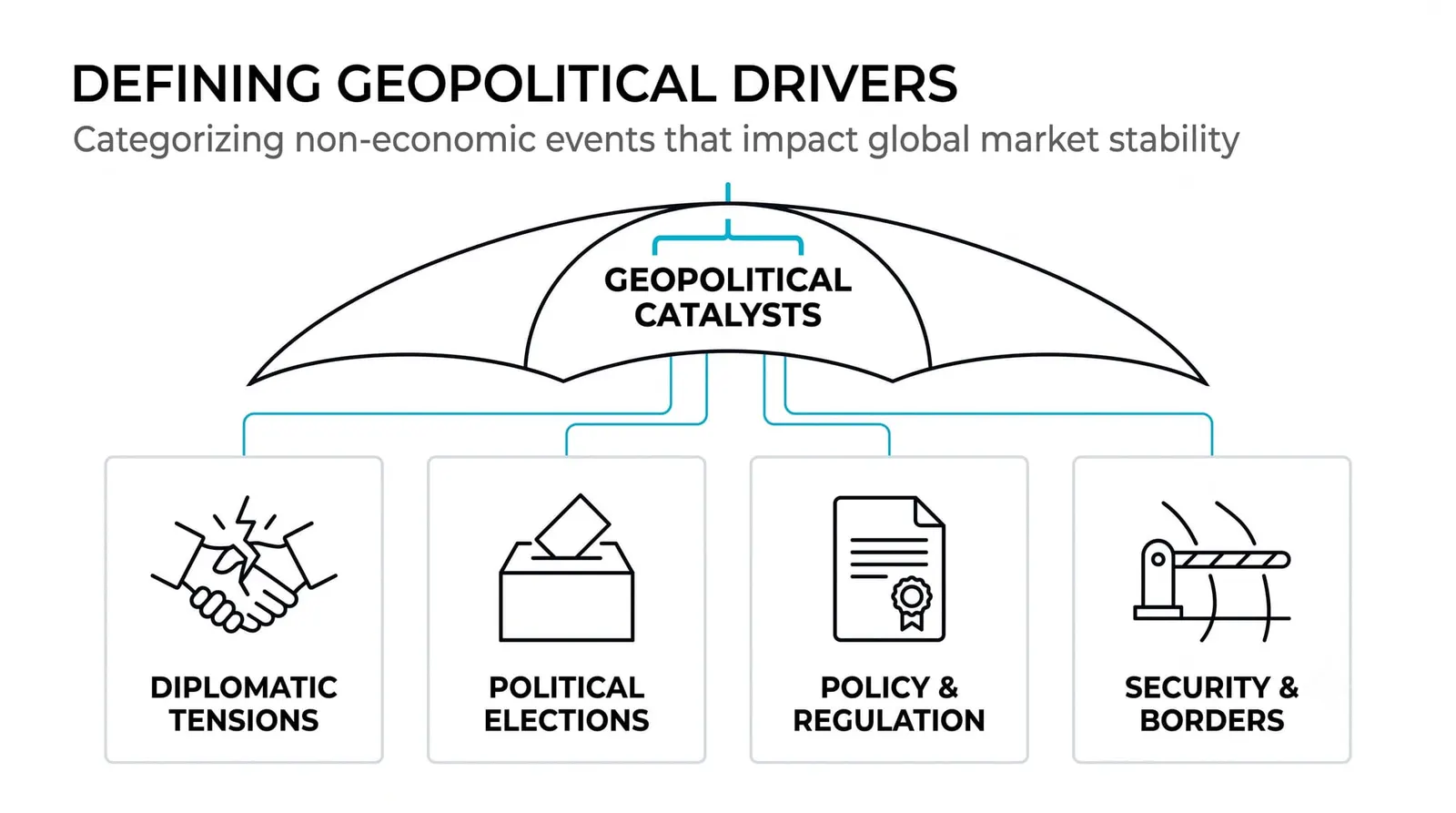
Four categories cover most of what moves markets.
Armed conflict. Wars, border clashes, blockades, and strikes on infrastructure. These threaten physical supply lines directly: shipping lanes, pipelines, factories, crops. They also threaten lives and property, which freezes investment in the affected region for years.
Sanctions and trade restrictions. One government limits another's access to finance, goods, or technology. No shots fired, but the rules of commerce change overnight. Assets held in the sanctioned country can become stranded. Companies that traded freely last quarter face a legal wall this quarter.
Elections and regime change. A vote or a transfer of power can rewrite tax law, spending priorities, central bank independence, and trade posture. Markets care less about who wins than about which rules survive the transition.
Diplomatic ruptures. Expelled ambassadors, collapsed treaties, withdrawn agreements. These rarely move markets on their own, but they signal that bigger rule changes may follow. Traders treat them as early warnings.
The common thread across all four is a threat to the rules: to property, to supply lines, to who may trade with whom. The table below maps each category to what it endangers and what usually moves first.
| Event type | What it threatens | What typically moves first |
|---|---|---|
| Armed conflict | Supply lines, physical property, regional stability | Commodities tied to the region, haven bonds, local equities |
| Sanctions | Access to finance, trade flows, asset ownership | The target's currency and bonds, affected exporters' stocks |
| Elections and regime change | Tax, spending, and regulatory rules | Domestic currency, domestic bonds, policy-sensitive sectors |
| Diplomatic rupture | Treaties, cooperation, future trade terms | Currencies of both parties, then risk sentiment broadly |
Why Markets React Before the Full Picture Is Known
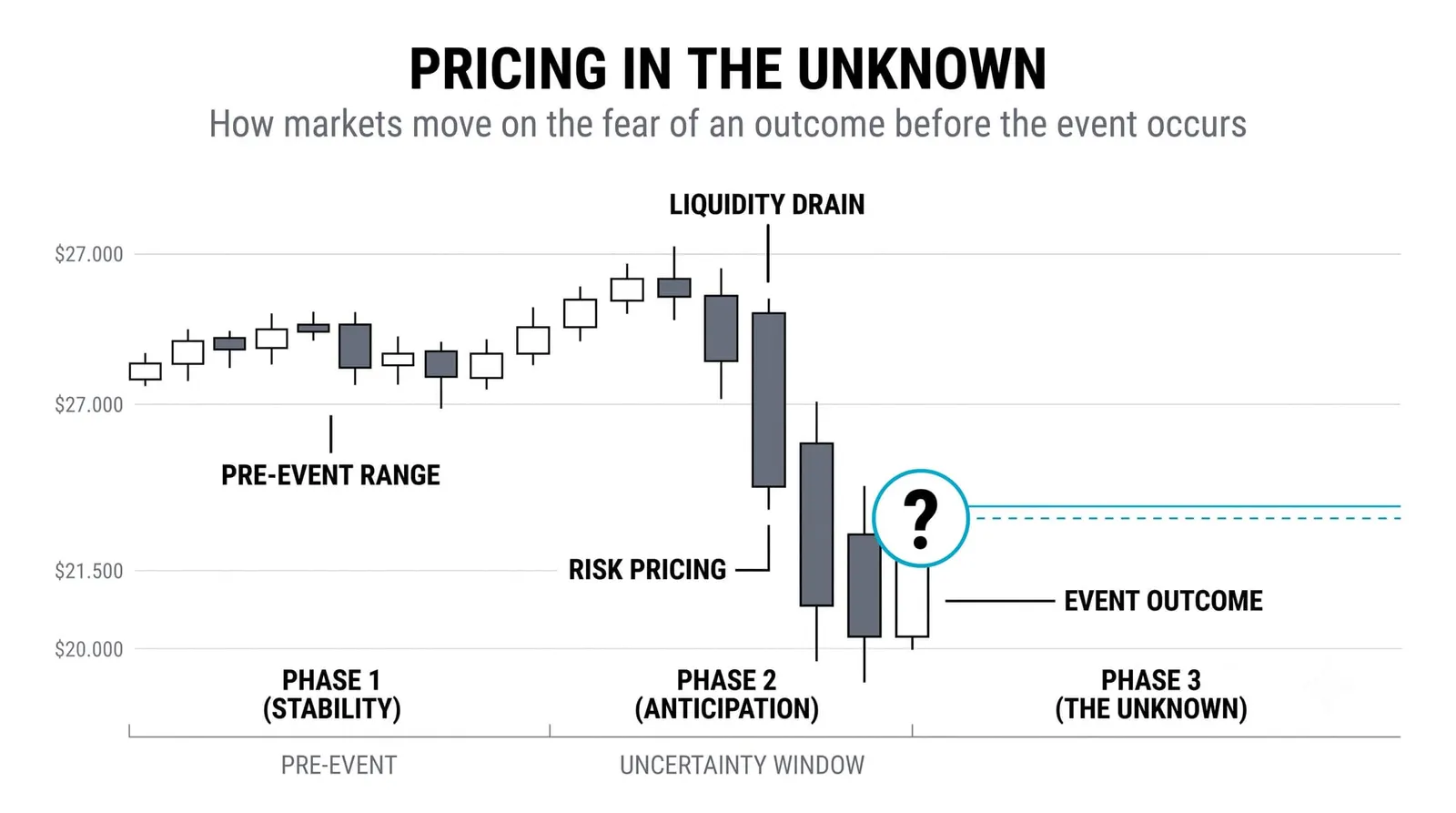
Uncertainty itself carries a price. When a shock hits, nobody knows whether it will escalate or fizzle, and the market cannot wait to find out. Prices reflect the full range of possible outcomes, weighted by probability. A fresh crisis widens that range dramatically. The worst case gets worse, and even a small probability of a terrible outcome forces prices lower.
This is why the first move is almost always a sell. In the fog of early news, traders cut exposure before they understand the situation, because the cost of being wrong while holding risk dwarfs the cost of being wrong while flat. Sell first, understand later, apologize in the retracement. That sequence is not cowardice. It is arithmetic.
Headlines in the first hours are also unreliable. Initial reports exaggerate, confuse, and contradict each other. The market knows this and prices the fog itself, not the facts, because the facts do not exist yet. The first price is a guess with money behind it.
Where the Money Runs: Safe Havens in Action
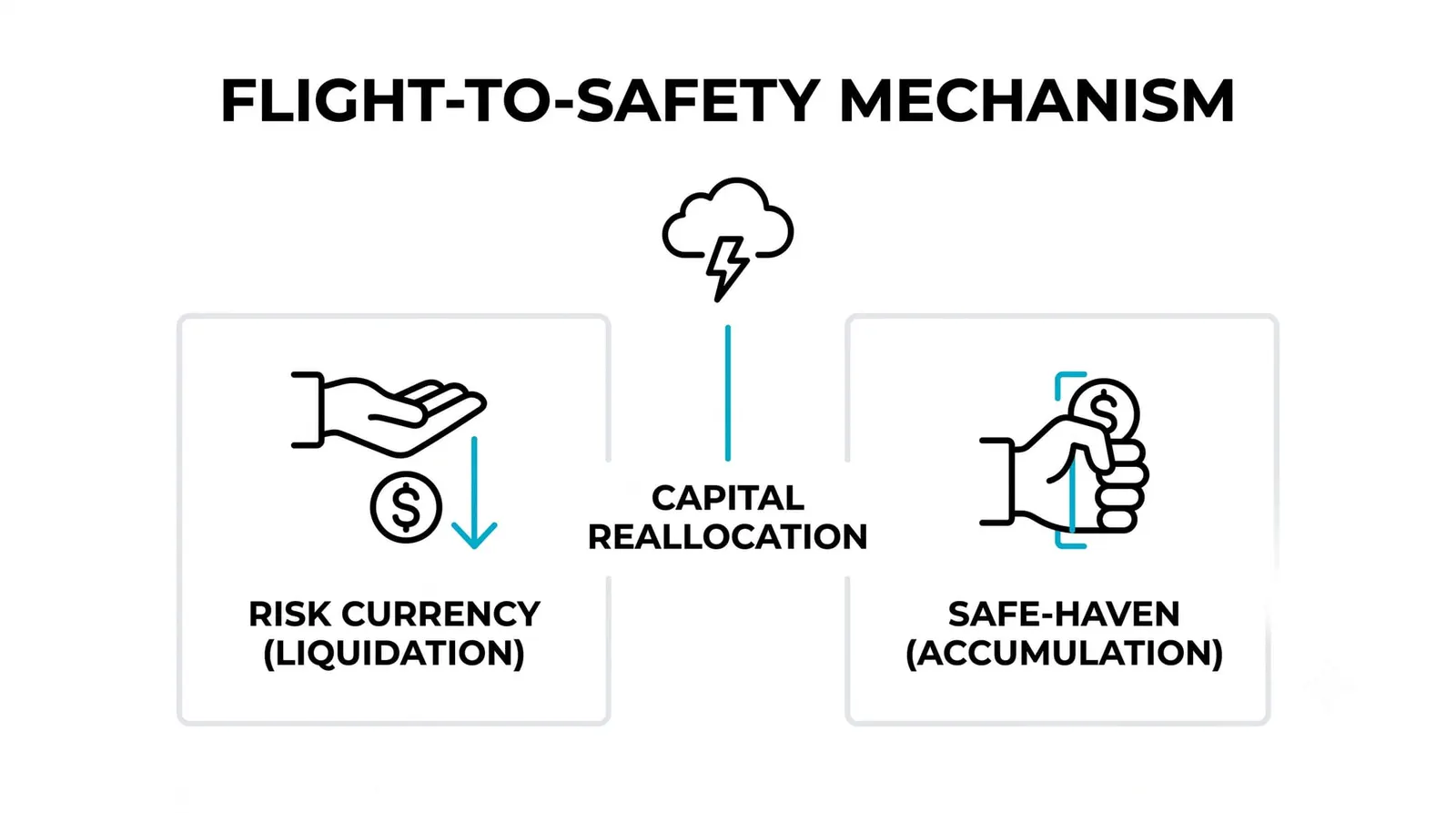
You met risk-on and risk-off in the intermarket lesson, and geopolitical shocks are where risk-off shows its purest form. Capital leaves anything exposed to the shock and crowds into assets trusted to hold value through chaos.
The classic havens are few. Top-tier government bonds from the largest, most stable issuers lead the list, because the full faith of a deep, liquid government stands behind them. Gold follows, valued precisely because no government prints it and no treaty governs it. A small group of deeply trusted currencies joins them, the ones backed by stable institutions and massive liquidity. You saw this pattern in the currency lesson: when risk appetite collapses, money pays for safety and stops asking about yield.
Notice what drives these flows. Havens rise on fear itself, whether or not the fear proves justified. Bond prices do not check casualty reports. They check positioning. If enough traders want protection at the same moment, haven prices climb even if the crisis evaporates by Friday. Fear is a real order flow, and order flow moves prices.
Why These Moves Are Often Sharp but Short-Lived
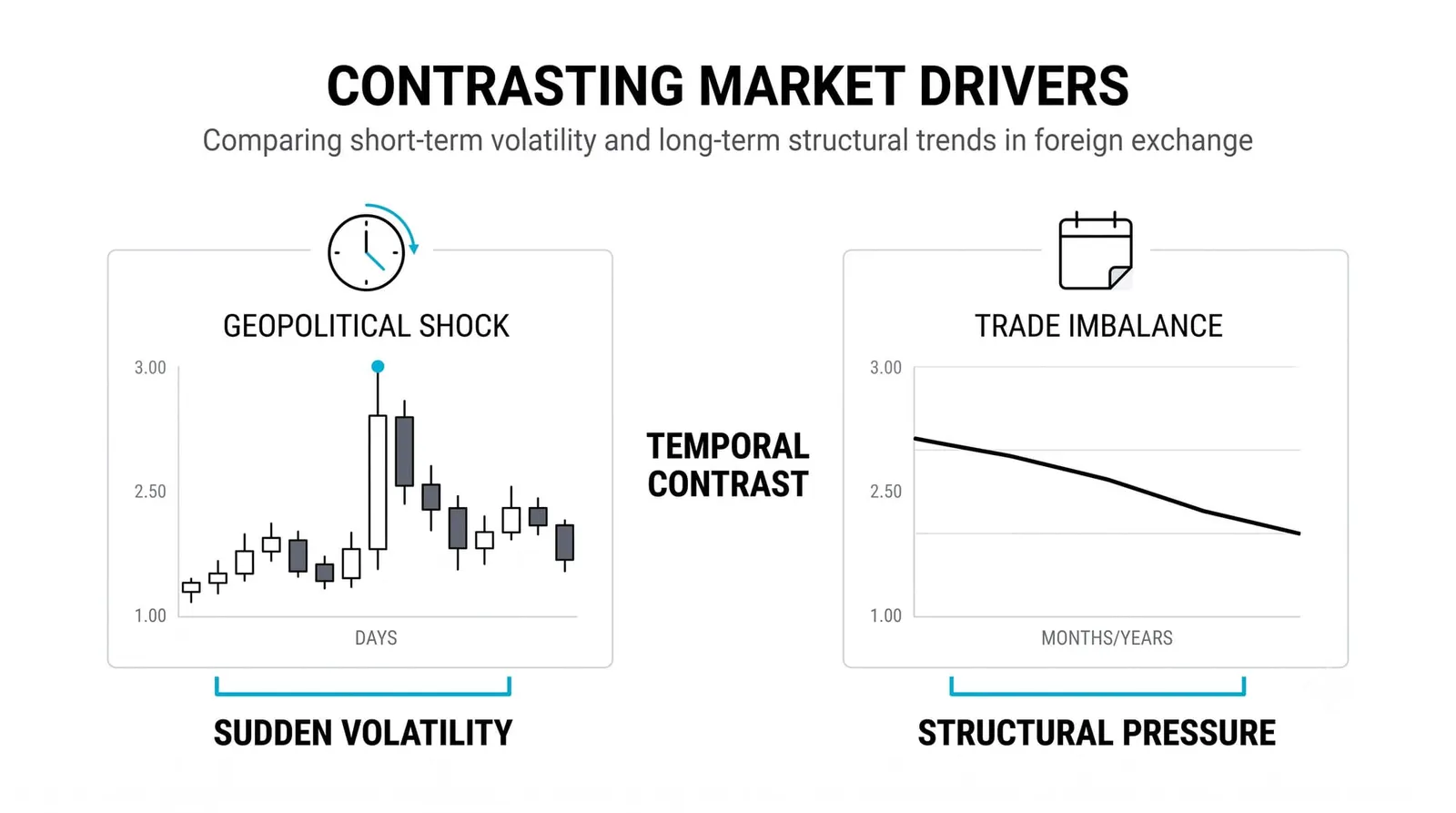
Most geopolitical spikes fade. The reason is mechanical. The initial move priced a wide range of outcomes, including catastrophic ones. When days pass and no escalation arrives, the catastrophic scenarios get reweighted toward zero, the uncertainty premium drains back out, and prices retrace toward where they started. The market sold probability, and the probability expired.
Most geopolitical headlines are noise with a short half-life.
The exceptions matter more than the rule. A shock that changes the actual supply of a key commodity does not fade, because the shortage is real and measurable. A shock that damages the credibility of a rule, such as the safety of sovereign reserves or the reliability of a treaty, does not fade either, because trust rebuilt slowly stays repriced for years. The filter is simple: ask whether the event changes physical supply or institutional credibility. If it changes neither, history says the move fades. If it changes one of them, the re-rating can last for years.
One Border Clash, Four Markets
Here is a hypothetical with round numbers. Imagine an armed skirmish breaks out between two mid-size economies, and both export a widely used industrial commodity. Together they supply a modest slice of the world market.
Day one. Traders fear the fighting will disrupt production and shipping. The commodity jumps 6 percent as buyers scramble to secure supply. Haven government bonds get bid hard and their yields fall. Stock indices in both countries drop 4 percent as investors dump anything exposed to the conflict. Risk-sensitive currencies sell off while haven currencies strengthen. Nobody knows if the clash will widen, so everyone prices the wide range.
Day three. No escalation. Both sides issue statements, the border quiets, shipping continues. The feared supply disruption never materializes. The uncertainty premium drains out, and roughly half of every move retraces. The commodity gives back 3 of its 6 points. Stocks recover 2 of their 4. Bonds and haven currencies unwind part of their gains. Traders who bought the panic peak paid for protection they never used.
The contrast case. Same clash, one change: this time one of the two parties is a top-three global producer of the commodity. Now the supply math actually shifts. Even without further fighting, sanctions, damaged infrastructure, and insurance costs keep output constrained. The commodity's 6 percent jump does not fade; it holds and builds for months, because every buyer in the world must now compete for a genuinely smaller pool of supply. Same headline shape, completely different durability. The difference is the supply math, never the drama.
Geopolitical Events, Answered
Should I trade the first move?
Generally no. The first move is the market selling probability in a fog of unreliable information, which means spreads widen, slippage grows, and you are competing against participants who react in milliseconds. By the time a retail trader sees the headline, the easy part of the move is gone. If you trade geopolitics at all, the retracement after a failed escalation usually offers better prices than the panic itself.
Do markets always recover from shocks?
No. Most shocks fade because most shocks change nothing structural, but events that alter real supply or institutional credibility leave permanent marks. The recovery pattern is a base rate, not a law. Your job is to sort each event into the fading category or the lasting category, using supply and credibility as the test, rather than assuming every dip is a buying opportunity.
Which assets hedge geopolitical risk?
Top-tier government bonds, gold, and a handful of deeply trusted currencies are the standard hedges. They work because they rise on fear itself, which is exactly when your risk assets fall. The trade-off is that hedges cost you in calm times: bonds yield little, gold yields nothing, and haven currencies often carry low rates. Protection you buy in calm and use in panic always costs carry.
How do I follow the news without drowning in it?
Filter by mechanism, not volume. For each headline, ask one question: does this threaten supply, property, or the rules of trade? If yes, identify which specific market that mechanism touches and watch that market's reaction rather than the commentary. If no, ignore it. One wire service and one calendar of scheduled events, such as elections and treaty deadlines, covers nearly everything that matters. The traders who drown are the ones reading every opinion about the event instead of watching the price of the thing the event affects.
Next in this level, scheduled news: how to read a release the way the market does, through the gap between what was expected and what arrived.