Building a Bias from the Top Down
Building a bias from the top down means you decide what the market is allowed to do before the session starts, by reading the weekly chart first, then the daily, and only then the intraday chart. Every trade you take after that already has context behind it. You are not reacting to candles. You are executing a decision you made while calm.

Think of it like furnishing a house. You would not buy furniture before the blueprint sets the rooms; the weekly and daily are the blueprint and the intraday chart is the furniture.
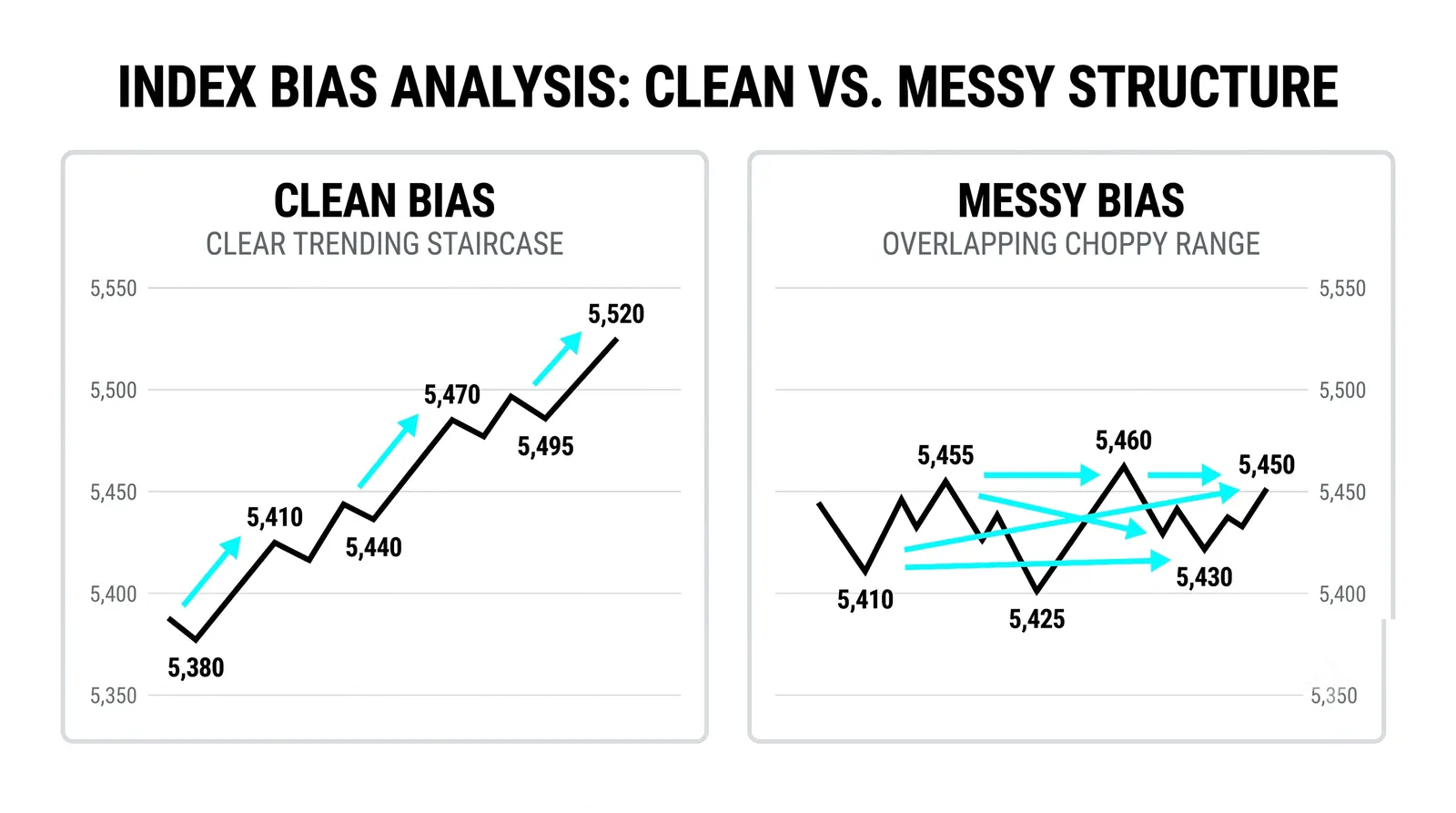
Direction Comes Before Setups
Most new traders lose fastest in one specific way. They take a clean-looking signal on a small timeframe that points directly against a bigger move they never checked. The setup was fine. The location was fatal.
A textbook bullish engulfing bar means very little if it prints inside a daily downtrend, under a daily level that just broke. The candle did its job. The trader skipped a step.
So the order of questions matters. The bias question comes first: which direction am I allowed to trade today, if any? The setup question comes second: where is my entry, stop, and target inside that permission?
Flip the order and you will always find a setup. There is always a pattern somewhere on some timeframe. The filter is what keeps you out of the ones fighting the larger flow.
A blunt truth: a mediocre setup in the right direction beats a beautiful setup against it.
The Ladder, In Order
Read the timeframes in a fixed sequence and never skip a rung. Each one answers a different question.
Weekly: which direction has the market been paying? Look at the swing structure. Higher highs and higher lows mean buyers have been paid for months. Lower highs and lower lows mean sellers have. A sideways weekly means nobody has been paid lately, and that is information too. You are not looking for entries here. You are establishing who has been right.
Daily: trend leg or pullback, and where is the nearest daily level? Now zoom in one step. If the weekly is up, is the daily currently pushing to new highs, or pulling back into a prior breakout or a higher low? Mark the nearest meaningful daily support and resistance. These levels are what your bias will hang on.
Intraday: timing only. The 1-hour or 15-minute chart comes last, and only after the first two agree or clearly conflict. Its job is narrow: show you where to enter, where you are wrong, and whether the risk is worth the distance to the target. The intraday chart never gets a vote on direction. It only gets a vote on timing.
If you catch yourself changing your directional view because of a 5-minute candle, the ladder has collapsed. Step back up.
What a Bias Is and Is Not
A bias is permission. It is a direction you trade and a direction you stand aside from, written down before the open.
A bias is never a prediction with a price and a date attached. "The market will hit 95 by Friday" is a guess dressed up as analysis. Nobody gets paid for being right about the future on a schedule.
Write your bias as a rule, not a feeling. The format that works is conditional:
- Long-only above 87, targeting the prior high.
- Neutral below 87, no trades until structure resolves.
- Short-only on a daily close below 86, targeting the next weekly level.
Notice what each line does. It names a condition, a direction, and an action. There is no room for negotiation with yourself mid-session, because the decision was already made when you were not staring at a moving price.
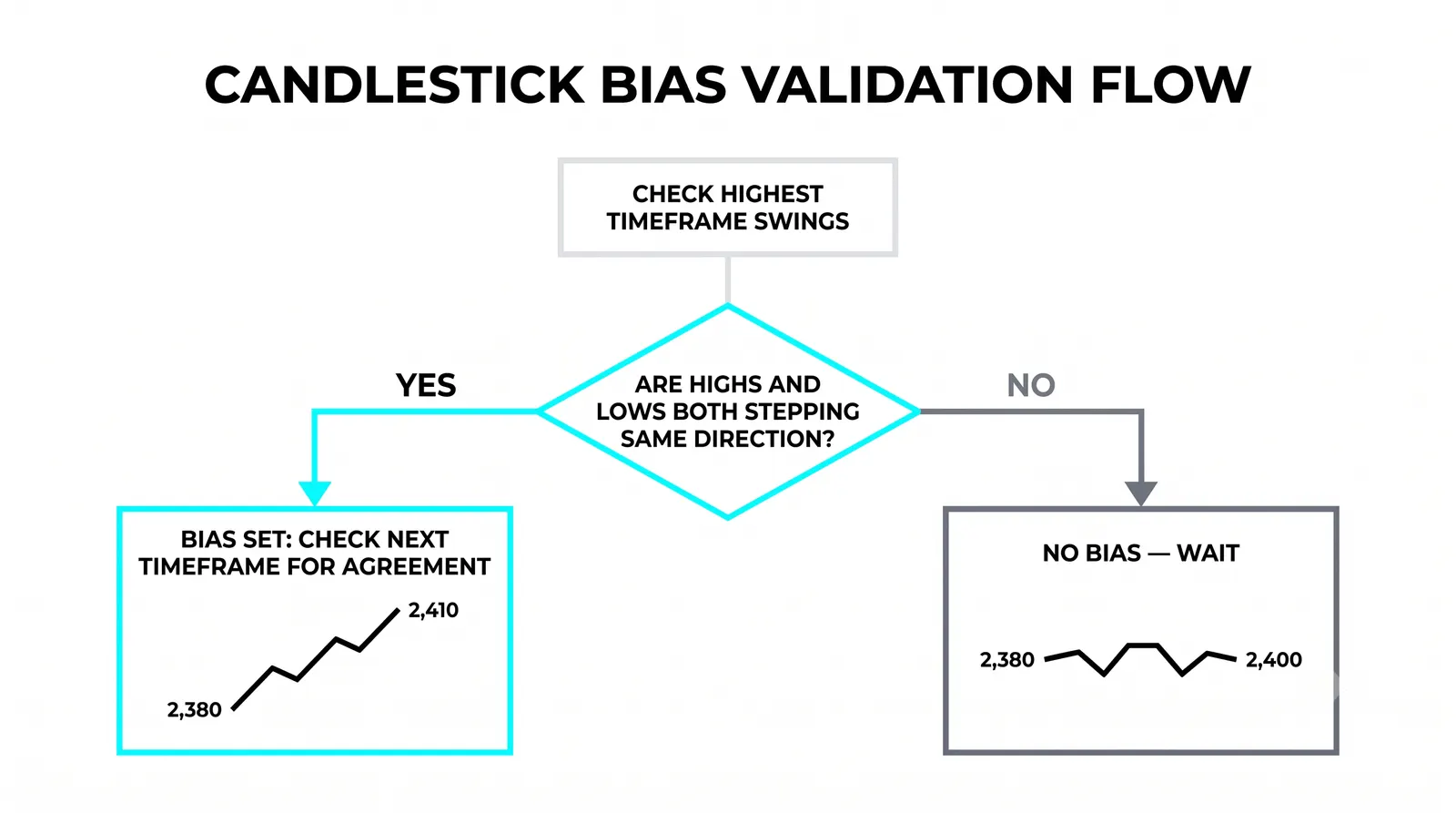
Traders who skip this step end up with a temperament problem, not an analysis problem. They take longs and shorts in the same hour and call it flexibility. That is the absence of a plan.
The Bias Can Downgrade
A bias is not a marriage. It has strength levels, and part of the skill is naming what weakens it before you are in the trade.
Use three grades:
- Strong. Weekly and daily agree, price is holding the level your idea depends on, and intraday structure confirms. Full size is permitted by your plan.
- Neutral. The timeframes conflict, or price is sitting in the middle of a range with no level nearby. You can watch, but there is nothing to do. No trade is a position.
- No-trade. The level your bias depended on has been violated, usually by a close through it. The idea is dead. You stand down entirely until a new structure forms.
Define the downgrade trigger in advance. The most common one is a close through the level your bias was built on. Not a wick, not a brief dip, a close. Wicks are noise; closes are decisions.
Changing your mind on evidence is the skill, not a weakness. The trader who holds a long bias through a daily close below support is not showing conviction. They are showing attachment. The market does not pay for loyalty to an idea.
A Full Pass Down the Ladder
Here is a hypothetical walk-through with round numbers, so you can see each rung do its job.
Weekly rung. The weekly chart has printed higher highs and higher lows since March. Buyers have been paid for months. Direction permitted: up. No entry information yet, and that is fine.
Daily rung. The daily chart is three weeks into a pullback from 92 down to 87. Price is still above the last daily higher low at 86. So the daily says: uptrend, currently pulling back, with a clear line at 86. The pullback is normal behavior inside a weekly advance, not yet a reversal. The nearest daily level below is 86; the level above is the 92 high.
Intraday rung. The 1-hour chart is ranging between 87 and 89. No break, no trigger. The range tells you where a long could enter (near 87, with the range low as a reference) but it has not fired yet.
The written bias. Long-only. Alert set at 87 for a potential entry if the 1-hour shows buyers stepping in there. Downgrade rule: a daily close below 86 kills the idea and moves the chart to no-trade until new structure forms.
Now notice what the session holds for this trader. If price chops between 88 and 89 all day, they do nothing, and doing nothing is correct. If price dips to 87 and the 1-hour prints a reversal, they take the long with a stop under the range and a target back at 92. If price closes a daily candle at 85.50, the bias is void and they stop looking for longs entirely.
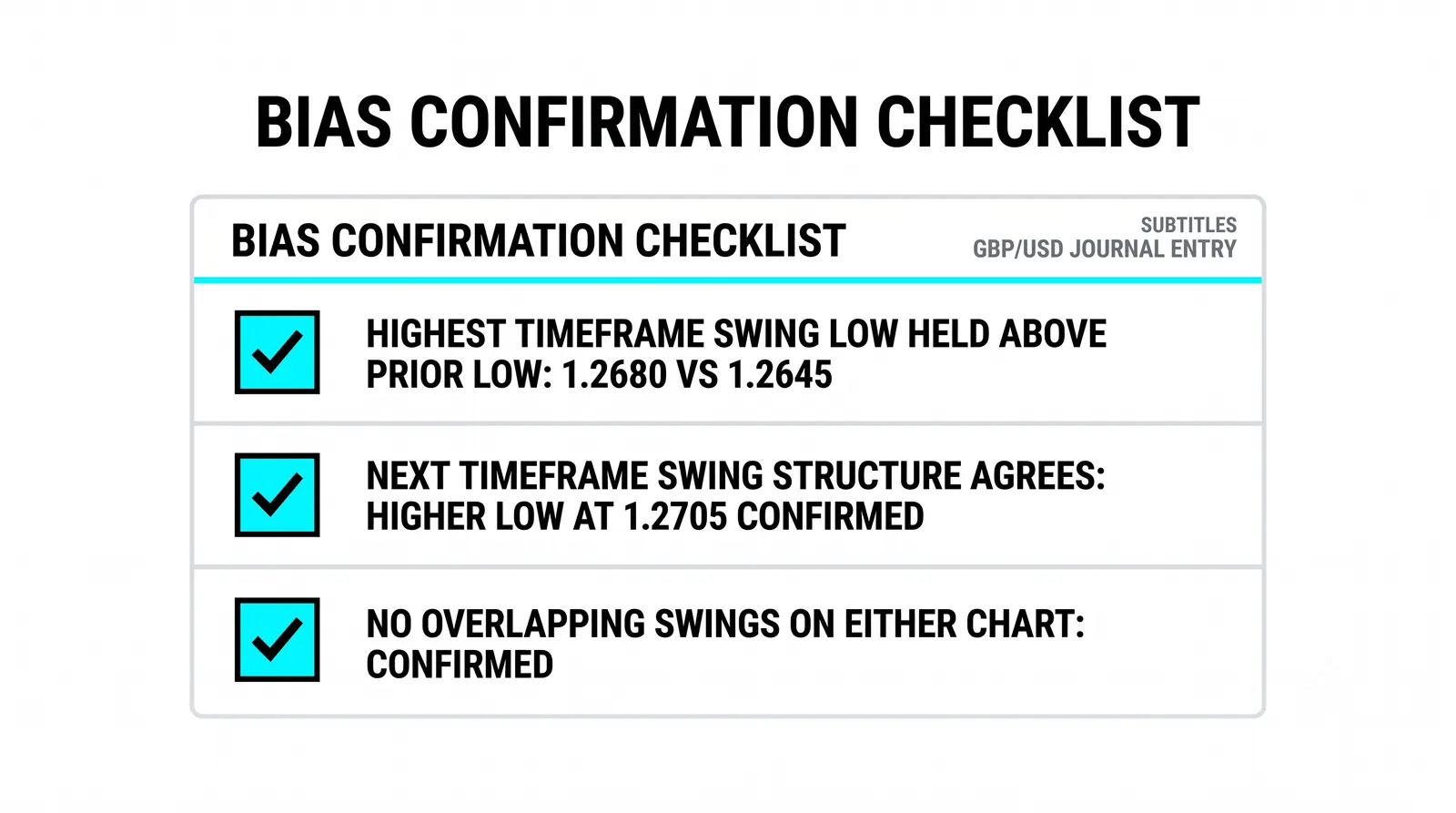
Every outcome has a pre-written response. That is what the ladder buys you.
How the Combinations Play Out
The weekly and daily do not always agree. Each combination produces a different bias and a different intraday job.
| Weekly / Daily State | The Bias | What You Do Intraday |
|---|---|---|
| Weekly up, daily pulling back | Long-only, patient | Wait for the pullback to reach a daily level; take longs only on intraday triggers at that level |
| Weekly up, daily up | Strong long | Trade longs actively on intraday pullbacks; shorts are off the table |
| Weekly flat | Neutral, reduced size | Trade only the edges of the weekly range, or stand aside; expect chop in the middle |
| Weekly down | Short-only or no-trade | Look for intraday rallies into daily resistance to short; ignore long setups entirely |
The pattern to see: the weekly sets the permission, the daily sets the location, and the intraday chart only ever handles execution. When the weekly is flat or against you, the correct amount of trading is often zero.
Questions About Building a Bias
How often should I update my bias?
Update it when the evidence changes, not on a clock. A weekly bias can hold for months. A daily bias usually survives until a close through the level it depends on. Reviewing once a day, after the close, is enough for most traders. Re-reading your bias every hour just invites the intraday noise to rewrite it.
Can I trade against my own bias?
You can, but you should treat it as a different, smaller category of trade with reduced size and a fast exit. Counter-bias trades are scalps against the flow, and they fail more often. Most developing traders do better by simply not taking them. The discipline of skipping is worth more than the occasional win.
Does this work for short-term trading?
Yes, and arguably it matters more there. A day trader still reads the daily and the 4-hour before touching the 5-minute chart. The ladder just compresses. Whatever your trading timeframe is, the two timeframes above it set your permission and your location.
What if the daily and weekly disagree?
Then your bias is neutral or reduced, and that is a complete answer. Conflict between timeframes usually means a pullback deep enough to look like a reversal, or a reversal early enough to look like a pullback. You do not have to solve it. You have to wait until price resolves it at a level, and your downgrade rules tell you exactly where that happens.
Once the ladder becomes habit, the next step is journaling each bias alongside the trade it produced, so you can measure how often your top-down read was actually right. That record is where the real refinement happens.