Currency Strength and Weakness, Explained
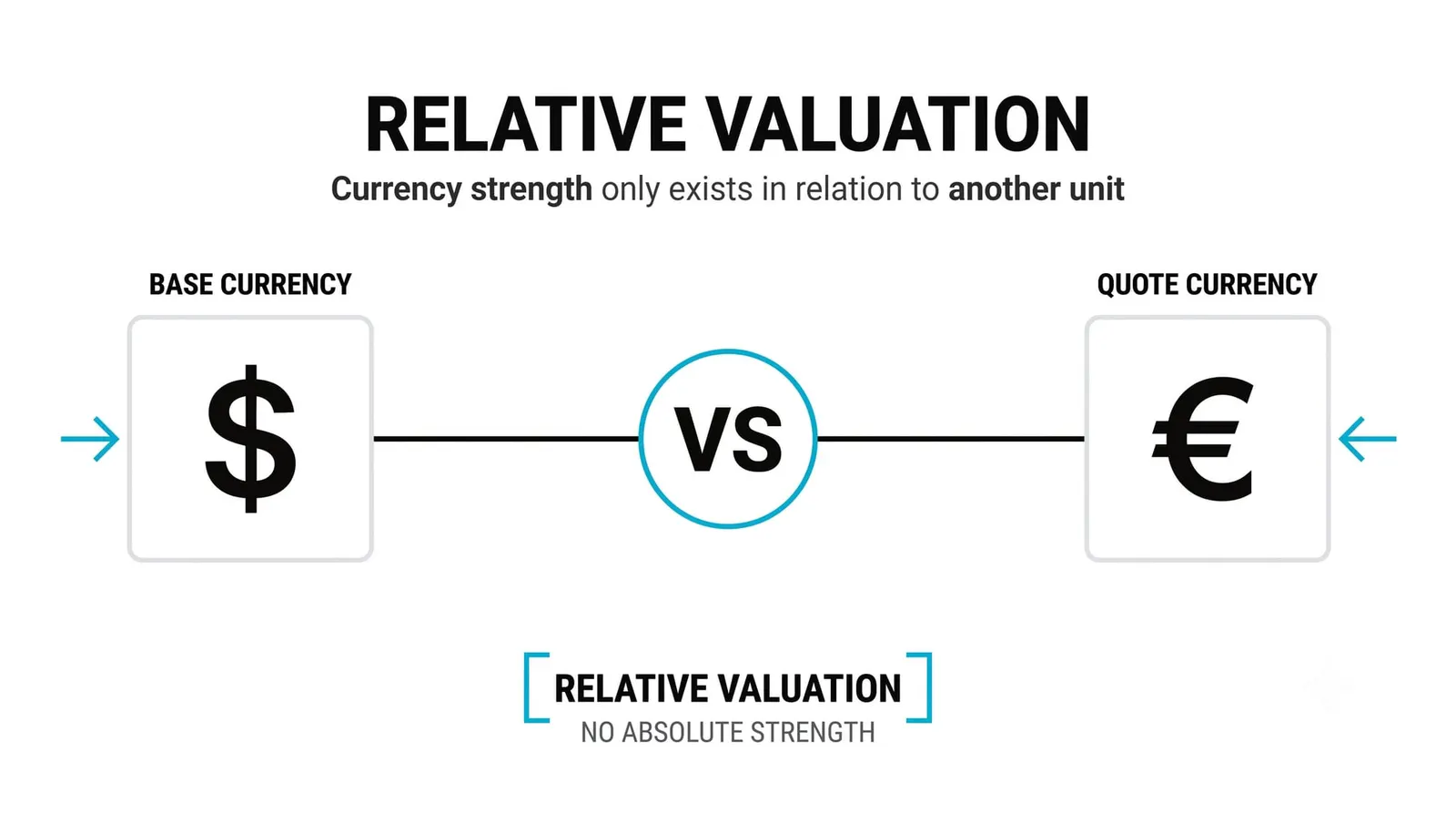
Currency strength is always a ranking, never a property one money holds alone. A currency is strong when it buys more of the other currencies, and weak when it buys less. There is no absolute scale to measure it against, the way you might measure weight or temperature.

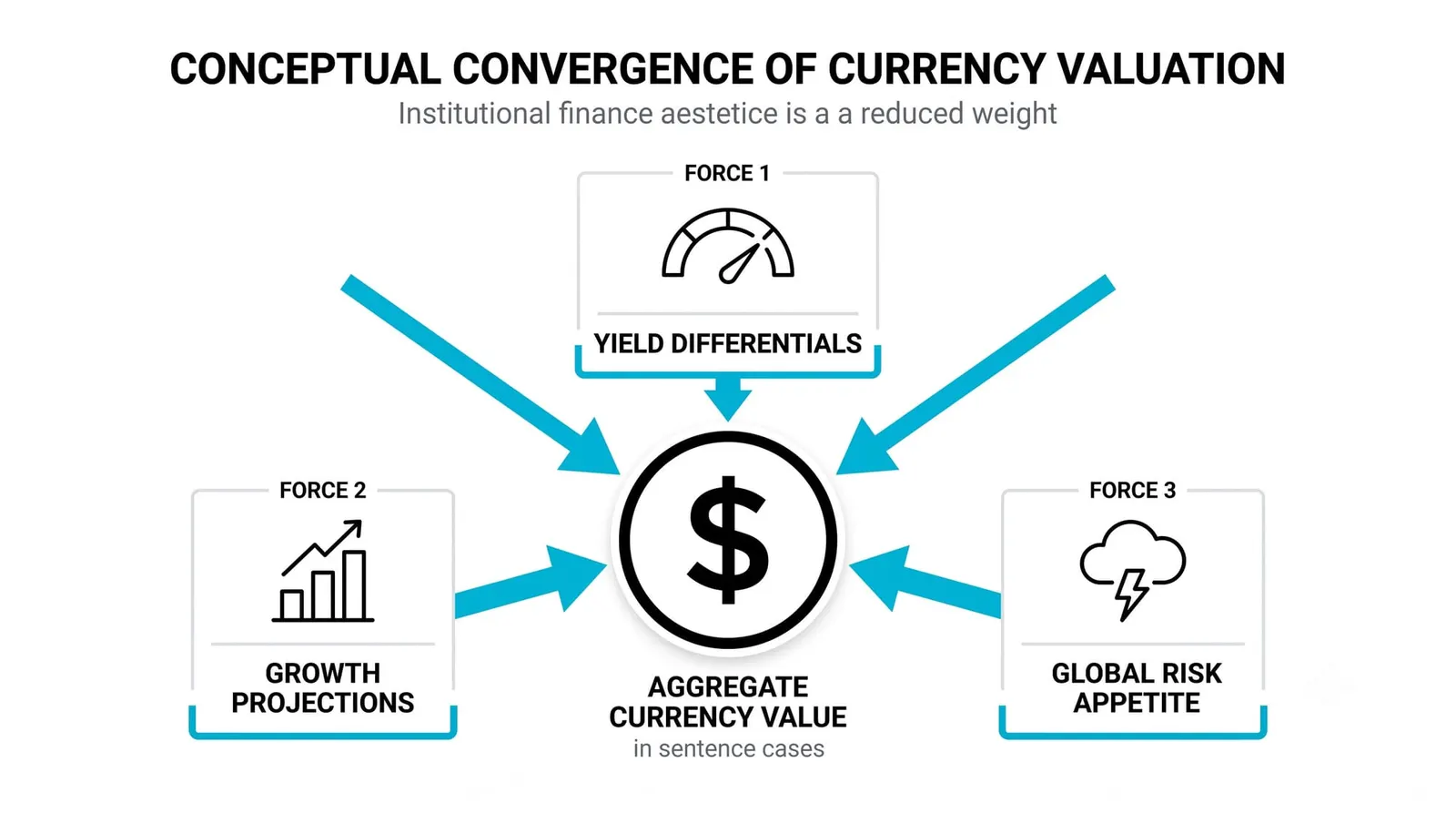
The ranking is driven by the same short list of macro forces this level has already covered: interest rates, growth, risk appetite, and the trade flows that ride along with them. Think of currency strength as peak-bagging: a summit is only high compared with the mountains around it, never in isolation. Once you accept that, the whole topic gets much simpler, because you stop asking "is this currency strong?" and start asking "strong against what, and why?"
What Currency Strength Actually Means
Strength is a relative measure among peers. When a trader says the dollar is strong, they mean it is rising against most of the other major currencies at the same time. When they say the yen is weak, they mean it is falling against most of them. The word always hides a comparison.
Because of this, analysts often build a basket to make the ranking visible. A dollar index, for example, measures one currency against a weighted group of trading partners and produces a single number. The number itself is not magic. It is just an average of several exchange rates, weighted by how much trade each partner represents. But it captures the idea well: strength means gaining against the group, not against one opponent.
The same currency can be strong against one neighbor and weak against another at the same time. Imagine a currency that rises 2 percent against one partner and falls 3 percent against another in the same month. Both statements are true. Neither is the full picture. This is why vague talk about a "strong currency" should always trigger the follow-up question: strong against whom?
Interest Rates: The Biggest Driver
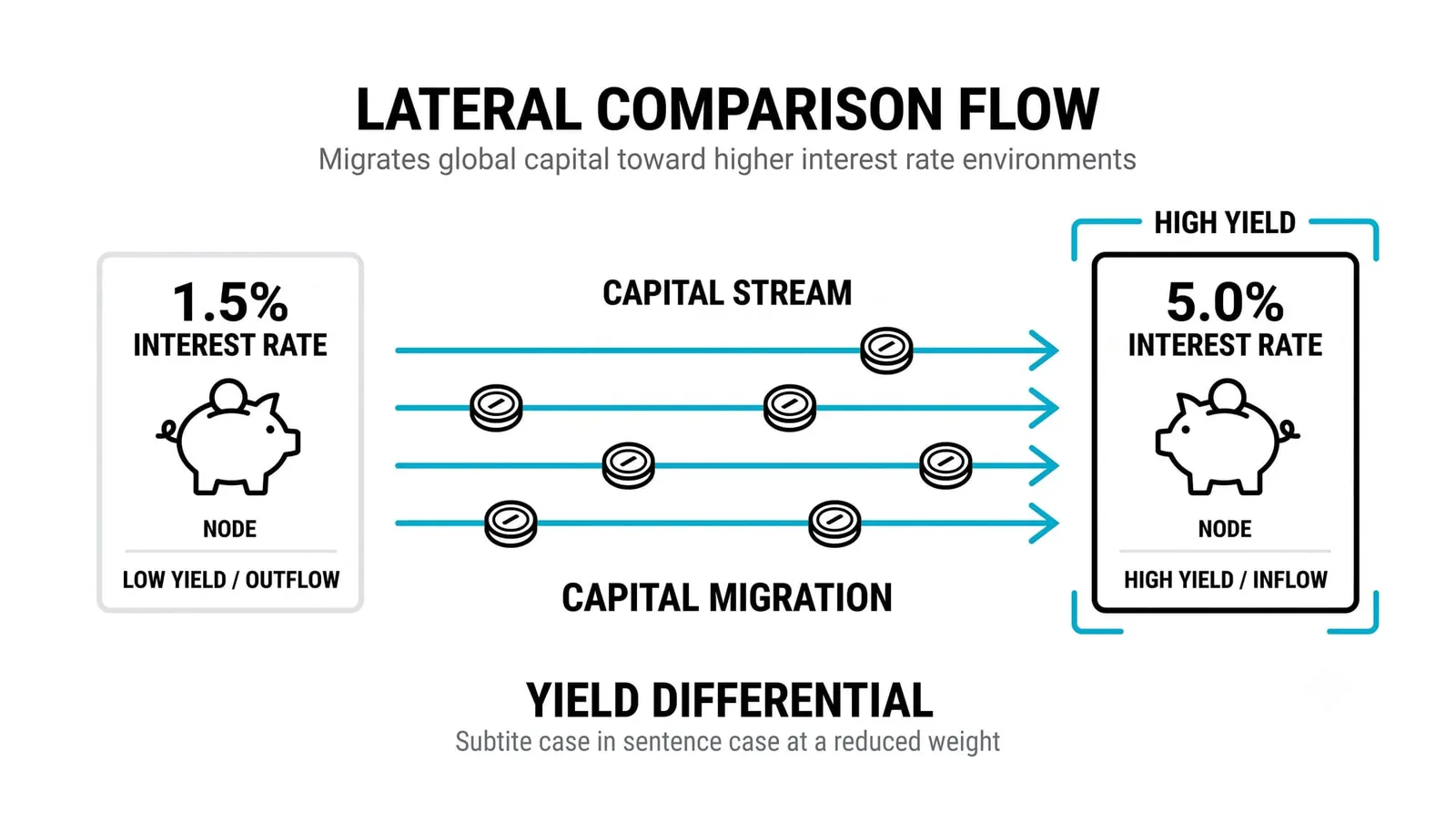
Of all the forces on the list, interest rates usually dominate. The mechanic was covered fully in the rates lesson: capital flows toward higher risk-adjusted yields, and buying those yields requires buying the currency first. That one line is the engine.
The flow itself is what creates the strength. When investors worldwide decide they want a country's bonds or deposits, they must exchange their own money for that country's money to get in. Millions of these conversions add up to steady demand for the currency, and steady demand pushes the price up. The yield attracts the flow; the flow moves the exchange rate.
What reshuffles the ranking is divergence. If two central banks move in opposite directions, one tightening while the other holds or cuts, the gap between their yields widens, and capital migrates toward the higher one. If both move together by similar amounts, the exchange rate between them may barely change, because neither side gained an edge. Traders watch central bank meetings so closely for exactly this reason: they are watching for divergence, not for any single decision in isolation.
Growth and Risk Appetite
Growth works through a similar channel. A fast-growing economy attracts investment and hiring flows, because businesses and investors want exposure to where the expansion is happening. Those flows, again, require buying the local currency first.
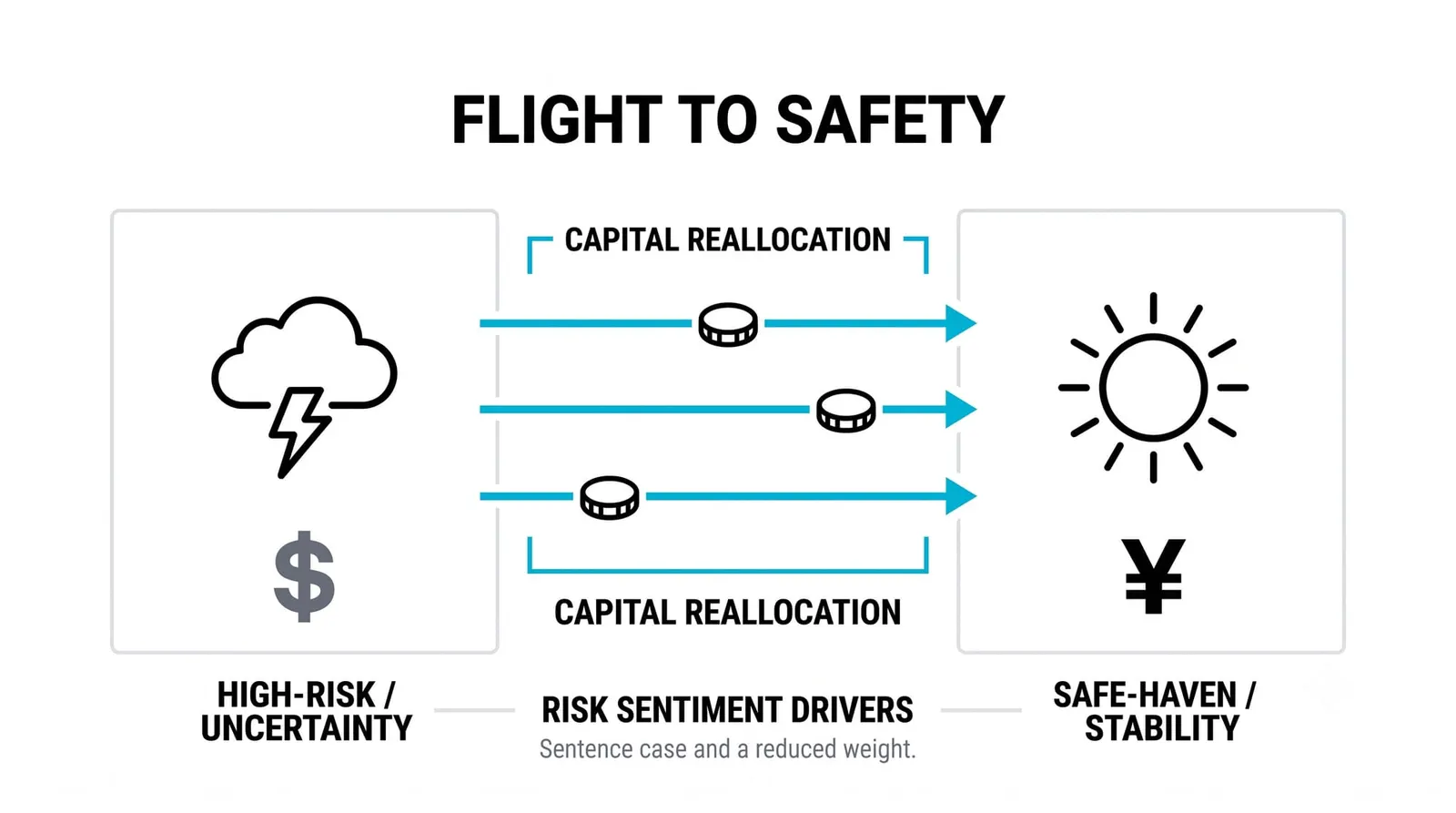
Risk appetite is the mood side of the ranking. When confidence is high, investors wander far from home in search of returns, and smaller or higher-yielding currencies benefit. When fear rises, money retreats to the currencies backed by deep, liquid, safe markets, and it does so fast. The telling detail is that in a fear episode, the weak currencies tend to fall together. Traders even have a nickname for them: the weak sisters. They rise together in good times and get sold together in bad ones, because the market is pricing the mood, not each country individually.
One line sums up the pair: growth decides who attracts money in calm times, and risk appetite decides who keeps it in rough ones.
Why Currencies Move Relative to Each Other, Not Alone
Every foreign exchange trade involves two currencies at once. There is no way to buy one without selling another. When you buy the euro against the dollar, you are simultaneously long the euro and short the dollar, and the price you see reflects both sides of that decision.
This means every candle on a chart carries two judgments, not one. A rising pair might mean the market likes the first currency. It might mean the market dislikes the second. Usually it is some blend of both, and the blend matters for what happens next, because the two sides respond to different news.
The practical consequence: a currency can look strong on a chart simply because its partner is falling. If a country's economy is mediocre but its trading partner's economy is worse, the pair rises and headlines call the first currency strong. Nothing improved on its side. It just lost a race more slowly. Reading exchange rates well means always asking which side of the pair is actually doing the moving.
Two Currencies, One Week
Here is a hypothetical walk through a single week, with invented round numbers, to show how the forces stack up. Region A's central bank signals that rate rises are coming. Region B's central bank cuts rates, and the same week B prints weak growth data. The A/B cross starts the week at 1.0000.
Monday and Tuesday, the rate story dominates. Capital shifts toward A's higher expected yields, and out of B's falling ones. The cross climbs to 1.0200. A is strong, B is weak, and the ranking is doing exactly what the rate differential predicts.
Wednesday, the twist arrives. A risk-off scare hits global markets. Fear spikes, and money runs for the deepest, safest markets available. Now here is the subtle part: the A/B cross does not simply freeze. Both currencies come under pressure in the broader ranking, but B falls further, because B was already the weaker credit and fear punishes weakness hardest. The cross pushes on to 1.0350 by Friday.
The lesson of the week: in calm conditions the ranking is decided by yield and growth. In a storm, it is decided by safety. A currency does not need to be the strongest to outperform in a panic. It only needs to be safer than its partner. The ranking is always relative, even when the whole board is falling.
The Four Forces at a Glance
| Force | What It Pushes | What You Watch |
|---|---|---|
| Interest rates | Capital toward higher risk-adjusted yields | Central bank decisions and the gap between two banks' paths |
| Growth | Investment and hiring flows toward expanding economies | Growth data and business surveys relative to peers |
| Risk appetite | Money toward safety in fear, toward yield in calm | Whether weak currencies are falling together |
| Trade flows | Steady underlying demand from exporters and importers | The trade balance and current account, covered in the next lesson |
That last row deserves a flag. The trade balance and current account get their own full lesson right after this one, so treat them here as a named force on the list and nothing more for now.
Currency Strength, Answered
Can two currencies both be strong at once?
Yes, against the rest of the field. Two currencies can both rise against a broad basket while the pair between them barely moves. Strength is measured against the group, so two climbers can share the top of the ranking while their own cross stays flat.
Is a strong currency good for a country?
It depends on who you ask inside that country. A strong currency makes imports cheaper and helps consumers, but it makes exports more expensive for foreign buyers and squeezes companies that sell abroad. Policymakers argue about this constantly, which tells you there is no single right answer.
Which pair should a new trader watch first?
Start with the most traded pair in the world, the euro against the dollar. It is the most liquid, the most heavily analyzed, and the cleanest place to watch the forces in this lesson operate without the noise that thinner pairs carry.
Does this apply to gold or crypto?
Only loosely. Gold and crypto trade against currencies and react to some of the same forces, especially risk appetite and real yields, but neither is issued by an economy with interest rates, trade flows, and a central bank behind it. The ranking framework was built for currencies, and it fits them best.
Next up is the force this lesson only named: the trade balance and the current account, where you will see how the flow of goods and money between countries creates a slow, persistent pull on exchange rates underneath everything covered here.