Gaps: Common, Breakaway, Runaway, Exhaustion
Exhaustion is the stage of a move where the fuel runs out, and in gap language it is the last chapter of a story that started with a breakaway. A gap is the chart skipping a scene: price closes at one level, then opens somewhere else entirely, with no trading in between. The four names matter because they are not interchangeable labels. A common gap means almost nothing. Breakaway, runaway, and exhaustion gaps each mark a different stage of a move's life, and exhaustion is the stage where the move itself is dying.

Think of it like a movie that skips a scene: the missing scene is where the real story happened, and traders spend the next few sessions deciding what it said.
What a Gap Actually Is
A gap is empty space on the chart. The prior session closes at one price, the next session opens at another, and nothing traded in the zone between them. That empty zone is information, because it means orders stacked up while the market was closed or illiquid, and price had to jump to find a counterparty.
The usual causes are overnight news, earnings releases, and order imbalance. A company reports after the bell, the numbers surprise, and by morning the buy orders far outweigh the sell orders at yesterday's price. The open simply jumps to where the two sides can meet.
In markets that trade around the clock, true gaps are rarer. Forex barely sleeps during the week, so most gaps there appear over the weekend, and those weekend gaps carry more weight precisely because they are unusual. Crypto trades continuously, so a real gap there is an event worth noticing.
The Common Gap: Noise, Mostly
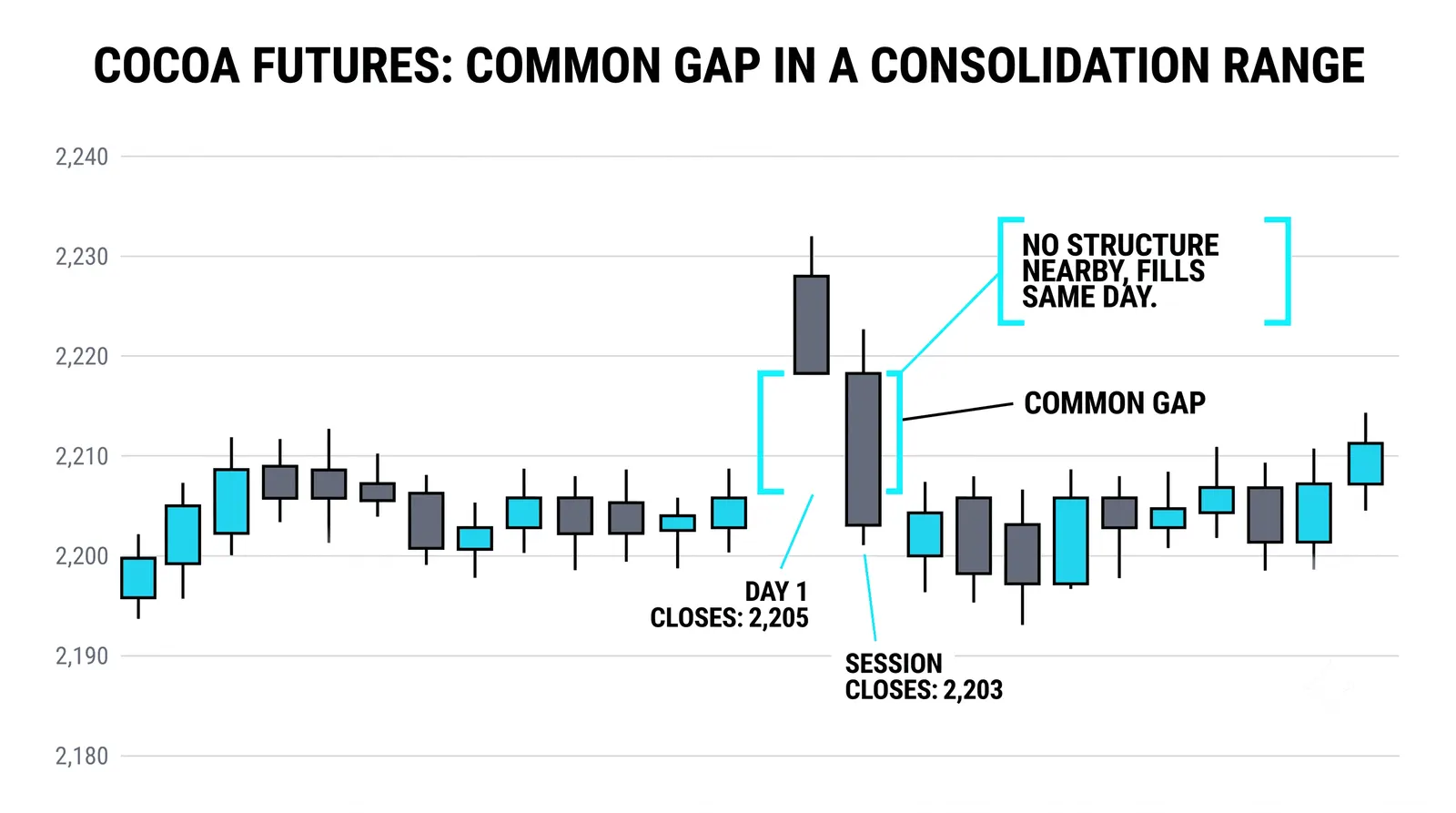
Most gaps you will ever see are common gaps. They appear inside quiet ranges, on thin volume, with no news behind them. Price drifts up at the open, drifts back, and the gap fills within days or even hours.
A common gap carries almost no information. It is the market clearing its throat. Beginners waste enormous energy analyzing these, hunting for meaning in what is usually just a slow morning in a sideways stock.
The honest read: if a gap forms inside a range you already knew about, on ordinary volume, assume it is common until proven otherwise.
The Breakaway Gap: The Move Begins
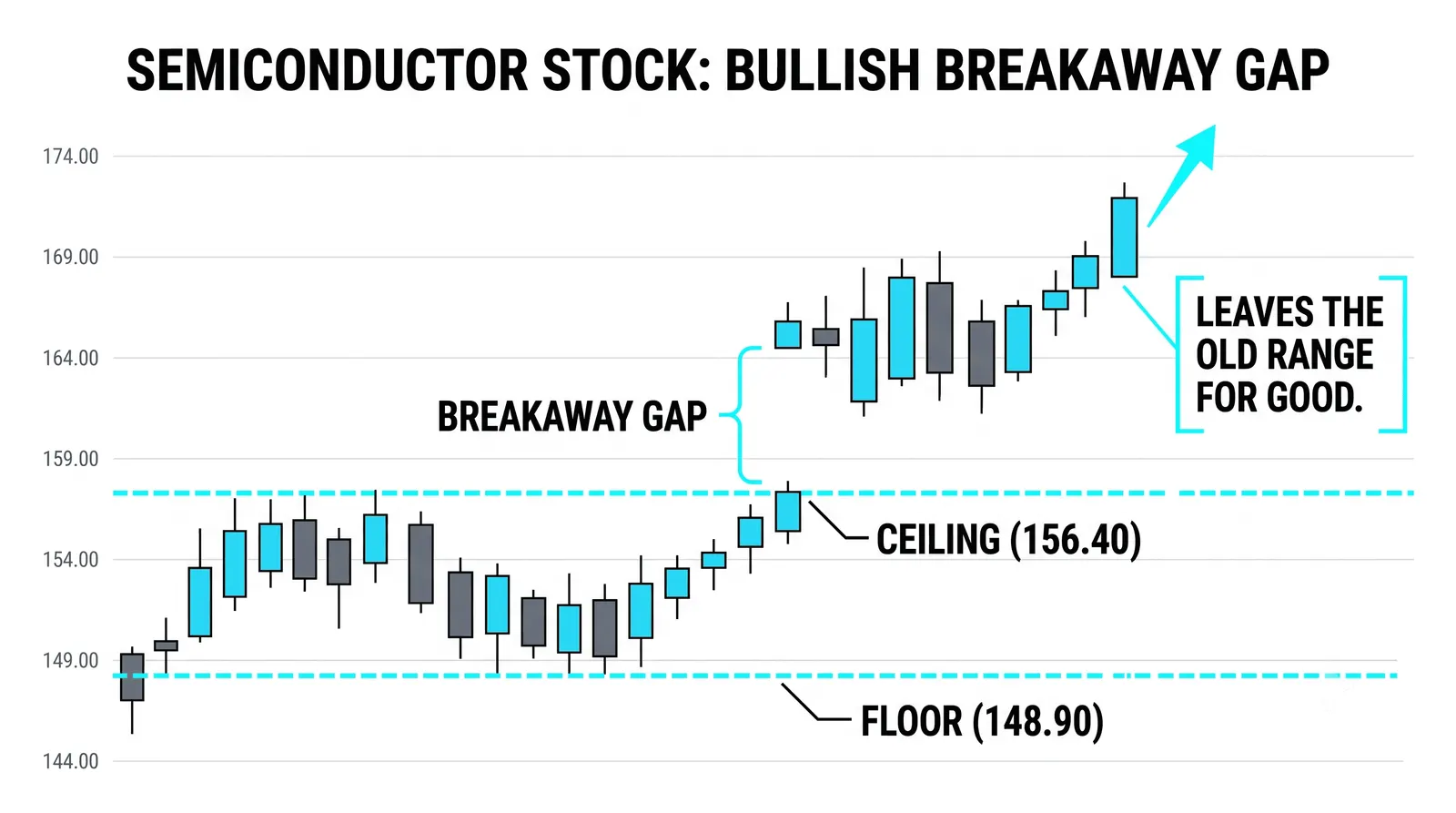
A breakaway gap leaves a range or a completed chart pattern behind, and it does so on heavy participation. Price was coiled, something real happened, and the open jumps clear of the entire structure. That jump is the market re-pricing, not hesitating.
Here is the blunt part: breakaway gaps usually do not get filled soon. The news or pressure that caused them was real, so there is no reason for price to come back and say sorry. Traders who wait for the fill often watch the move leave without them.
The gap zone itself tends to become the new support or resistance. The empty space where nobody traded turns into a floor or ceiling later, because that is where the market last agreed the old price was wrong.
The Runaway Gap: Confirmation Mid-Trend
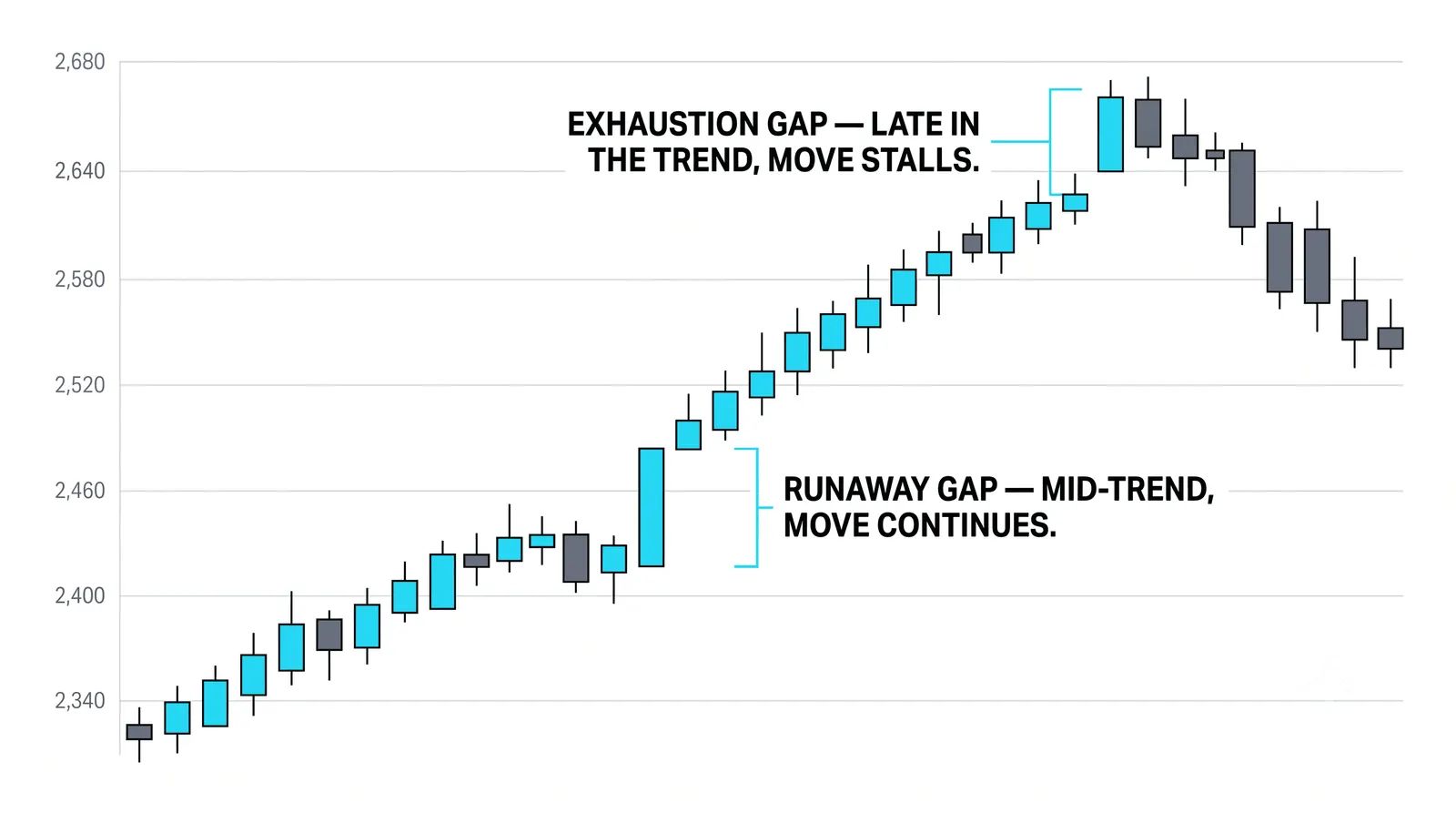
A runaway gap appears in the middle of an established trend, after the move is already underway. It confirms that participation is still arriving. The trend gaps in its own direction, on strong volume, and keeps going.
You will also hear it called a measuring gap. The idea is that the distance traveled from the start of the move to the gap sometimes projects the remaining distance beyond it. Treat that as a rough guide only. It is a tendency, not a rule, and plenty of trends fall short or blow past the projection.
What the runaway gap tells you is simpler: the move still has fuel, and the crowd is still chasing.
The Exhaustion Gap: The Last Buyers Arrive
An exhaustion gap shows up late, after an extended run. Price gaps in the trend's direction one more time, and it looks like strength. It is not. The last buyers are jumping in, and there is nobody left after them.
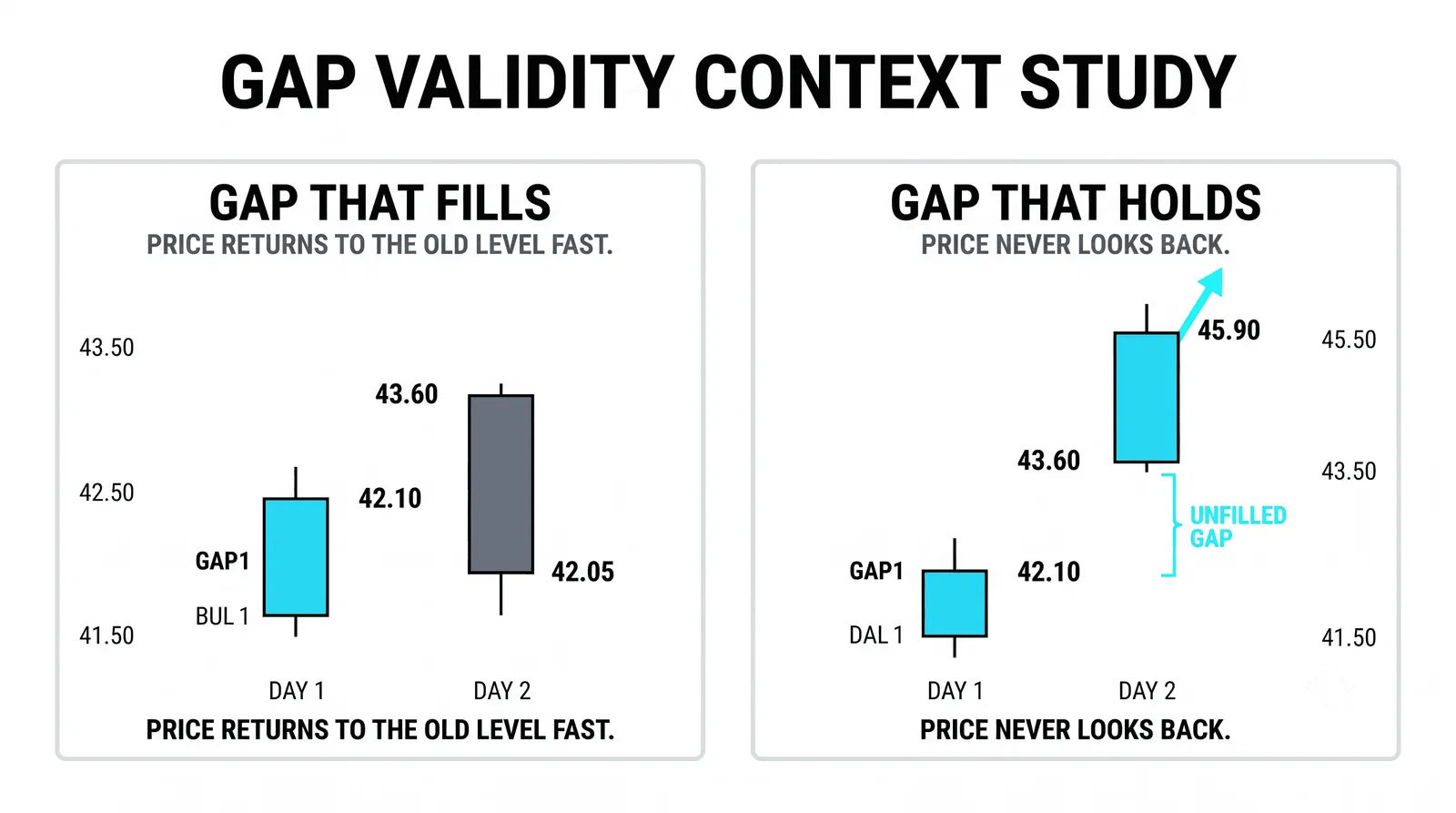
The tell is what happens next. The gap fills quickly, often within days, because the buying that caused it was the final burst rather than a new wave. When a late gap fills fast after a long run, the move is usually over, at least for a while.
Name the sequence plainly: breakaway, runaway, exhaustion. That is the life story of a move told in gaps. Birth, middle age, and the final sprint before the finish line.
One honest sentence on tactics: many traders treat a fast-filling late gap as a warning to tighten stops or take profits rather than a signal to short, and that is as far as this lesson goes.
The Gap That Filled by Friday
Here is a hypothetical walk through all three stages, with round numbers.
A stock closes at 50. After the bell it reports strong earnings, and the next morning it opens at 54. Volume is triple the norm. Price never comes back to 50, or 52, or anywhere near the gap. That is a breakaway gap, and the zone between 50 and 54 becomes support for the weeks that follow.
Weeks later the stock is trending and closes at 58. The next open is 61, again on heavy volume, and the trend continues. That is a runaway gap. A rough measuring read would project the move to extend about as far beyond 61 as it traveled to get there, and in this case it roughly does.
The next month, after a long climb into the mid-60s, the stock closes at 66 and gaps to open at 67.50. But this time it stalls the same day. By Thursday it trades back through 66, filling the gap, and it closes the week at 64. The last gap filled almost immediately, after an extended run. That was the exhaustion gap, and the move was done.
Same stock, three gaps, three different meanings. The label depends entirely on where in the move the gap appears and what price does afterward.
The Four Gaps Side by Side
| Gap type | Where it forms | What it usually does next | Information it carries |
|---|---|---|---|
| Common | Inside quiet ranges, low volume | Fills quickly, often within days | Almost none; ordinary noise |
| Breakaway | Leaving a range or completed pattern | Does not fill soon; gap zone becomes support or resistance | A real re-pricing; a move is starting |
| Runaway | Mid-trend, in the trend's direction | Trend continues; sometimes projects remaining distance | The move still has fuel |
| Exhaustion | Late in an extended run | Fills quickly; the move often ends | The last buyers have arrived; fuel is gone |
Common Questions About Gaps
Do all gaps get filled?
No. Common and exhaustion gaps usually fill, but breakaway gaps often stay open for months or years, and runaway gaps can remain unfilled for a long time too. "Gaps always fill" is one of those sayings that survives because it is true often enough to sound wise and false often enough to cost you money.
What makes a breakaway gap different from a common one?
Location and volume. A breakaway gap clears a range or pattern boundary on heavy participation and does not look back, while a common gap forms inside the range on ordinary volume and fills fast. If the gap escapes structure, it is probably a breakaway; if it happens inside structure, it is probably common.
Can a runaway gap appear more than once in a trend?
Yes. Strong trends can produce two or even three runaway gaps as new waves of participation arrive. Each one confirms the trend is alive, though each additional gap also brings the move closer to the point where the next gap is the exhaustion one.
How do I tell an exhaustion gap from a runaway gap in real time?
You often cannot with certainty on the day it happens, so judge by context and follow-through. Ask how far the move has already run and how many gaps came before, then watch the next few sessions: a gap that holds and extends is behaving like a runaway, while a gap that stalls and fills within days after a long run was exhaustion. The fill itself is the confirmation.
Once you can place a gap in the move's life story, the next skill is reading what happens around the gap zone itself, because that empty space tends to matter again when price returns to it. That is where gap reading connects back to support and resistance, and it is where we go next.