How Price Reacts at Fibonacci Levels
How price reacts at a fibonacci level takes exactly three forms: the bounce that turns at the touch, the rejection that overshoots and refuses, and the break that closes beyond the line. Telling the three apart is the skill, because the level itself is only location and the response is the information. A trader who knows where the 61.8 percent line sits knows where to watch. A trader who can read the reaction knows what to do.

Think of a knock at a door: the visitor is turned away on the step, let in and thrown back out, or the door gives way entirely, and each outcome tells the visitor something different about the house. The earlier lessons in this section established where the levels sit and which ones the crowd watches. This lesson covers the event itself, what the reaction looks like when it arrives and what each shape of it is worth.
The Three Responses, Defined
The bounce is the cleanest read. Price touches the line and turns without ceremony. No wick through, no hesitation, no drama. The level held on the first test, and the chart shows a candle that respected the line from the moment it arrived.
The rejection is the dramatic one. Price pierces the line by a fraction, wicks through it, and closes back on the original side. The overshoot flushes the last stop orders sitting just beyond the level before the turn begins. The anatomy matters: the wick is the probe, the close is the decision. A wick through the line that closes back above it is refusal, not failure. Many traders see the wick and assume the level broke. The close says otherwise.
The break is the informative one. A close beyond the line, not a poke, converts the level from support to reference on the other side. The watch hands over to the next line down or up. The break is the only response that ends the trade idea outright, because the idea was built on the level holding.
The cluster method reads exactly this way, with the reaction at the line carrying the message the line itself cannot. The line proposes. The response decides. A trader who enters on the line without waiting for a response has skipped the only step that carries information.
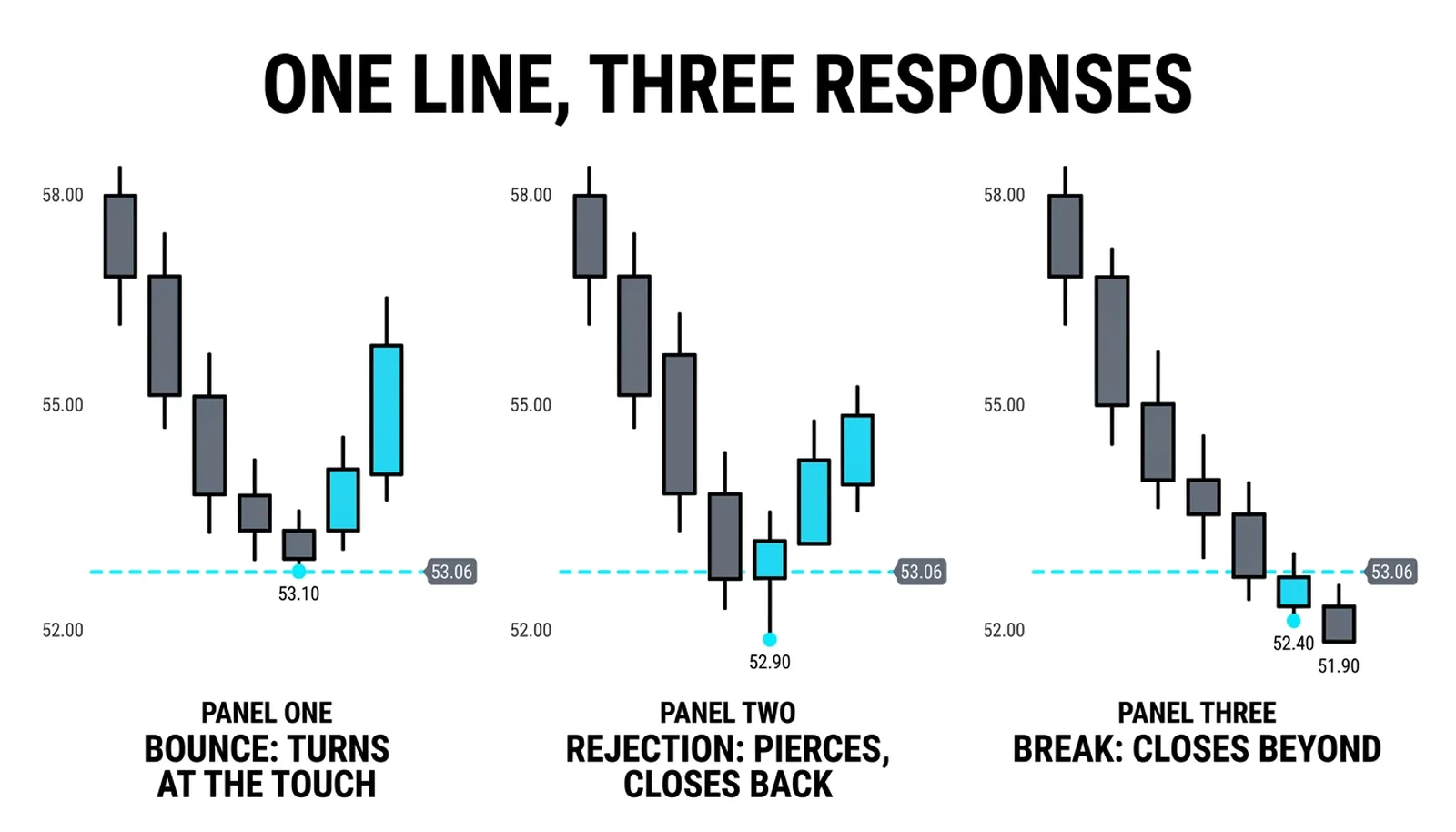
What Each Response Is Worth
The bounce carries the highest reliability and the worst entry. The price action canon is direct here: the first test of a level is the most reliable one, because it is the test the crowd prepared for. Orders cluster at the obvious line, and the first arrival meets the full weight of that preparation. Later tests meet thinner defense, because each touch spends some of the orders resting there.
The rejection carries the best entry and the most confusion. The flush beyond the line clears out the stops of traders who bought the touch, and that clearing often fuels the turn. A trader who waits for the rejection's confirmation close gets filled after the weak hands have exited, at a price the bounce never offered. The wick that scared everyone improved the trade.
The break carries no trade at the level, and that is its value. A close beyond the line flips the level's role. What was support becomes a reference on the other side, a place price may retest from below before continuing. The level stops being an entry candidate and becomes context for the next one. Knowing when a level is dead saves more money than knowing when one is alive.
One blunt sentence belongs here: most losing fibonacci trades are correct levels with unread reactions. The measurement was fine. The response was ignored.
Trading the Reaction, Not the Line
The working rule is simple. The line marks the location. The confirmation close marks the event. Entry comes after the close, not at the touch.
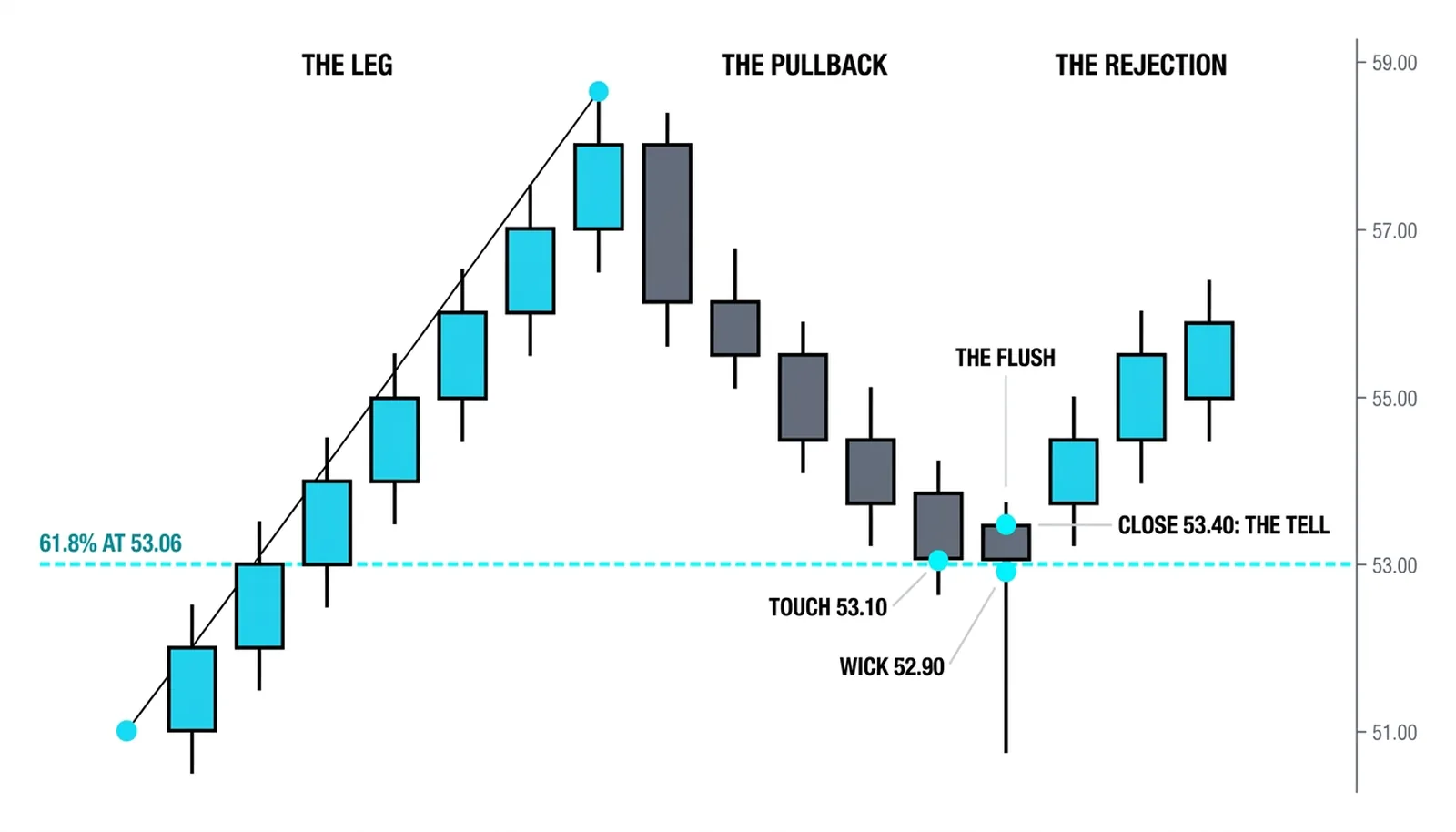
For a rejection, the confirmation is the candle that wicks through the line and closes back on the original side. The entry sits just beyond that close. The stop sits beyond the wick's extreme, because if price trades past the deepest point of the probe, the refusal has failed and the read is wrong. Risk is defined by the wick, which is exactly as it should be. The market showed how far the probe went; the stop respects that boundary.
For a bounce with no wick, the same logic applies with the touch itself as the extreme. The stop goes a small buffer beyond the line, and the entry waits for at least one candle closing away from the level in the intended direction.
Now the honesty. Waiting costs something. The confirmation close is always a worse price than the touch, and on a clean bounce the trader who bought the line beats the trader who waited. But the same wick that flatters a rejection entry stops the early buyer. The trader who bought the first touch at the line, without a confirmation close, exited on the flush before the turn ever started. The wick teaches the discipline: the response is the event, and the line is only where the event happens.
A close beyond the line kills the read entirely. No averaging down, no widening the stop, no arguing that the level is "still roughly intact." The watch hands over to the next level, and the trade idea is closed with it.
The Test at 53.06
A hypothetical example with round numbers. A leg runs 8.00 points, from 50.00 up to 58.00. The 61.8 percent retracement line sits at 53.06, and the 78.6 percent line sits at 51.71. Price pulls back from the high and approaches the first level.
Price touches 53.10, just above the line. Then it wicks down to 52.90, through the line, flushing the stops of anyone who bought the touch. The candle closes back at 53.40, above the line. That is a textbook rejection: the probe went through, the close refused.
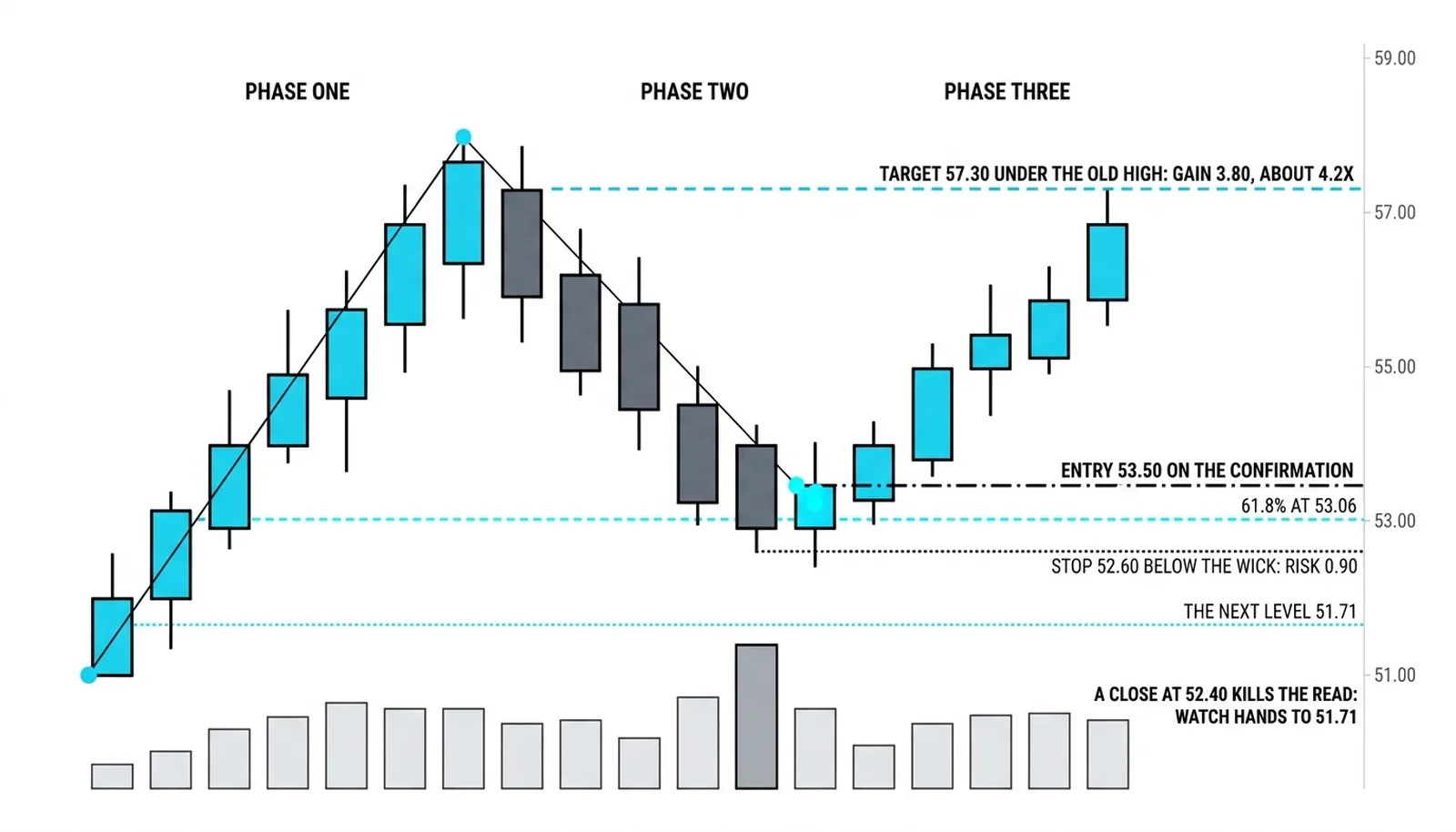
The long entry is taken at 53.50, just beyond the confirmation close. The stop sits at 52.60, below the wick's extreme of 52.90 with a small buffer. Risk is 0.90 per share. The first target is 57.30, just under the old high at 58.00, a gain of 3.80. The reward-to-risk ratio is about 4.2 to 1.
The entry paid for waiting in two ways. The confirmation close filtered out the false break, and the rejection's flush improved the fill relative to where the turn confirmed. The same wick that flattered this entry would have stopped a trader who bought the first touch at 53.10 without a confirmation close.
Now the failed version. Price touches the line, wicks through, and then closes at 52.40, below the line. The read dies on that close. There is no rejection, because the refusal never came. The level converts from support to reference, the long idea is cancelled before entry, and the watch hands down to the 78.6 percent line at 51.71, where the whole process starts again with fresh eyes.
| Response | The Tell | The Message | The Trader's Move |
|---|---|---|---|
| Bounce | Touch and turn, no wick through | Level held on the first test | Enter after a confirming close, stop beyond the line |
| Rejection | Wick through, close back on the original side | Stops flushed, level refused to break | Enter beyond the close, stop beyond the wick's extreme |
| Break | Close beyond the line | Level is dead, role flipped | Cancel the idea, hand the watch to the next level |
| Repeated tests | Each touch weaker than the last | Resting orders are spent | Treat later tests as less reliable than the first |
Fibonacci Reaction Questions, Answered
How do you know if a fibonacci level will hold?
You do not know in advance, and no measurement can tell you. The level marks a location where a response is likely; the response itself tells you whether the level held. The first test is the most reliable because the crowd's orders are freshest there, but reliability is a tendency, not a promise. The job is to read the reaction, not to predict it.
What is a rejection at a fibonacci level?
A rejection is a wick through the line followed by a close back on the original side. Price overshoots, flushes the stop orders sitting just beyond the level, and then refuses to stay there. The tell is the close, not the wick. A wick through the line with a close back above it means the level held under pressure, and the flush often improves the entry that follows.
What does it mean when price breaks a fibonacci level?
A close beyond the line means the level has failed and its role flips. Former support becomes a reference on the other side, and the watch moves to the next level in the sequence. The break is the only response that ends the trade idea outright, and the correct response to it is cancellation, not adjustment.
Should you enter at the level or wait for the reaction?
Wait for the reaction. Entering at the line gets the best price on the trades that work and full participation in every flush that stops you out before the turn. Waiting for the confirmation close costs a few ticks on clean bounces and saves the entire loss on every rejection's wick. Over a series of trades, the information in the response is worth more than the price improvement at the touch.
The next lesson stays in this section and collects its failure modes: the drawing mistakes and the usage mistakes that waste correctly drawn levels. The reading method stays identical: location first, response second, entry third.