Deep Retracements: 61.8 and 78.6
Deep retracements are pullbacks that surrender most of the prior leg, the 61.8 to 78.6 percent band, and what they signal is strain. A counter-move that travels that far with ease is evidence in itself that the other side has grown, and the trend is no longer unopposed. The shallow pullback from the last lesson confirmed strength because sellers could barely push. The deep pullback says the opposite: sellers pushed, and they pushed far.

Think of a crane's counterweight lowered nearly to the ground, the machine still balanced, yet how far the weight fell is the honest measure of the load it is holding. That is the deep band. The trend may still stand, but the depth tells you how heavy the opposition has become.
The golden-zone lesson traded this band: entries inside it, stops beyond it. This lesson reads the same depth as evidence, what the depth itself announces about the trend's condition before any trade is taken.
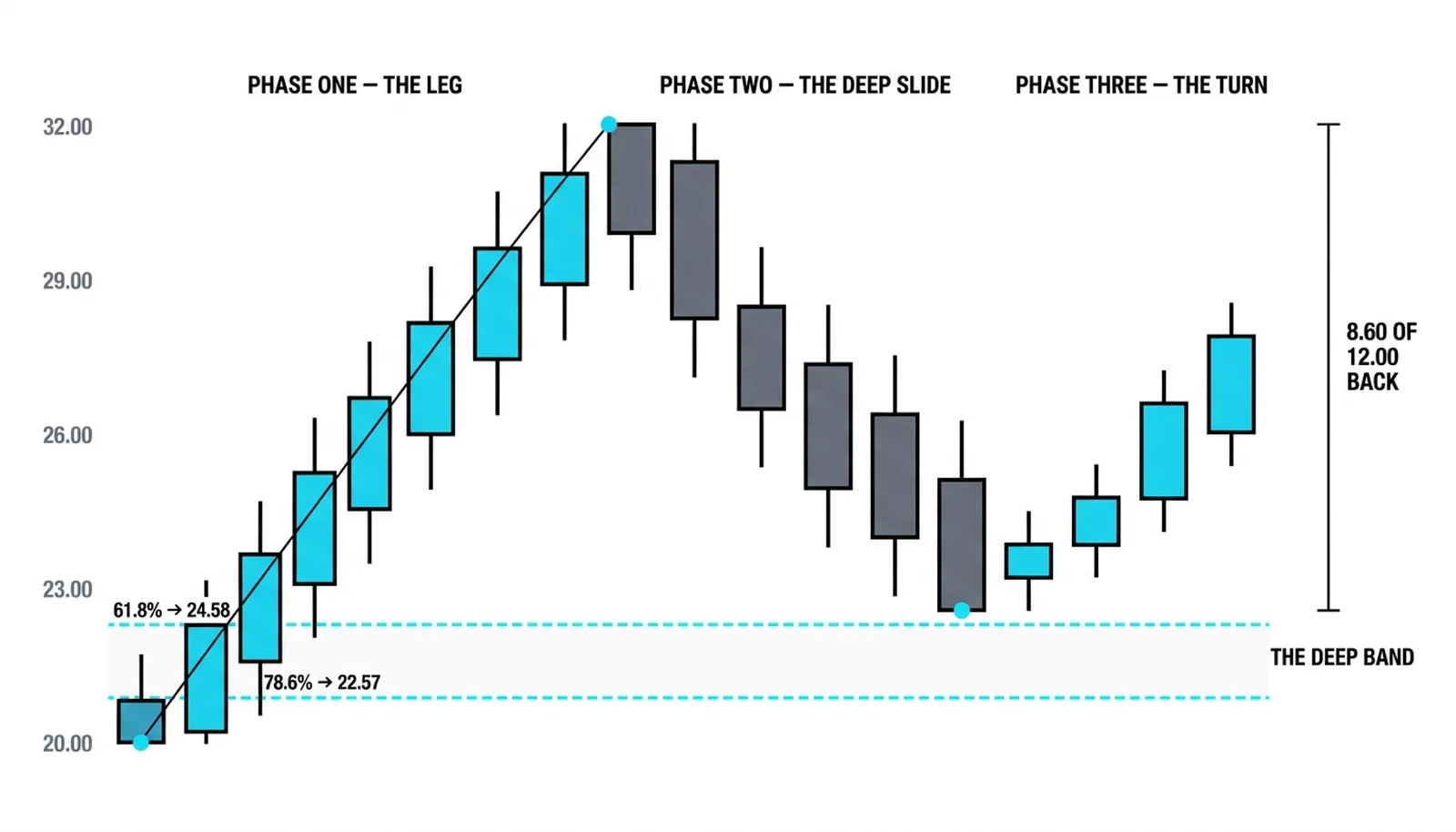
Why Depth Reads as Strain
Every point the pullback re-surrenders is a point of the trend's own work undone. A leg that climbed twelve points spent real buying effort building those twelve. When eight or nine of them come back, that effort has been erased, and the market knows it.
The crowd's accounting changes as the depth grows. The latecomers who bought near the top of the leg go under water first. Their exits become supply, and that supply feeds the decline further. Each tick deeper converts another layer of hopeful buyers into forced sellers.
Then the market's question itself shifts. In a shallow pullback, traders ask how far the trend runs. In a deep one, they ask whether it survives. That change in the question is the strain made visible. Price has not broken the trend yet, but the burden of proof has moved, and it now sits on the buyers.
What the Two Deep Lines Are Worth
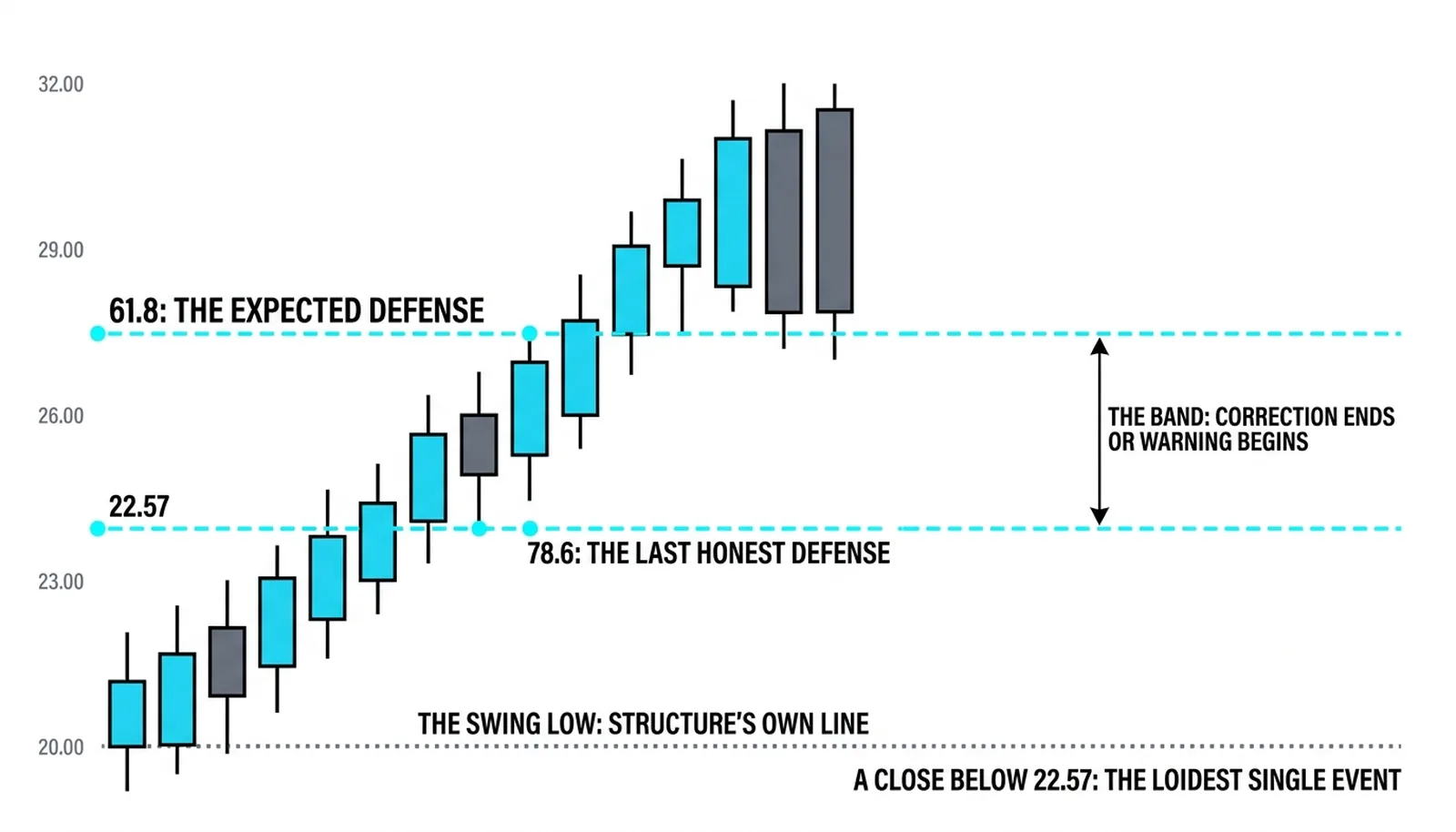
The two lines do not carry equal weight, and treating them as interchangeable is a common mistake. The 61.8 is the defense the trend is expected to make. It is the line where a healthy correction stops being one. A pullback that halts at or just past 61.8 and turns with commitment has done what strong trends do under pressure.
The 78.6 is the last honest defense. Beyond it, the pullback stops reading as a pullback and starts reading as something worse. A dip to 78.6 that holds can still be a correction, technically, but it is a correction that has consumed nearly the entire leg, and the trend that emerges from it is a weakened one.
The most informative single event this measurement produces is a close beyond the 78.6. Not a wick, not an intraday poke, a close. That close tells you the last defense failed on the record, and the burden of proof transfers entirely to anyone still arguing for continuation.
The cluster method agrees from the measurement side: the deep zone is where corrections either end entirely or stop pretending to be corrections. The depth itself carries the warning. You do not need an indicator to confirm what the retrace already announced.
Trading the Deep Pullback
Start with posture. Deep is a reading of strain, not a conclusion of death. Plenty of trends launch their strongest advances from deep pullbacks, precisely because the deep wash clears out every weak holder and leaves the field to committed buyers. But the trader's posture must change with the depth: smaller size, wider patience, and a turn that must be proven rather than assumed.
Smaller size first. The deep band is where the trend is most on trial, so the capital committed there should reflect the trial. If a shallow-retracement entry earns full size, a deep-band entry earns a fraction of it. This is not timidity. It is pricing the uncertainty the depth revealed.
Then the proven turn. In a shallow pullback, the level itself can justify the entry because the trend's strength does the work. In a deep one, the level is not enough. You wait for price to stop falling inside the band and show a genuine turn, a reversal bar, a higher low, a reclaim of a broken micro-level. The entry comes after the evidence, not before it.
The tape-reading framework's rule for exactly this situation: a deep pullback demotes the trend to a trading range until the structure proves otherwise. The trader stops assuming continuation and starts requiring evidence. That single demotion reframes every decision in the band. You are no longer buying a trend cheaply. You are buying the lower edge of a possible range, and ranges get sold at the top, not held for new highs.
Finally, the exit logic. A close beyond the far line of the band ends the trade idea and the read at once. The deep band converts from opportunity to warning, and attention moves down to the prior swing low, the level whose break would complete a change of character. The deep retracement, traded honestly, always knows where its own failure lives.
The Turn at 23.90
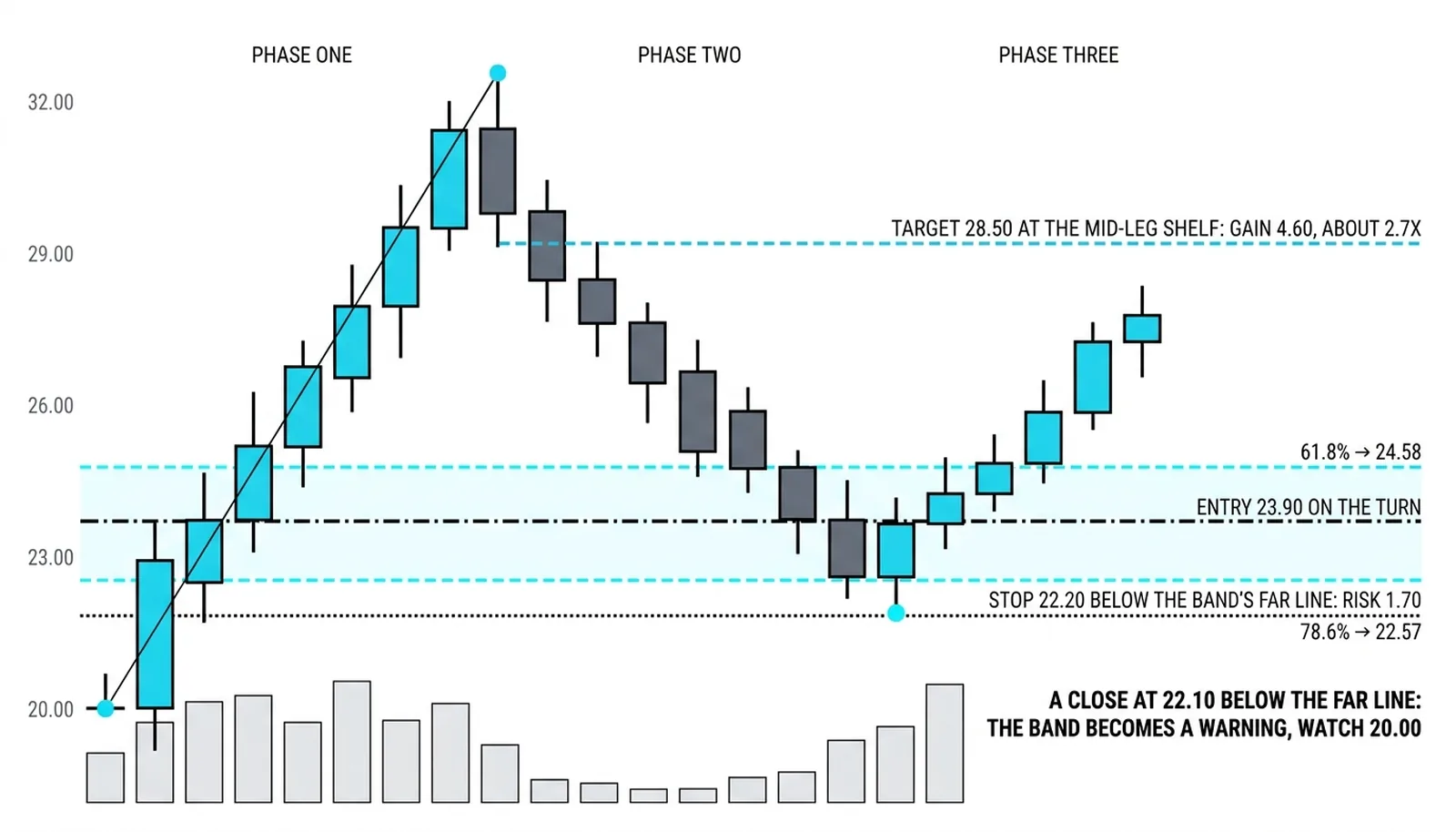
A hypothetical illustration, all numbers invented and round. A leg runs 12.00 points, from 20.00 up to 32.00. The deep band spans 24.58 at the 61.8 line down to 22.57 at the 78.6 line.
Price slides into the band, touches 23.40, and stops. The next bars hold above the low, then push up with a strong close. The turn is proven. The long is taken at 23.90, with the stop at 22.20, just below the band's far line. Risk is 1.70 per unit.
The first target is the mid-leg shelf at 28.50. The gain is 4.60, about 2.7 times the risk. The size on this trade is deliberately smaller than a shallow-retracement trade would carry, because the deep band is where the trend is most on trial.
Now the failed version. Price closes at 22.10, below the 78.6 line. The trade is out at the stop, and more importantly the read flips. The whole band converts from opportunity to warning. The watch hands down to the swing low at 20.00, where a break would complete the change of character the structure lessons described. Same chart, same levels, two opposite messages, and the close beyond the line is what decided between them.
| The Depth Reached | The Line | The Strain Read | The Response |
|---|---|---|---|
| Pull of 61.8 percent of the leg | 61.8 | Expected defense; a healthy correction's limit | Watch for the turn; reduced size if trading it |
| Between the two deep lines | 61.8 to 78.6 | Strain confirmed; latecomers under water | Require a proven turn before any entry |
| Pull of 78.6 percent of the leg | 78.6 | Last honest defense; trend on trial | Smallest size, or stand aside entirely |
| Close beyond the band | Past 78.6 | Defense failed; pullback reads as something worse | Exit, flip to warning, watch the prior swing low |
Deep Retracement Questions, Answered
What is a deep retracement?
A deep retracement is a pullback that gives back most of the prior leg, conventionally the 61.8 to 78.6 percent band. It signals strain: the counter-move traveled far enough to prove the opposing side has grown, and the trend can no longer be treated as unopposed.
What does the 78.6 retracement level mean?
The 78.6 is the last honest defense of a correction. A hold there keeps the pullback technically alive, but barely, and a close beyond it is the loudest single event the measurement produces, converting the setup from opportunity into warning.
Is a deep pullback a sign the trend is ending?
No, it is a sign of strain, not death. Many trends launch their strongest advances from deep pullbacks because the wash clears weak holders. What changes is your posture: smaller size, more patience, and a turn that must be proven rather than assumed.
When does a deep retracement become a reversal?
A close beyond the 78.6 line is the first formal step, and a break of the prior swing low completes the change of character. Until that second event, the structure lessons treat the move as a trend under trial, with the burden of proof resting on the buyers.
Depth is only one dimension of the pullback. The next lesson takes up the reactions themselves: the bounce, the rejection, and the break at the lines, and what each one says about the level it met.