Effort to Rise vs Effort to Fall
Effort to rise versus effort to fall is the discipline of comparing the volume behind a market's rallies against the volume behind its declines over a stretch of time. Both directions need effort. Whichever direction is getting the effort is the side the market's professionals are backing, and that is the side you want to understand before you commit money.

Think of pushing a heavy cart uphill: it takes effort to move it up, and it takes effort to stop it when it rolls downhill. Markets work the same way. A rally does not happen by accident, and a decline is not free. Someone is paying for every move, and the volume tells you who is paying more.
Measuring Conviction Across Moves
An earlier lesson in this series covered effort versus result on single bars and single trends. This lesson measures the same law across whole moves, in both directions, over several swings.
The method is simple. Take a stretch of price action with clear rally legs and decline legs. Add up or eyeball the volume on the rally legs, then do the same for the decline legs. Compare the two. Do this inside one feed, on the same instrument, so the comparison stays honest. Mixing instruments or sessions muddies the reading.
The reading works in rough bands, not exact ratios:
- Rally legs running two to three times the volume of the decline legs: conviction sits with buyers.
- Decline legs running two to three times the volume of the rally legs: conviction sits with sellers.
- Roughly even volume on both sides: no conviction either way, expect chop or a fight at the current level.
Precision matters less than the gap. A market where rallies print double the volume of declines is telling you something a market with even volume is not. You are reading which side is working harder, not computing an exact figure.
What Conviction With Buyers Looks Like
Volume expands on the pushes up and dries on the pullbacks. That is the signature.
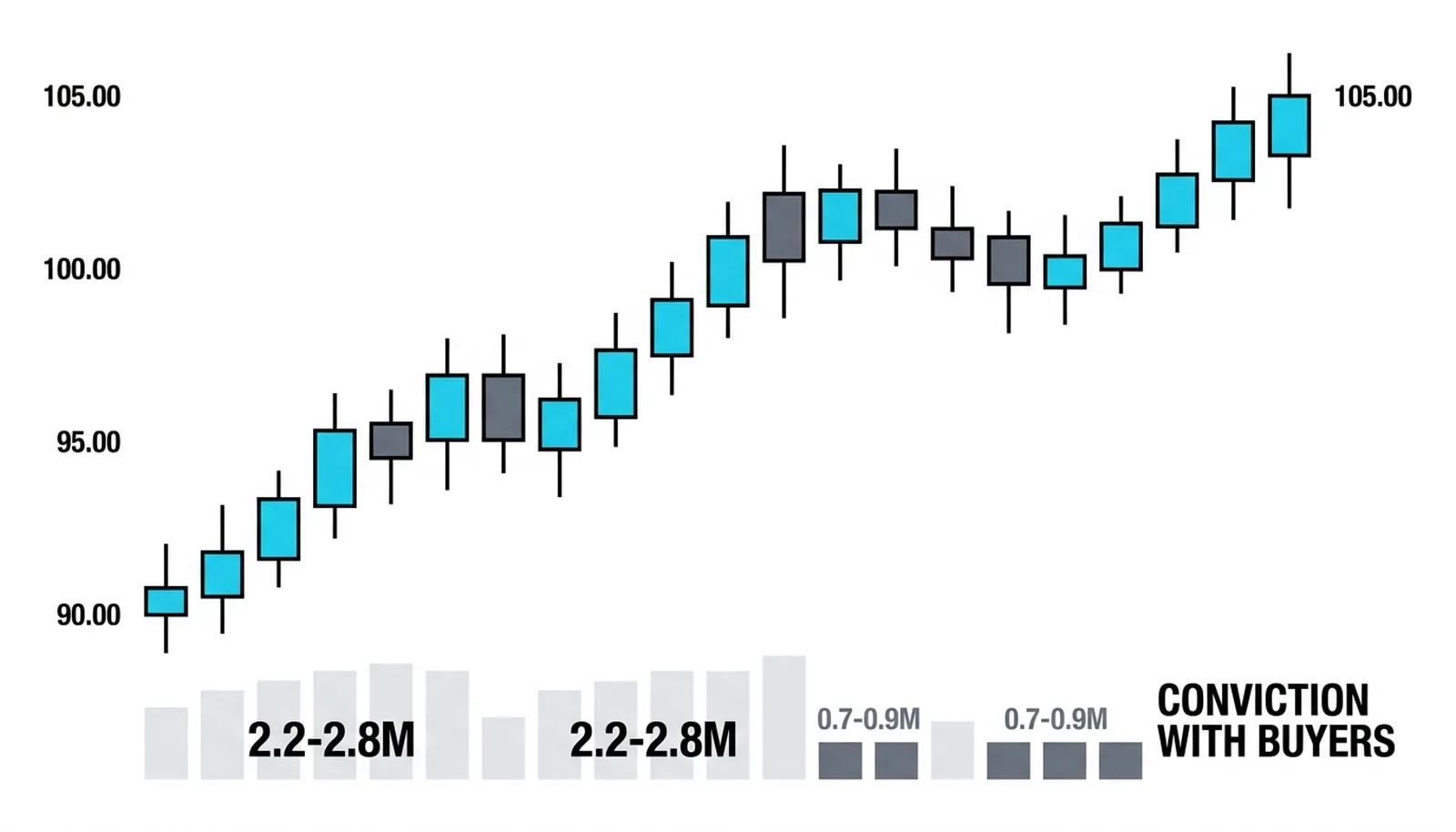
Each rally leg draws more participation than the pullback that follows it. Buyers step in with size when price advances, and sellers show little appetite when price dips. The trend is being funded. Money is flowing in on the advances and staying put on the retreats.
This changes how you treat pullbacks. In a trend with buyer conviction, a pullback on shrinking volume is a low-risk observation rather than a threat. The sellers are not putting effort into the decline. Nobody serious is distributing. You can watch the dip, wait for demand to return, and act from evidence instead of fear.
The pattern also gives you a warning system for free. The day a pullback starts printing volume that rivals the rally legs, the funding story has changed. You do not need to predict. You only need to notice.
What Conviction With Sellers Looks Like
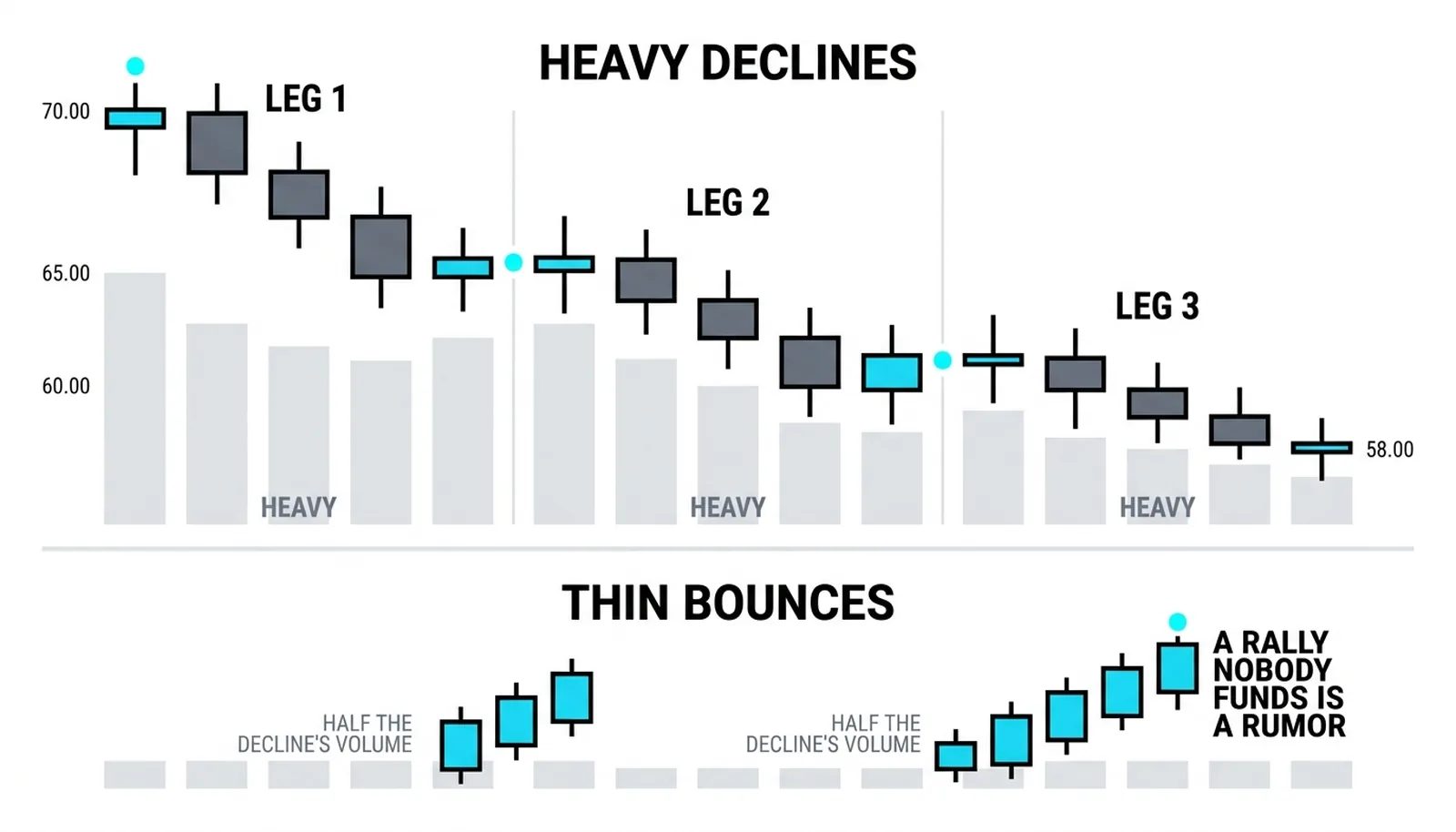
Mirror the picture. Declines print heavy volume, rallies print thin volume. Every bounce is being sold.
In this tape, buyers show up timidly on the bounces and sellers hit hard on the drops. The bounces exist because shorts cover or bargain hunters nibble, not because real demand has arrived. The declines exist because someone with size wants out.
A rally nobody funds is a rumor of a recovery.
Traders get trapped here by reading price alone. A bounce of several points looks like strength on the chart. The volume says otherwise. If the bounce carries half the volume of the decline that preceded it, the professionals have not changed sides and are using the bounce to sell at better prices.
The discipline cuts both ways. Falling markets need effort just as much as rising ones. The volume on a decline is the sellers' effort, and it deserves the same careful reading you give the buyers' effort on a rally. Ignoring it because "price just fell" is how traders buy every dip in a real downtrend.
The Flip Is the Signal
Static readings are useful. Changing readings are where the money is.
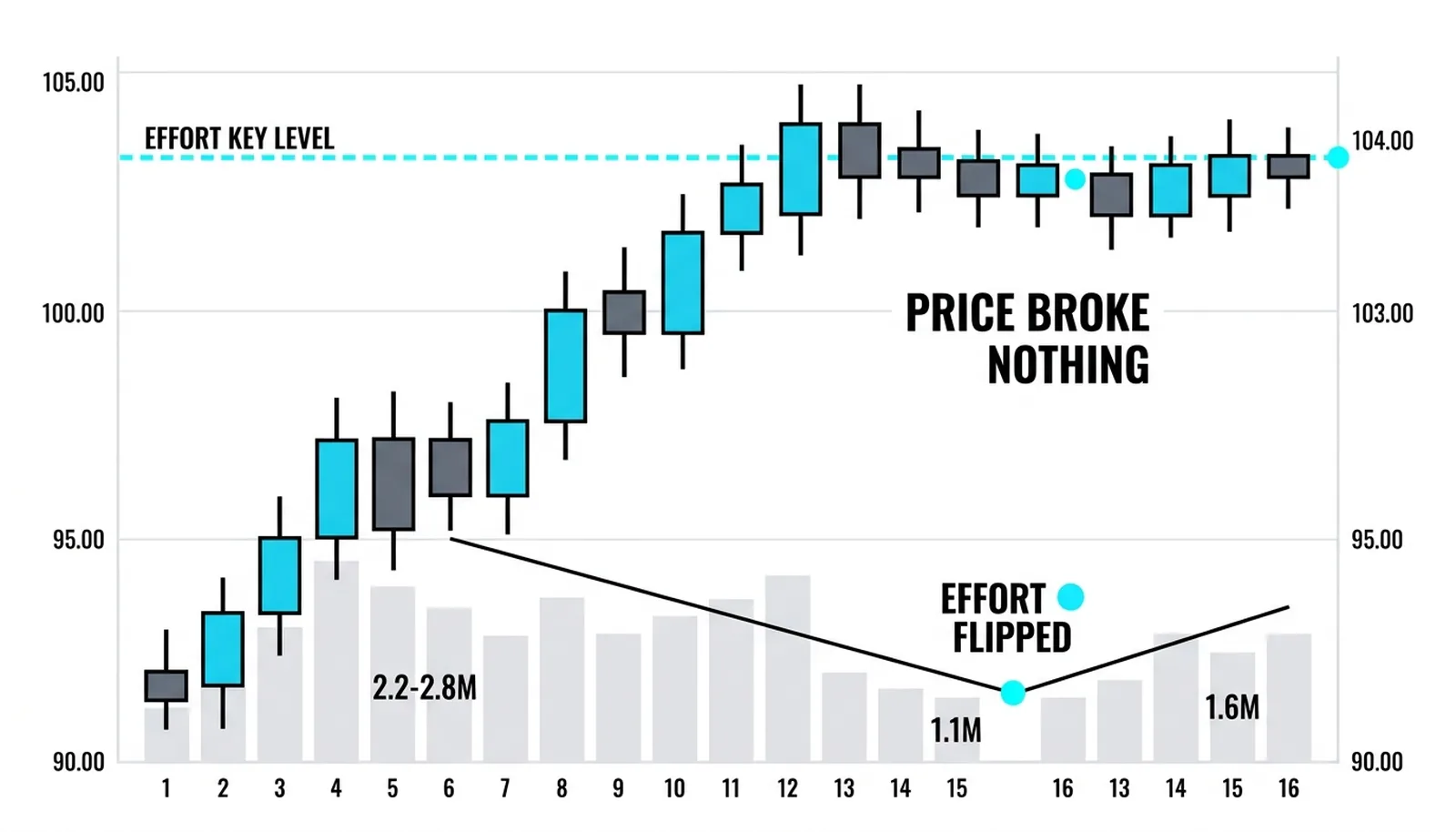
Watch what happens when rally volume shrinks swing over swing while decline volume grows. Price may still be near its highs. Nothing on the chart has broken. But the effort has changed hands, and effort usually changes hands before price does.
This is the same story divergence tells, told with effort instead of price. Momentum divergence says the pushes are weakening. Effort flipping says the buyers have stopped funding the pushes and the sellers have started funding the declines. Two readings, one story.
Use this as a corroboration habit. When effort, divergence, and climactic action agree, you have a strong read. When they disagree, you have a reason to wait. A market that prints a buying climax, then shows shrinking rally volume and growing decline volume, then prints bearish divergence, is telling one story three ways, and stories told three ways deserve respect.
The flip warns before price confirms. That warning is its value. By the time price breaks structure, the traders who read effort have already stepped aside.
One Trend, Two Readings
A hypothetical example with invented round numbers.
A stock climbs from 90 to 105 over several weeks. The rally legs print volume between 2.2 and 2.8 million shares. The pullbacks print between 0.7 and 0.9 million. Rallies run roughly three times the declines. Conviction sits with buyers. Pullbacks are observations, not threats, and the trader holding longs has evidence to stay patient.
Weeks later, the same stock still trades near its highs. But the last two rally legs printed 1.1 million shares each, and the last two pullbacks printed 1.6 million. Price has broken nothing. The trendline holds. The moving averages still point up.
The effort has flipped sides anyway. Declines now outwork rallies. The honest action here is not a short sale; the trend has not broken and shorting an intact uptrend is a guess. The honest action is refusing new longs until the effort repairs. Existing positions get managed with more suspicion, tighter plans, and a clear line where the reading is wrong.
| Period | Rally-leg volume | Decline-leg volume | Verdict |
|---|---|---|---|
| Weeks 1–4 | 2.2–2.8 million | 0.7–0.9 million | Conviction with buyers |
| Weeks 5–6 | 1.8–2.0 million | 1.0–1.2 million | Buyers still lead, gap narrowing |
| Weeks 7–8 | 1.1 million | 1.6 million | Effort flipping to sellers |
| Following weeks | To be measured | To be measured | No new longs until effort repairs |
Notice what the table does not require: prediction. Each row is an observation with a matching behavior. The verdict column changes only when the volume changes.
Effort to Rise vs Effort to Fall, Answered
What does effort to rise mean in trading?
Effort to rise is the volume a market must spend to push prices higher. Rising prices require buying, and buying at scale shows up as volume. When rally legs carry heavy volume, real money is funding the advance. When rallies carry thin volume, the advance has no funding behind it and deserves suspicion.
Do markets need effort to fall?
Yes, falling takes effort too. The gravity trap is the belief that prices drop on their own while rising requires work. A decline on heavy volume is sellers spending real effort to push price down or exit at scale. That effort deserves the same reading as the buyers' effort on a rally, because it tells you which side the professionals are backing.
How do I measure conviction with volume?
Compare rally-leg volume against decline-leg volume over several swings on the same instrument. Rallies running two to three times the declines means conviction sits with buyers. The reverse means conviction sits with sellers. Roughly even volume means neither side has committed. Work in rough bands, not exact ratios, and watch how the comparison changes swing over swing.
What does it mean when effort flips sides?
It means the funding has changed hands before the price has. Rally volume shrinking while decline volume grows, near the highs of an intact trend, is an early warning that sellers have taken over the work. The disciplined response is to stop adding in the old direction and tighten management of what you hold, not to reverse position against an unbroken trend.
Once you can read which side is working harder, the next question is what happens when that effort hits a wall. That is where the upthrust bar comes in: a single bar where effort meets supply in the open, and the next lesson takes it apart piece by piece.