The Upthrust Bar: A Distribution Signal
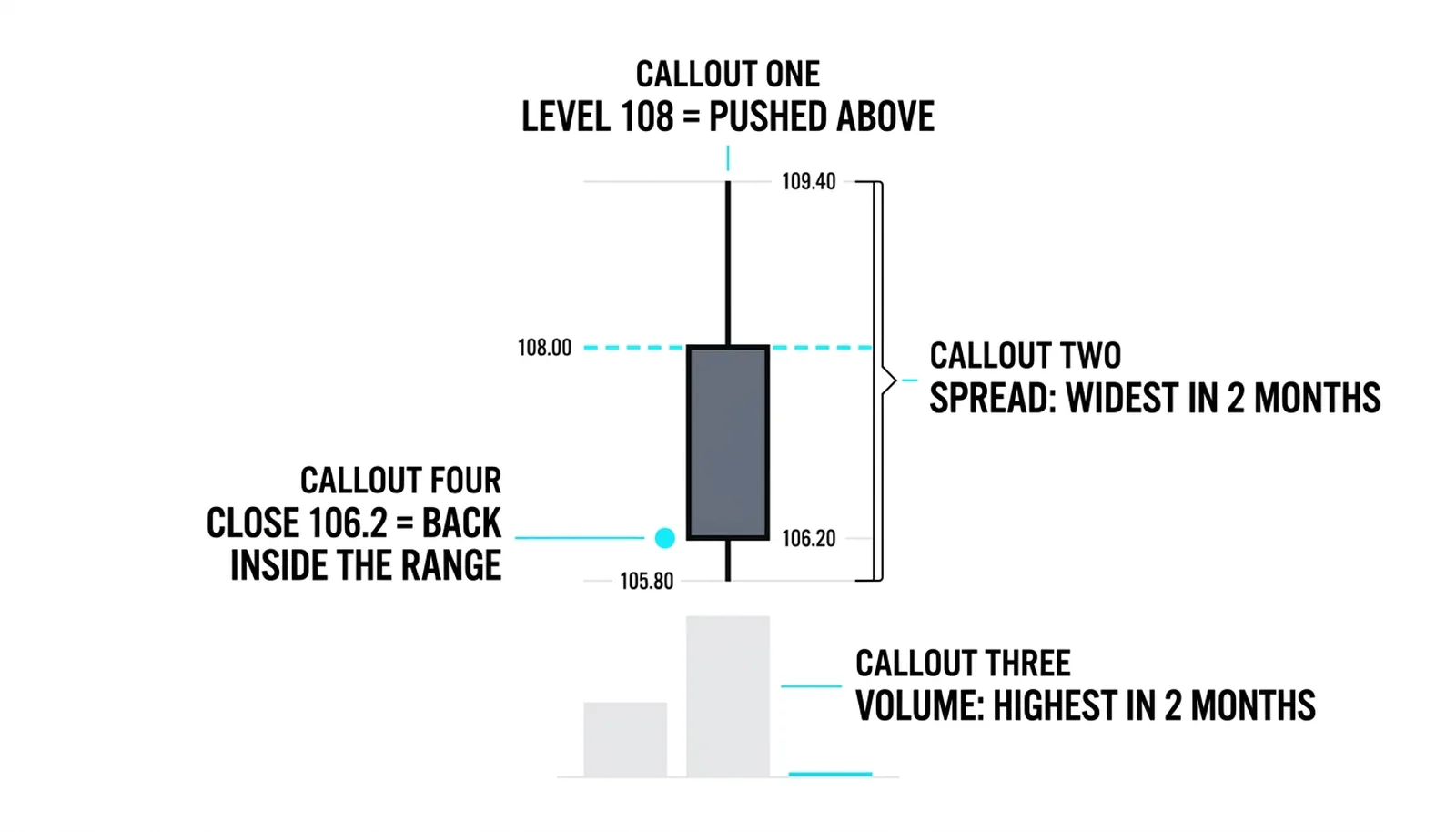
An upthrust bar is a bar that pushes above a prior high or resistance on a wide spread, then closes back inside the range below that level, usually on heavy volume, and it reads as a failed breakout in which the push above the level was used to sell into, a distribution signal in VSA terms. The buyers who chased the break are left holding positions above a ceiling that just proved itself again. The breakout was never real. It was a brief excursion above resistance that the market rejected within the same bar.

Think of the matador's cape: the charge is invited so the pass can happen. The push above the level draws breakout buyers in, and their orders provide the crowd that sellers need. Then price comes back down, the cape drops, and the buyers are left standing on the wrong side of the level.
Earlier lessons in this framework covered stopping volume and the test bar, which describe the absorption side of the story near lows. The upthrust is the distribution-side counterpart, and this time the trapped side is the buyers above the level.
The Anatomy of an Upthrust
Four parts define the pattern, and all four should be present before you treat the bar as an upthrust.
A push above the prior high or resistance. The bar must trade through a level the market already respects. A random high in the middle of nowhere carries no meaning. The level is the reference point that makes the failure readable.
A wide spread. The bar's range from high to low should be noticeably larger than recent bars. A wide spread tells you the bar traveled a long way, and the distance between the high and the close is the measure of rejection.
Heavy volume. The bar should print clearly above-average volume. High volume on a bar that fails to hold its gains means a large amount of business was done, and the net result of all that business was a close back below the level. Someone absorbed the buying.
A close back inside the range. The close must come back below the broken level, ideally into the lower half of the bar. This is the defining feature. If the bar closes above the level and holds, you do not have an upthrust. You have something else entirely.
Location matters most. An upthrust carries its greatest weight at the top of a trading range, or after an extended advance where the market has already traveled a long way. In the middle of a trendless chop, the same shape means less, because there is less at stake above the level.
Why the Failed Breakout Matters
Every trader who bought the break is now trapped above the level. They bought at the high of the bar or on the way up, expecting continuation, and within the same session the market closed below their entry. Their position is underwater from the start.
Trapped buyers become forced sellers. Some exit immediately on the close. Others hold for a bar or two, hoping the breakout reasserts itself, and then exit when it does not. Either way, their exits add supply on the way down and fuel the move back into the range.
The level itself also changes character. Resistance that once held now has a crowd of trapped buyers sitting directly above it. If price rallies back toward that level later, those buyers may sell at breakeven just to escape, which adds another layer of supply exactly where the market already showed weakness. The failed breakout does more than signal a reaction lower. It makes the ceiling stronger for the next attempt.
The Aftermath Rules
Expect a reaction lower. The standard read after a valid upthrust is a drift or decline back into the range, often toward the opposite side of the structure. The heavier the volume on the thrust bar and the weaker the close, the more weight the expectation carries.
The read is voided if price quickly recovers back above the thrust high. A fast reclaim of the level tells you the selling was absorbed and the buyers regained control. When that happens, the upthrust label no longer applies, and treating it as resistance will cost you.
The market told you the breakout was rented, not owned. Respect that message until the market takes it back with a decisive close above the thrust high.
Upthrust Versus a Genuine Breakout
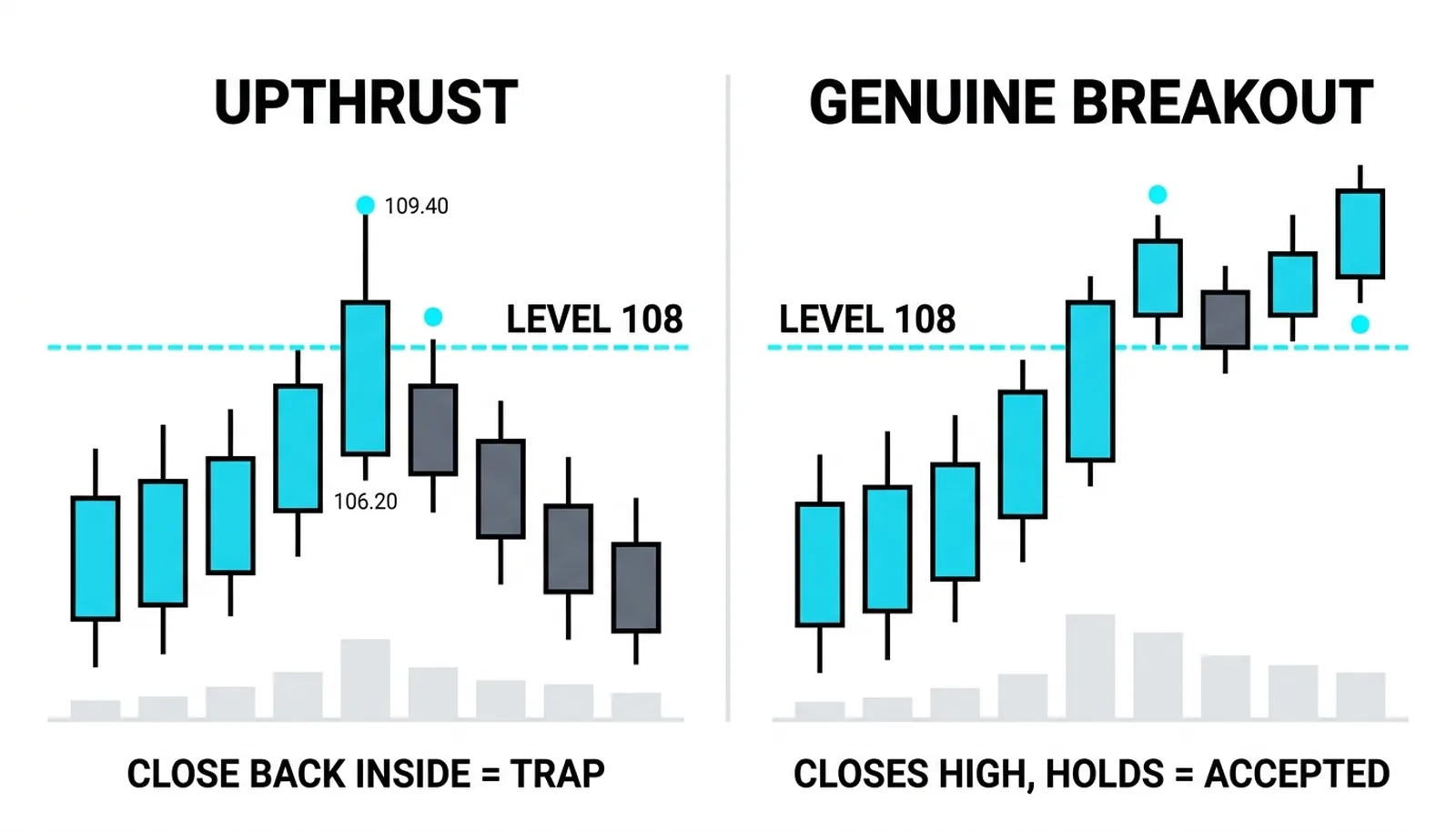
A genuine breakout closes above the level and builds on it. The breakout bar typically closes near its high, and the bars that follow hold above the level, often pausing or pulling back toward it on low volume as the market accepts the new ground.
An upthrust does the opposite. It closes back inside the range on heavy volume, and the follow-up bars fail to reclaim the level. The close position inside the bar is the first separator: near the high suggests acceptance, back inside the range suggests rejection. The follow-up bars are the second separator: quiet holding above the level confirms a breakout, while a slide back down on continued volume confirms the upthrust.
When in doubt, wait one bar. One extra bar of information usually resolves the ambiguity, and the cost of waiting is small compared with the cost of buying a trap.
One honest caveat about the story behind all this. The popular narrative says professionals marked price up through the level to trigger breakout buys and resting stop orders, then sold into that liquidity. That story is a model, not proven intent. You cannot see motive on a chart. What you can see is enough: the breakout failed, the spread was wide, the volume was heavy, and the close came back inside the range. Trade the measurements, not the movie.
One Level, One Trap
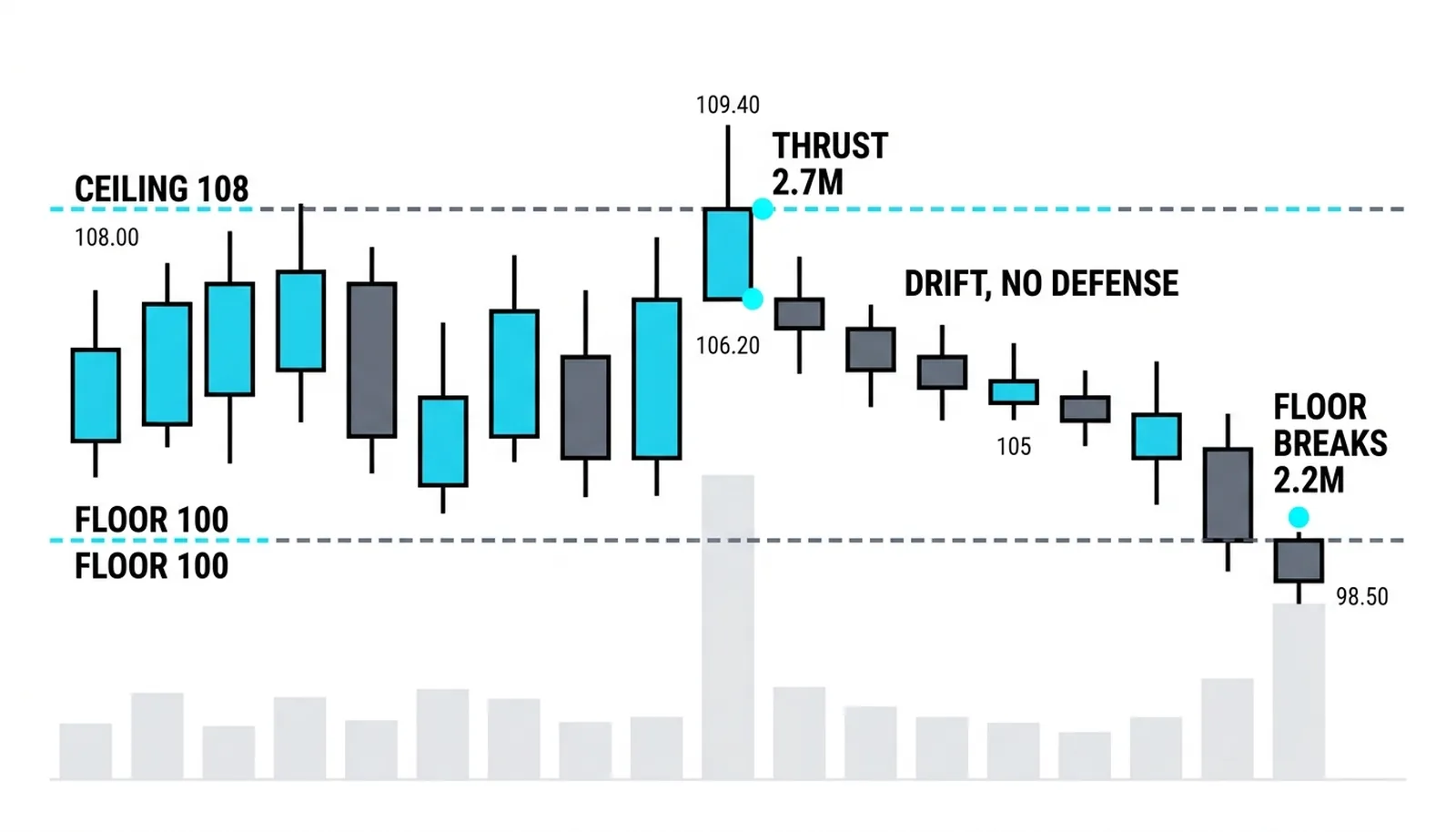
All numbers here are invented round figures for illustration. A stock has ranged between 100 and 108 for six weeks. The 108 ceiling has been tested three times and held each time, so the level is well established and widely watched.
Stage one, the thrust bar. Price pushes to 109.4 intraday, clearing the ceiling, on 2.7 million shares, the highest volume in two months. The spread is the widest in two months. But the bar closes at 106.2, back inside the range and in the lower half of the bar. Every element of the upthrust is present: the push above the level, the wide spread, the heavy volume, the close back inside.
Stage two, the drift. Over the next three sessions, price slides from 106 toward 105 on fading volume. Nobody is defending the break. The trapped buyers from the thrust bar are feeding supply into a market with no fresh demand above the level. The low volume on the drift is consistent with an absence of buying rather than aggressive new selling, which fits the read.
Stage three, the breakdown. Ten sessions after the thrust, the range floor at 100 breaks on 2.2 million shares. The upthrust at the ceiling and the break of the floor now form a coherent sequence: distribution at the top, no sponsorship in the middle, and supply winning at the bottom.
The liquidity story explains this sequence memorably. The measurements prove it. You never needed to know who sold at 109. You only needed the spread, the volume, and the close.
| Stage | Reading | Verdict |
|---|---|---|
| Thrust bar to 109.4, close 106.2, 2.7M shares | Wide spread, heavy volume, close back inside the range | Upthrust: breakout failed, distribution likely |
| Three-session drift, 106 to 105, fading volume | No demand above the level, trapped buyers exiting | Read confirmed, reaction lower in progress |
| Floor at 100 breaks on 2.2M shares | Supply takes out the range low | Sequence complete, range resolved downward |
The Upthrust Bar, Answered
What is an upthrust bar in trading?
An upthrust bar is a bar that trades above a prior high or resistance level on a wide spread and heavy volume, then closes back inside the range below that level. It marks a failed breakout and is read as a sign of distribution, with the buyers who chased the break left trapped above the level.
Why does an upthrust signal distribution?
Because heavy volume that produces no upward progress means supply met the demand and won. The bar did a large amount of business above the level, yet closed below it, which tells you sellers used the breakout buying as an opportunity to offload. The trapped buyers above the level then become future sellers, reinforcing the reading.
What is the difference between an upthrust and a breakout?
A genuine breakout closes above the level and holds there, often pausing on low volume as the market accepts the new price. An upthrust closes back inside the range on heavy volume and fails to reclaim the level on the following bars. The close position within the bar and the behavior of the next one or two bars separate the two.
What voids an upthrust reading?
A fast recovery back above the thrust bar's high voids the reading. If price reclaims the level decisively and holds, the selling on the thrust bar was absorbed, the failure has been repaired, and the distribution interpretation no longer stands.
The upthrust completes the core set of spread-and-volume patterns in this framework. From here, the next step is learning how these single-bar signals combine into sequences, starting with the pseudo upthrust, the same shape printed on weaker volume, and the other variations that separate a strong read from a soft one. Distribution rarely announces itself with one bar alone. It leaves a trail, and reading that trail across a whole range is where volume analysis starts to pay for the effort it demands.