DCF: Discounted Cash Flow, Explained
DCF, discounted cash flow, is a valuation method that estimates what a business is worth today by adding up all the cash it will generate in the future, with each future amount shrunk back to today's terms. It is compound interest read backward.

Instead of growing a deposit forward year by year, DCF shrinks future cash back to the present, one discount at a time.
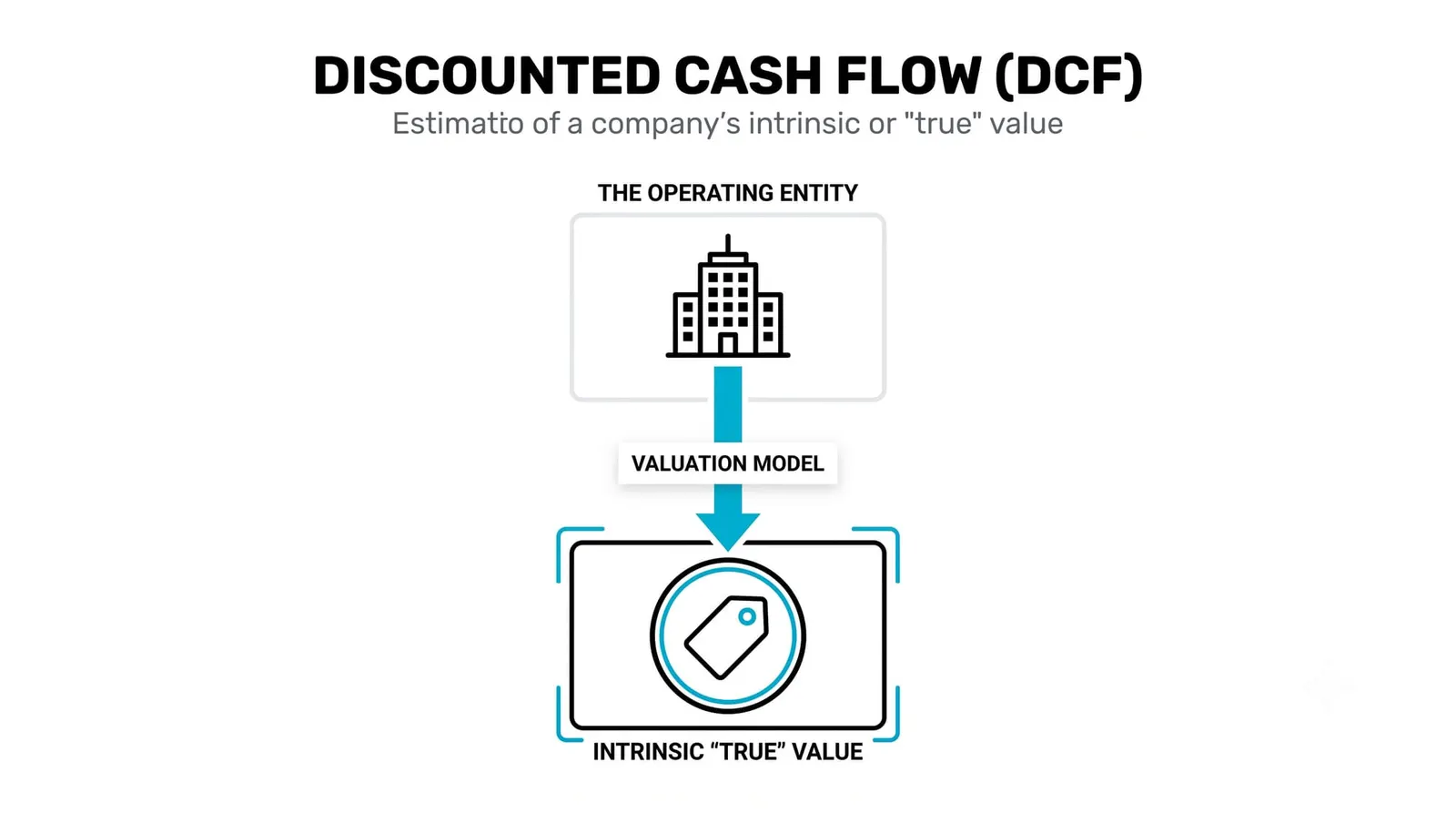
And the discount rate at the heart of it is an old friend. Earlier this level you learned about interest rates and the price of money. The discount rate is that idea doing valuation work.
What DCF Is Actually Trying to Do
Start from one claim: a business is worth what it can pay out over its life. Not what its stock traded at yesterday, not what a similar company sold for, but the total cash its owners can pull out of it from now until it winds down.
DCF turns that claim into arithmetic with three inputs:
- Forecast cash flows. Your estimate of the cash the business will generate, year by year.
- The discount rate. The rate you use to shrink each future amount back to today's terms.
- A terminal value. A single number standing in for everything the business earns after your explicit forecast ends.
Every valuation argument you will ever hear is a fight over one of these three. Someone thinks the cash flows are too optimistic. Someone thinks the discount rate is too low. Someone thinks the terminal value assumes the company lives forever at a growth rate nothing has ever sustained. The model is just the arena.
Future Cash Flows: The Starting Ingredient
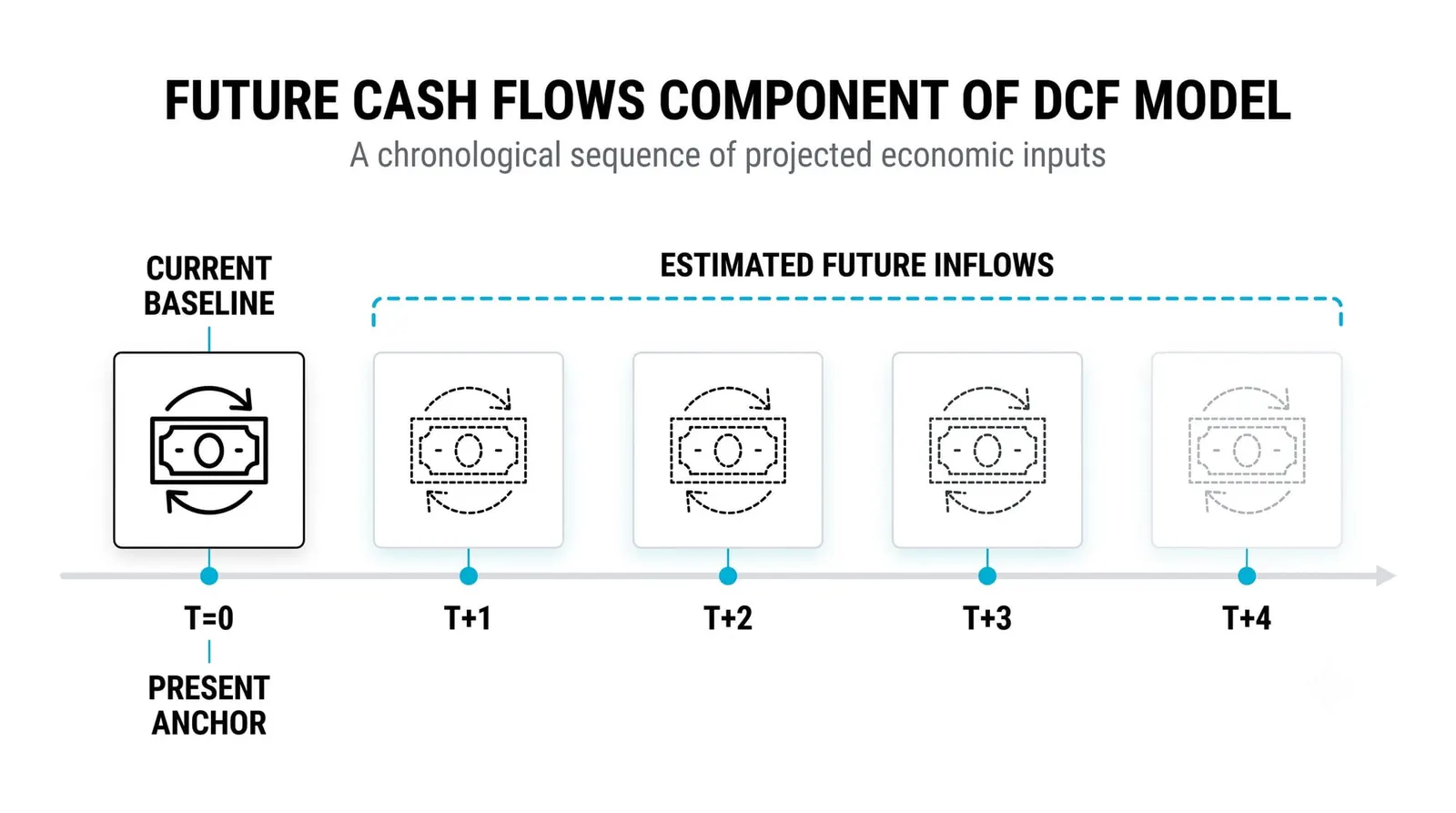
The cash in question is free cash flow: the cash left after the business has paid to run itself and to maintain its assets. Revenue minus costs, minus the spending needed to keep the machines running and the lights on. What remains is what an owner could actually take home.
Then comes the forecast. Most models project five or ten years of explicit cash flows, then hand everything beyond that to the terminal value. Five years is common for stable businesses. Ten years appears when someone wants to model a growth phase in detail.
Be honest about what a forecast is. Year one rests on budgets, order books, and recent history. Year five rests on assumptions about competition, pricing, and demand that nobody can verify. The further out you forecast, the more you are guessing. A DCF does not remove that problem. It just forces you to write the guesses down.
Discounting: Why a Dollar Later Is Worth Less Than a Dollar Today
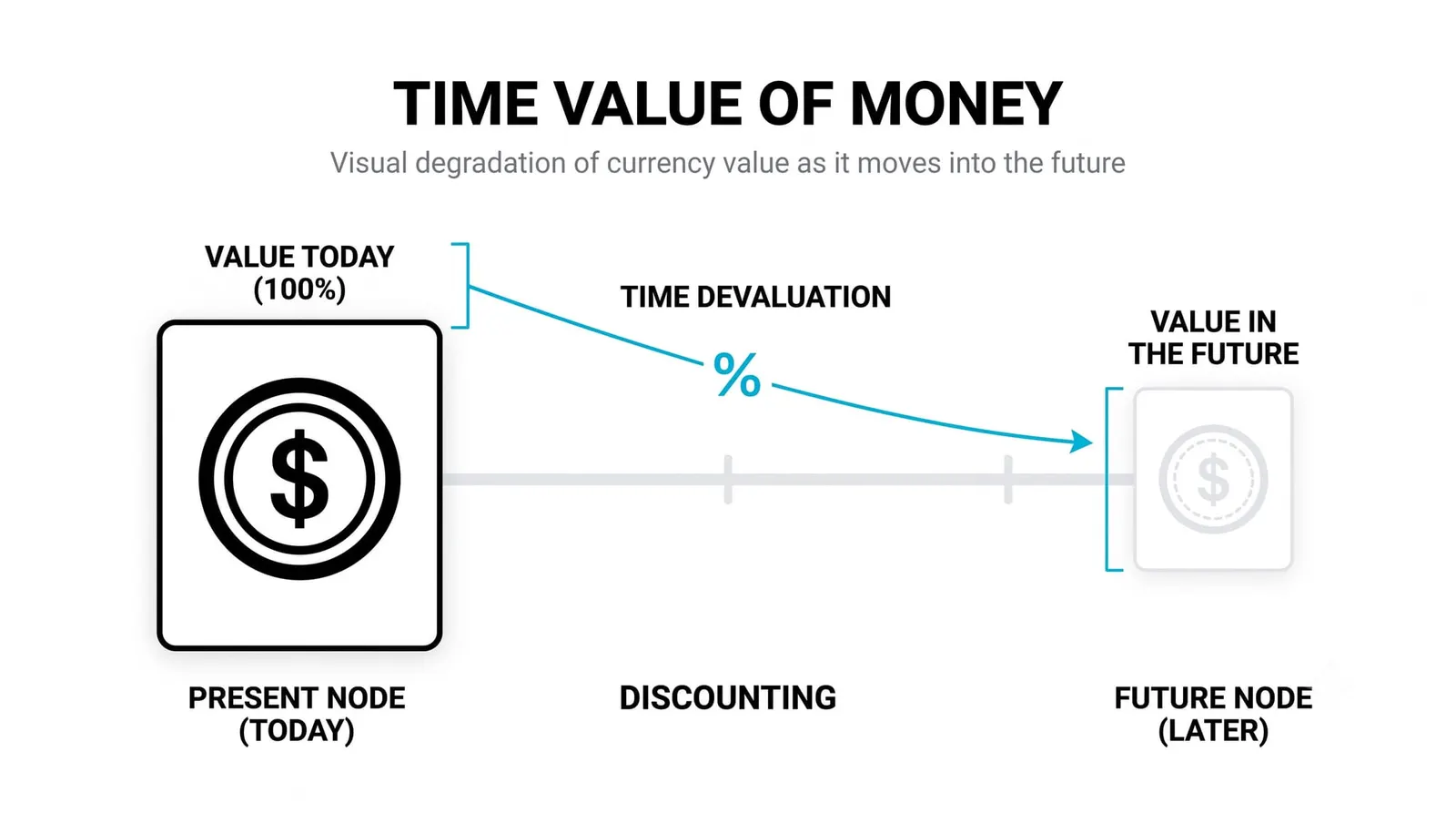
Three reasons make future cash worth less than cash in hand. Inflation erodes what a dollar buys. Risk means the future cash might never arrive at all. And waiting carries an opportunity cost, because money held today could be earning a return elsewhere.
The discount rate bundles all three into one number. It is the interest rate idea you already know, pointed in reverse. A bank asks: what will 100 today grow to? A DCF asks: what is 110 next year worth right now?
Here is the intuition with round numbers. At a 10 percent discount rate, 110 arriving one year from now is worth exactly 100 today, because 100 growing at 10 percent becomes 110. Cash arriving two years out gets discounted twice. Cash arriving ten years out gets discounted ten times, and shrinks hard.
This is why distant cash flows barely move a valuation. At a 10 percent rate, a payment twenty years away is worth roughly fifteen cents on the dollar today. The model's answer is dominated by the near years and by the terminal value, which is itself mostly a function of the discount rate.
Why DCF Is a Framework, Not a Precise Answer
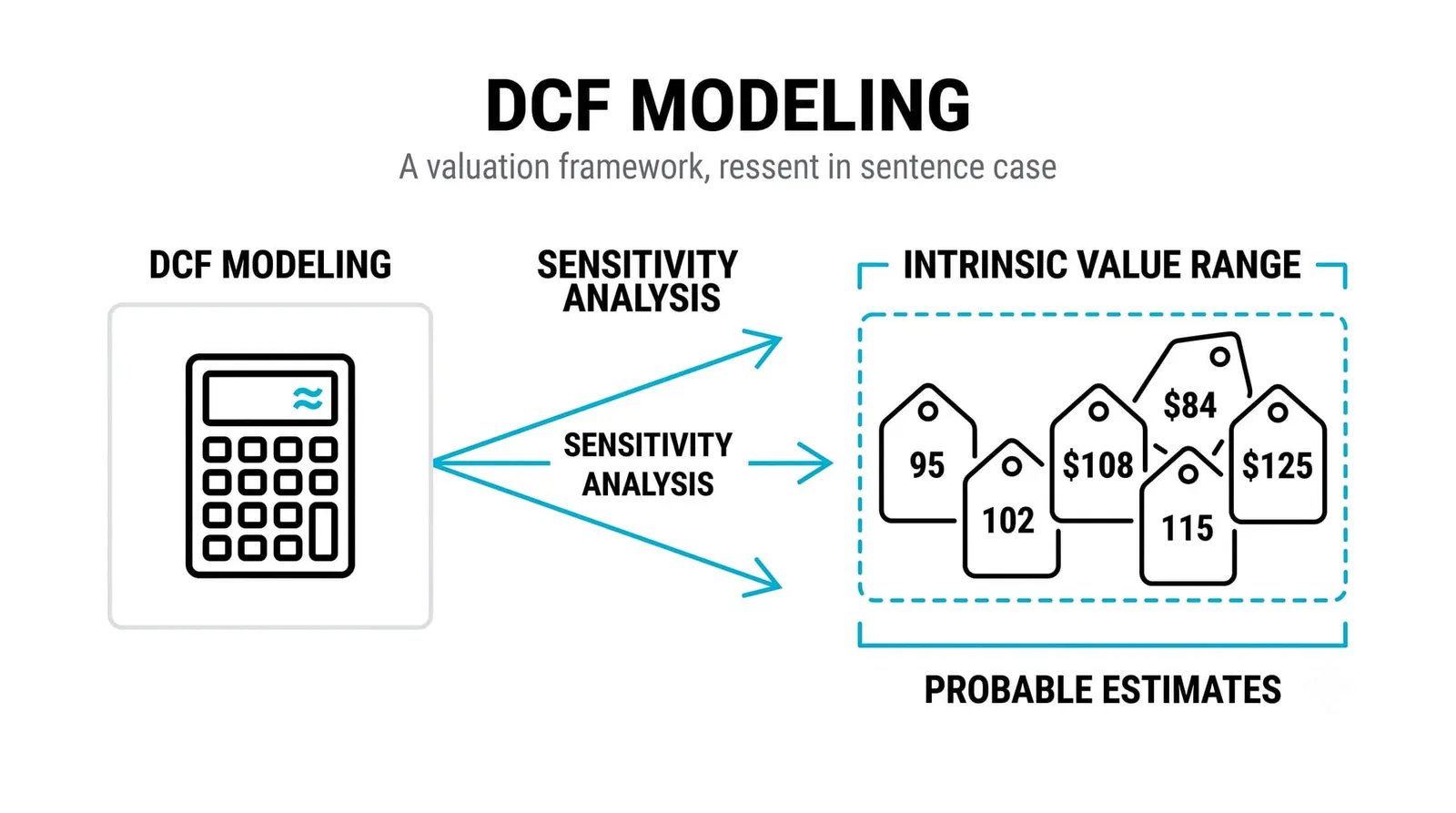
Small changes in assumptions produce big changes in the answer. Nudge the discount rate from 10 percent to 8 percent and a valuation can rise by a quarter or more. Extend the growth assumption by two years and it shifts again. The model amplifies its inputs.
So treat any DCF output with two decimal places as false precision. The math is exact. The inputs are not. A spreadsheet will happily divide a guess by a guess and hand you a result that looks like a measurement.
The real value of the exercise is the discipline. Building a DCF forces you to state, in numbers, what you believe about a company's growth, its risk, and the time you are willing to wait. Once those beliefs are on paper, you can argue with them, stress them, and compare them against the price the market is asking. That is what the model is for. The number it prints is a byproduct.
One Machine, Three Believers
Imagine a machine, purely hypothetical, that will generate exactly 100 per year for five years and then be worth nothing. No terminal value, no growth, no inflation twists. The only question is what that stream is worth today.
Three analysts look at the identical machine. The only thing they disagree on is the discount rate.
- An optimist sees a dependable machine in a stable setting and discounts at 8 percent. Discounting each year's 100 back at 8 percent and adding the five pieces gives a value of roughly 399.
- A cautious analyst uses 10 percent. Same cash flows, same machine. The five discounted pieces sum to roughly 379.
- A pessimist worries about breakdowns and competition and demands 15 percent. The machine is now worth roughly 335.
Same 100 per year. Same five years. Three values spread across a range of about 64, driven entirely by one input.
That spread tells you where valuation arguments actually live. Reasonable people rarely fight over what a solid business earned last year; that is in the filings. They fight over the discount rate, because the discount rate is a judgment about risk dressed up as a number. When you read two analysts with wildly different price targets on the same company, the gap is usually hiding there.
The table below lays out the moving parts of any DCF and how each one pushes the answer around.
| Component | What it is | How it moves the answer |
|---|---|---|
| Cash flow forecast | Year-by-year estimate of free cash flow | Higher forecasts raise the value, roughly in proportion |
| Discount rate | The rate shrinking future cash to today's terms | A lower rate lifts the value sharply; a higher rate compresses it |
| Terminal value | One number for all cash flows beyond the forecast | Often the largest single chunk; small assumption changes swing it hard |
| The discounting step | Dividing each future amount by (1 + rate) for each year out | Hits distant cash hardest, so long-dated hopes count for little |
The DCF Model, Answered
Do I need DCF to invest?
No. Plenty of investors never build one and rely on multiples, asset values, or simple business judgment instead. DCF is worth learning because it teaches you what every valuation method is secretly assuming about cash, risk, and time, even the quick ones.
Why do two analysts get different values for the same company?
Because the model's output is only as settled as its inputs, and the inputs are opinions. Different growth forecasts, different discount rates, and different terminal assumptions produce different answers from identical financial statements. The disagreement is information: it tells you exactly which beliefs separate the bulls from the bears.
What discount rate should I use?
There is no single correct rate. Common practice starts from a baseline return for tying money up, then adds a premium for the risk that the cash flows disappoint. Riskier, less predictable businesses get higher rates. The honest approach is to test several rates and see how much of your conclusion survives, rather than hunting for one perfect number.
What happens to a DCF when rates rise?
Rising interest rates push discount rates up across the board, and higher discount rates shrink every future cash flow. The effect is strongest on valuations built from distant cash, which is why long-duration growth stories tend to reprice hardest when rate expectations move. The cash flows did not change. The yardstick did.
You now have the second great family of valuation in your toolkit, built from cash, time, and the price of money. Next in this level, the documents underneath every number in this cluster: the income statement, walked line by line, from revenue down to the profit that EPS and P/E are built on.