Change of Character: the Earliest Warning
A change of character is the first break against the trend: price closing beyond the most recent swing point in the opposite direction of the prevailing sequence. It is not yet a reversal by the formal definition. It is the earliest piece of structural evidence that control may be changing hands, and it arrives before any textbook trend change can be declared.

Think of a metronome that slips a beat: the steady tick has not stopped, but the count no longer lands where it should, and anyone keeping time feels the wobble first. The trend still looks intact on the chart. The sequence of highs and lows still reads the old way. But one swing point just failed to hold, and that single failure is the wobble. The previous lesson covered the break of structure, the break that extends a trend and proves continued control. This lesson covers the same event pointed the other way: the first break against the sequence.
The Nearest Defense Breaks First
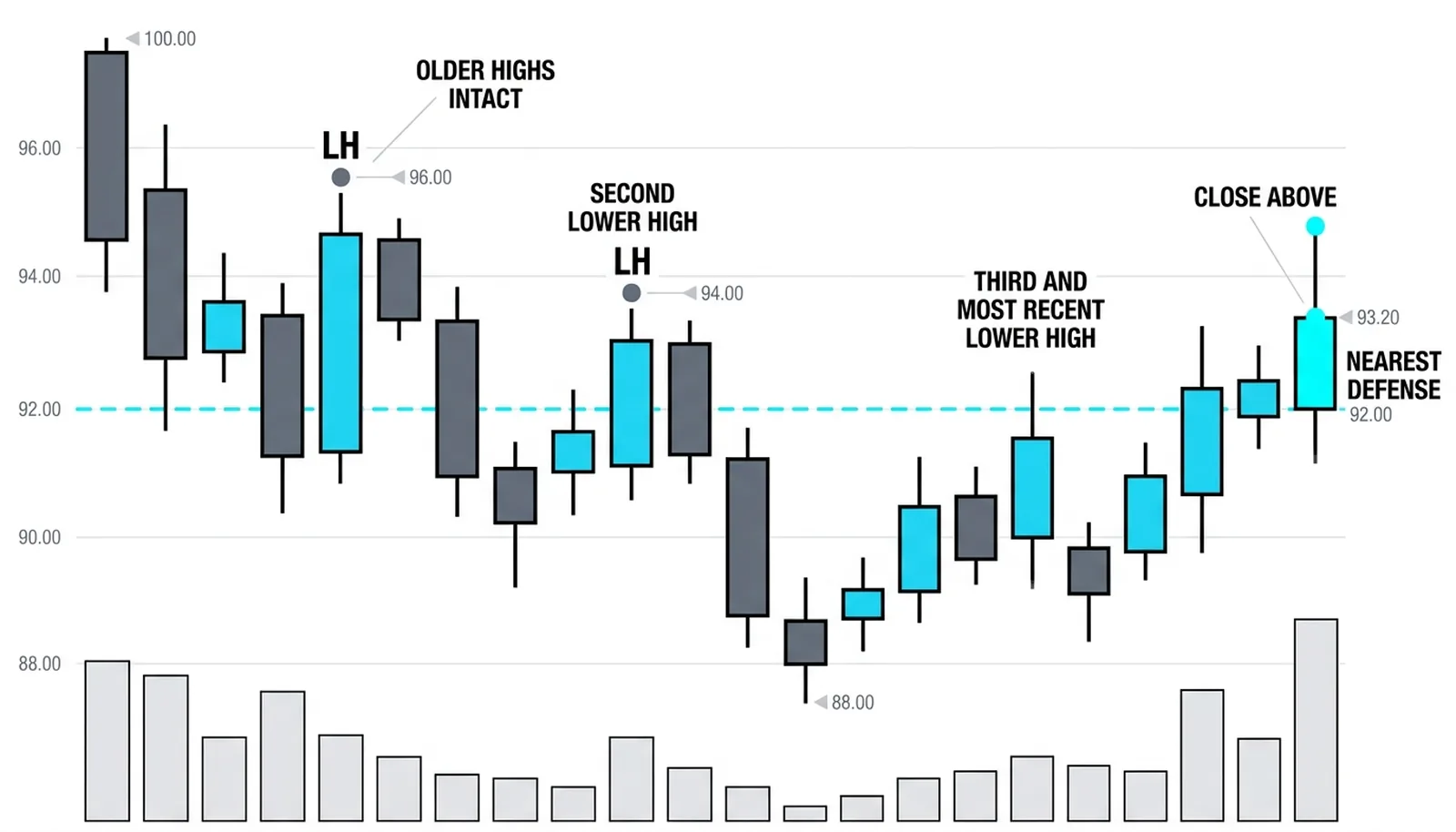
In a downtrend, price prints lower highs and lower lows. Each lower high is a place where sellers turned a rally back. The most recent lower high is the trend's nearest defense, the closest price where the side in control last proved itself.
A close above that level is the change of character. Not a wick through it, not an intraday poke. A close. The close matters because it means buyers held the gain through the bar's end rather than surrendering it back to sellers.
Why does this event come first? Because the formal definition of a trend change demands more. The price action canon defines a trend by the pattern of highs and lows together, and that label dies only when both break their pattern. A downtrend officially ends when price stops making lower lows and starts making higher highs. The first counter-break usually prints long before that full confirmation, which is precisely why traders watch it. It is the earliest evidence the sequence has stopped obeying.
The mirror works the same way in an uptrend. Price prints higher highs and higher lows. The most recent higher low is the last place buyers defended a dip. A close below that low is the change of character to the downside, the first hint that buyers no longer control the pullbacks.
One detail separates careful readers from careless ones: which swing counts. Use the most recent significant swing, the one the trend actually respected, not a minor wiggle inside a larger move. If the last rally in a downtrend topped at a clear lower high, that is the level. A tiny two-bar bump inside the decline is not.
Naming It Honestly
The phrase change of character comes from the modern practitioner world. Course creators, order-flow communities, and the smart-money vocabulary gave the event its current name and spread it widely.
The mechanism is far older than the name. The tape-reading framework describes the same moment as the break of the lower high that flips the always-in reading from short toward neutral or long. The price action framework frames it as the first failure of the trend's most recent swing. Wyckoff readers would recognize it inside their own vocabulary of preliminary signs. Different labels, same event: the nearest defense gave way.
No book owns this idea, and no community invented the behavior. Price has been failing at swing points since charts existed. What the modern name adds is convenience, a short handle for a moment every serious chart reader already tracked.
That honesty matters for how much trust the signal deserves. A catchy name can make an ordinary event sound like a secret. The event itself is ordinary: one swing point breaking earlier than the full reversal, with all the unreliability that earliness carries.
Trading the Warning, Not the Break
The warning is not the entry. That sentence deserves to stand alone.
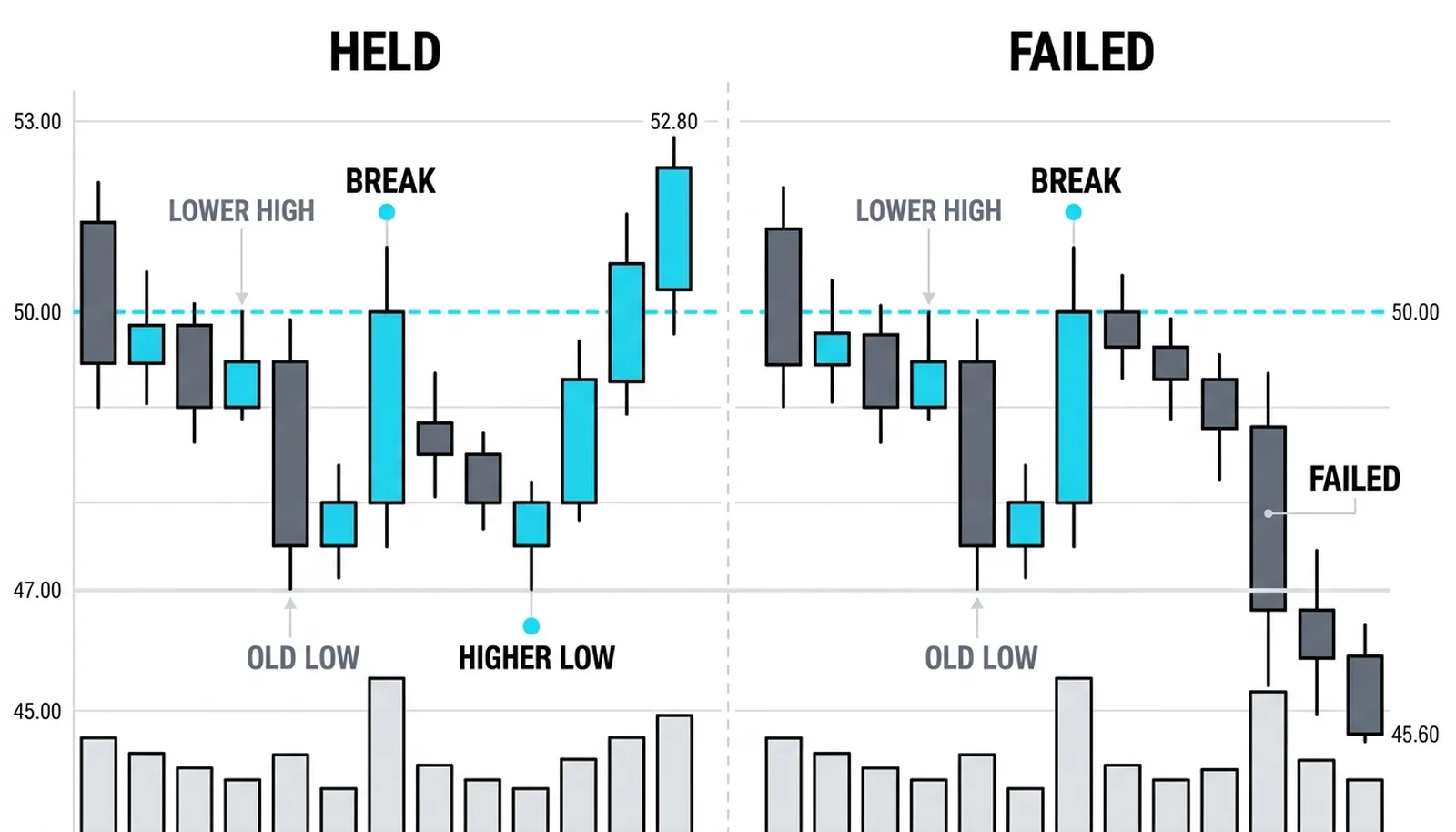
The disciplined sequence after a change of character is to wait for the test. The test is the pullback that follows the counter-break, the first dip after price closes above the old lower high. That pullback shows whether buyers can hold ground they just took.
The entry takes the first higher low the new attempt forms. Price pulls back, holds above the old low, and turns up. The trigger comes as the recovery pushes back through the short-term pivot the pullback created.
The stop sits below that pullback low, with a buffer. If buyers cannot hold the first higher low, the warning failed and there is no reason to stay.
The first target is the next piece of prior structure, the old lower high region where sellers last mattered. That zone is the nearest place supply previously appeared, so it is the logical first place to expect resistance.
The invalidation is just as clear. A close back below the broken level, or the old extreme low taken out, voids the warning entirely. The downtrend stands, and the character change gets filed as a failed attempt.
Now the cost. The earliest signal is also the least confirmed. Most first breaks against a trend get tested, and a good number fail outright. The change of character buys information earlier at the price of certainty later. The discipline that reconciles the two is smaller size on the first signal and a second look at the test before full commitment. Traders who treat every first break as a full reversal donate money to traders who wait one swing longer.
The Break Above 79.50
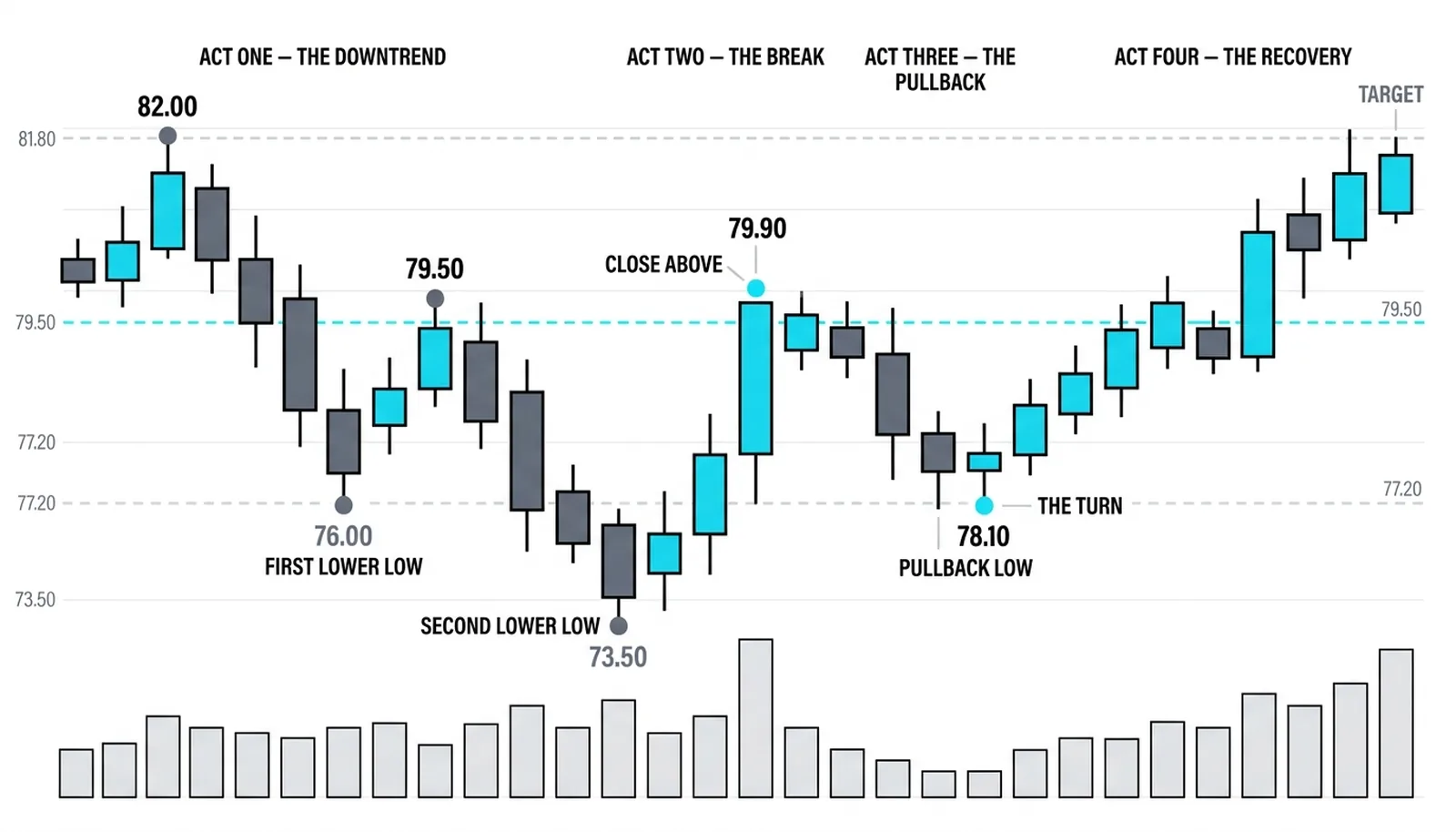
A hypothetical downtrend prints lower highs at 82.00 and then 79.50, with lower lows at 76.00 and then 73.50. Sellers remain in control; every rally dies lower than the last.
Price rallies and closes at 79.90, above the most recent lower high at 79.50. That close is the change of character. No long yet. The warning only.
Price pulls back to 78.10, holds well above the old low at 73.50, and turns up. The long triggers at 78.40 as the recovery pushes back through the short-term pivot. The stop sits at 77.20, below the pullback low with a buffer, risking 1.20. The target is the older lower high region at 81.80, for a gain of 3.40, about 2.8 times the risk.
The failed version: instead of holding, price rolls over and closes at 73.10, below the old low. The character change is void. The downtrend stands, and anyone who bought the break without waiting for the test holds a losing position inside a trend that never ended.
| Step | Price | The Signal | The Response |
|---|---|---|---|
| Counter-break | Close at 79.90 | Change of character above 79.50 | Mark the warning, no entry |
| The test | Pullback to 78.10 | Holds above old low at 73.50 | Watch for the turn up |
| The trigger | Entry at 78.40 | First higher low confirmed | Long, stop 77.20, target 81.80 |
| The failure | Close at 73.10 | Old low broken, warning void | No trade, downtrend intact |
Change of Character Questions, Answered
What is a change of character in trading?
A change of character is the first close beyond the most recent swing point against the trend: above the latest lower high in a downtrend, or below the latest higher low in an uptrend. It is the earliest structural evidence that the current sequence has stopped obeying, arriving before any formal trend change can be declared.
Is a change of character the same as a reversal?
No. A reversal requires the full pattern of highs and lows to flip, while a change of character is only the first counter-break against one swing point. Many changes of character fail and the original trend resumes, so the event is a warning, not a confirmed reversal.
Why wait for the pullback after a change of character?
Because the first break against a trend is the least confirmed signal on the chart, and the pullback tests whether the new side can hold the ground it took. The pullback that holds above the old extreme and forms a higher low converts a raw warning into a tradeable setup with a defined stop.
What confirms that the character change is real?
Confirmation comes from the test: a pullback that holds above the old low and turns up, followed by price pushing beyond the counter-break high. Failure shows up as a close back below the broken level or the old extreme taken out, which voids the warning and leaves the original trend in control.
The next lesson steps back one level and shows how breaks of structure and changes of character combine into a single running read of the chart, so each new swing updates the bias instead of being judged alone.