Shallow Retracements: 23.6 and 38.2
Shallow retracements are pullbacks that surrender less than half of the prior leg, stalling at or above the 23.6 and 38.2 percent lines before the trend resumes. What it signals is strength. A trend whose pullbacks stay shallow is a trend nobody was offered at a discount, because the buyers who missed the first leg refuse to wait for a better price and step in early, again and again, before the decline can reach the deeper lines where most textbooks say reactions belong.

Think of a spring pressed lightly: the coils barely engage, and the push back arrives almost as quickly as the press. That is the shallow pullback in one image. The counter-move never gathers enough weight to matter, and the original direction reasserts itself before the correction can develop into anything worth fearing. The golden-zone lesson covered the opposite end of this family, the deep band where reactions cluster and corrections become the story. This lesson stays at the near end, where corrections stay short and the trend's strength shows first.
What Shallow Depth Says About Strength
Depth is information. Every pullback is a test of how much selling the trend can absorb, and a shallow pullback is a test the sellers failed almost immediately. The counter-move barely gets started before resting buyers absorb it, which tells you the urgency sits on the buying side.
The price action canon states it directly: the strongest trends retrace least. Brief pullbacks are the signature of strength, and the trader who learns to buy them early enters where the crowd is still waiting for a discount that never comes. That waiting crowd powers the whole pattern. Each shallow dip leaves another group unfilled, and their resting orders sit just below, ready to catch the next dip even higher.
This is why shallow retracements cluster in strong trends rather than appearing randomly. The discount-hunters build a base that keeps rising. Sellers take profits, price dips a fraction of the leg, the unfilled buyers pounce, and the sequence repeats. The pullback's shallowness is not a detail. It is the trend confessing how one-sided the pressure is.
The honest counterweight: a shallow dip can also mean apathy, a quiet drift rather than aggressive buying. Depth alone never proves strength. The turn off the shallow line has to show momentum behind it, or the reading is a guess.
The Two Shallow Lines
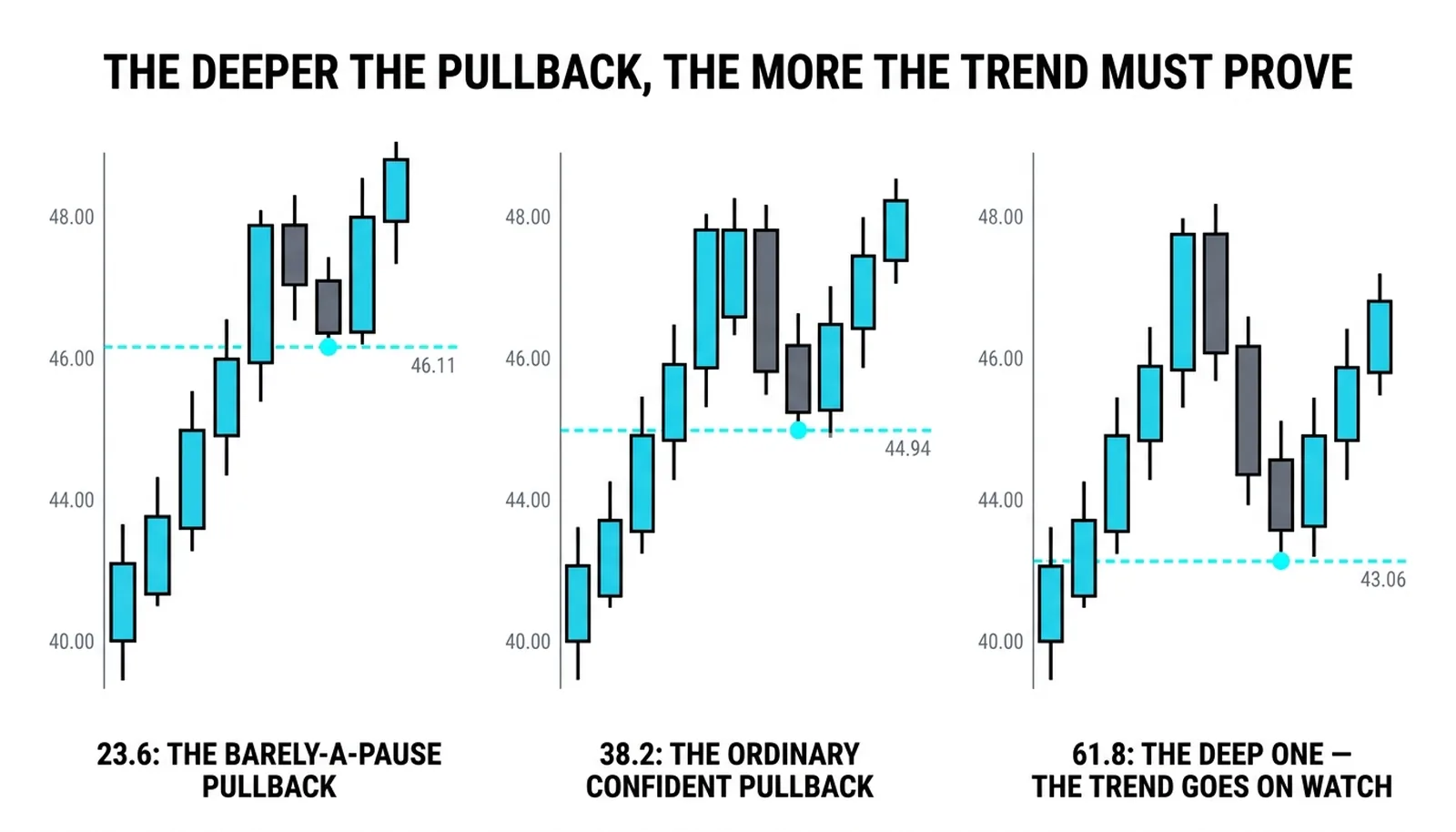
The 23.6 line is the barely-a-pause level. It marks a pullback so brief that it belongs to trend days and vertical moves, the kind of dip that lasts a few candles and offers almost no time to decide. Anyone waiting for the tool's deeper lines on such a move is simply not filled. The trade leaves without them.
The 38.2 line is the ordinary confident pullback. It is deep enough to shake out the impatient, the traders who bought late and flinch at the first red candles, and shallow enough that the trend itself is never in question. Most healthy continuation entries in a strong trend happen between these two lines, and the zone between them is where shallow-retracement trading actually lives.
Who watches these lines? Fewer participants than at the deep band, and that matters. The 50 and 61.8 levels attract the crowd, the algorithms, and the textbook orders. The shallow lines attract continuation traders, breakout chasers, and momentum systems. Thinner attention means thinner reactions, which is a real cost and belongs in the honest telling later in this lesson.
Fibonacci cluster practice grades corrections by exactly this depth in the symmetry work: a shallow correction sets the expectation that the trend's next leg carries the strength forward, and the projection of the next leg is built off that assumption. Depth is more than a description of the past. It is an input into what you expect next.
Trading the Shallow Pullback
The trade is a continuation bet on a tight leash. You are buying strength, not value, and everything about the trade's construction follows from that choice.
- The stop is tight because the pullback is small. That cuts both ways. A tight stop improves the reward-to-risk arithmetic, but it also sits close enough to be clipped by ordinary noise. Place it below the pullback's low, not below some round number of your own invention.
- Momentum must confirm the turn. A shallow dip gives the level less room to do the work alone. You need to see the turn actually happen: a strong reversal candle, a momentum shift, buyers visibly stepping in. Buying the line blind is a weaker version of this trade.
- Reactions at shallow lines are thinner and more fragile. Fewer resting orders means less structural support. The level can be sliced through without ceremony, which is why the confirmation requirement exists.
- The multiple is smaller, and that is the honest price. Entering higher and stopping tighter usually yields a smaller reward-to-risk than a deep-band entry. You are paying for a higher-probability continuation with a modest payout. That trade-off is fair, but say it to yourself plainly.
The read dies fast, and that is a feature. A shallow-retracement trade either works quickly or the premise is wrong. If price closes below the 38.2 line, the strength story on that leg is over. Do not widen the stop and hope. The watch hands to the deep band, where the correction itself becomes the story and a different lesson applies.
The Turn at 46.10
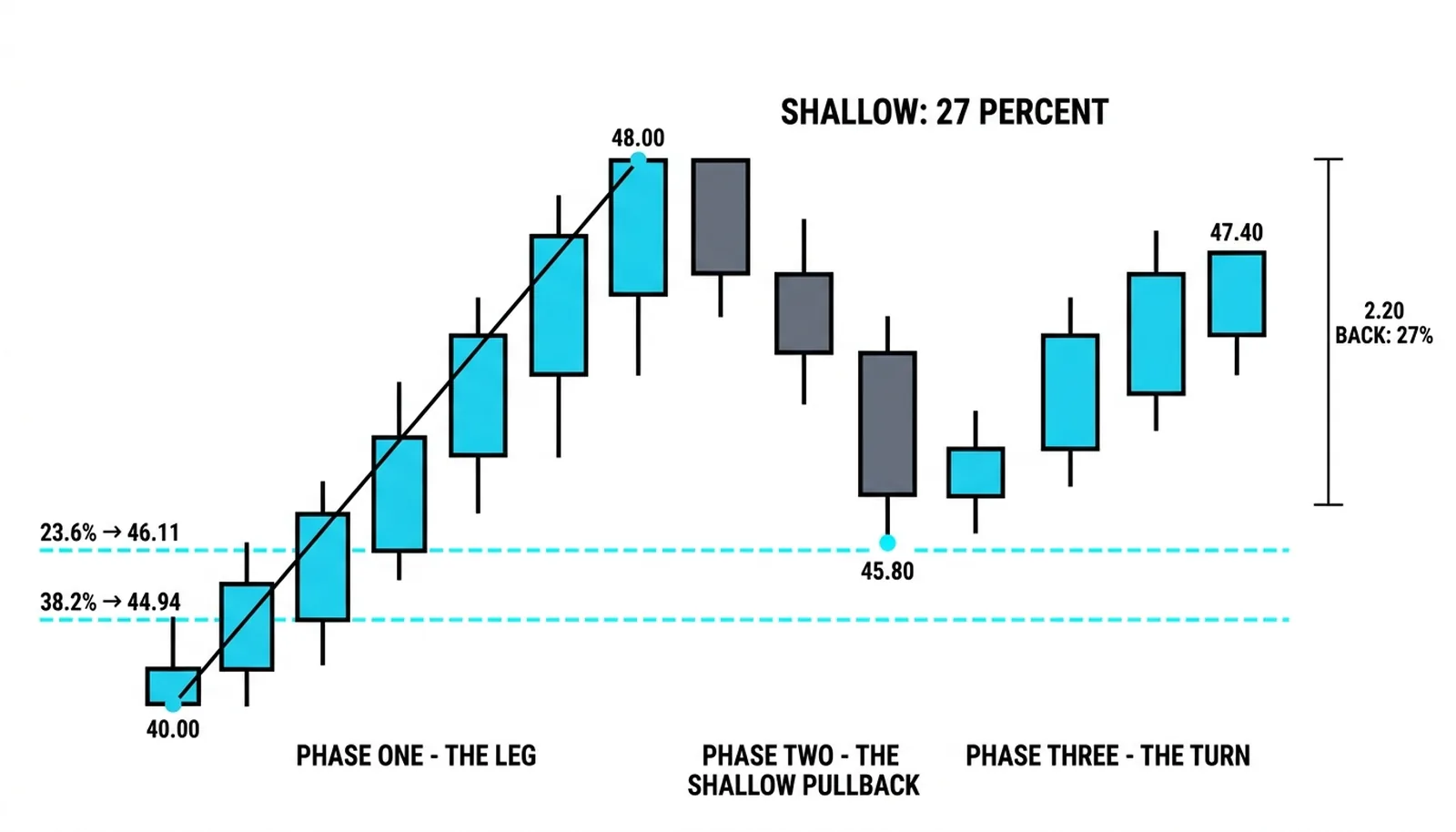
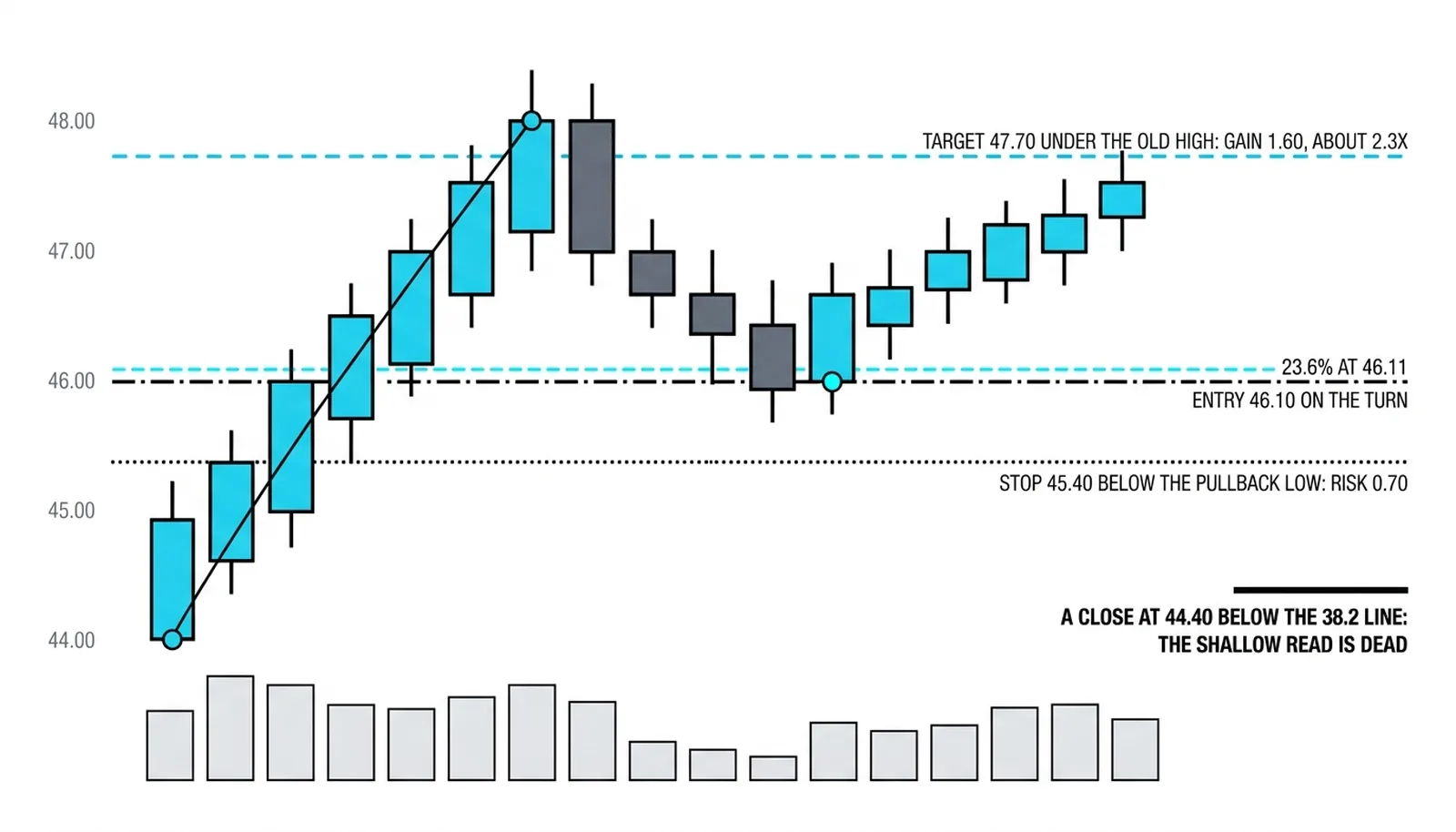
Here is the full trade with round numbers, all hypothetical. A leg runs 8.00 points, from 40.00 up to 48.00. Anchoring the tool on that leg, the 23.6 line sits at 46.11 and the 38.2 line at 44.94.
Price pulls back to 45.80, a dip that lands between the two shallow lines, and turns with a strong close back upward. The long is taken at 46.10, just under the 23.6 line, once the turn confirms. The stop goes at 45.40, below the pullback's low, risking 0.70 per unit.
The first target is 47.70, just under the old high at 48.00. That is a gain of 1.60 against a risk of 0.70, roughly 2.3 times the risk. Respectable, not spectacular. That is the shallow trade's honest shape: a modest multiple on a continuation that was never seriously threatened.
Now the failed version. Instead of turning at 45.80, price keeps sliding and closes at 44.40, below the 38.2 line at 44.94. The shallow read is dead. The strength story on that leg is finished, and the watch hands to the deep band near 43.06, the 61.8 region, where the correction itself becomes the question. Anyone still holding the 46.10 long through that close is trading hope, not a level.
| Depth reached | Line | Strength read | Response |
|---|---|---|---|
| Barely a pause | 23.6 | Extreme strength; trend-day behavior | Enter on the turn or accept missing it |
| Confident pullback | 38.2 | Healthy strength; normal continuation | Buy the confirmed turn, tight stop below |
| Close below 38.2 | Below 44.94 in the example | Shallow story dead | Stand down; hand the watch to the deep band |
| Deep band near 61.8 | Near 43.06 in the example | Trend on trial; correction is the story | Reassess with the golden-zone framework |
Shallow Retracement Questions, Answered
What is a shallow retracement?
A shallow retracement is a pullback that surrenders less than half of the prior leg, stalling at or above the 23.6 or 38.2 percent lines before the trend resumes. It is the short end of the correction family, the opposite of the deep golden-zone band.
What does the 23.6 retracement level mean?
It marks a barely-a-pause pullback, the kind of dip seen on trend days and vertical moves. A move that holds the 23.6 line is telling you buyers are so urgent that the counter-move never develops, and anyone waiting for deeper levels simply does not get filled.
Are shallow pullbacks a sign of strength?
Yes, with one condition. Shallow depth shows that resting buyers keep absorbing the selling early, which is the signature of a strong trend. The condition is that the turn off the line must show real momentum, because a shallow drift can also reflect indifference rather than aggression.
When does a shallow retracement fail?
It fails when price closes below the 38.2 line. That close ends the strength story on that leg, and the correct response is to stand down and hand the analysis to the deep band, where the correction itself becomes the question under study.
The next lesson moves to the far end of the family, the deep lines at 61.8 and 78.6, where the pullback surrenders most of the leg and the trend stops getting the benefit of the doubt.