The Crab: Structure and Trading Rules
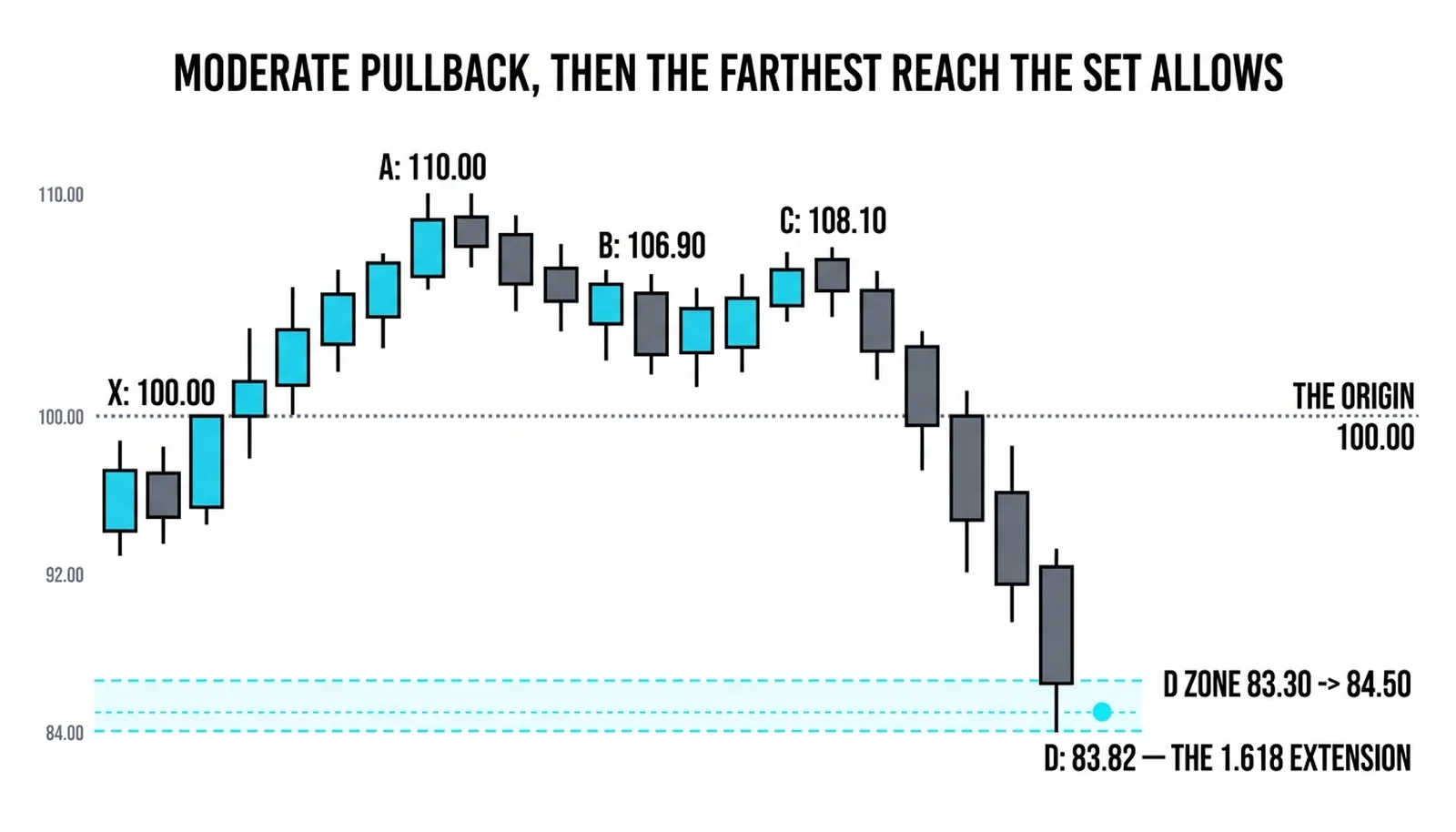
The crab pattern is the harmonic whose structure reaches the deepest extension in the family, with its final point landing on the 1.618 extension of the first swing. Where the other patterns complete at levels inside or just past the origin, the crab demands that price run through the origin entirely and keep going, out to a mark more than half again the size of the original move. That single requirement defines everything about the pattern: its shape, its rarity, its reward, and its difficulty.

Think of the end of a diving board: the farthest point from solid ground, the smallest platform on the whole structure, a place reached only one way and left only one way. The D point of the crab sits at that tip. Price has traveled the full length of the board, past the supports, and the zone where the structure can still hold is narrow. The earlier extension lessons taught the general idea of targets beyond the old swing; this lesson trades the extreme case, the pullback that returns through the origin and out the other side to the deepest mark the set allows.
The Deepest Pattern in the Set
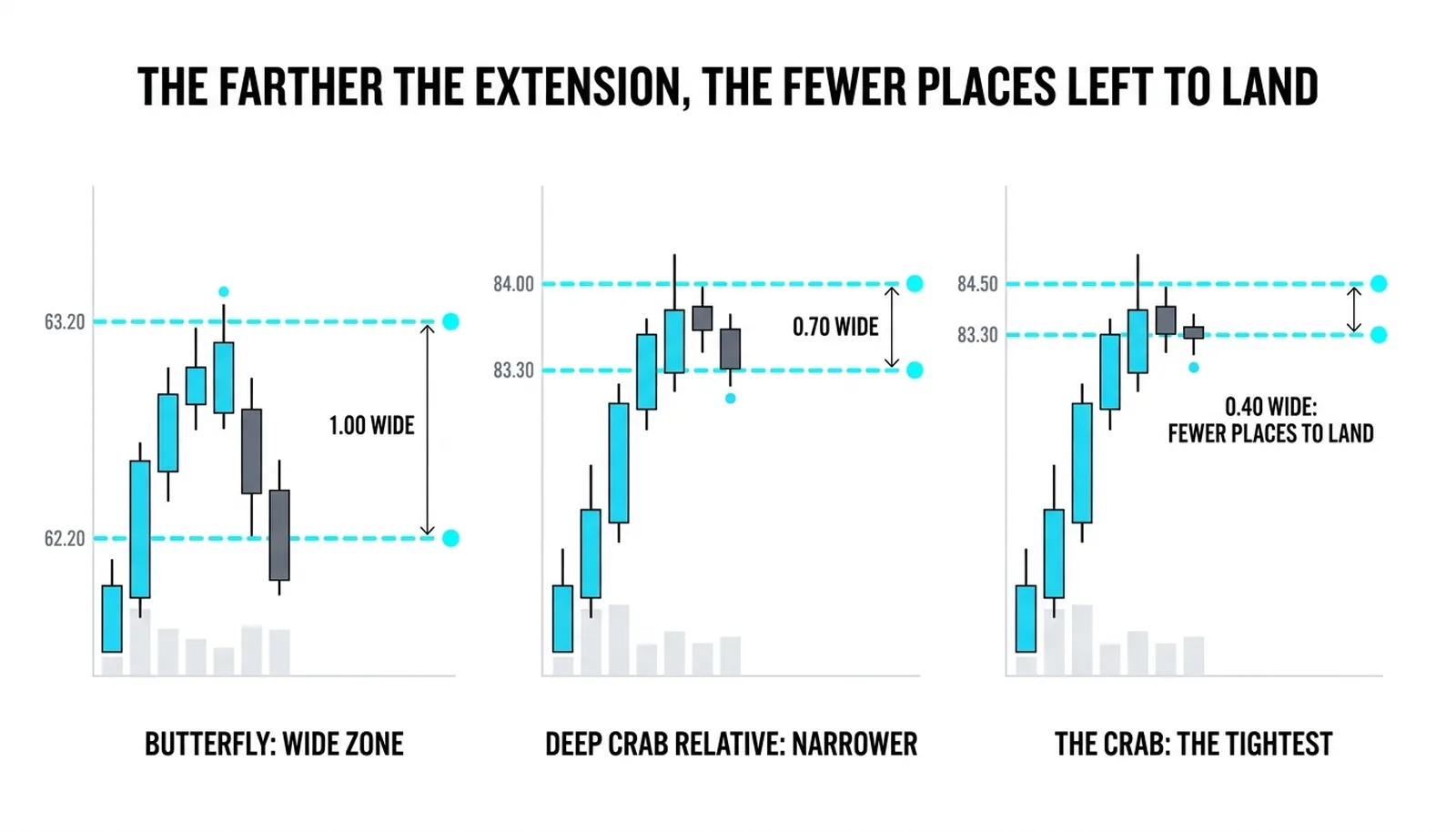
Harmonic trading doctrine treats the crab as the precision instrument of the harmonic family, and the reason is mechanical. The D point must land on the 1.618 extension of XA. Deep extensions leave the smallest margin. A market that has run past its origin by more than half the original swing has very few places left to go, so the zone where the measurements agree is tight.
The gates that build the structure are specific. The B point sits between the 38.2 and 61.8 percent retracement of XA, a moderate pullback. The C point commonly retraces near 61.8 percent of the AB leg. The BC projection runs deep, between 2.618 and 3.618. An AB equals CD structure, with a 1.618 variant, completes the cluster at the same region the XA extension marks.
That confluence is the point. Several independent measurements, each derived from a different leg of the move, must land in the same narrow band. When they do, the zone carries more weight than any single ratio would on its own. When they do not, there is no pattern, and the honest response is to skip the trade.
A pattern that fails its ratios is not a pattern. It is a drawing.
Precision at the Extreme
The payoff for that tight zone is the widest first target in the block. Because D sits so deep, even a modest recovery, the standard 38.2 percent retracement of the A-to-D leg, covers a large distance in price terms. The stop, placed just beyond the zone, is small by comparison. The reward-to-risk that results is the largest of any pattern covered so far.
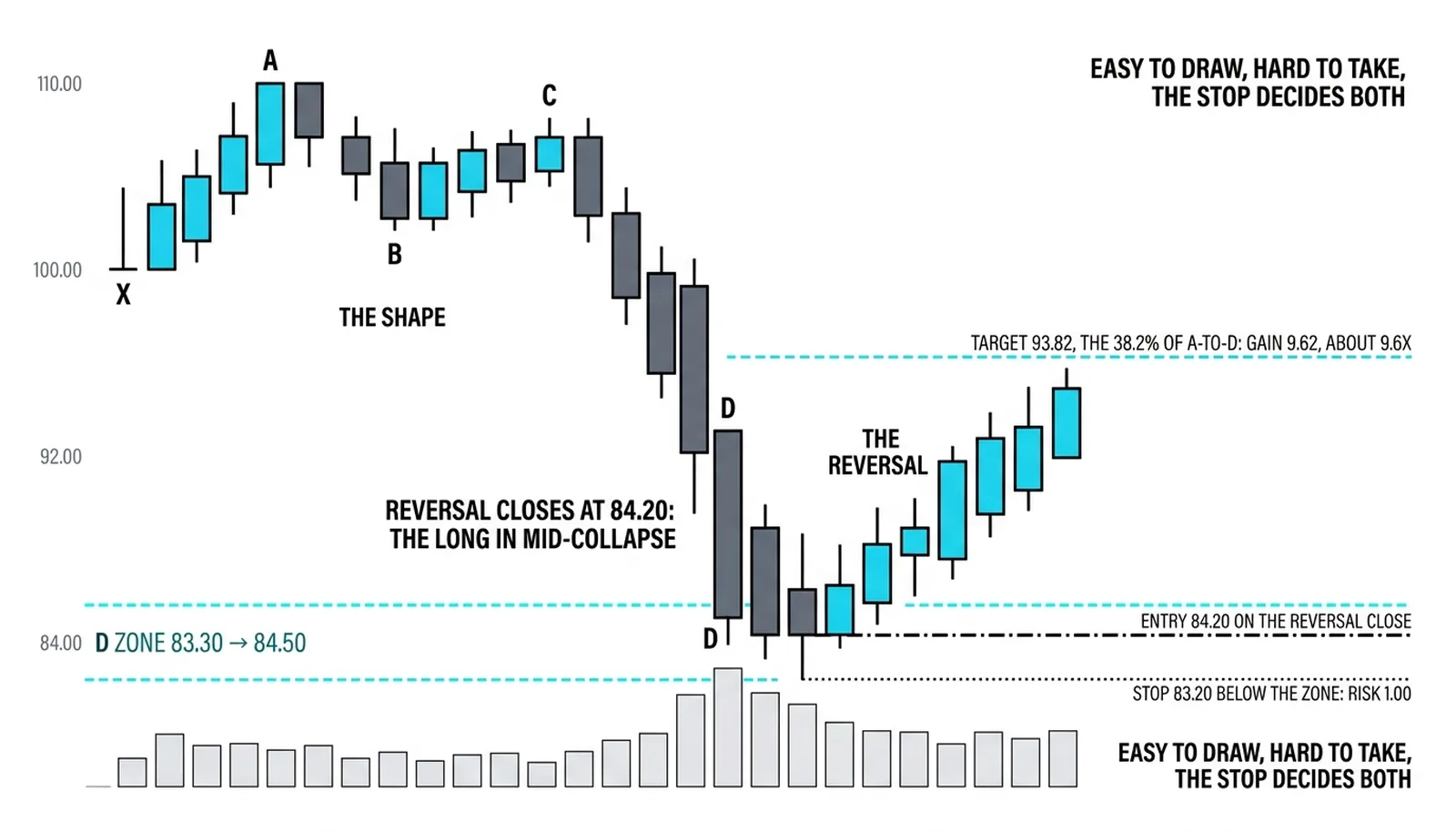
The cost is discomfort. A market reaching the 1.618 extension has fallen past every level the ordinary retracement work respects. Buying there means buying in mid-collapse. Selling there means selling in mid-blowoff. The drawdown against the position, before the turn confirms, is the most uncomfortable in the set, and the pattern is easy to draw and hard to take.
That is the trade's real filter. The ratios select the zone. The trader's ability to act against every easy signal, and to accept the stop without argument when the zone fails, is what converts the geometry into a result.
The Low at 83.82
Here is a hypothetical bullish crab with round numbers. The swing runs from X at 100.00 up to A at 110.00, a ten-point leg. B pulls back to 106.18, a 38.2 percent retracement. C rallies to 108.54, a 61.8 percent retrace of the AB leg. Then price declines through the origin and keeps falling, down to D at 83.82, the 1.618 extension of XA measured below it.
| Point | Leg It Ends | Defining Ratio | Example Price |
|---|---|---|---|
| X | Origin of the structure | Starting reference | 100.00 |
| A | XA swing | First swing high | 110.00 |
| B | AB retracement | 38.2 to 61.8 percent of XA | 106.18 |
| C | BC rally | Near 61.8 percent of AB | 108.54 |
| D | CD decline | 1.618 extension of XA | 83.82 |
The trade waits for confirmation rather than catching the low blind. A reversal candle closes at 84.20, just above the zone, and the long is taken there. The stop sits at 83.20, below the zone, risking 1.00 per unit. The first target is 93.82, the 38.2 percent retracement of the A-to-D leg. That is a gain of 9.62 against 1.00 of risk, roughly 9.6 times the amount at stake.
No other pattern in the set offers that ratio on its first target. None asks as much in exchange, either.
That ratio does its work only across many attempts. A pattern completed once proves nothing, and a pattern traded ten times with the stop moved once by hand gives back everything the wide multiple earned. The sizing follows from the stop: 1.00 of risk per unit can be sized up or down to a fixed dollar risk, and the fixed dollar risk is what survives the losing runs that a deep-extension pattern inevitably supplies. The 9.6 times is the average's raw material, never a promise about any single trade.
The failed version is simple to define. A close at 83.00, below the zone, voids the pattern. The harder truth arrives before any trade: a market at 83.82 has fallen past every level the retracement work respects, and the pattern asks the trader to buy exactly where every easy signal says the market is broken. The discipline that pays is the same discipline that drew the zone. The 1.618 line is the argument, and the close below 83.00 is the refutation. Both are written down before the entry, not negotiated after.
Crab Questions, Answered
What is the crab pattern?
The crab is a harmonic reversal pattern whose final point completes on the 1.618 extension of the initial XA swing, the deepest extension in the harmonic set. It was defined within harmonic trading doctrine, and its identity rests on that single extreme measurement supported by a deep BC projection and a moderate B-point retracement.
Why is the crab considered precise?
Because deep extensions leave the smallest margin. When price has run past its origin by more than half the original swing, very few valid completion zones remain, so the area where the XA extension, the BC projection, and the AB equals CD variant all agree is narrow. Tight agreement among independent measurements is what precision means in this context.
What is the 1.618 extension?
It is a projection of the XA leg's full length, multiplied by 1.618 and measured from the far side of the structure. In the worked example, the ten-point XA leg projects 16.18 points beyond A's opposite extreme, placing D at 83.82. The level is fixed by arithmetic, not by opinion, which is what makes it testable.
Is the crab harder to trade than other harmonics?
Yes, and the difficulty is psychological rather than technical. The entry requires buying a market in mid-collapse or selling one in mid-blowoff, at a point where every simpler signal says the move is broken. The drawdown against the position before confirmation is the most uncomfortable in the set, and many traders who draw the zone correctly still cannot take the trade.
The crab closes the named structures in this block. What remains is the skill that ties all of them together: turning a zone of lines into a managed trade, with the entry, stop, targets, and invalidation written before the market gets there. That checklist is the next lesson, and it applies to every pattern covered so far.