Break-Even Stops: What the Move Really Costs
A break-even stop is a stop-loss order moved from its original level up to your entry price, so the worst case on a live trade is no longer a loss. You remove the risk below entry. In exchange, you accept a much higher chance of being stopped out of the trade for nothing. That trade-off is the whole subject, and most traders only ever think about the first half of it.

What the Move Actually Is
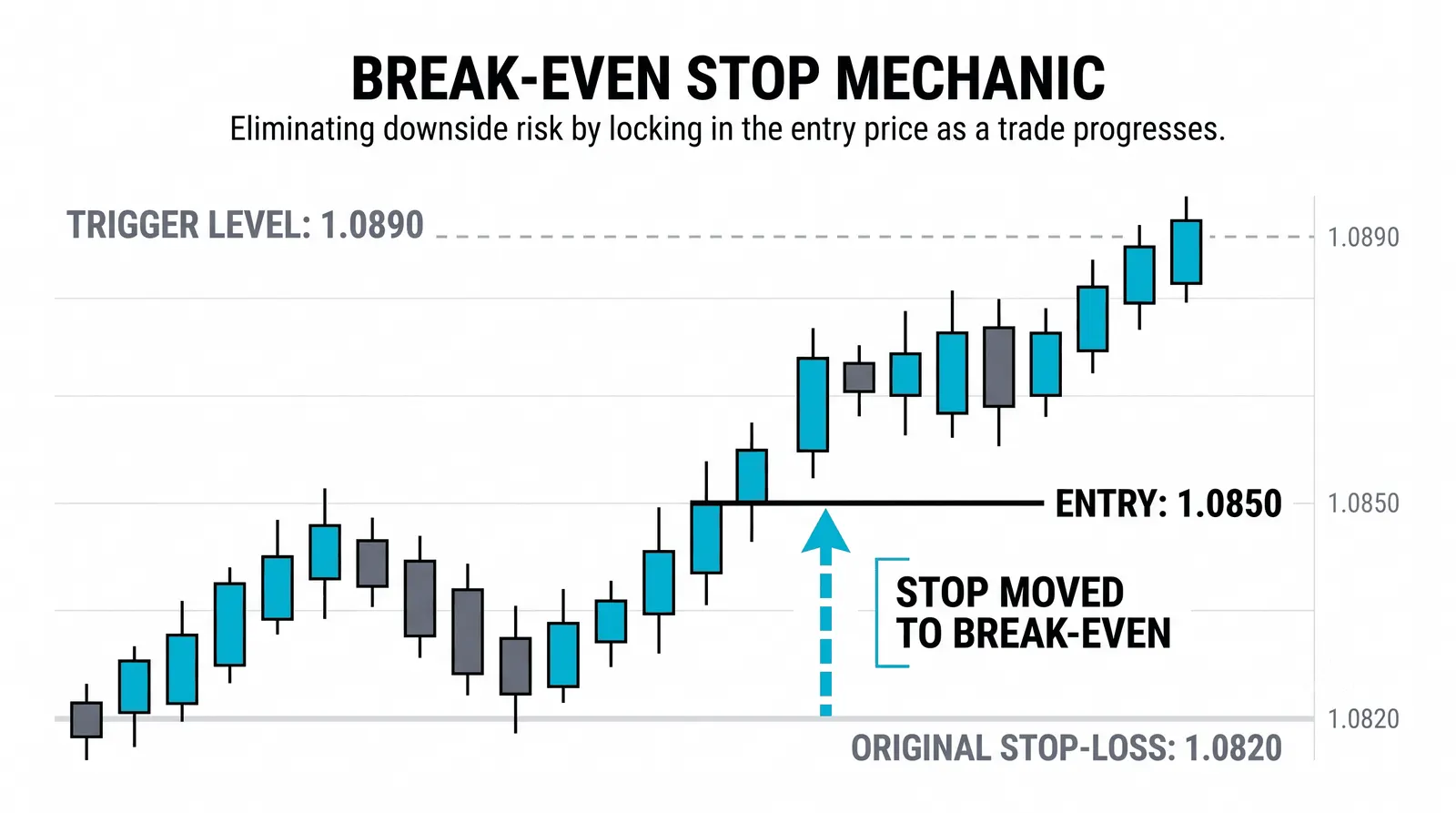
Your original stop sits one unit of risk below entry. That distance was chosen for a reason: it marks the price where your trade idea is wrong. When you move the stop to entry, the position stays open, but the worst case changes from minus the full risk to roughly zero, minus costs.
Nothing about the market changed when you clicked that button. Only your exposure did.
Treat the move as a new decision about a new position. You are effectively closing a trade with one risk profile and opening a different one with a free look at the upside. It deserves the same deliberation as the entry did, not a reflex click the moment price ticks in your favor.
What It Gives and What It Takes
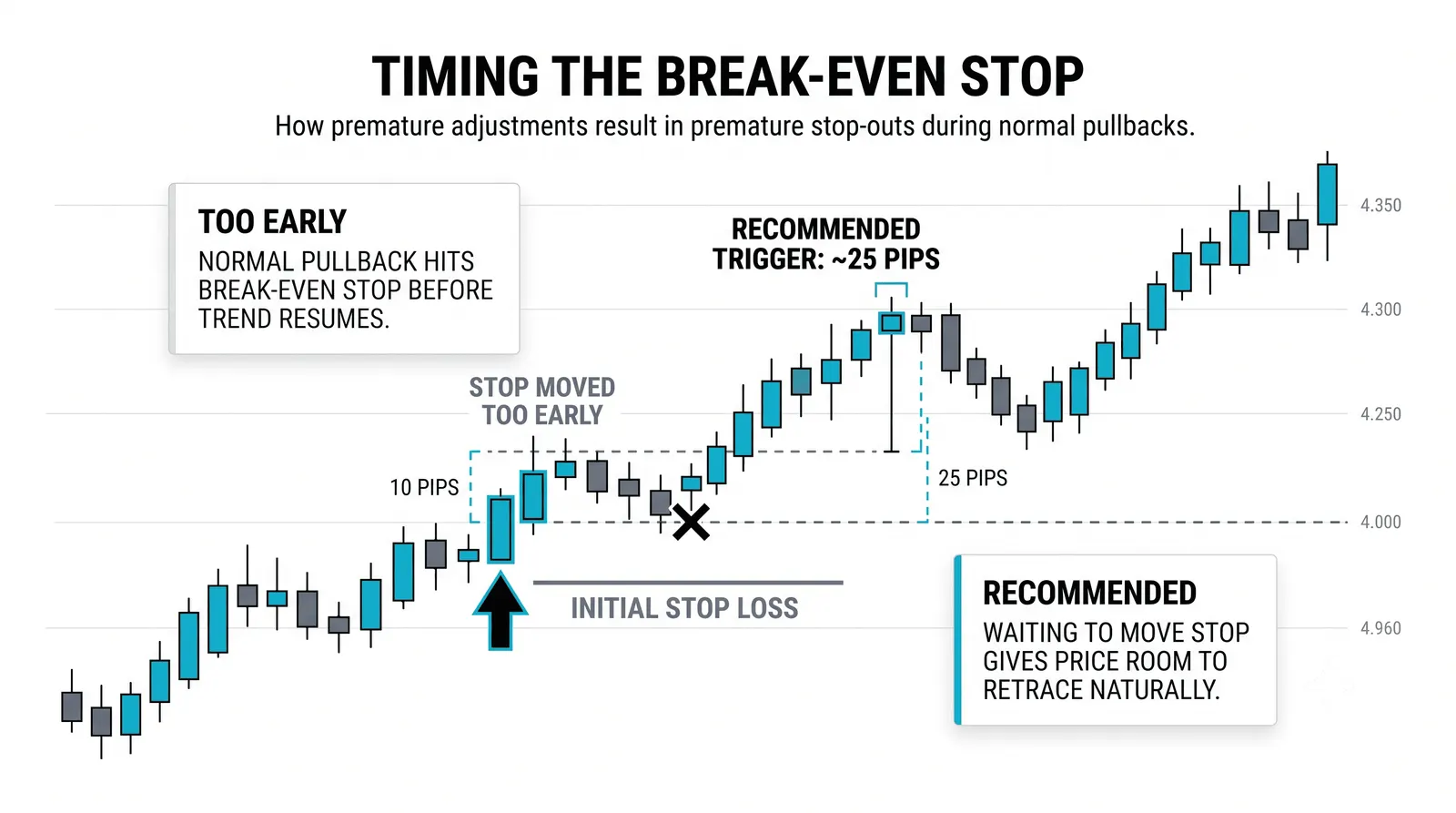
The move gives you three real things. From the moment of the move, that trade cannot lose. Strings of break-even exits genuinely reduce drawdown compared to strings of full losses. And the psychological relief is real: watching a winner come back through your entry and stop you at a loss is one of the more corrosive experiences in trading.
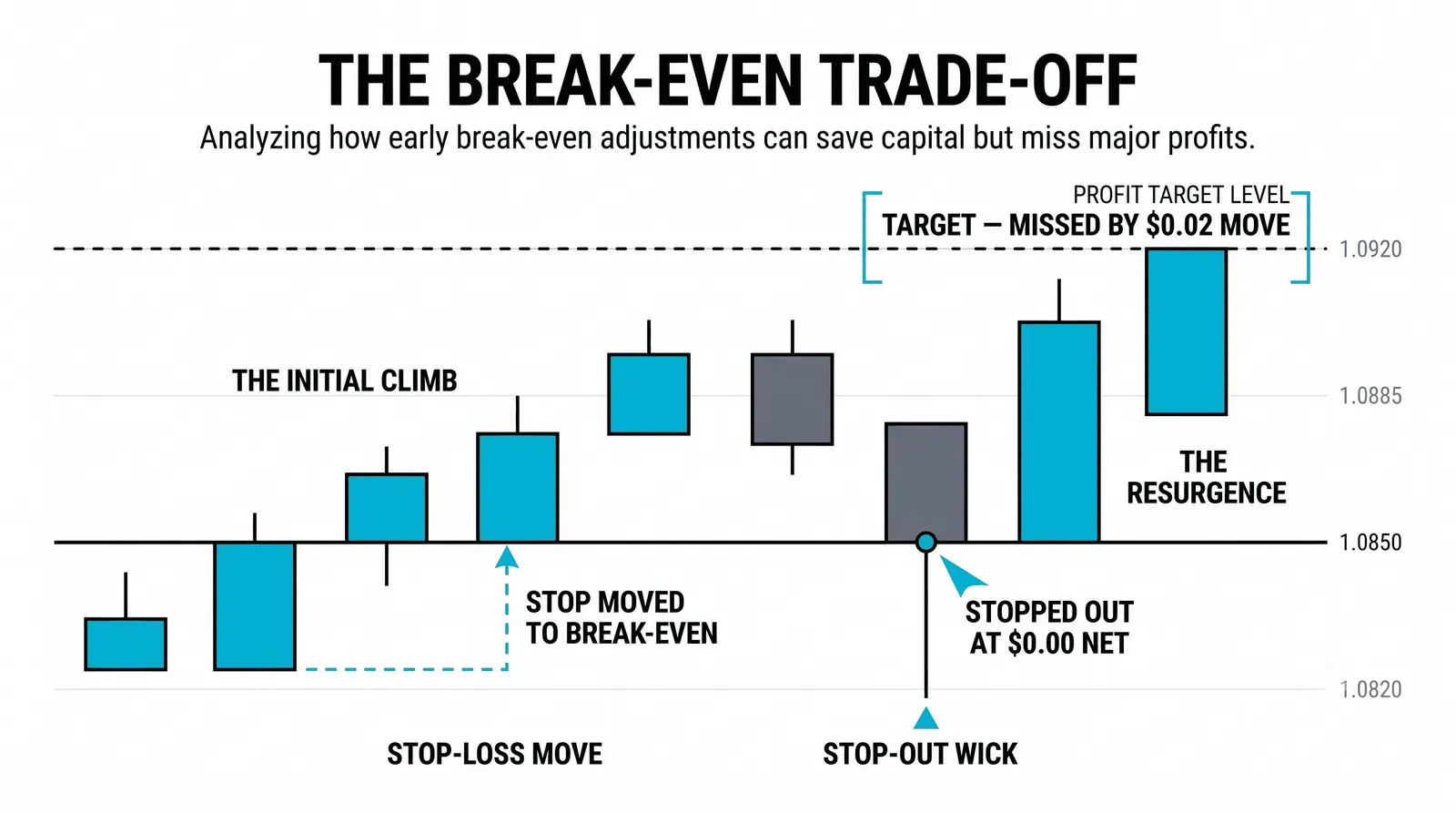
Here is what it takes. Ordinary pullbacks that would have survived your original stop now kill the trade at entry. Your win rate drops, often sharply, because trades that needed room to breathe no longer get it. And the zeros are not free. You paid the spread and commission on every one of them, and you spent time and attention managing a position that returned nothing.
Moving a stop to break-even is buying insurance: the premium is paid in trades that get rescued for nothing. Some traders happily pay that premium. Others would rather keep the full risk and the fuller upside. Neither is wrong. Paying the premium without knowing its price is the only actual mistake.
Why the Zeros Feel So Bad
A string of break-even exits reads as failure. You were right about direction, the trade moved your way, and you got nothing. After five of those in a row, the policy feels broken even when it is doing exactly what it was designed to do.
Memory is a terrible accountant here. Your brain weights the near-misses heavily and forgets the quiet disasters the policy prevented. Only a written scoreboard can tell you whether the policy pays. Log every trade, note whether the stop was moved and when, and review the totals after fifty or a hundred trades. The numbers will settle an argument your feelings cannot.
When It Earns Its Keep
There are situations where the move is clearly justified:
- A scheduled news event that could gap price straight through your original stop, turning a controlled loss into a large one.
- The session is ending and you will not be watching. An unmanaged full-risk position overnight is a different bet than the one you placed.
- The structure broke. The reason for the trade is gone, but price has not yet hit your stop. Moving to break-even, or simply exiting, respects the fact that the trade's logic is dead.
And there are situations where it reliably hurts you:
- The first normal pullback in a trend-following approach. Trends breathe. A stop at entry cannot survive the breathing.
- Wide-ranging, noisy markets. If the average swing is larger than the distance from price to your entry, the break-even stop sits inside the noise and will be hit by accident.
- Any fixed rule applied for no reason except that zeros feel safer than losses. Comfort is not an edge.
A Worked Example With Round Numbers
Imagine a hypothetical trader running 100 trades, each risking 100 to make 300. Two stop policies, same entries, same exits on winners.
Policy A: never move the stop. 40 winners pay 12,000. 60 losers cost 6,000. Net result: +6,000.
Policy B: move the stop to break-even whenever the trade reaches +100. Now the outcomes split. 30 winners run clean to +300 and pay 9,000. 10 winners touch +100 first, pull back, and die at entry for 0. Of the losers, 40 stop at the original level for -4,000, and 20 touch +100 first and die at entry for 0. Net result: +5,000.
Policy B traded 1,000 of profit for a smoother ride and fewer red days. Some traders would take that deal every time. Others would call it an expensive way to feel calm. The point is not which policy wins in the abstract. The point is to choose one with numbers like these instead of with fear.
Comparing the Policies Side by Side
| Stop policy | Worst case on a trade | Typical win rate | Typical effect on results |
|---|---|---|---|
| Static stop, never moved | Full original risk | Highest of the three | Best raw expectancy, deepest drawdowns |
| Break-even after +1R | Roughly zero minus costs | Drops noticeably | Smoother equity curve, lower total profit |
| Break-even after structure breaks | Roughly zero minus costs | Drops modestly | Small cost, exits trades whose logic is dead |
Notice the pattern. The more mechanically you move the stop, the more win rate you surrender. The more the move is tied to a real change in the trade, the less it costs you.
Questions About Break-Even Stops
When should I move my stop to break-even?
Move it when something real changes: a news event ahead, the end of your watching hours, or the breakdown of the structure that justified the trade. Do not move it just because price ticked a fixed distance in your favor. A trigger like "+1R" is only sensible if you have tested what it does to your results over a large sample.
Why does my break-even stop keep getting hit?
Because your entry price sits inside the market's normal noise. Pullbacks of one unit of risk or more are routine in most instruments, and a stop at entry cannot survive any of them. If this keeps happening, either move the trigger further out, wait for structure to shift before moving, or accept that your approach needs the original stop to stay put.
Does moving to break-even improve my win rate?
No, it lowers it. Trades that would have pulled back and then continued to your target now close at zero instead of at a profit. What improves is the count of losing trades, because some losers become zeros. Whether that swap helps your bottom line depends entirely on your numbers, which is why the written record matters more than the feeling.
Is trading at break-even free?
No. You pay the spread and commission on every break-even exit, you give back the winners the move killed early, and you spend attention managing positions that return nothing. The zeros feel free because no money leaves the account on that trade. The ledger across a hundred trades tells the truer story.
Once you can price a stop policy honestly, the next question is where the stop and target sit relative to each other in the first place. That is the reward-to-risk decision, and it shapes everything downstream, including whether a break-even rule helps or quietly bleeds you.