Combo Patterns: When Reasons Stack
Combo patterns are not new shapes to memorize. The idea is simpler and harder at the same time: stack several independent reasons on one trade. A pattern supplies the trigger. A level supplies the location. A trend supplies the direction. When all three agree, the trade has more than one reason to exist, and that is the difference between a setup and a coincidence.

Everything in this block so far has been single shapes, each promising one thing. The marubozu promised conviction. The wick promised rejection. The two-bar reversal promised a shift in control. This closing lesson multiplies them. The shapes exist to become triggers inside a stack, and the stack is where the edge lives. Think of a braid of three strands: one strand alone is thread, three strands braided together hold real weight.
The Ladder of Reasons
Reasons have an order, and the order matters because each rung answers a different question. Build the ladder the same way every time.
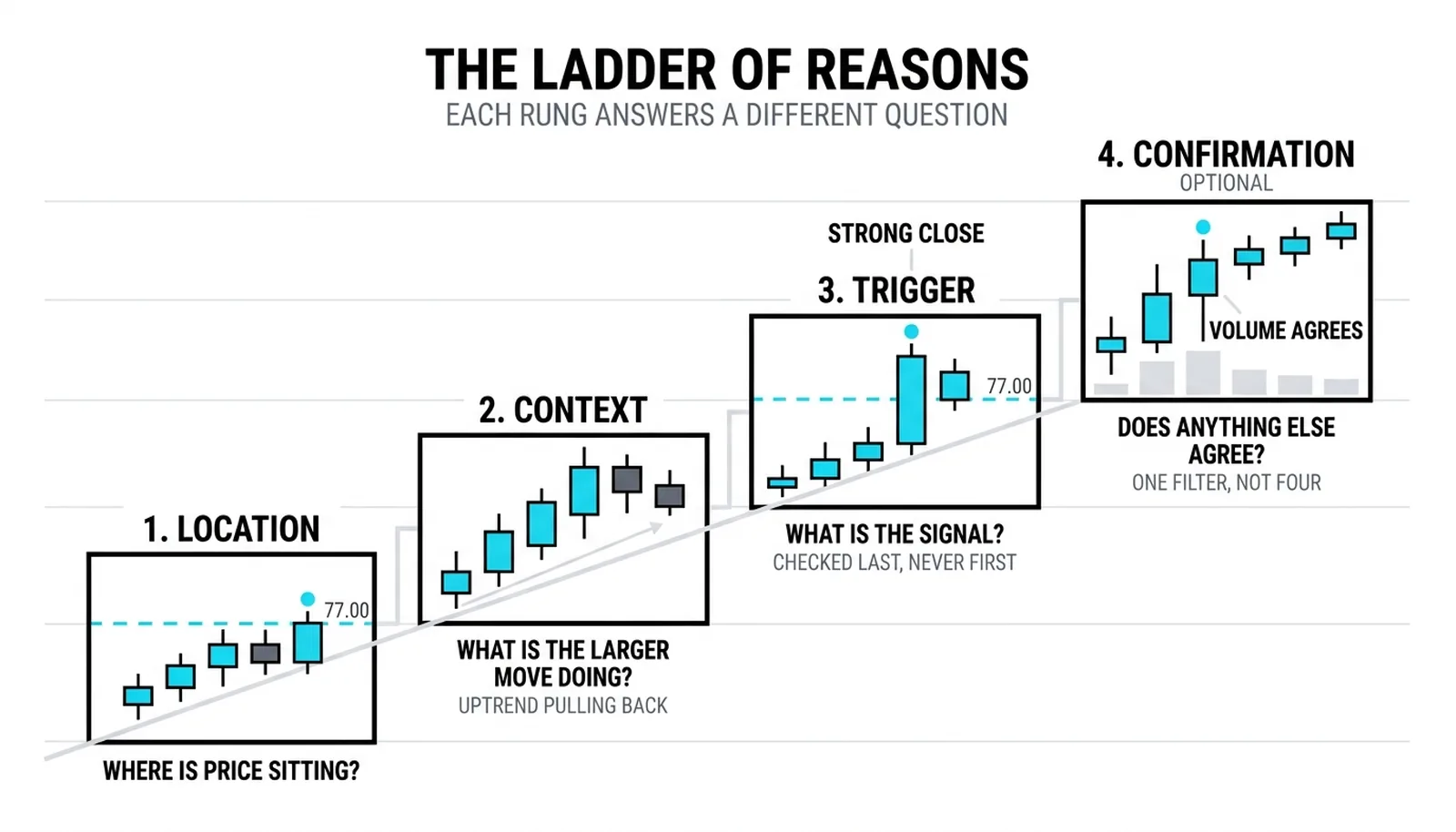
Location comes first. Where is price sitting? A prior swing high or low, a breakout shelf, a well-tested support or resistance zone. Without a meaningful location, nothing that happens there carries information. A signal in the middle of nowhere is noise with good posture.
Context comes second. What is the larger move doing? An uptrend pulling back, a range pressing its ceiling, a downtrend pausing after a long slide. Context also includes the run that preceded the bar. A reversal signal after five strong trend candles means something. The same signal after two flat candles means little.
The trigger comes third. This is where the candle shapes from this block earn their keep. The quality rules stay the same: a strong close, a decisive wick, a body that commits. The trigger is the last thing you check, never the first.
Confirmation is fourth and optional. Volume expanding on the move, or a single indicator filter that agrees. One filter, not four. This rung can tip a borderline case, but it never substitutes for the first three.
The Independence Test
The test most traders skip: three reasons that are really one opinion are one reason.
Three bearish candle shapes in a row inside the same range is a single bearish read, not three. Each candle was generated by the same sideways indecision, so each one repeats the same message. Stacking them feels like rigor. It is actually repetition, nothing more.
A real stack answers different questions. The pattern answers what is happening. The level answers where it is happening. The trend answers which way the larger flow runs. Three questions, three answers, three strands. If two of your reasons trace back to the same information, collapse them into one and re-count honestly.
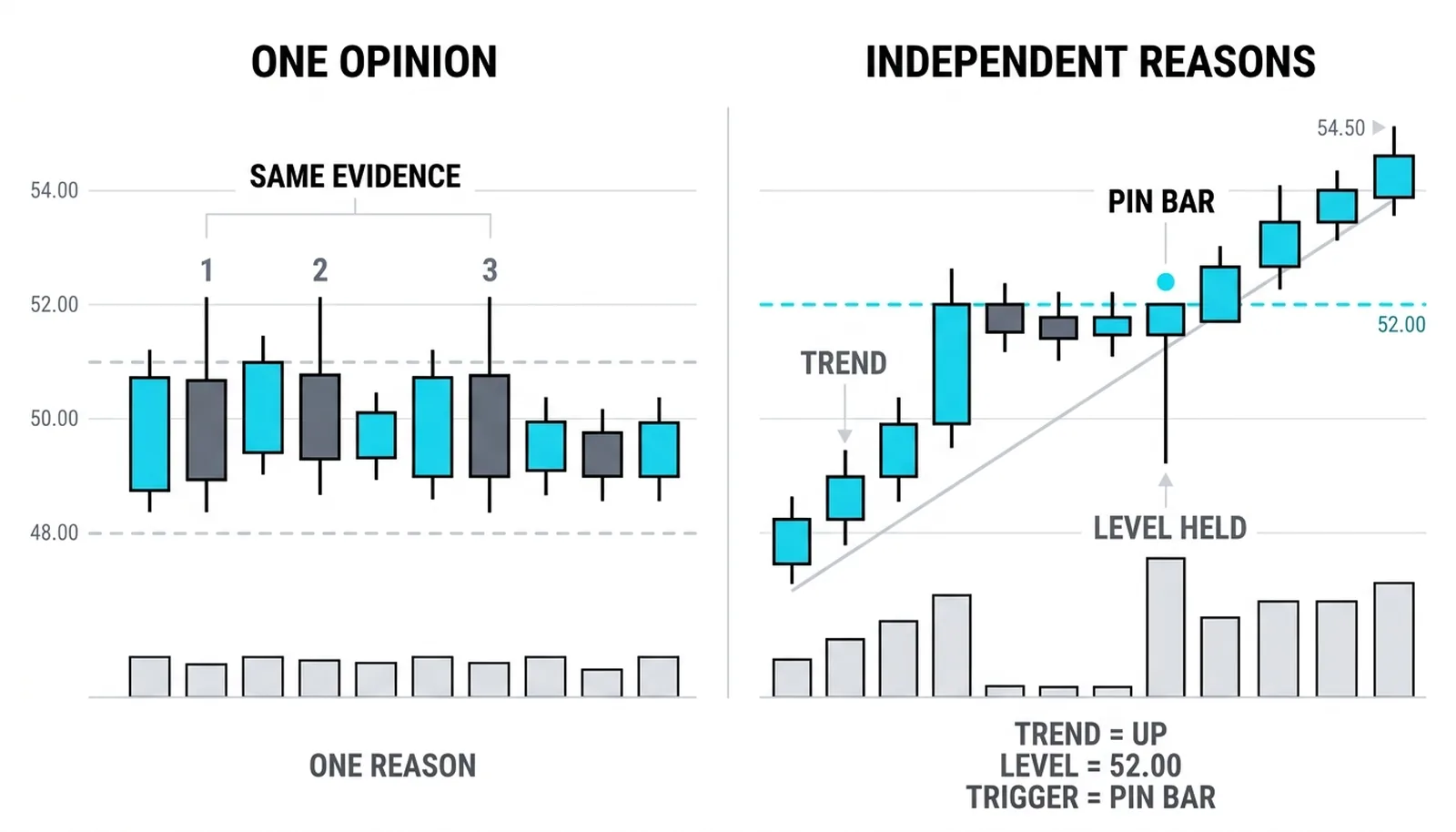
A quick self-test before entry: say each reason out loud in one sentence, and check that no two sentences share the same evidence. If the level and the trigger both come from the same candle, you have two reasons at most, and possibly one.
What the Evidence Says
The claim that stacking beats single signals is not folklore. Quantitative pattern research ran paired backtests across pattern-plus-indicator configurations, engulfing bars combined with volatility bands, doji bars combined with momentum filters, and the combined versions tested better than the bare shapes. The blunt conclusion from quantitative pattern research about single patterns: unlikely to deliver a profitable strategy alone. Patterns work better combined.
The tape-reading framework describes the same law from the discretionary side. The best turns happen where several reasons meet at one price, a confluence. The price action canon adds a second idea worth keeping: the second-entry principle, where the same reason appears twice after the first attempt failed. That is stacking in time rather than stacking in kind, and it counts.
Modern practice formalizes this with a higher-frame map and a lower-frame trigger. The higher timeframe supplies location and context, the lower timeframe supplies the trigger bar. Two frames, two questions, two independent reasons before the candle even prints.
Building the Checklist
Turn the ladder into a fixed routine. Before any entry, write down the level, the trend, and the trigger. If all three are present and independent, the trade qualifies. If only the trigger is present, the trade does not exist, no matter how pretty the candle looks.
Then the honesty. Stacking raises the odds. It never raises them to certainty. Every added reason also cuts the frequency of trades, sometimes sharply, and a trader who demands three strands will sit through long quiet stretches. That is the cost, and it is worth paying.
The actual skill this lesson teaches is refusal. Passing on a beautiful candle in an ugly spot feels wrong the first dozen times. Do it anyway. The candle was never the reason.
Three Reasons at 44.00
A hypothetical illustration with round numbers. A stock in a clear uptrend pulls back onto a prior breakout shelf at 44.00. That is reason one, the level.
The pullback is the first higher low after a fresh leg up. The trend is intact and the dip is its first real test. That is reason two, the direction.
On the shelf, a bullish pin bar prints. Its lower wick reaches 43.70 and the body closes at 44.55, near the top of the bar. That is reason three, the trigger.
The plan: enter at the next open, 44.60. The stop sits at 43.60, just below the wick tip, risking 1.00 per share. The target is the prior high at 47.80, a gain of 3.20, or 3.2 times the risk.
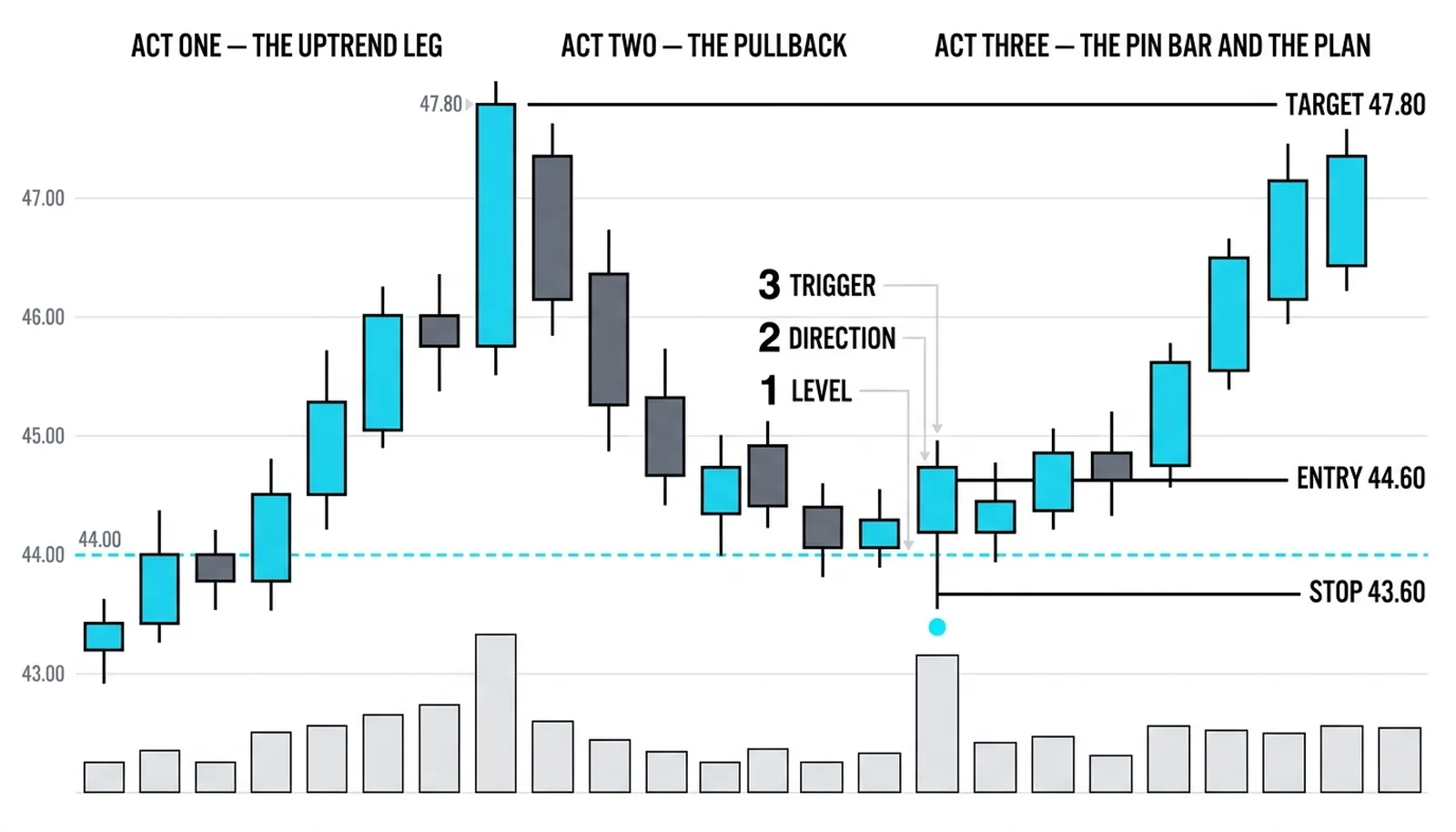
Now the pass case. The same pin bar prints mid-range at 45.80, with no level beneath it and no fresh leg behind it. One reason. No trade.
And the failed version. Some three-reason entries still lose; price closes below 43.60 and the stop does its job. The stack raised the odds, never the certainty. One loss against a sound process is tuition, not an indictment of the method.
| Layer | Question it answers | Strong version | Weak version |
|---|---|---|---|
| Location | Where is this happening? | Prior breakout shelf, tested support | Open space mid-range |
| Context | Which way is the larger flow? | First pullback in a fresh uptrend | Choppy, directionless drift |
| Trigger | What is happening now? | Pin bar closing near its high | Small indecisive candle |
| Confirmation | Does anything else agree? | Volume expands on the signal bar | Three indicators echoing one fact |
Combo Pattern Questions, Answered
What are combo patterns in trading?
Combo patterns are trades built from several independent reasons at once: a level for location, a trend for direction, and a candle pattern for the trigger. The term describes the stacking method, not a new candlestick shape.
How many signals do you need before entering a trade?
Three independent reasons is a sound minimum: location, context, and trigger. More is fine only if each new reason answers a genuinely different question, and every added filter will reduce how often you trade.
Does stacking signals guarantee anything?
No. Stacking improves the probability of a trade working, and nothing more. Three-reason setups still fail regularly, which is why the stop loss stays part of the plan regardless of how many strands the braid has.
What is confluence?
Confluence is the meeting of several independent reasons at one price. A support shelf, a trend pullback, and a reversal bar all pointing the same way at the same spot is confluence, and it is the practical name for everything this lesson describes.
With the core price action patterns now closed, the next block turns to market structure itself, where the ladder gains its strongest location layer yet: the swing highs, swing lows, and breaks that give every level in this lesson its meaning.