The Two-Bar Reversal: When Spikes Collide
A two-bar reversal is a trend bar in one direction followed immediately by a trend bar in the opposite direction, two spikes colliding at an extreme, and the second spike traps everyone who chased the first. The first bar looks like conviction. The second bar proves it was exhaustion. Together they mark the point where one side ran out of traders and the other side took over in a single exchange.

Think of the king-of-the-castle game, where one player fights to the top of the hill and is thrown straight back down before the game settles, the top changing hands in one violent exchange. Bar one is the climb. Bar two is the shove. What matters is not that someone reached the top but that they could not stay there.
The outside and engulfing bar lesson covered the one-bar version of this fight, where a single bar swallows its neighbor. The two-bar reversal needs no overlap at all. Two clean trend bars in opposite directions are enough, which makes the pattern visible even where candle bodies do not line up neatly.
Two Spikes and a Trap
Bar one is the emotional spike. It is usually a climax bar at the end of a run, often the largest bar of the whole move. In a downtrend it is a big bear trend bar closing near its low, printing a fresh extreme. Everyone watching feels the same pull: the move is accelerating, get in or miss it.
That feeling is the setup. A climax bar at the end of a long run is frequently the last burst of one side's energy, not the start of a new leg. Late sellers chase the close. Early shorts add. The bar looks strong because it is crowded.
Bar two is the repudiation. It opens near bar one's close and drives hard the other way, closing near its own extreme. No overlap with bar one is required. What is required is conviction in the opposite direction, a real trend bar that closes at or near its far end.
The trap is the fuel. Everyone who sold bar one's close is underwater the moment bar two opens against them. Their buy-to-cover exits push bar two further. The same thing happens in reverse at tops: late buyers become forced sellers. The second spike feeds on the first spike's crowd.
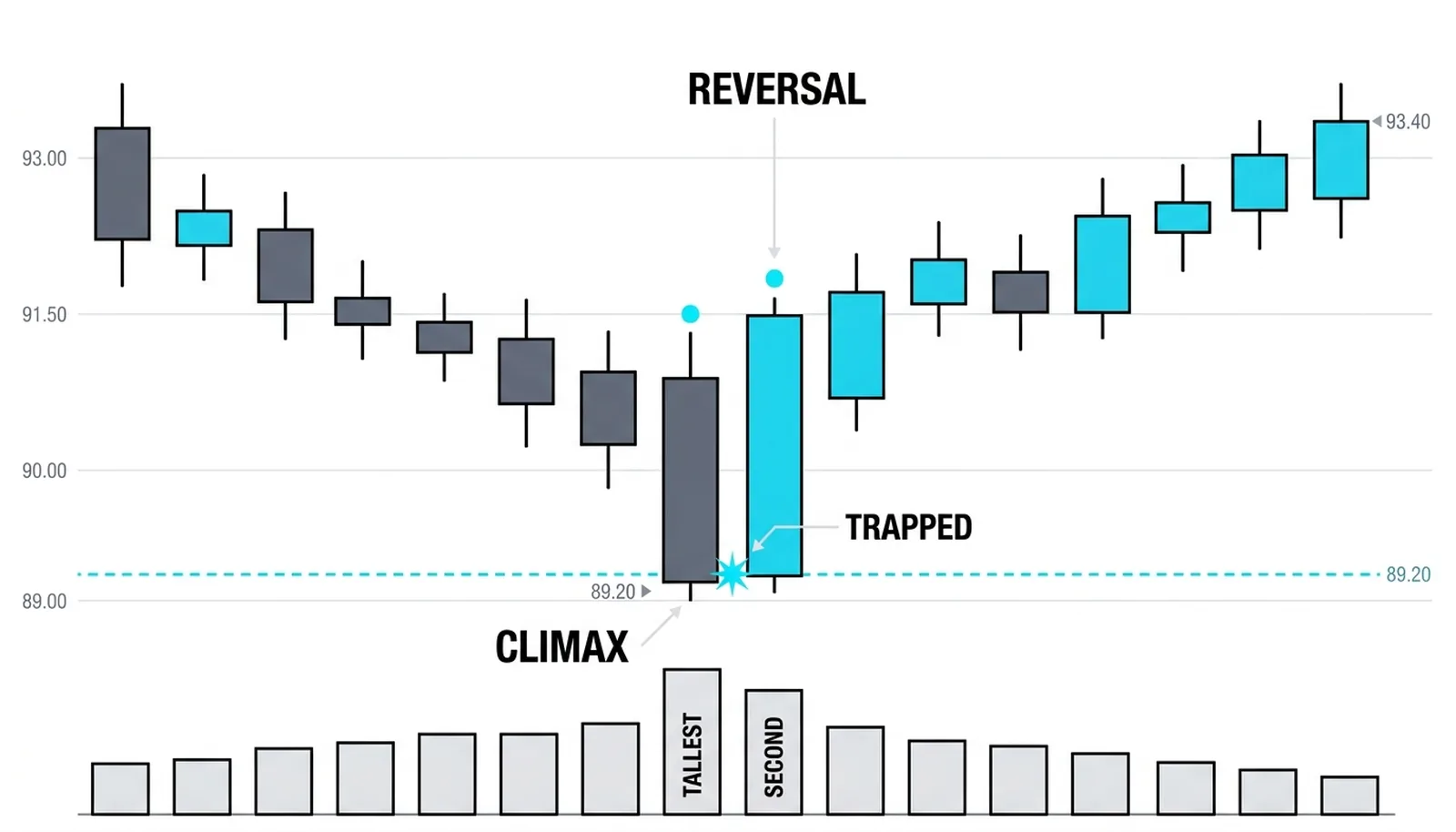
Two mediocre bars pointing in opposite directions is noise, not a signal. The pattern demands that both bars be real trend bars with closes at their extremes. A small bar one and a small bar two at a random spot in the middle of a range tells you nothing about who is trapped.
The Same Event on Three Time Frames
The price action canon calls this the climactic reversal and adds a time-frame insight that changes how you read it. The same event appears as a many-bar spike reversal on a low frame, as a two-bar reversal one frame up, and as a single reversal bar two frames up. Nothing about the underlying fight changes. Only the candle boundaries shift.
This means you should read the event on whichever frame shows it cleanest. If the five-minute chart shows a messy seven-bar turn and the fifteen-minute chart shows two crisp opposing trend bars, the fifteen-minute chart is telling the story better. Do not force the pattern onto a frame that muddies it.
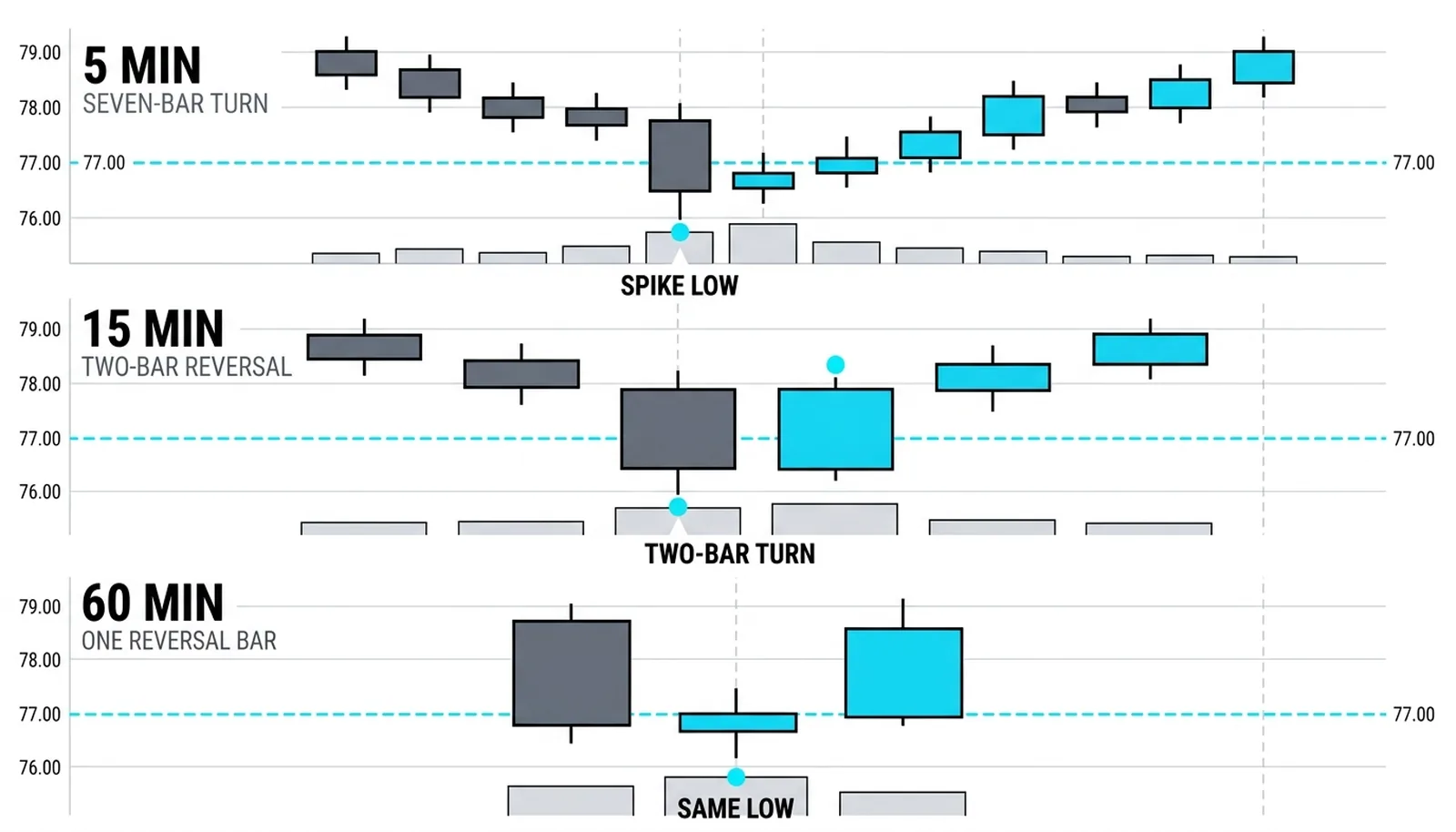
Location decides whether the collision matters. Three contexts carry the most weight:
- After a trend line break. The trend has already cracked once. A two-bar reversal at that point is the second piece of evidence that control is changing hands.
- At a level. Support, resistance, a prior swing extreme. The spike into the level and the spike away from it confirm that the level is defended.
- With the trend, ending a pullback. The tape-reading framework's two-bar reversal at the moving average marks a high-two entry, the pullback's failure to continue becoming the trend's resumption signal.
Where it fails is just as specific. Buying a two-bar reversal at the top of a trading range is forcing a trade at the worst price in the range. Countertrend reversals in general fail more often than they succeed. Most reversal attempts die, and the market very often returns to test the extreme that just reversed.
Trading the Collision
The entry triggers on the break of bar two's extreme in the new direction. If the reversal is bullish, you buy the break above bar two's high. You do not buy during bar two, because bar two has not proven it will close strong until it closes. The break of its extreme is other traders confirming the turn with their own orders.
The stop lives beyond bar one's extreme tip. That tip is the price the first spike proved and the second spike repudiated. If price trades back through it, the collision is void and the original move is resuming. There is no logical place for the stop inside the pattern, because every price between the two extremes is contested ground.
The price action canon's strength test separates the good ones from the guesses. The best reversals have large bars on both sides, and preferably a second entry, a chance to enter again after the first test of the extreme holds. If the market reverses, pulls back to retest the zone, and produces another strong bar in the new direction, that second entry is often the higher-probability trade.
Expect the test. Most V-shaped turns get retested at least once, because the traders who missed the first entry are waiting at the old extreme. A retest that holds is normal behavior, not a failed signal. A retest that blows through the extreme is the exit doing its job.
The honesty, stated plainly: without a strong signal bar the odds sink toward a guess. If bar two is small, closes mid-range, or takes three bars to do what one should have done, skip it. The pattern's entire edge comes from the violence of the exchange. A polite disagreement between two candles has no trapped crowd and no fuel.
The Collision at 89.50
A hypothetical illustration with round numbers. A market has been in a downtrend for weeks and sells off hard into a known shelf at 89.50.
Bar one is a bear trend bar. It opens at 89.90 and drives down to close at 89.20, printing a new low for the whole move. It is the largest bar of the decline. Late sellers chase the close, convinced the shelf has broken.
Bar two opens at 89.25 and rips upward, closing at 90.10. It takes back all of bar one and more. Every short from bar one's close is now underwater, and their covering pours fuel into the rally.
The trade: the long triggers on the break above 90.20, bar two's high plus a tick. The stop sits at 89.10, below bar one's low, risking 1.10. The target is the broken shelf overhead at 92.60, a gain of 2.40, roughly 2.2 times the risk.
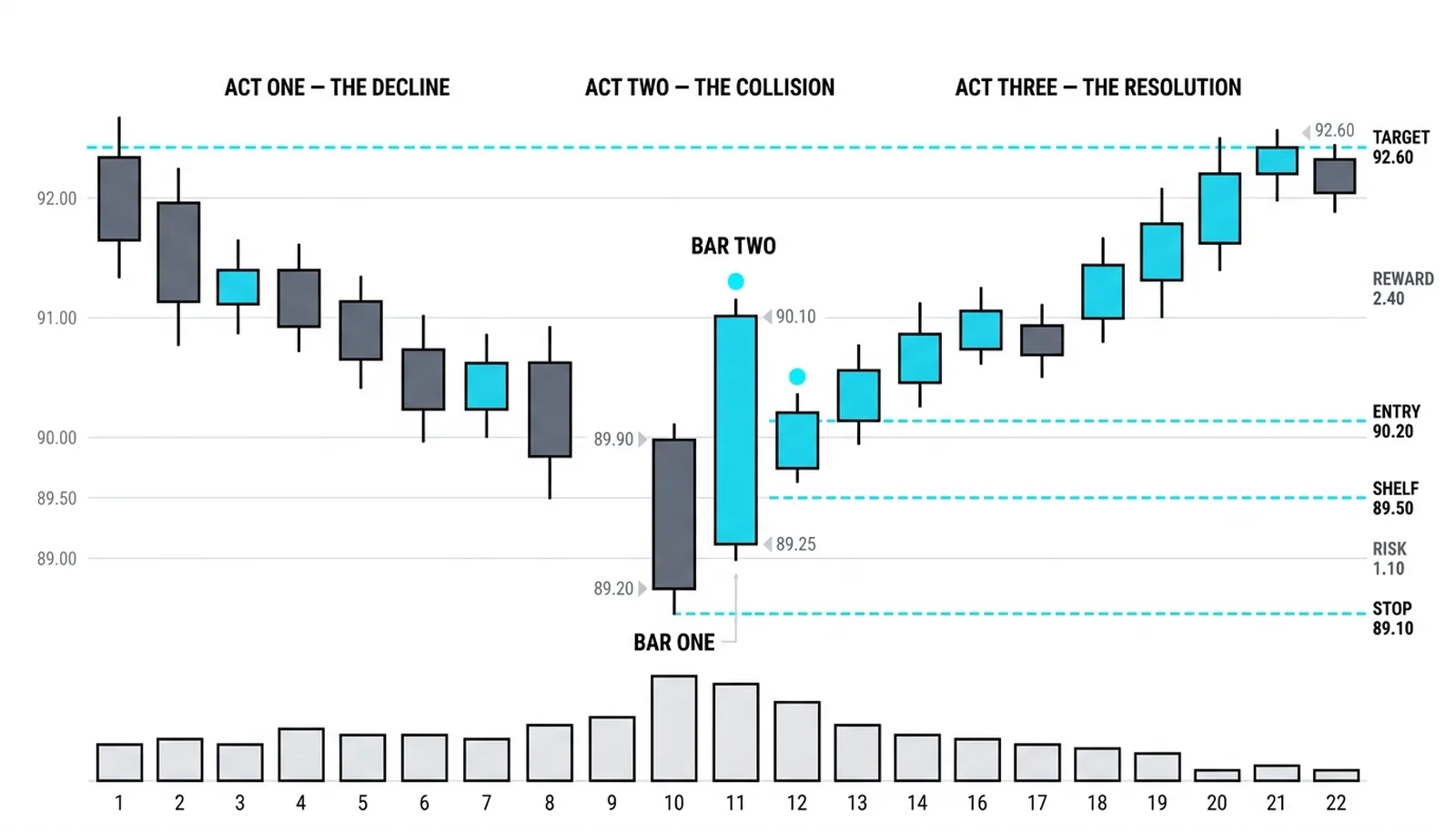
The failed version: price stalls after entry, and two bars later trades back below 89.10. The exit fires for the planned 1.10 loss. The collision is void, the downtrend is resuming, and the trade idea is dead at the exact price that was always going to decide it. That is what a well-placed stop buys you.
| Component | What It Is | What It Proves | The Common Mistake |
|---|---|---|---|
| Bar one | Climax trend bar at the end of a run, often the largest of the move | One side's final burst of energy, crowded with late entries | Reading the big bar as strength to chase instead of exhaustion |
| Bar two | Opposite trend bar closing near its own extreme, no overlap required | The other side has seized control in one exchange | Accepting a small, mid-range close as a valid second bar |
| Entry | Break of bar two's extreme in the new direction | Other traders are confirming the turn with real orders | Entering during bar two before it has proven its close |
| Stop | Beyond bar one's extreme tip | The price that voids the collision if retaken | Placing the stop inside the pattern where noise can tag it |
Two-Bar Reversal Questions, Answered
What is a two-bar reversal?
A two-bar reversal is a trend bar in one direction followed immediately by a trend bar in the opposite direction, with the second bar trapping everyone who chased the first. Both bars should be real trend bars closing near their extremes, and the pattern carries the most weight after a trend line break, at a level, or as the end of a pullback within a trend.
Is a two-bar reversal the same as an engulfing bar?
No. An engulfing bar is the one-bar version, where a single bar's body swallows its neighbor's body. A two-bar reversal needs no overlap at all, just two clean opposing trend bars, so it stays visible on charts and time frames where candle bodies do not line up neatly enough to engulf.
Does a two-bar reversal need to happen at a level?
It does not strictly need one, but location is what separates signal from noise. A collision at support, resistance, a prior extreme, or a trend moving average has a reason to exist, because orders are clustered there. The same two bars in the middle of a range, with nothing on either side, is usually just two bars.
What if the second bar fails?
If price trades back through bar one's extreme, the pattern is void and you exit at the stop, no debate. A weaker failure, where bar two never breaks its own extreme and the move drifts sideways, is a signal that never triggered, so there was no trade to lose. The more common outcome to plan for is the retest: most V-shaped turns get tested at least once, and a retest that holds is often the better second entry the tape-reading framework describes.
Next in the series, the signals stop appearing one at a time. The confluence lesson stacks the marubozu, the wick read, and the two-bar reversal into a single trade decision, with rules for how many agreeing signals are enough and when a stack is just noise that agrees with itself.