Bollinger Bands and Mean Reversion
Mean reversion with Bollinger Bands is the trade built on stretch and release: price runs far from its average, the bands mark how far, and the trade aims at the pull back toward that average, usually the middle band itself. The bands define the stretch. The reversion is the bet that the stretch matters.

A dog on a leash runs hard to the fence and gets pulled back toward the walker. The stretch itself sets up the return; the further the run, the harder the leash pulls. The escape hatch is built into the analogy and the trade alike: sometimes the walker changes course, the leash pays out instead of snapping back, and the stretch keeps stretching. Everything this lesson teaches lives in the gap between those two outcomes.
The tool's construction lives in the full breakdown lesson; this lesson owns the trading use, and the breakout lesson owns the opposite read of the same band touches.
The Middle Band Is the Target
The classic reversion trade has three parts. Price stretches to a band in a quiet market, which is the setup. The touch, or a close back inside the band, is the trigger. The objective is the middle band, not the far band, and that choice is the design: the middle band is the 20-bar average price has been orbiting, the most defensible magnet on the chart, while the far band is a moving guess about a move that may never happen.
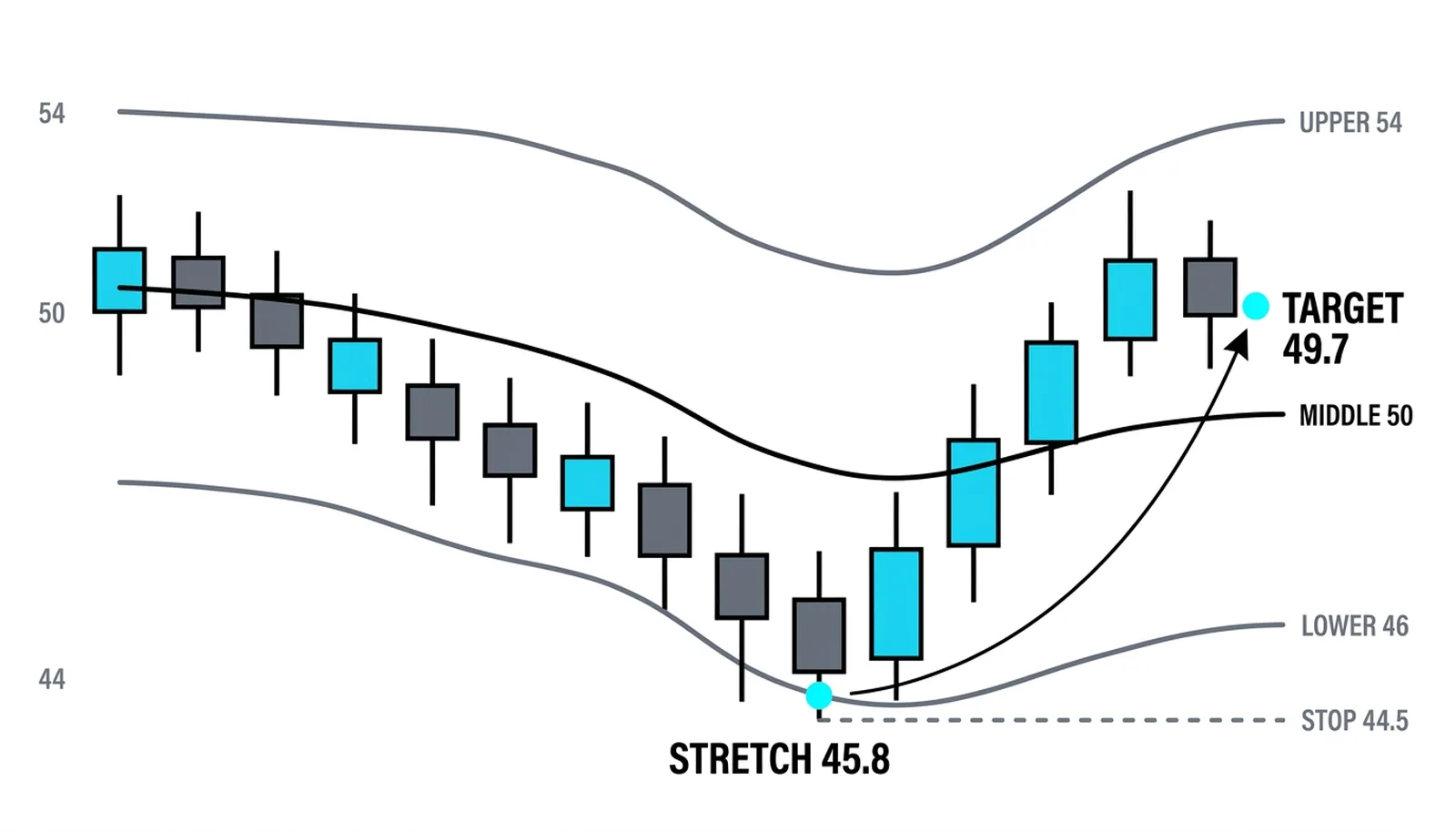
Stops live beyond the stretch: below the extreme of the push that hit the band, sized so the worst case costs a fixed, small amount. The shape of the strategy follows from the targets. Frequent modest wins, occasional deeper losses, and the position size must be built for the losing streaks that shape guarantees.
The Regime Question: Range or Trend
Reversion works while the market oscillates. The signature is visible in the bands themselves: flat, roughly parallel, with price ping-ponging between the edges and the middle, every stretch resolving back to the average. In that regime the band touch is a genuine setup and the middle band is a realistic objective.
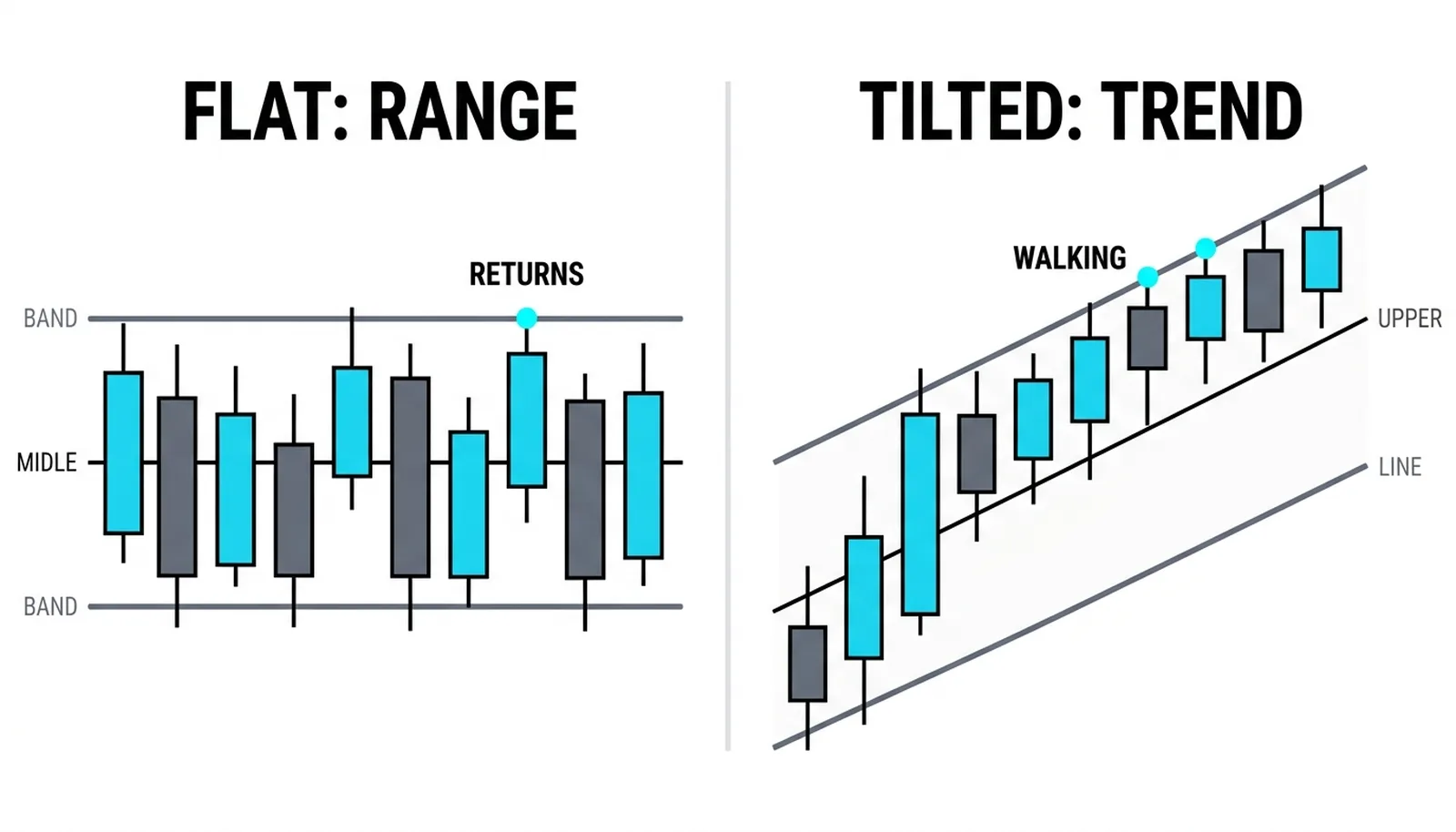
Reversion dies when the market trends. Price pins to one band, the middle band stops acting like a magnet, and every stretch resolves further out instead of back. The research record is blunt about the stakes: studies of band-based strategies find no consistent edge over buy and hold, and the variants that did show results were often the contrarian ones in range-friendly markets, which is another way of saying the regime decided everything. Three checkpoints sort the regimes: band slope, band parallelism, and whether closes keep returning past the middle band. Flat and parallel with returns past the middle is reversion territory. Tilted bands with closes refusing to cross the middle is trend territory, and the touch is a continuation signal in reversion clothing.
When the Reversion Fails
The failure deserves a precise description, because it has a shape. The trader fades a band touch in what looks like a range. Price rests at the band for a bar or two, then resumes walking it. The stop, placed beyond the stretch, gets hit not because the entry was early but because the regime changed while the setup looked identical on the last twenty bars. In a trend, the leash is being paid out, not snapped back, and each additional stretch is the market announcing that the anchor moved.
The defenses are structural, not predictive. The stop beyond the stretch caps each failure at a known cost. A regime check before entry, ideally a trend-strength read like the one in the ADX lesson, filters the worst fades. And a momentum extreme alongside the stretch, the confluence read covered with the RSI zones lesson, upgrades the touch from a coin toss to a setup. Stretch plus momentum extreme plus range regime is a trade. Stretch alone is a hope.
Making the Trade Respectable
The honesty paragraph comes before the polish. Mean reversion edges decay as crowds find them; the academic record on band strategies is unflattering precisely because the obvious versions got crowded. What survives is discipline: the regime filter, the fixed stop, the middle-band target instead of greedier ones, and sizing built for the losing streak the strategy's shape makes inevitable. The trader who sizes for the streak and refuses trend-regime entries keeps the edge small but real. The trader who doubles after three wins donates it back.
Volatility context belongs in the checklist too. Quiet stretches chain together, as the volatility lesson covered, and quiet is the friend of this trade: reversion entries taken while BandWidth sits near its floor, in flat parallel bands, historically behave far better than the same entries taken mid-expansion, when the leash is already paying out.
Two Trades, One Tool, Opposite Regimes
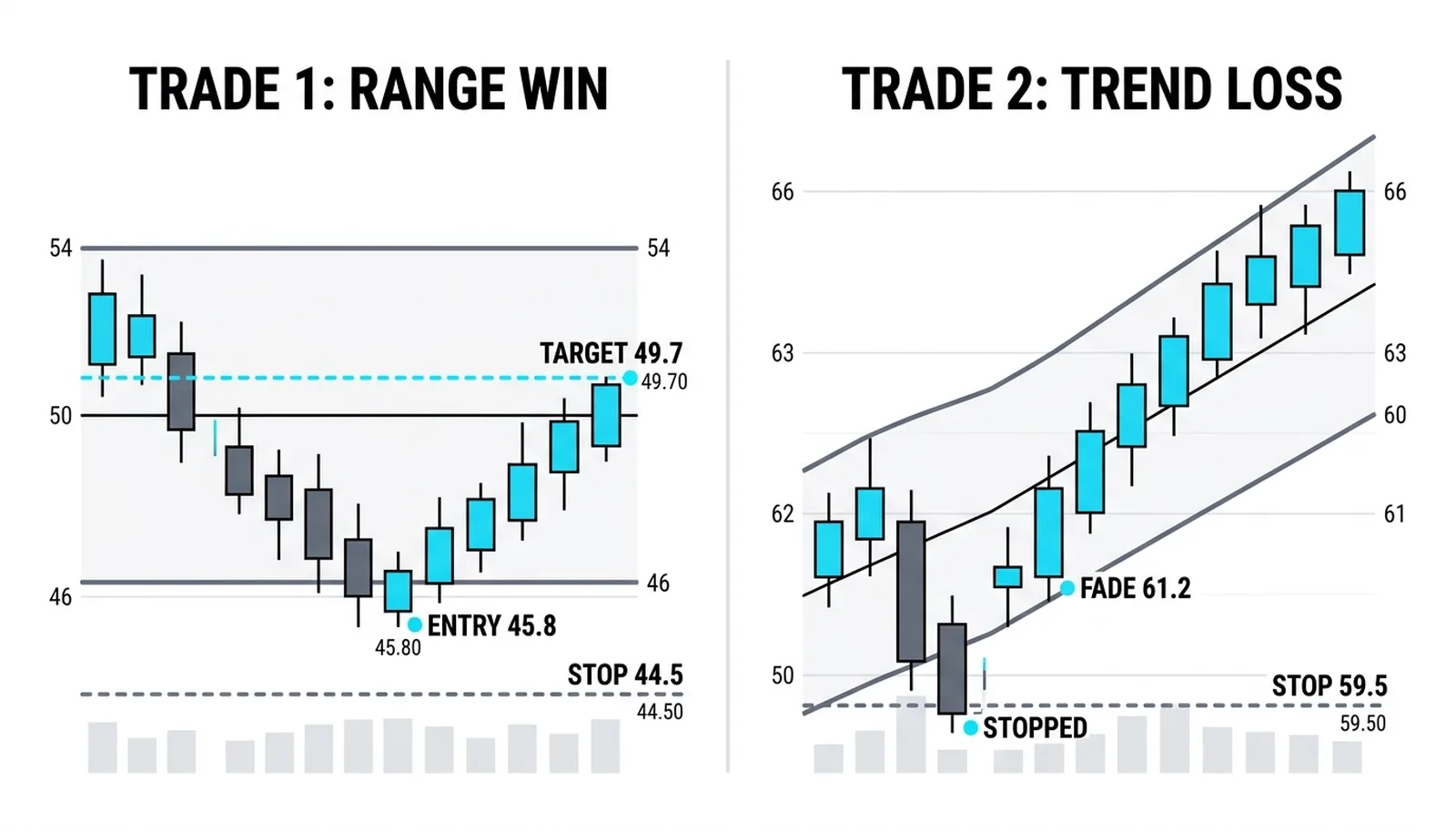
Round numbers, all hypothetical. Trade one: a market has ranged for weeks, bands at 46 and 54 with the middle at 50, bands flat and parallel. Price dips and closes at 45.8, below the lower band. Entry on the touch, stop at 44.5 beyond the stretch, target the middle band at 50. Two sessions later price closes at 49.7 and the target fills. The textbook reversion, roughly 9 percent on risked capital, in and out inside a week.
Trade two: same tool, same-looking touch, different market. After weeks of climbing, price touches the lower band at 61, the bands tilted steeply upward the whole way. The fade entry fills at 61.2. Price rests at the band for two bars, then resumes the walk to 66. The stop at 59.5 takes the loss. Same signal, same bands, same discipline. The regime was the difference, and the regime was visible in the band slope before the entry, which is the lesson both trades exist to teach.
| The regime read | The appropriate response | |
|---|---|---|
| Band touch, flat parallel bands | Range regime; stretch with a real pull back | The classic reversion setup, target the middle band |
| Band touch, bands tilting | Trend regime leaking in; the anchor is moving | Stand down or demand heavy confluence |
| Closes returning past the middle | The average still acts as a magnet; range intact | Reversion assumptions hold; trade them |
| Closes pinned to one band | Band-walking; reversion has failed repeatedly | No fades; the touch is a continuation signal |
Bollinger Bands and Mean Reversion, Answered
How do Bollinger Bands show mean reversion?
The bands measure how far price has stretched from its 20-bar average, and reversion is the pull back toward that average. A touch of a band marks a stretch at its recent extreme; the middle band, the average itself, is the natural destination of the return in a range regime.
What is the target of a Bollinger Band reversion trade?
The middle band, not the far band. The middle is the 20-bar average price has been orbiting, which makes it the most defensible magnet. Targeting the opposite band turns a modest, repeatable objective into a guess about a move that may never arrive.
Does mean reversion work in trends?
No, and the failures have a signature: price rests at the band, then keeps walking it while the stop gets hit. In trends each band touch is a continuation signal. The regime check, band slope plus whether closes return past the middle band, decides which market you are actually in.
How do I know if the market is in a range or a trend?
Read the bands and the closes: flat parallel bands with closes returning past the middle indicate a range; tilted bands with closes pinned near one band indicate a trend. A trend-strength filter such as ADX and a momentum confirmation such as an RSI extreme at the stretch add two independent votes before the entry.