The Bollinger Band Breakout, Explained
A Bollinger Band breakout is a close outside a band while the bands are widening, and the reading that matters is expansion: volatility arriving and picking a direction. The band touch by itself prints neither buy nor sell. What turns a touch into a trade is the close, the widening behind it, and the behavior of the bars that follow.

A pressure-release valve makes the order of events concrete. Pressure builds while the valve stays seated. When the valve finally lifts, the valve confirms the push, but the flow decides the direction, and the flow keeps flowing or it does not. Bands work the same way: the pinch builds the pressure, the close outside the band is the valve lifting, and the expansion that follows is the flow worth watching.
This lesson picks up where the squeeze lesson ends, at the moment the release starts. It also sets up the contrast with the mean reversion lesson, which trades the same band touches in the opposite regime.
Touch Versus Close: Where the Line Sits
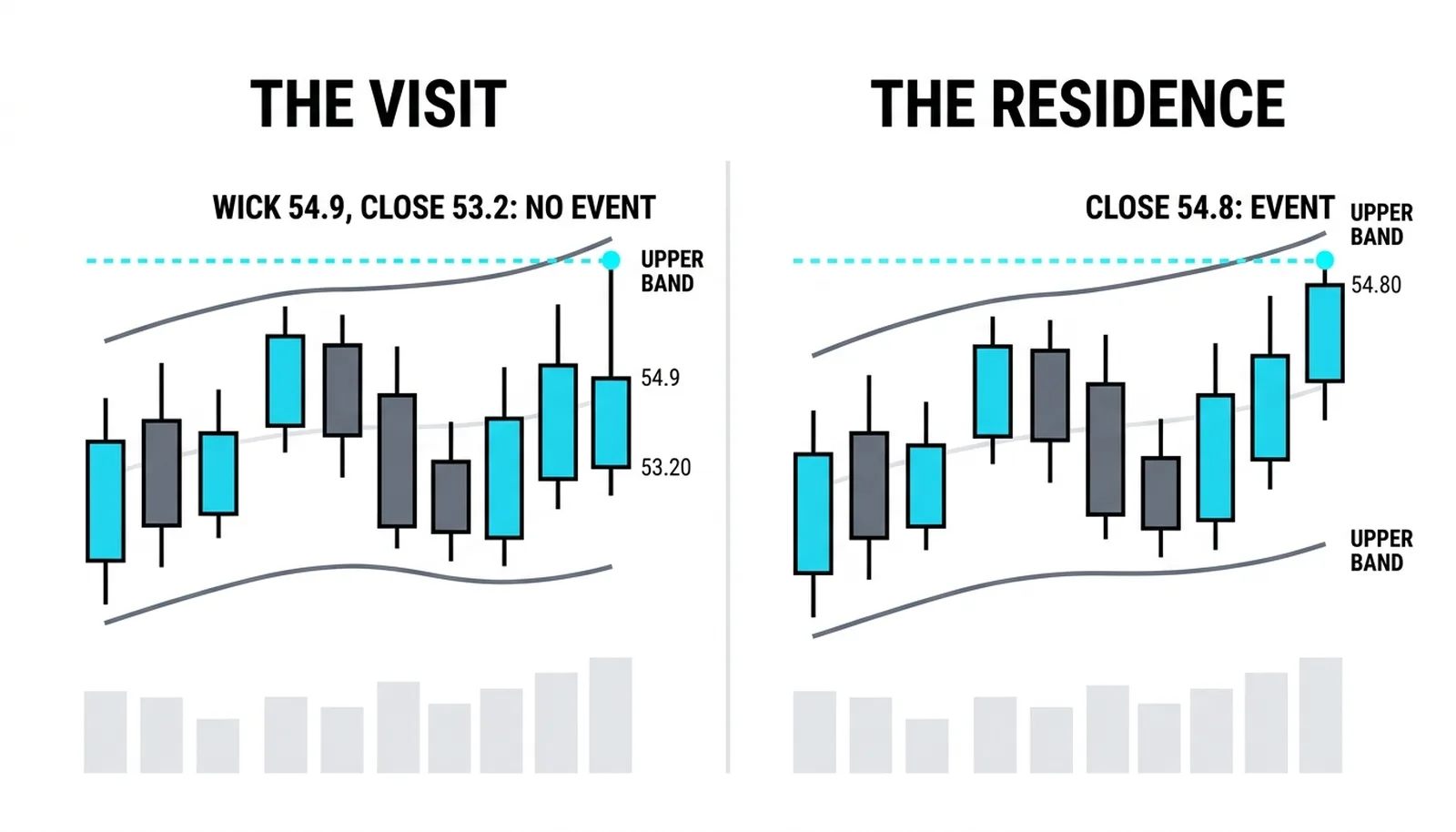
A wick that pokes outside a band is a visit. A close outside the band is a residence. The working convention treats the close as the event, and the reasoning is practical: wicks record intrabar extremes that often mean nothing once the bar finishes, while closes reflect where the market was willing to hold positions when the bar ended.
The convention has a cost worth stating plainly. Waiting for the close surrenders part of the move, sometimes a large part in fast markets. That surrendered slice is the price of the filter. Traders who take every wick outside the band buy the noise the close-waiters skip, and they also buy the failures. Neither choice is free; the close convention buys confirmation with give-up.
Expansion Is the Confirmation
A close outside a band, with the bands still flat and narrow, is usually a quiet market doing quiet-market things. The version worth trading pairs the close with widening: BandWidth rising off a low, the bands bending in the breakout's direction, the whole envelope deforming as volatility arrives. The geometry tells you the move has force behind it rather than being one bar's opinion.
The best follow-through historically comes from expansions that begin at squeezes, for the reason the squeeze lesson covers: a market that printed its calmest stretch in months has stored pressure, and the release carries that stored energy. A breakout from mid-range bands starts from no such reserve. Same signal, different fuel tank.
The Head-Fake Problem
Bollinger's own writing gave the failure mode a name: the head-fake. One bar closes outside a band, then snaps straight back inside, and the breakout that looked like the start of something turns out to be the last push of a range. It happens often enough to plan around, and the mechanics explain why: the final shove of a tired range frequently comes from the traders who wanted the breakout most, and when nothing follows them, the close re-enters the bands and the move dies.
Three checks separate the real ones, and none is secret. Demand the following bar to hold outside the band rather than accepting the first close. Watch the band slope: real expansions bend the band in the breakout's direction within a few bars. Ask for agreement from a second measure, momentum or volume, so a lone bar cannot manufacture a trade. The squeeze lesson's oscillator filter lives at exactly this junction, and the ADX lesson covers the trend-strength read that keeps traders from buying expansion inside a range.
Walking the Band: When Trends Ride the Edge
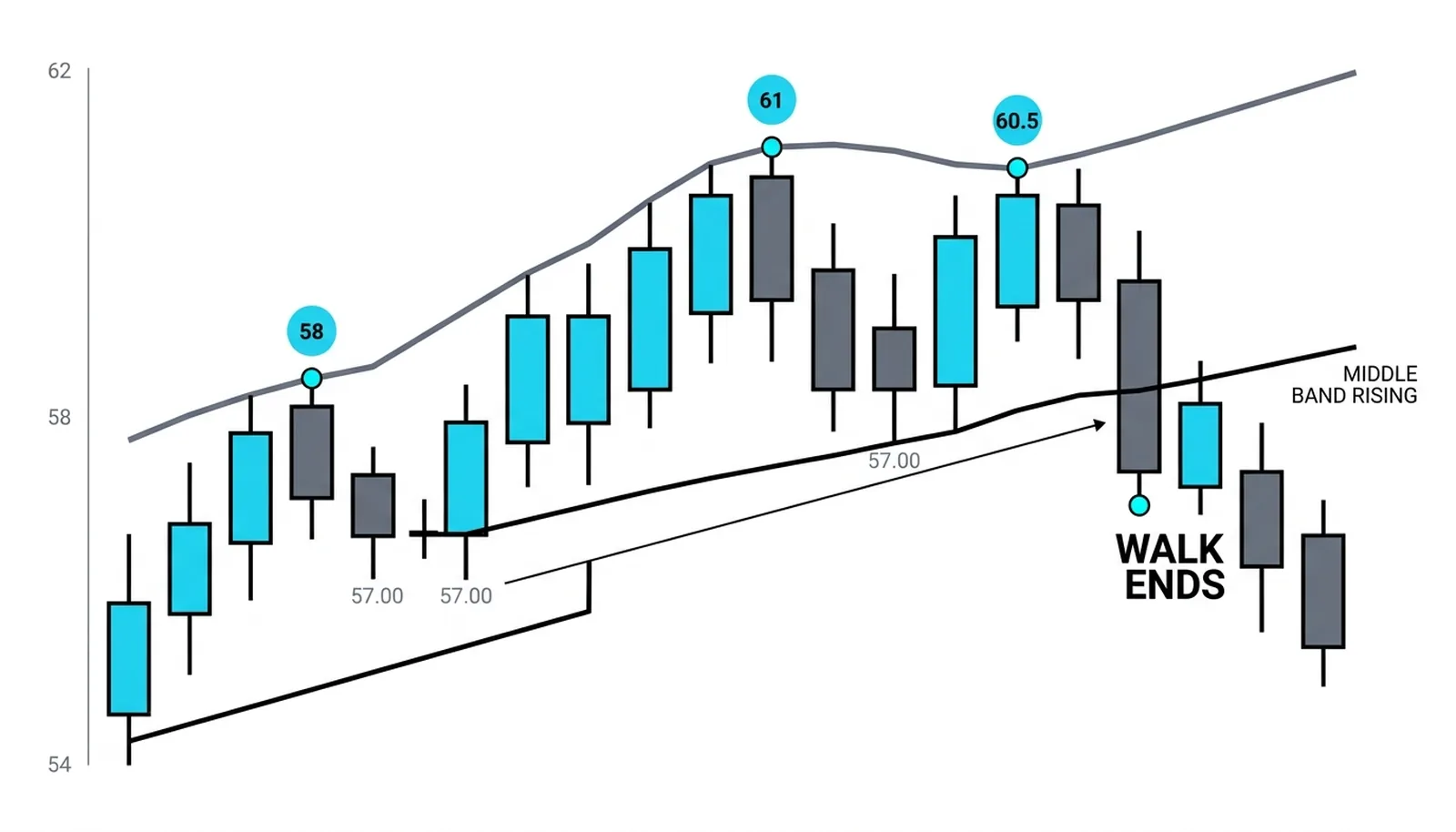
Strong trends produce a signature the touch-and-fade crowd learns to fear: price keeps closing at or near the upper band, eases back toward the middle band in shallow pullbacks, then returns and closes at the band again. Traders call it band-walking. In %b terms, the reading stays pinned above roughly 0.8 between brief dips toward 0.5, over and over, for as long as the trend runs.
Walking is continuation evidence, not a fresh signal each time. Each touch of the band in a walking sequence says the trend is still the regime, which is the exact opposite of what the same touch says in a flat, parallel band structure. Deciding which regime you are in comes back to the trend filter, and to the honest admission that the mean reversion lesson trades the opposite read of the same geometry.
One Expansion, Read Bar by Bar
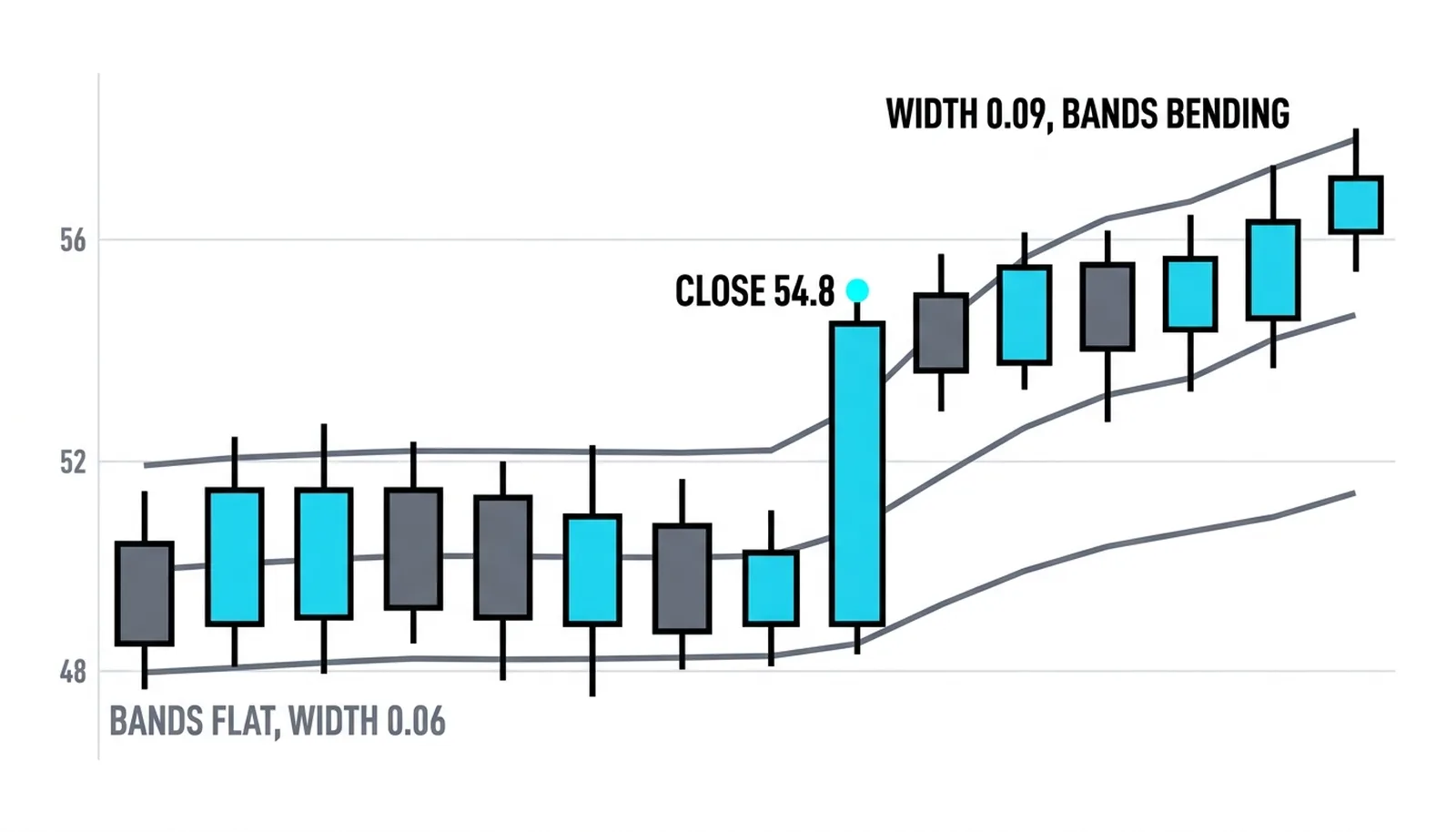
Round numbers, all hypothetical. A market has ranged between 48 and 52 for weeks. The bands sit at 46 and 54, flat, with BandWidth at 0.06.
Session one closes at 54.8, above the upper band, and BandWidth jumps to 0.09. The bands are bending. Session two closes 55.6 while the upper band has climbed to 55, so the close outside is confirmed by a band moving to meet it. The expansion is real by the three checks: held outside, band bending, and the market's momentum reading agreeing.
The head-fake contrast, one session earlier: a wick spiked to 54.9 but the close printed 53.2, back inside the bands, on flat width. No close outside, no expansion, no event. Same price territory, opposite verdict, and the difference was the close and the width, not the touch.
Then the walk: three weeks of closes at 58, 61, 60.5, each pullback holding 57 and the middle band rising underneath. Nobody bought a signal per touch. The band touches confirmed what the widening already said, until the day a pullback sliced through the middle band and the walk was over.
| What it is | The response | |
|---|---|---|
| Wick outside flat bands | Intrabar noise; no close outside, no expansion | No event; wait for the bar to finish |
| Close outside widening bands | The breakout convention, confirmed by expansion | The tradeable version; verify the follow-through bar |
| Close outside, back inside next bar | The head-fake; the range's last push | Exit or skip; the failure mode is information too |
| Repeated band touches, shallow pullbacks | Band-walking; trend continuation signature | Read as regime evidence, not fresh signals |
Bollinger Band Breakout, Answered
What counts as a Bollinger Band breakout?
A close outside a band while the bands are widening. The close is the event and the expansion is the confirmation; a touch from a wick on flat bands fails both conditions and is usually the range doing range things.
Does price touching a band mean breakout?
No. Touches happen constantly in both regimes. In quiet markets a touch is stretch, and the mean reversion lesson trades the return from it. In trends, touches repeat as continuation. The breakout read requires a close outside the band plus width expanding behind it.
What is a head-fake in Bollinger Bands?
A bar that closes outside a band and snaps back inside the next bar, killing the breakout. The term comes from John Bollinger's own writing on the tool. The defenses are mechanical: require the following bar to hold outside, watch the band slope bend in the breakout's direction, and demand agreement from momentum or volume.
What is band-walking?
The trend signature where price repeatedly closes at or near one band while shallow pullbacks hold the middle band. It reads as continuation evidence: each touch says the trend is still the regime. Fading those touches in a walking sequence is how reversion traders donate money in trends.