What Is Auction Market Theory?
The auction is the right mental model for every market you will ever trade. Auction market theory is the framework that treats every market as a two-sided auction, where price is the advertiser, value is discovered through completed business rather than calculated, and every session answers three questions: who is in control, where is value, and is price being accepted or rejected.

Start with a shift in how you read a quote. A price on your screen is an offer, an invitation to do business, and the market's way of asking whether anyone wants to trade at that level, not a verdict on what something is worth. Some offers get taken. Most get ignored. The ones that get taken, repeatedly and in size, are where value actually lives.
Picture a fish market at dawn, where the seller calls a price and keeps adjusting it until buyers start lifting the goods, and that first burst of real business is where the true price of the morning lives. Your chart works the same way. Price moves around looking for business, and the places where business actually happens tell you what the market agreed on.
The Market as a Two-Sided Auction
Every market has buyers who want to pay less and sellers who want to receive more. Neither side can transact alone. Price moves up to attract sellers and down to attract buyers, and the auction keeps running because the two sides keep disagreeing about what the thing is worth.
Price advertises. The crowd responds. When price rises and trade dries up, the offer was too high and buyers walked away. When price drops and trade dries up, the offer was too low and sellers stepped back. When price sits in a zone and trade flows freely, both sides have found a level they can do business at.
The evidence is always completed business, never opinion. A level where thousands of shares changed hands carries information. A level price touched once and abandoned carries almost none. This is why auction theory pairs so naturally with volume: the auction's advertising is price, and the auction's receipts are volume.
One consequence surprises new traders. Markets do not exist to trend. They exist to facilitate trade, to match buyers and sellers in size. Most of any session is spent discovering and confirming value, rotating around a price both sides accept. Trend is the exception. Trend happens when the auction fails to find agreement and price has to keep moving to locate the next area where business can be done.
The Wyckoff deep-dive you just completed describes the same reality from a different angle. The campaigns of the classic accumulation and distribution framework, the cycles run by large operators, are one famous description of what auction theory formalizes. Auction theory generalizes the idea: every session, not only the big campaigns, is a negotiation between two sides searching for a price where trade can happen.
Fair Price Is Discovered, Never Calculated
Value in an auction is the residue of completed business. It is the zone where the most trade actually occurred, built transaction by transaction. No formula produces it in advance. No model, ratio, or discounted cash flow tells the auction what it must agree on today.
This is a hard idea for analytically minded traders. You can compute a fair value for a stock and be completely right about it, and the market can ignore your number for months. The auction does not care what should be fair. It only records what was accepted. Fair price, in practice, is where the most business got done, and it moves when the business moves.
That is why markets keep rotating back to the same zones. A price that hosted heavy trade yesterday is a price both sides already agreed to. Returning to it is cheap and easy. Moving away from it requires one side to press hard enough that the other side refuses to follow, and that takes energy, information, or both.
Two honesty beats belong here. First, auction theory describes tendencies of organized two-sided markets, not laws. Illiquid instruments and manipulated names auction badly, because the framework needs real participation on both sides. A thin penny stock with one dominant holder is not running a clean auction, and reading it as one will mislead you.
Second, the theory does not predict. It describes the state of the negotiation. Your edge as a trader is reading that state clearly, knowing who is pressing, where agreement sits, and whether a move is being accepted, rather than forecasting the news. Forecasting is a different game with worse odds.
The Three Questions Every Session Answers
Auction theory compresses session reading into three standing questions. The rest of this block answers them one by one, with dedicated tools for each. Learn the questions now and the tools will slot into place.
Who is in control? Buyers, sellers, or neither. Control shows in which direction probes succeed and which direction gets rejected. A session where every dip gets bought and every rally stalls tells you buyers hold the initiative even before price confirms it.
Where is value? The zone where business concentrated. The value area and the point of control, the single price with the most business, are the next lessons in this block. Once you can locate value, every other price becomes readable as above value, below value, or inside it.
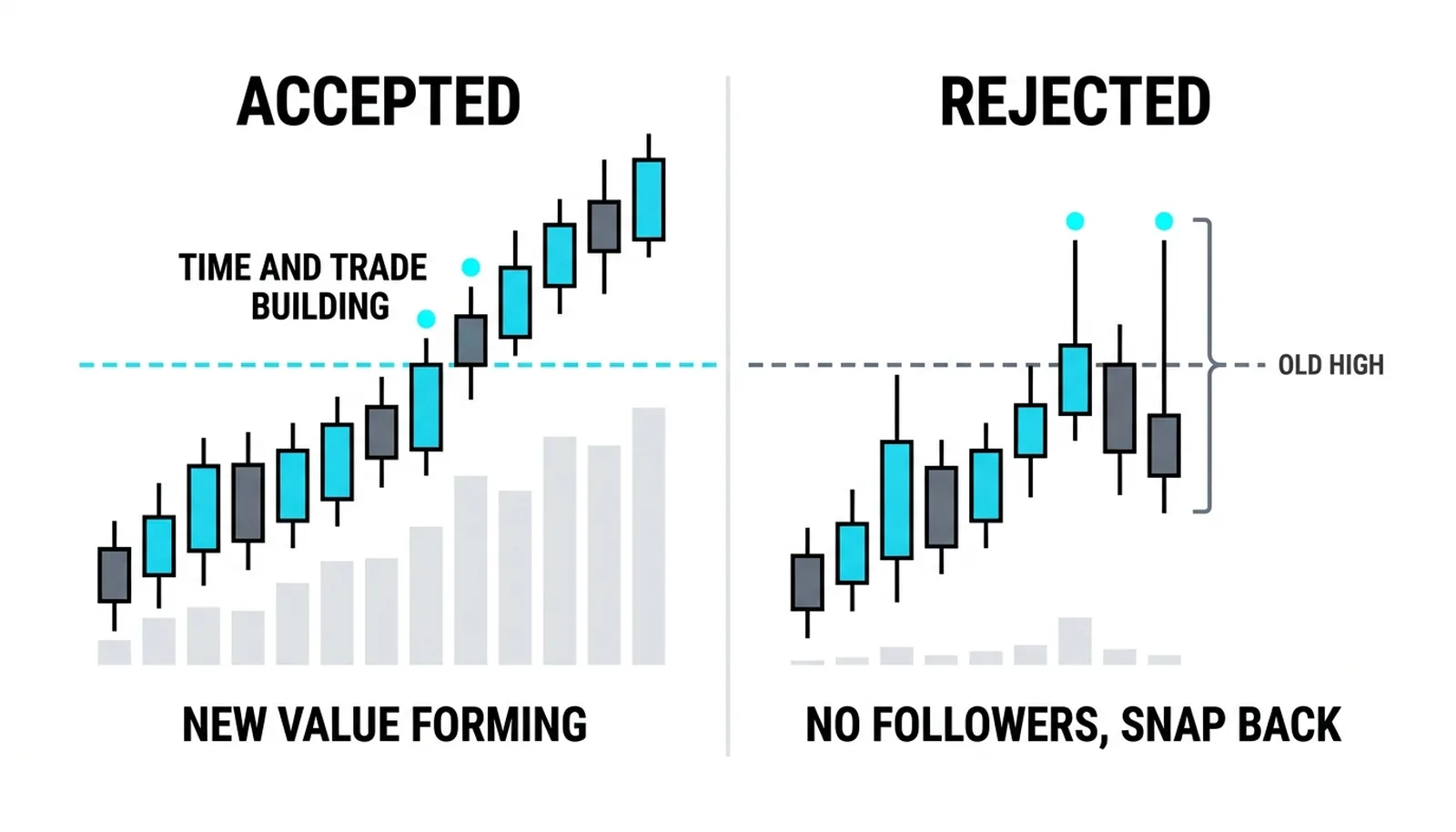
Is price being accepted or rejected? Acceptance looks like time and trade building at a new level. Rejection looks like a fast probe that finds no followers and snaps back. Initiative activity pushes price toward new ground. Responsive activity pushes it back toward value. The coming lessons on initiative versus responsive behavior and balance versus imbalance turn this question into a working method.
One clarity line before the example. Auction market theory is the idea. The Market Profile is one famous display of it, a particular chart format that organizes the auction's data. The theory does not require that chart. Candles, volume, and the three questions are enough to think in auction terms.
One Session, Start to Close
Here is a full hypothetical session read through the auction lens. All numbers are invented round figures for illustration.
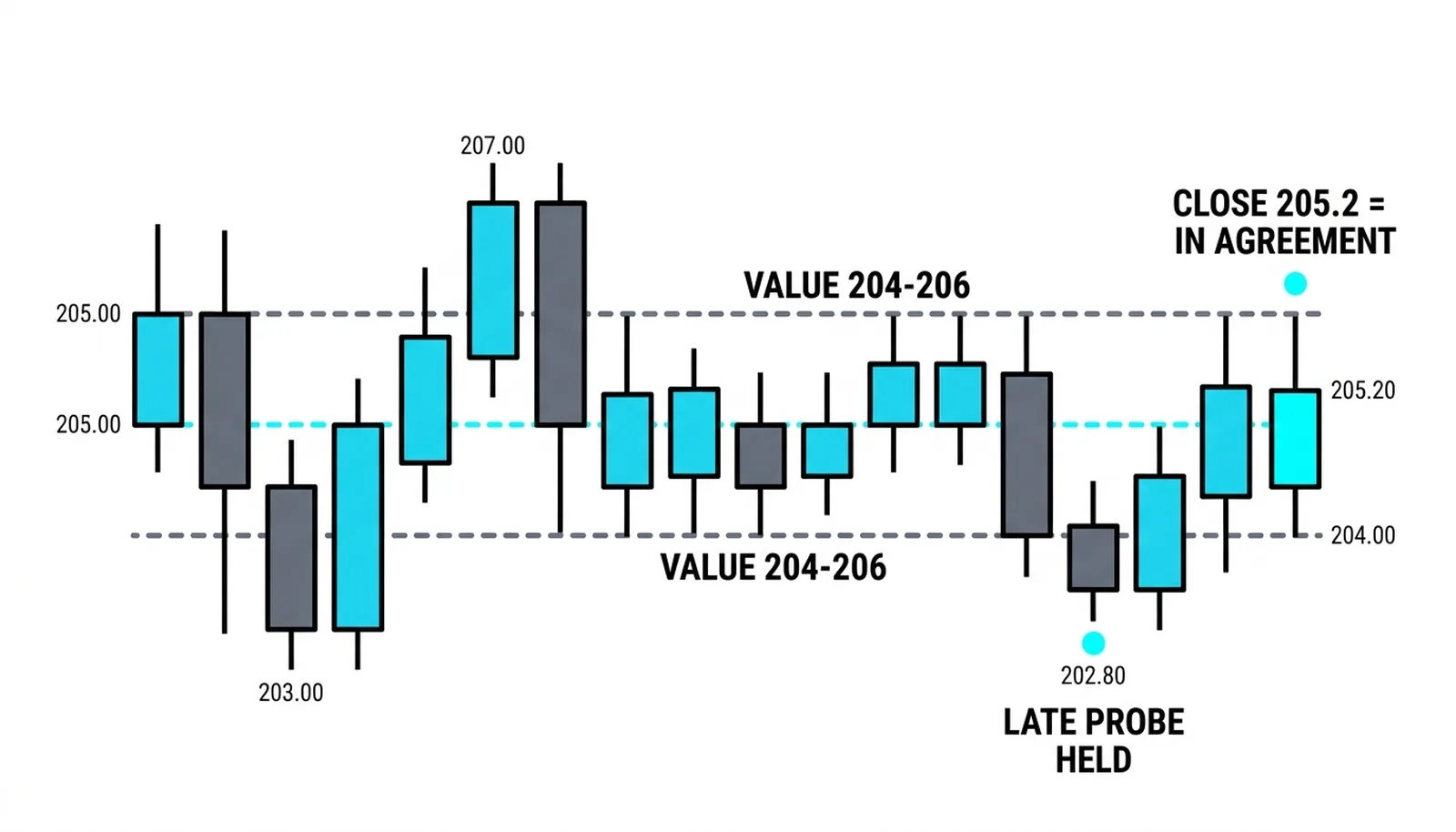
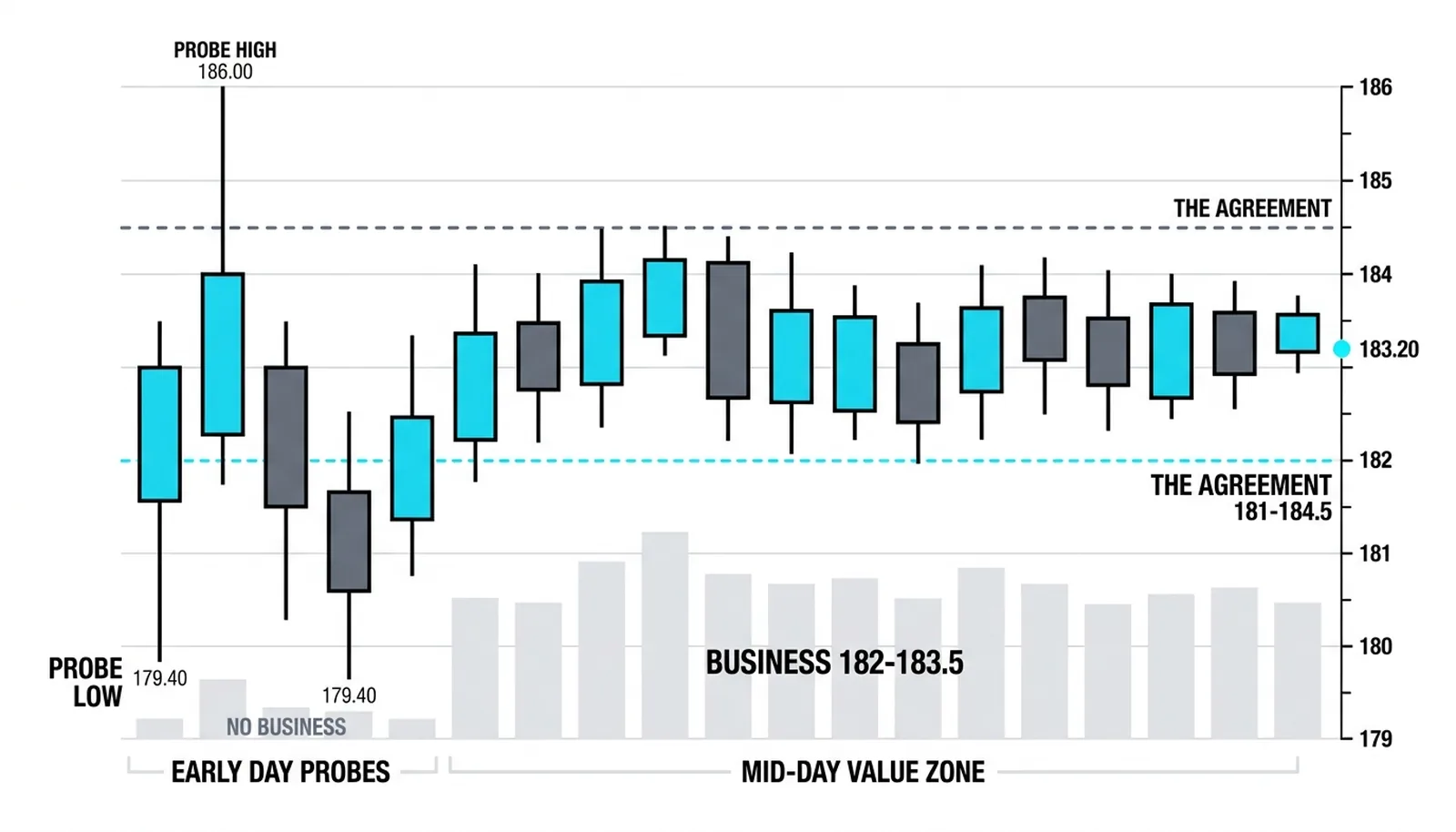
A stock opens at 205. In the first hour, sellers push price down to 203. Buyers do not follow the move lower, trade thins, and price rotates back up. Then buyers push to 207. Sellers do not follow either, trade thins again, and price falls back. Both probes were rejected. The auction tested both directions and found no business at the extremes.
For the middle of the day, business concentrates between 204 and 206. Most of the session's volume trades inside that band. The auction has found its value area, and both sides are transacting there comfortably.
Late in the day, sellers make one more push to 202.8. This time real buyers appear, trade builds at the low, and price holds above it. That probe found responsive buyers willing to do business, so it succeeded where the morning's probe failed, but only as far as attracting defense, not as far as breaking the day's structure.
The session closes at 205.2, near the center of the day's business. A close near the middle of the value area says the auction ended in agreement. Neither side won. Price probed both directions, both were refused, and the market settled where the most trade occurred.
| Auction stage | What price did | What it proved |
|---|---|---|
| Opening probes | Tested 203 and 207, both rejected | No business at the extremes; both sides refused to follow |
| Midday rotation | Trade concentrated between 204 and 206 | Value discovered; both sides accepted this zone |
| Late probe and close | Dipped to 202.8, buyers appeared, closed at 205.2 | Responsive buyers defended the low; session ended in agreement |
Notice what you did not need for any of that. No indicator, no news feed, no forecast. Only the three questions, asked in order, with volume as the evidence.
Auction Market Theory, Answered
What is auction market theory in simple terms?
It is the framework that treats every market as a two-sided auction where price advertises, the crowd responds, and value is discovered through completed business. Every session answers three questions: who is in control, where is value, and whether price is being accepted or rejected.
Is auction market theory the same as Market Profile?
No. Auction market theory is the idea, and the Market Profile is one famous display of that idea. The theory does not require the Profile chart. You can read the auction from ordinary candles and volume once you know the three questions.
What does fair price mean in trading?
Fair price is where the most business actually got done rather than what a formula says the instrument should be worth; it is discovered through completed trade and it moves when the business moves. Markets keep returning to it because both sides already agreed there once.
Why do markets keep returning to value?
Because a price that hosted heavy trade is a price both sides already accepted, and revisiting it is easy while moving away from it takes real pressure. Most sessions rotate around value, and trend appears only when the auction fails to find agreement and must search for a new zone.
Next in this block, the framework gets its measuring tools: the value area and the point of control, the two levels that turn "where is value" from a question into a line on your chart.