Balancing Markets vs Imbalanced Markets
An imbalanced market is one where new information or new money has broken the old agreement and price is being repriced, directionally, with initiative trade in charge. A balancing market is the opposite state: buyers and sellers agree on the current terms, value areas overlap day after day, and responsive trade dominates.

Every market you ever trade sits in one of these two states, or in the transition between them. Think of a tightrope walker, balanced over the same stretch of cable by constant small corrections, until a gust of wind forces a completely different kind of movement, and the wind, not the walker, decides when it stops. Your job is not to predict the gust. Your job is to know which state you are in, because the playbook that wins in one state loses badly in the other.
The preceding lessons covered value, the point of control, and the two kinds of activity, responsive and initiative. This lesson is about the two conditions those pieces combine into, and how one condition hands over to the other. One tie-back worth making: the balancing state is where the Wyckoff campaigns from the earlier lessons do their slow work, with the classic accumulation and distribution framework playing out inside the very ranges this lesson describes.
Balance: The Auction in Agreement
Balance is what agreement looks like on a chart. Day after day, the value areas overlap. The market keeps auctioning through roughly the same prices, and both sides keep showing up to trade there.
The clearest fingerprint is a point of control that will not migrate. If the price where the most business got done sits near the same level for several sessions, neither side is winning. New information is not arriving, or what arrives is not enough to change anyone's mind.
In this state, time does the work. Price rotates from one side of the range to the other, and the rotation itself is the opportunity. The playbook that wins is responsive: fade the edges. When price probes above the established value area, responsive sellers step in and push it back. When it dips below, responsive buyers do the same. The edges hold because both sides treat those prices as unfair, and they act on that judgment.
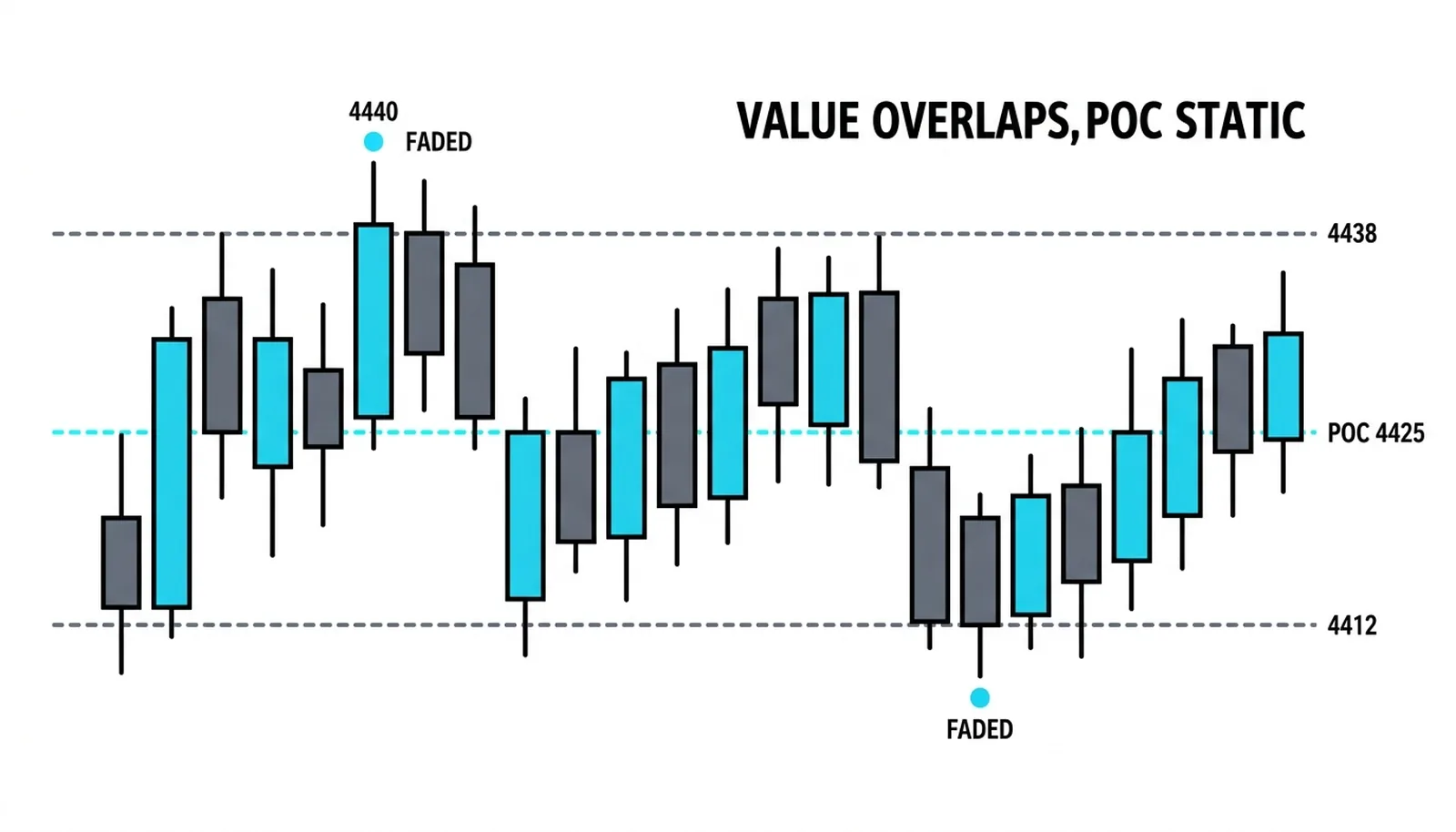
What this means practically is that breakouts are suspect inside balance. A push beyond the range that fails to attract follow-through is exactly the move the responsive trader wants to fade. Most probes fail. That is the defining feature of the state.
One caution. Balance feels boring, and boredom breeds sloppy entries. The edge is in the discipline of selling strength and buying weakness at the extremes, not in the middle of the range where the odds are a coin flip.
Imbalance: New Money Forces a Reprice
Imbalance begins when the agreement breaks. Something changes: news, a shift in positioning, a large new participant. The old prices no longer reflect what the market believes, and the auction moves directionally to find the prices that do.
The classic opening move is a gap. Price opens outside the prior value area entirely, skipping the negotiation. A gap is the market announcing that yesterday's terms are void.
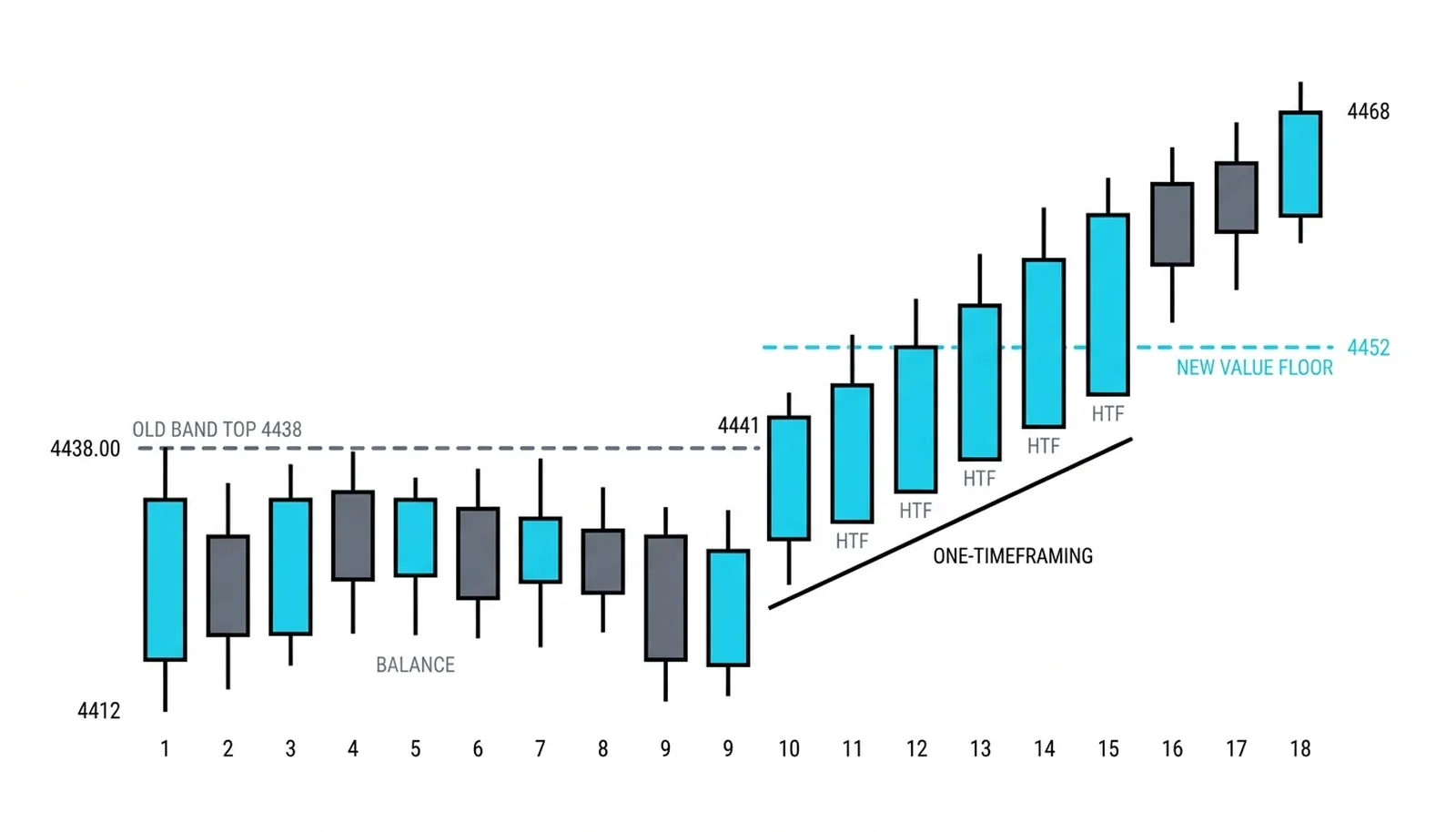
The signature behavior inside imbalance is one-timeframing. One-timeframing means that successive periods, say half-hour brackets, keep printing higher highs and higher lows without ever trading back through the prior period's low. In a downtrend, the mirror: lower lows and lower highs, with no period trading back above the prior period's high. One side is in control the entire session, and the other side never gets a turn.
Then comes the confirmation that matters most: value steps directionally. Day after day, the value area forms higher than the day before, or lower. The market is accepting the new prices, doing business there, and then doing business further along, not merely spiking and retreating. Initiative trade is in charge, and the responsive playbook, fading the extremes, gets run over.
In this state the playbook flips. You trade with the move, on pullbacks that hold, or you stand aside. Fading a one-timeframing market because it feels extended is one of the most reliable ways to donate money.
The Transition
Balance ends when the auction accepts prices outside the old area. Acceptance is the key word. A poke above the range that gets slapped back is not acceptance. Expansion with follow-through is: price breaks out, holds out, and a new value area forms beyond the old one. The moment value builds outside the prior range, the old agreement is dead and imbalance is underway.
Imbalance ends differently. It ends when initiative fails at the extremes. The directional push stalls, the one-timeframing breaks, and value stops stepping. Price starts rotating around a level instead of marching away from it. That pause is the birth of the next balance, often at prices far from where the last one lived.
Two honesty beats belong here. First, these states are read in hindsight at their edges. A fading move inside balance looks exactly like the start of imbalance until it does not, and a stalling trend looks like a new balance until the trend resumes. This is why the evidence outranks the speed of the move. Accepted prices and stepped value are the proof. A fast candle is not.
Second, imbalance is not automatically an opportunity. By the time value confirms the reprice, much of the move has already been paid for. The practical edge is knowing which state you are in so the right playbook is on the table and the wrong one is put away, not catching the transition perfectly.
Three Quiet Days, Then the Gap
Imagine an index, all numbers hypothetical and round. For three sessions it balances. The value areas overlap heavily, each sitting roughly between 4,412 and 4,438. The points of control print at 4,425, then 4,427, then 4,424. The POC will not migrate. The market agrees.
During those three days, the playbook is responsive. A probe to 4,440 gets sold back into the range. A dip toward 4,410 gets bought. Time is doing the work, and the fades keep paying.
On the fourth day, news hits and the index opens at 4,441, above the old high. That open alone proves nothing. Gaps can fail. The first four half-hour periods then print consecutively higher highs and higher lows, with no period trading back through the prior period's low. That is one-timeframing, and it says initiative buyers are in charge and responsive sellers are absent.
The session closes at 4,468, and the day's value area prints from 4,452 to 4,466, stepped fully above the old 4,412 to 4,438 band, with no overlap at all. That is the confirmation. The auction has accepted prices outside the old area and built new value beyond it. The reprice is real.
Now the old 4,438 area changes roles. What was the top of the agreement becomes a reference level below, the kind of zone pullbacks are measured against. If the market later revisits 4,438 and holds, that is the old ceiling acting as a floor, and bulls treat it as defended ground.
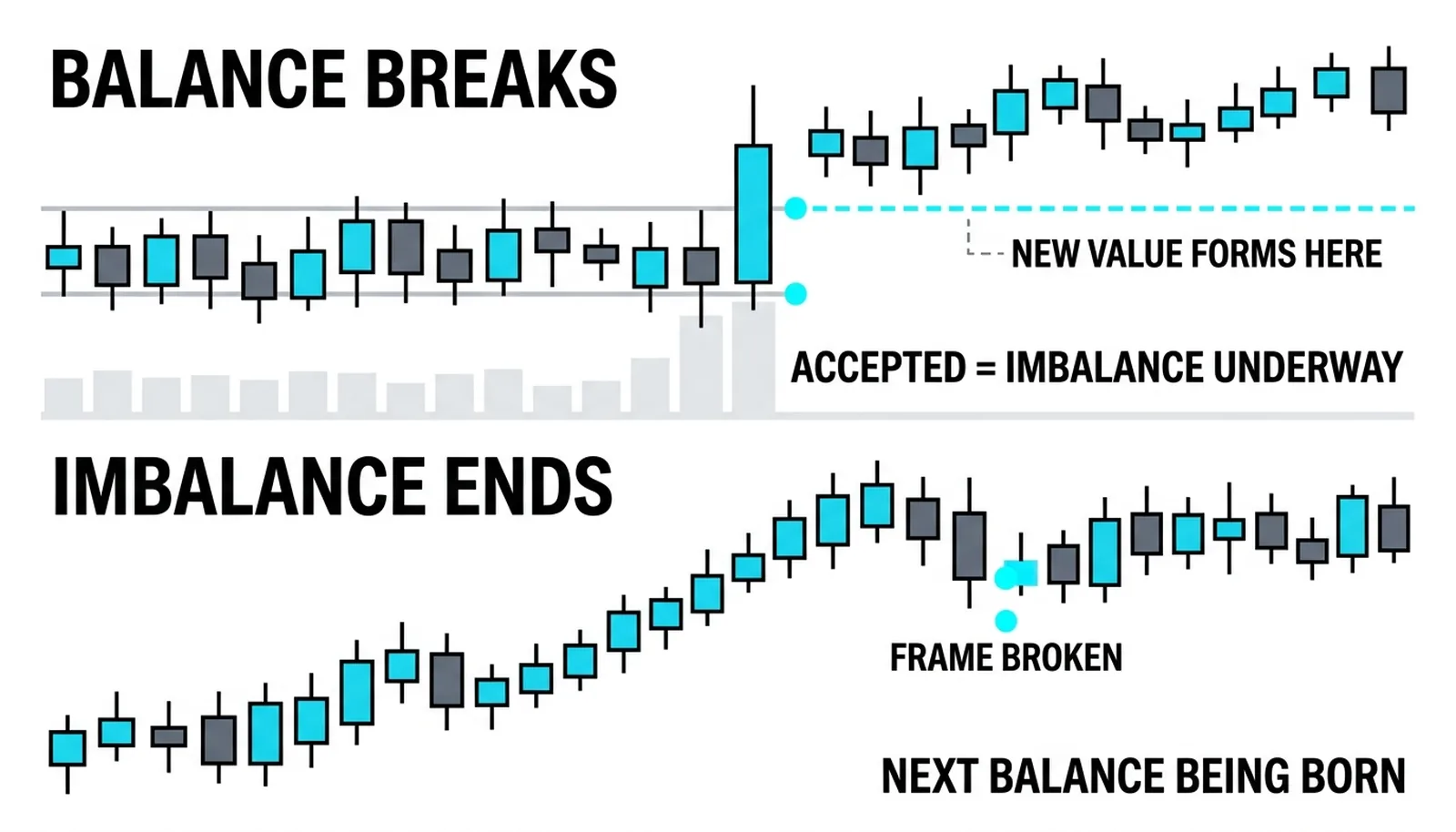
What ends this phase? Watch for the one-timeframing to stop. When a period finally trades back through a prior period's low, when value stops stepping higher and starts overlapping, initiative has failed at the extremes. That pause is the next balance being born, and the playbook flips back to responsive.
| State or Event | Value Behavior | Playbook That Wins | Signal It Has Ended |
|---|---|---|---|
| Balance | Value areas overlap day after day; POC static | Responsive fades at the range edges | Price accepted outside the old area, new value forming beyond it |
| Balance breaking | Expansion out of the range with follow-through | Stop fading; wait for confirmation of acceptance | New value area forms fully outside the old one |
| Imbalance | Value steps directionally day after day | Trade with the move on pullbacks that hold | One-timeframing breaks; initiative fails at the extremes |
| Imbalance ending | Value stops stepping, begins to overlap | Stand aside or prepare the responsive playbook | Rotation around a level confirms a new balance |
Balancing and Imbalanced Markets, Answered
What is a balancing market in trading?
A balancing market is one where buyers and sellers agree on current prices, so value areas overlap session after session and the point of control stays put. Responsive trade dominates, and the winning tactic is fading moves at the edges of the range.
What does imbalance mean in the market profile?
In market profile terms, imbalance means the auction is repricing directionally because the old agreement has broken. You see gaps, one-timeframing, and value areas stepping higher or lower day after day, with initiative trade in control.
What is one-timeframing?
One-timeframing is when successive periods keep printing higher highs and higher lows, or the mirror in a downtrend, without any period trading back through the prior period's extreme. It shows one side controls the entire session.
How do you know when a balance is breaking?
A balance is breaking when the auction accepts prices outside the old value area, meaning price expands out of the range, holds there, and builds a new value area beyond it. A fast poke that fails is not a break; acceptance and stepped value are the proof.
Next, the volume block turns to the tools that measure these states directly: how the profile is drawn, how the day's shape is classified, and how to read the open for clues about which playbook the session will demand.