The Value Area: Where Price Is Accepted
The value area is the price range where roughly seventy percent of a session's completed business took place, the zone both sides of the auction actually accepted as fair. It is bounded by the value area high and the value area low, and it centers on the single price where the most volume printed. Everything else on a volume profile hangs off these lines.

Think of a neighborhood where most houses sell within one price band every season, because buyers and sellers quietly agree that band is fair, while the odd sale far above or below proves nothing about the area. The value area is that band, measured from the tape rather than from asking prices. It shows where agreement happened, not where anyone hoped it would.
The Edges of Agreement
The previous lesson covered the discovery loop itself, the auction probing up and down until trade gets done. This lesson measures what that loop produced. The measurement starts with two lines.
The value area high marks the upper boundary of the range holding about seventy percent of the session's volume. The value area low marks the lower boundary. Inside those two lines sits the bulk of the day's negotiated business. Above the high, buyers pushed but found few sellers willing to deal. Below the low, sellers pushed and found few buyers.
Between them sits the point of control, the single price that printed the most volume all session. It is the center of gravity of the day's trade, and it earns its own lesson next. For now, treat it as the anchor the two edges are drawn around.
The classic accumulation and distribution framework taught a version of this idea long before profile software existed, reading where the composite operator did business and where they refused to. The edges matter because they are falsifiable. Price either respects them or it does not, and both outcomes carry information.
Acceptance Versus Rejection
Acceptance means price spends time inside the area and volume builds there. Rejection means a quick excursion outside with almost no business transacted and a fast return. Time and volume are the tell, not the excursion itself.
A poke above the value area high that lasts twenty minutes and prints thin volume is a failed auction. The market tested new terms and the other side declined. Price falls back into the range, and the old agreement still governs.
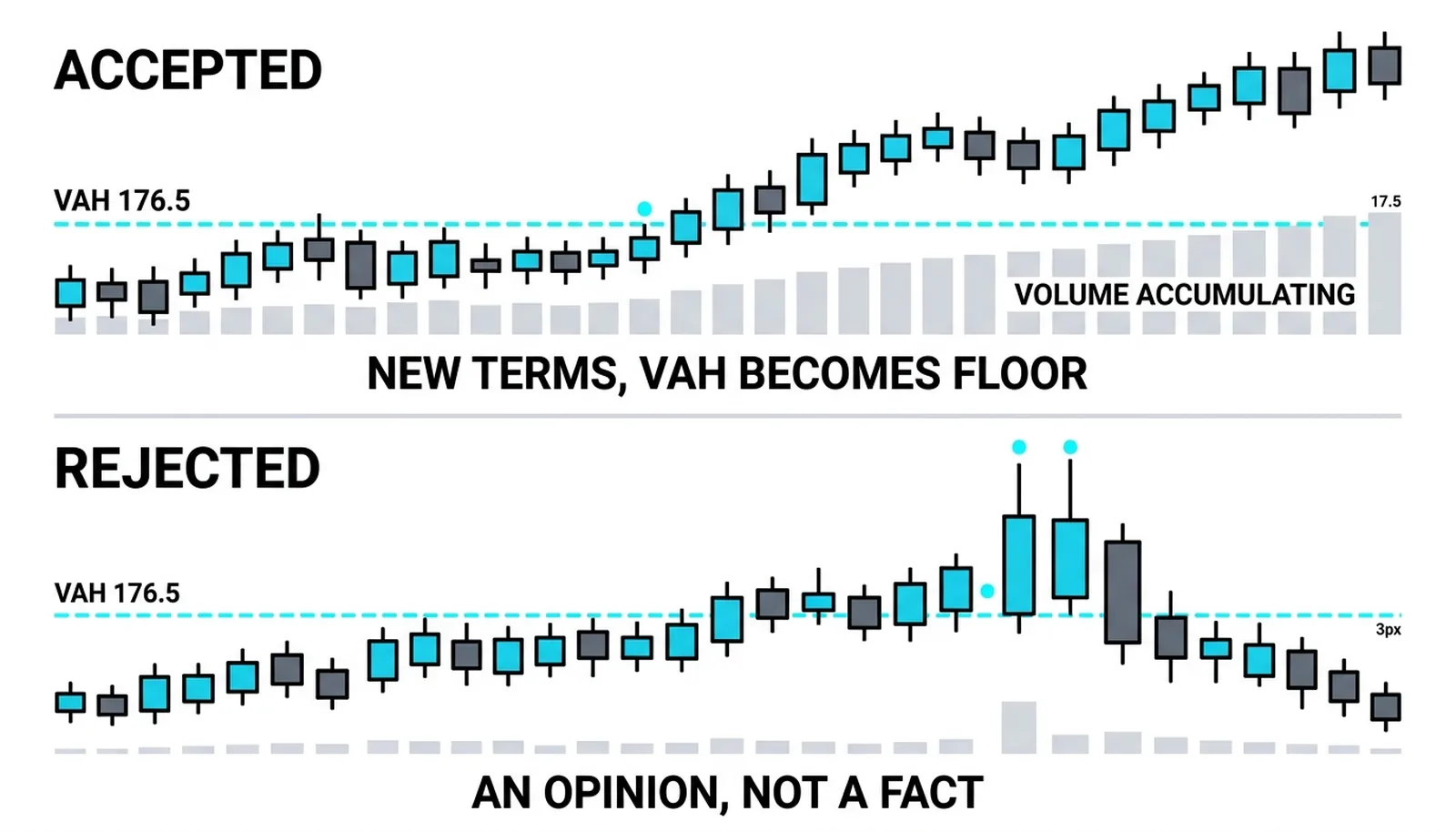
A move above the high that holds, builds volume, and keeps printing business at the new level is something else entirely. That is acceptance at new terms. The market has renegotiated, and yesterday's value area high stops being a ceiling and starts acting as a floor candidates.
- Accepted: time passes, volume accumulates, pullbacks are shallow, and the level trades from both sides.
- Rejected: a fast spike, empty volume at the extreme, and a return to the prior range with momentum.
A level without volume behind it is an opinion, not a fact.
The Eighty Percent Rule
One of the most quoted tendencies from the market profile tradition concerns what happens after the market opens outside the prior day's value area. The setup has three parts, and each part must be present.
First, the session opens outside the previous value area, above the high or below the low. Second, price holds outside through the first two half-hour periods, refusing to re-enter the old range. Third, the read: the tradition holds that the odds then favor a rotation back through the entire prior value area, edge to edge. Practitioners call this the eighty percent rule.
Teach it to yourself as a conditional tendency, never a promise. The logic is sound: an open outside value that cannot attract follow-through is a rejected open, and a rejected open tends to travel back across the area where business actually lives. But the one-in-five failure case is the important one. When price opens outside, holds, and never rotates, the market is accepting new terms, and that alternative outcome often marks the start of a genuine repricing.
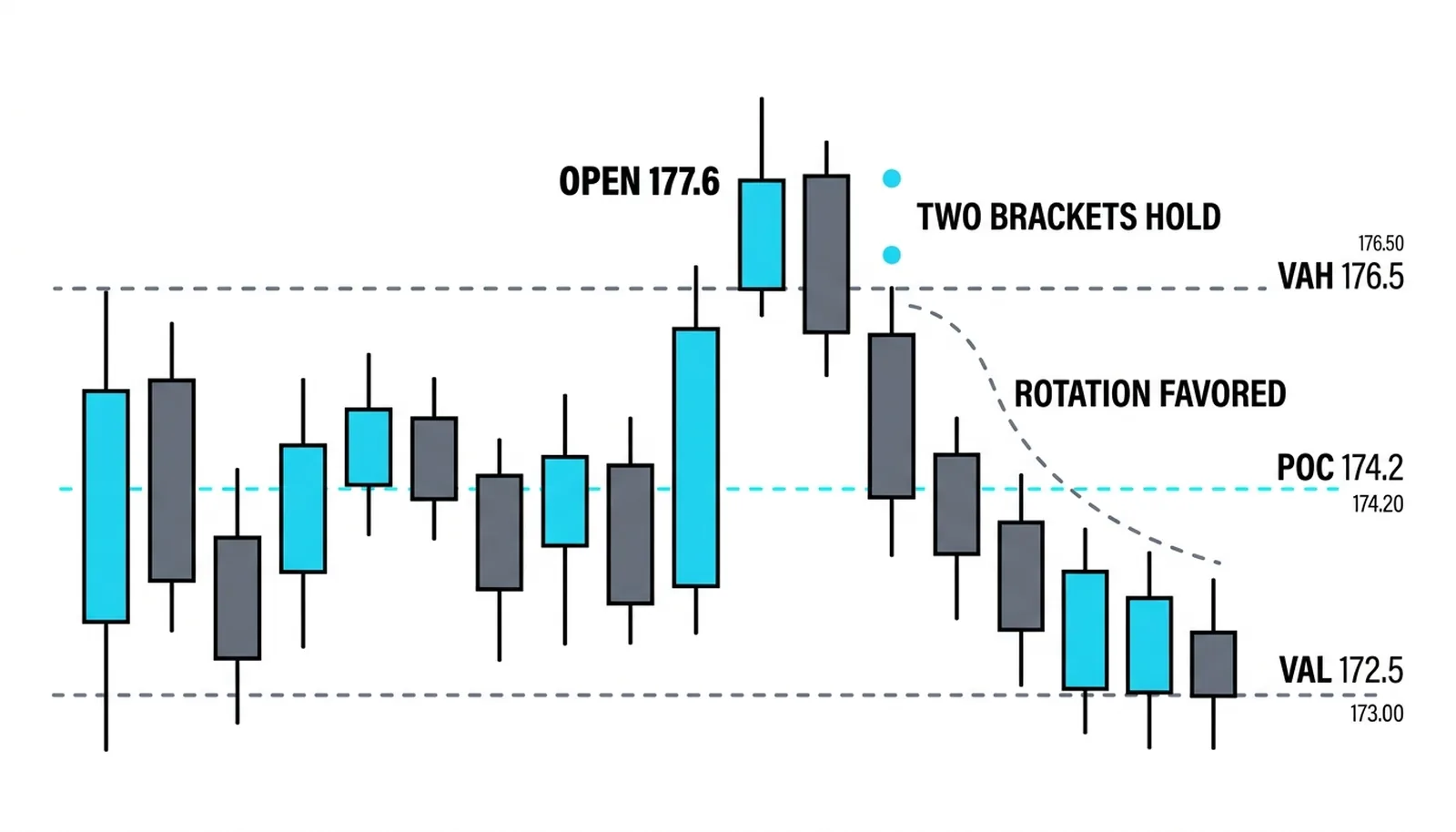
Two half-hour brackets is the classic filter because it weeds out the opening noise. A brief dip outside that snaps back within minutes tells you little. Sustained refusal to re-enter tells you the probe has failed in a meaningful way.
One Profile, Measured
Here is a fully hypothetical session with round numbers, built only to show the read at each step.
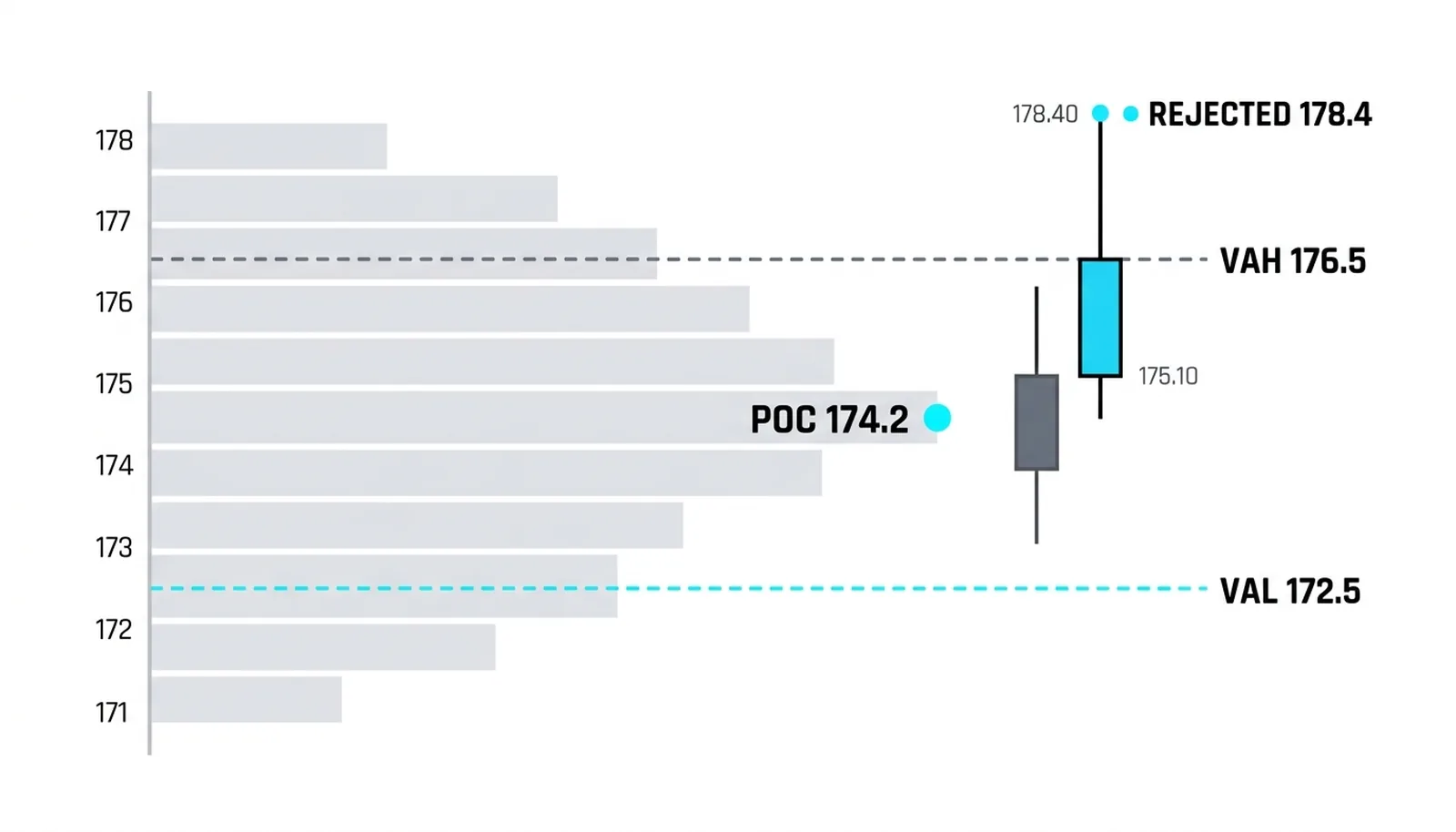
A stock's session profile shows the heaviest single price at 174.2. Business thins in both directions from there until seventy percent of the day's volume sits between 172.5 and 176.5. The measurement is done: value area low 172.5, value area high 176.5, point of control 174.2.
During the first hour, price probes up to 178.4. Almost no volume trades there. Within twenty minutes the stock is back under 176.5. That excursion is rejection: the market tested higher terms, found no willing business, and retreated. The session closes at 175.1, inside the area, above the point of control. The old agreement held.
The next morning opens at 177.6, above the prior value area high. Price holds above 176.5 through the first two half-hour brackets. Now the eighty percent rule applies: the conditional read favors a rotation back through the entire prior area, down toward 172.5. The alternative, acceptance above 176.5 with volume building up there, would flip the read to repricing higher.
| Level | Definition | What It Means | What Flips the Read |
|---|---|---|---|
| Value area high (176.5) | Upper edge of the range holding 70% of volume | Ceiling of yesterday's agreement | Acceptance above it with volume building |
| Value area low (172.5) | Lower edge of the range holding 70% of volume | Floor of yesterday's agreement | Acceptance below it with volume building |
| Point of control (174.2) | Single price with the most volume | Center of the day's negotiation | A new session building its heaviest volume far away |
| Open outside value (177.6) | Open beyond the prior area, held two brackets | Rejected open, rotation odds rise | Failure to rotate, acceptance at new terms |
Two honesty points belong here. First, the seventy percent figure is a convention, not a law of nature. Different platforms compute the value area slightly differently, using different tick groupings and rounding. Compare structure across tools, never decimals. A value area high of 176.5 on one platform and 176.4 on another is the same line.
Second, a single day's value area describes one negotiation. Value is only meaningful in sequence. Today's area versus yesterday's tells you whether the market is repricing higher, repricing lower, or agreeing to keep the old terms. Overlapping areas day after day signal balance. Areas that march steadily upward or downward signal a market actively moving its estimate of fair price.
Value Area, Answered
What is the value area in trading?
The value area is the price range containing roughly seventy percent of a session's traded volume, bounded by the value area high and low and centered on the point of control. It marks where the auction actually did business, which traders read as the zone both sides treated as fair.
What are value area high and value area low?
They are the upper and lower boundaries of that seventy percent range. Above the high, the market found too little business to sustain trade; below the low, the same in the other direction. Both lines act as reference points for the next session's acceptance or rejection tests.
What is the 80 percent rule in market profile?
It is a conditional tendency from the profile tradition: when price opens outside the prior value area and holds outside through the first two half-hour periods, the odds favor a rotation back through the entire prior area. It is a tendency with a meaningful failure rate, and the failure case, acceptance at new terms, is itself a strong signal.
How do you know if price has accepted a level?
Acceptance shows up as time plus volume: price dwells at the level, business accumulates there, and pullbacks stay shallow. Rejection looks the opposite, a fast probe, thin volume at the extreme, and a quick return to the prior range.
Next in this block, the point of control gets its own lesson: why the single heaviest price of the session behaves differently from the edges, and how traders use it as a pivot, a reference, and a lie detector for breakouts.