Point of Control: Where Volume Concentrates
The point of control is the single price where volume concentrates most heavily in a session, the price where more contracts, shares, or lots changed hands than at any other level that day. It is the market's fairest price for that session, the level both buyers and sellers agreed on most often. And it is the level price keeps returning to, as long as both sides still accept the old terms.

Think of it as a village well. Nearly every bucket of the day is drawn there because that is where the most people agreed to come, and everything else in the village is arranged around trips to it.
The Fairest Price on the Profile
When you built a horizontal volume profile in the earlier lesson on vertical versus horizontal volume, the point of control appeared as the longest bar on the histogram. That lesson named it in passing. This lesson owns it, and it owns the center of the value area while the previous lesson owns the value area itself.
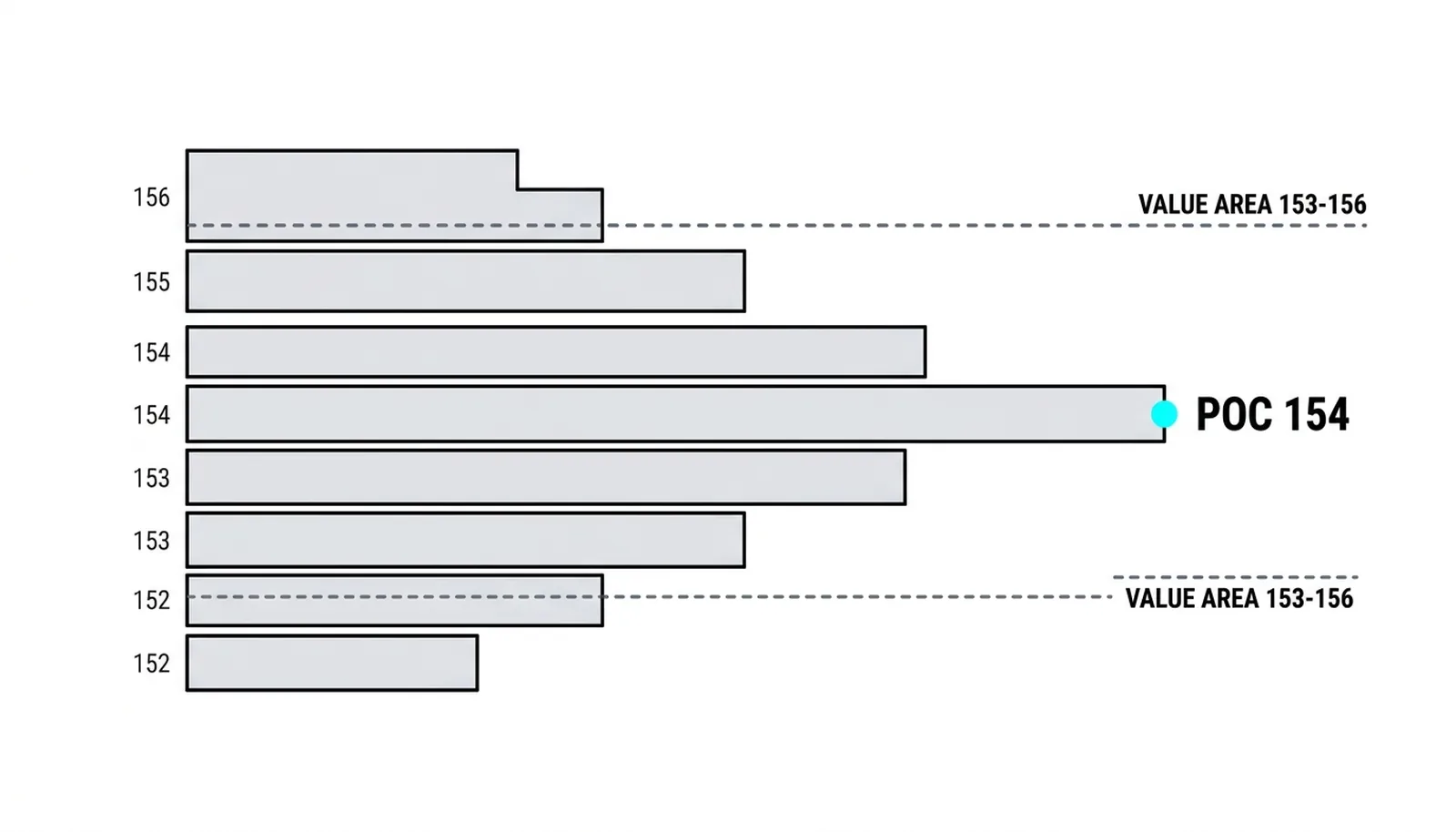
The mechanics are simple. Every trade prints at a price. Add up all the volume at each price across the session, and one price wins. That winner is the point of control, usually shortened to POC.
Why does volume concentrate at one price? Because that is where disagreement was cheapest to settle. Buyers felt they were not overpaying. Sellers felt they were not giving the asset away. Both sides could do size there without regret, so they did.
That makes the POC a measure of conviction, more than raw activity. A price where a few panicked orders crossed is noise. A price where the largest share of the day's business cleared is a negotiated agreement.
The classic accumulation and distribution framework builds the method on this idea of the market as a negotiation between large interests, and the POC is the modern volume-profile expression of where that negotiation settled.
One blunt point: the POC is a fact, not an opinion. You do not draw it, you read it. Either the volume printed there or it did not.
What the Market Does at the POC
Price returns to the POC because that is where the unfinished business lives. Stops sit near it. Entries that traders planned but missed cluster around it. Fills that large participants still need to complete tend to get worked at the price where the most liquidity already proved itself.
The revisit itself carries information. There are two versions, and they mean opposite things.
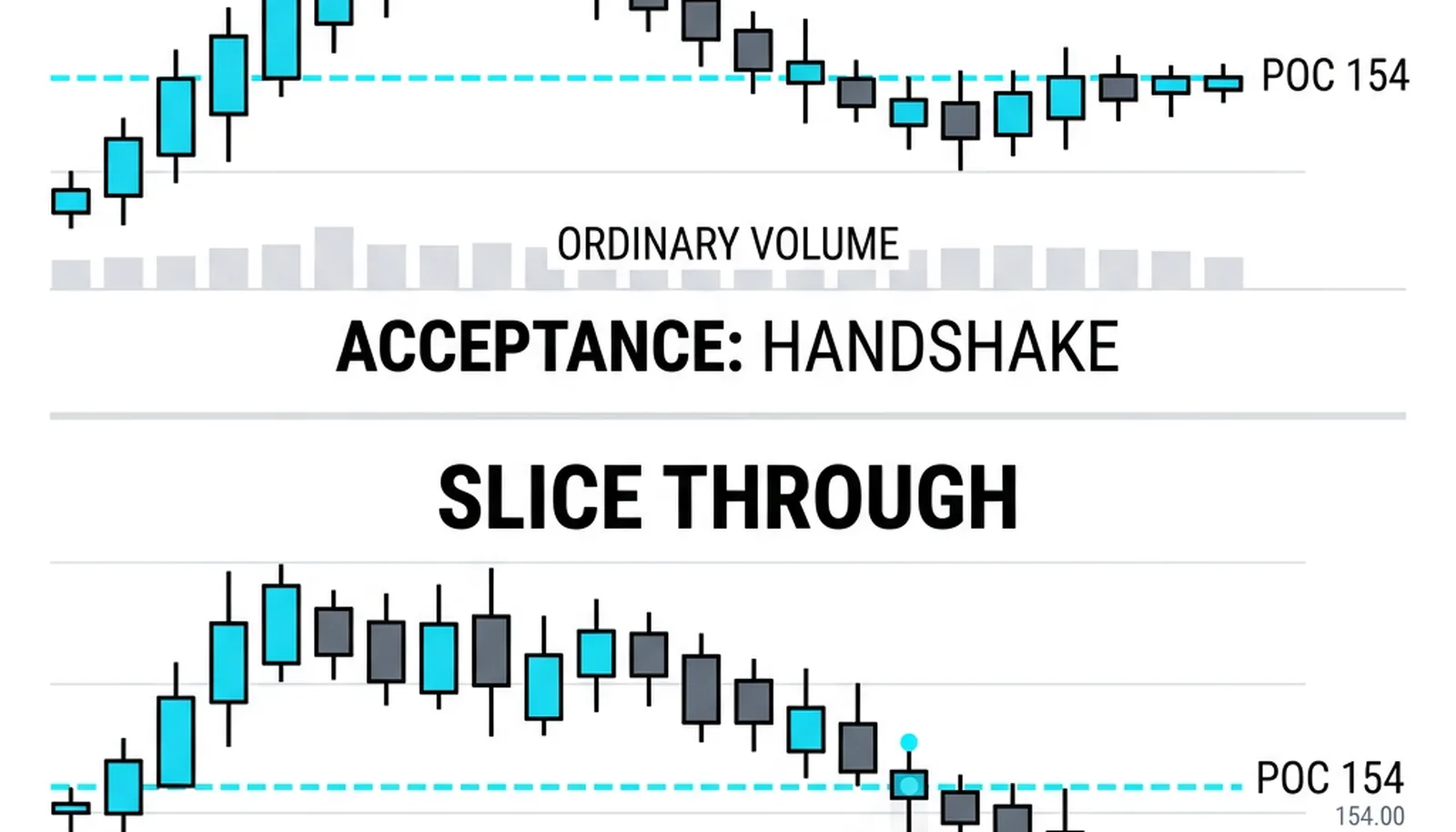
An orderly return that holds is acceptance. Price drifts back to the POC on ordinary or declining volume, trades there, and stabilizes. The market is confirming that the old agreement still stands. Both sides looked at the level again and shook hands.
A return that slices through on expanding volume is repricing. Price arrives at the POC and does not pause. It cuts through with heavy participation. The market is saying the old terms no longer apply, and the agreement is being torn up in real time.
The distinction matters more than the level itself. A trader who treats every touch of the POC as support will buy the slicing break and get run over. A trader who reads the volume behavior at the level knows which version they are watching.
Two honesty beats belong here. First, the POC is a level, not a force. Price is not magnetically required to visit it. Treating every excursion away from the POC as a guaranteed pilgrimage back turns a description into a superstition, and superstitions are expensive.
Second, on fast or illiquid days the POC can land on a spike of thin volume, a price where one burst printed and nothing else happened. Such a POC means little. The surrounding shape of the profile is part of the reading, and a lopsided profile with a lonely peak deserves skepticism, not confidence.
POC Across Days
One session's POC tells you where that day agreed. Several sessions of POCs tell you whether the agreement is holding.
When three or more consecutive sessions print their POCs at nearly the same price, the market is in balance. Each day, the full weight of trading activity re-confirmed the same fair price. Neither side has found a reason to renegotiate. The market is agreeing to keep the old terms.
Balanced markets frustrate breakout traders and reward patience. Price rotates around the shared POC, excursions fail, and the value area from the previous lesson keeps overlapping day after day.
A migrating POC tells the opposite story. When each day's point of control steps higher than the last, or lower than the last, the market is repricing its agreement. Yesterday's fair price is being abandoned in an orderly way, with volume following the move rather than fighting it.
This is the sequence read that matters. A static cluster of POCs says wait, or trade the rotation back toward the level. A marching line of POCs says the balance has broken and the auction has moved. The direction of the migration is the direction of the new agreement.
Three Days at One Price
The following numbers are invented and round, purely to illustrate the read. Imagine three consecutive sessions on a hypothetical instrument.
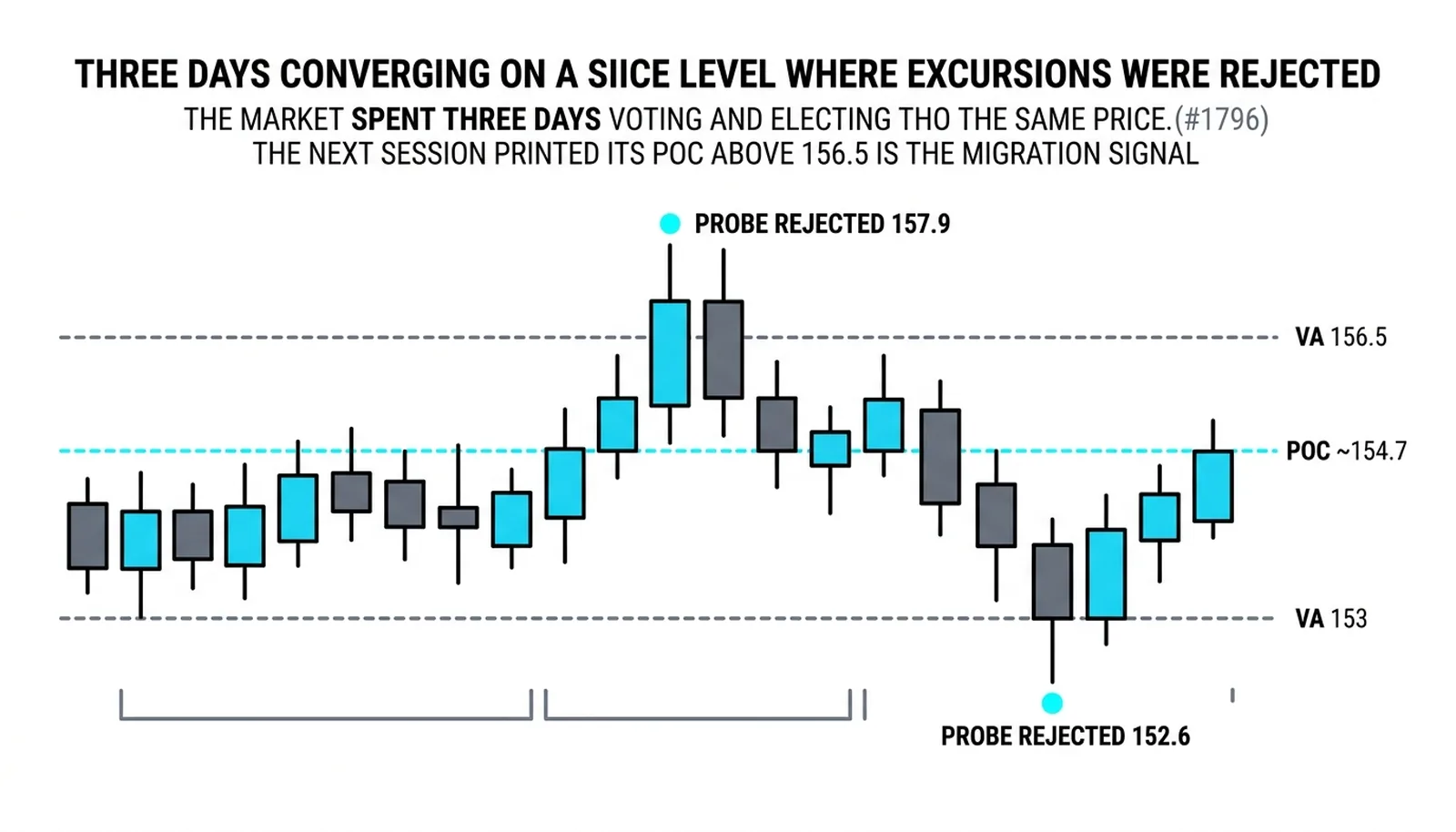
Day one prints a point of control at 154.6, with a value area running roughly from 153 to 156.5. Day two prints its POC at 154.8. During that session price runs up to 157.9, finds no volume willing to follow, and is back at 155.2 within an hour. Day three prints its POC at 154.5. Early that morning price dips to 152.6 in the first hour, then recovers and closes at 154.9, a few cents from the POC.
Read each excursion. The run to 157.9 was a probe above the agreed zone. Volume refused to participate at those prices, so the auction returned to where business had been done. The dip to 152.6 was the same test on the downside, and it met the same answer. Both excursions failed, and both failures confirmed the same center.
The three POCs, 154.6, 154.8, and 154.5, sit within a fraction of a point of each other. Each day's value area overlaps the last. That is balance, plainly stated. The market spent three days voting and kept electing the same price.
Now the repricing signal. Suppose the next session prints its POC above 156.5, with the whole value area stepping up alongside it. That is the migration. The agreement has moved, volume has followed, and the old center near 154.7 becomes history rather than a reference.
| Session | Point of Control | The Excursion | The Read |
|---|---|---|---|
| Day one | 154.6 | None, range holds 153 to 156.5 | Terms established |
| Day two | 154.8 | Spike to 157.9, back at 155.2 within an hour | Upside probe rejected, balance holds |
| Day three | 154.5 | Dip to 152.6, closes at 154.9 | Downside probe rejected, balance holds |
| Day four (hypothetical) | Above 156.5 | Value area steps up with it | Repricing, old agreement abandoned |
Point of Control, Answered
What is the point of control in trading?
The point of control is the single price where the most volume traded during a session, read off a horizontal volume profile. It represents the price both buyers and sellers accepted most often, making it the day's fairest price and the center of the value area.
Why does price return to the POC?
Price returns to the POC because that is where the most business was transacted, so unfinished orders, stops, and planned entries cluster there. A return on orderly volume that holds signals acceptance of the old terms, while a slice through on expanding volume signals repricing.
What does a migrating point of control mean?
A migrating POC means the market is repricing its agreement. When each session's point of control steps steadily higher or lower, with the value area following, the old fair price is being abandoned in an orderly, volume-supported way. The direction of the migration marks the direction of the new consensus.
Is the POC the same as the volume-weighted average price?
No. The POC is the single price with the most traded volume, while VWAP is a running average of all prices weighted by volume across the session. The two often sit near each other in balanced markets, but they measure different things and can diverge sharply on trending days.
The next lesson widens the lens again, from the single busiest price to the behavior that surrounds it: initiative versus responsive activity, and how to tell which side is driving the auction and which side is only reacting to it.