The Composite Man: Reading Smart Money
The composite is the single most useful character in the entire Wyckoff method, and the word belongs in your vocabulary from this lesson forward. The composite man is a mental device: you read the market as if one skilled operator stood behind every price move, buying quietly into weakness, selling quietly into strength, and running campaigns in stages. The tangle of millions of orders becomes one mind you can reason about.

That sounds like mysticism. It is not. It is compression. When you watch a chart and ask what "the market" is doing, you get noise for an answer. When you ask what one patient, well-funded, unsentimental trader would be doing at this exact spot, the chart starts making sense. The device turns chaos into intent.
Think of a ghostwriter whose style is recognizable across unsigned pages: the tape is unsigned too, but the hand leaves a style. The classic accumulation and distribution framework holds that the style repeats because the job repeats. Someone large must always build a position without paying up for it, and must always unload one without giving it away. That constraint shapes every chart you will ever read.
The previous lessons covered the three laws and the location principle. Those were the rules of the game. This lesson introduces the player the whole method assumes.
Who the Composite Man Is
Wyckoff built this idea in the tape-reading era, around the Magazine of Wall Street, which launched in 1907. Decades of interviewing and observing the great operators of the day showed the same playbook converging across different operators. Wyckoff folded them into one fictional figure and taught students to trade against that figure's logic.
The core claim is simple. Chart patterns are not random geometry. They are the trace of one planning mind executing a campaign: accumulate, mark up, distribute, mark down. If a mind planned it, a mind can read it.
You already know this character by other names. Smart money. Institutions. The inside crowd. Every generation of traders invents a fresh label for the same observation: size moves differently than noise, and size leaves traces.
The names change because the behavior does not. A pension fund building a position over six weeks faces the same problem a 1920s pool operator faced. Too big to buy all at once. Too visible to buy aggressively. Forced to be patient, and forced to be sneaky.
The Operator's Habits
Three habits define the composite man, and each one leaves a signature you can actually see on a chart.
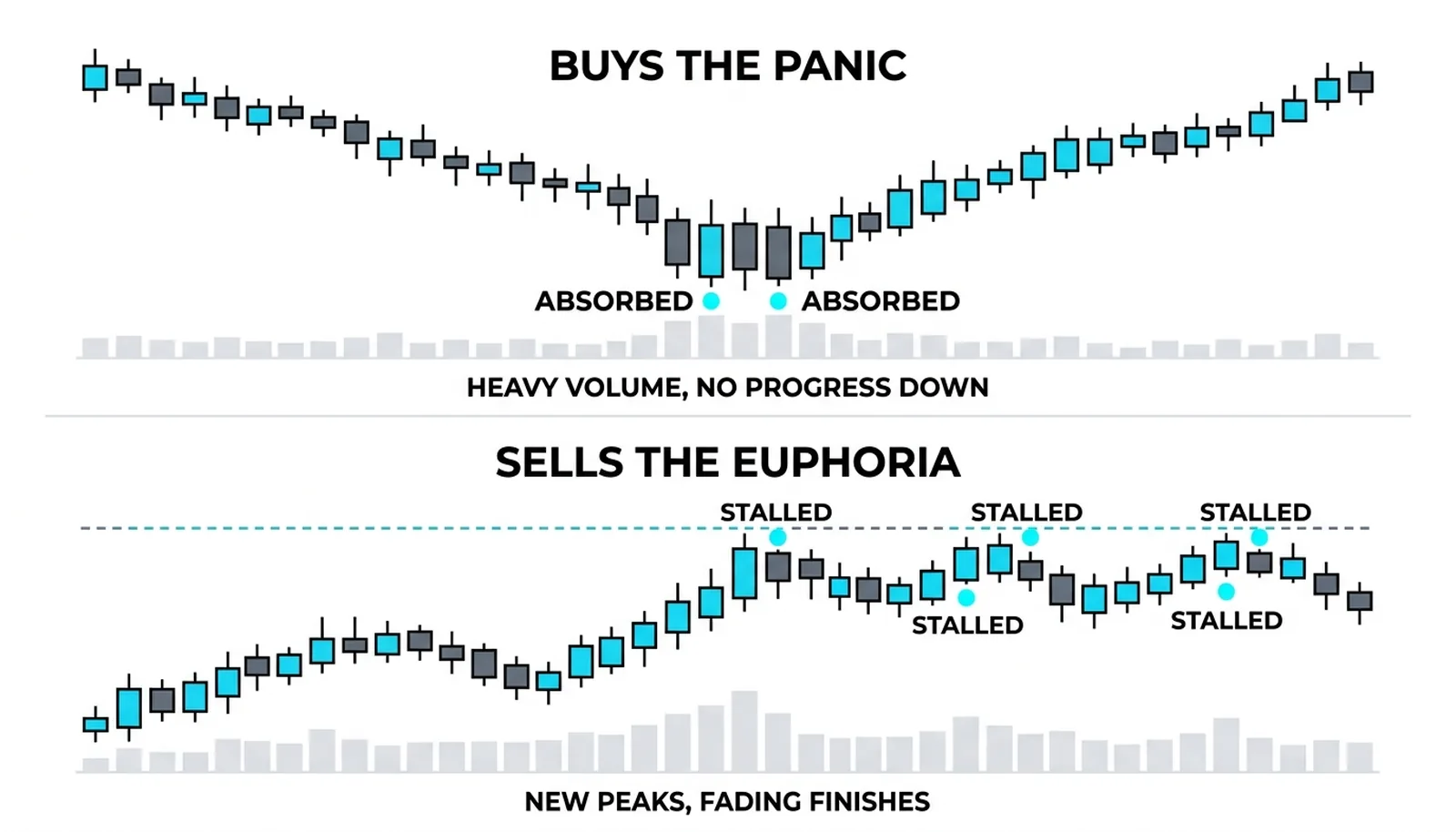
The operator buys into weakness, because that is where sellers of size can be found. Nobody hands you a large position at a good price out of generosity. Large sellers appear during fear, when holders capitulate and beg for a bid. The observable signature is absorption at support: heavy volume on down moves, but price stops falling. Someone is catching everything thrown at the market, the stopping volume signature from earlier in this level.
The operator sells into strength, because that is where buyers of size can be found. Euphoric rallies bring eager buyers to the door, and eager buyers absorb huge supply without flinching. The signature is fading rallies into highs: price pushes to new peaks on strong volume, then stalls or slips, again and again, as if a ceiling keeps reappearing.
The operator needs a crowd. Accumulation requires panic to buy from. Distribution requires euphoria to sell to. No emotion, no counterparty. This is why climaxes matter so much in Wyckoff analysis: the emotional extreme is not the end of the operator's interest, it is the moment the largest transactions become possible.
One more habit ties the rest together. The biggest positions are hidden inside ordinary-looking bars. A bar that prints millions of shares and closes mid-range looks unremarkable to a casual glance. That is the point. Loud volume with quiet price is the operator's camouflage, and learning to spot it is most of the skill.
How to Use the Device
The device changes one question. You stop asking "why did price move?" and start asking "what was the operator doing?" The first question invites speculation about news and motives you cannot verify. The second invites observation of behavior you can measure.
The payoff is coherence. Read separately, absorption at support, a selling climax, and a quiet range look like three unrelated events. Read through one mind, they become chapters of a single campaign: shake out the weak hands, buy the panic, rest while the position fills. The same facts, re-read through one narrator, connect into a story with a direction.
Build the habit at the level of individual fills. Every time you buy, someone sold to you. Every time you sell, someone bought from you. Ask who is likely on the other side of this fill and why they want it. If you are panic-selling near a low after weeks of decline, there is a decent chance the other side is exactly who the classic accumulation and distribution framework warned you about.
This discipline also cools your own emotions. The composite man profits from your feelings, so treating your fear and greed as the device's raw material makes you less willing to hand them over.
A Model, Not a Person
Now the honesty, because this idea invites abuse. The composite man is a model, not a person. Today's tape holds millions of participants and armies of algorithms, and no single figure directs the show. The device compresses their net activity into one character so you can reason about it.
The model earns its keep because campaign-shaped behavior is real. Large positions genuinely cannot be built or unwound instantly, so the traces of size genuinely cluster into phases. But the measurements, not the narrative, do the proving. Volume, spread, and progress either confirm the story or they do not.
What the model cannot do is convict anyone. You will never know who bought or why. The operator is a character you read the tape through, not a suspect you convict.
Traders who forget this slide into conspiracy thinking, where every loss is manipulation and every move is a trap set personally for them. That framing feels sophisticated and teaches nothing. Keep the device, drop the paranoia.
One Range, One Mind
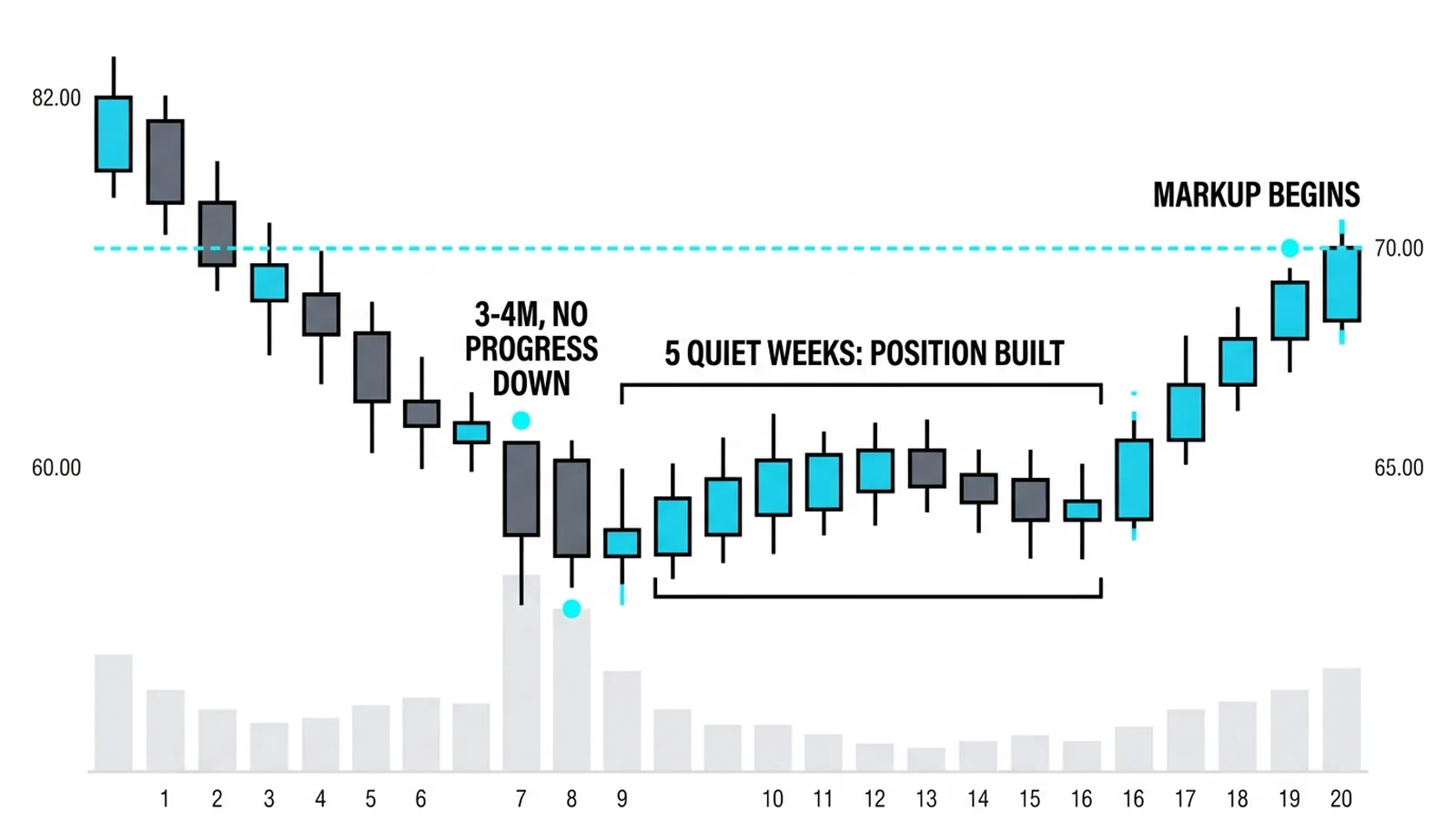
All numbers below are invented round figures for illustration. A stock falls from 82 to 60 over two months. Near the low, down bars print 3.4 and 4.1 million shares against a 1.2 million average, yet price stops making downward progress. The range then holds between 59 and 65 for five weeks on quieter volume. Markup begins.
Watch the two readings diverge at each stage:
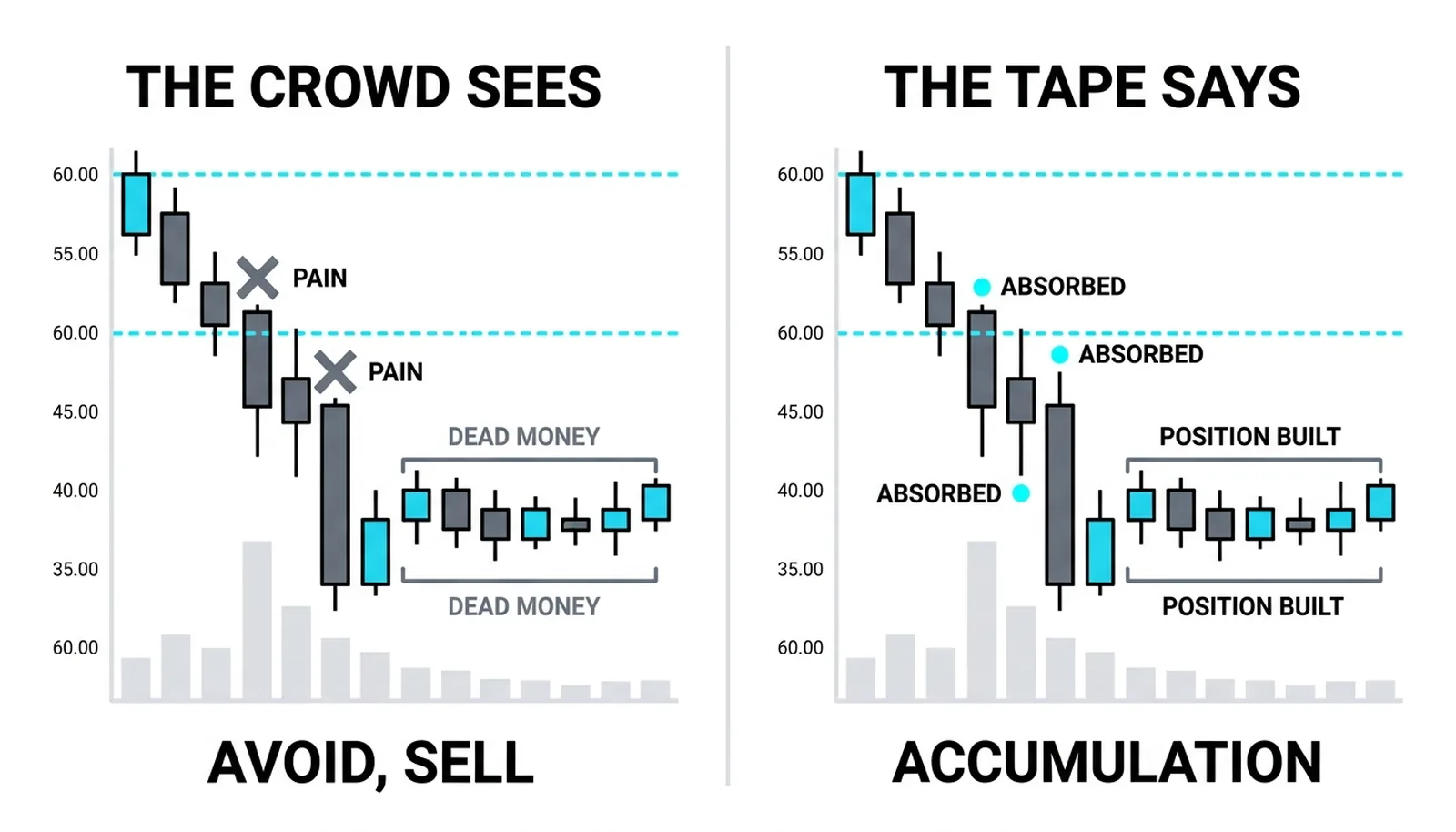
| Stage | What the crowd sees | What the operator is doing |
|---|---|---|
| Drop from 82 to 60 | A broken stock to avoid or dump | Watching, waiting for forced sellers to appear |
| Huge down bars that stop falling | More pain coming, sell before zero | Buying the panic; triple-average volume with no progress means supply is being absorbed |
| Five-week range, 59 to 65 | Boredom, dead money, nothing happening | Quietly completing the position inside ordinary-looking bars |
The crowd's read was reasonable at every step and wrong at every step. The operator's read required no secret information, only the willingness to ask what heavy volume with no decline actually means. When markup finally began, the crowd called it a surprise. Nothing about it surprised the composite man.
The Composite Man, Answered
What is the composite man in the Wyckoff method?
The composite man is a fictional single operator in the Wyckoff method, a mental device for reading the market as if one skilled trader planned every move. The device buys weakness, sells strength, and runs campaigns in stages, so millions of real orders can be reasoned about as one mind.
Is the composite man a real person?
No. The composite man is a model that compresses the net behavior of millions of participants, including algorithms, into one character. The campaign-shaped traces are real and measurable; the single puppet master is not.
How do you identify smart money activity?
Look for the signatures the habits leave behind: heavy volume that fails to push price lower at support (absorption), repeated stalling at highs on strong volume (distribution), emotional climaxes at extremes, and large volume hidden inside ordinary-looking closes. Price behavior confirms the story or kills it.
What is the modern equivalent of the composite man?
Smart money, institutions, and the inside crowd are the same character under new names. Any participant large enough that building or exiting a position takes weeks faces the operator's constraints and leaves the operator's traces.
Next, the method gives this character a script: the four market phases that every campaign moves through, from accumulation to markdown and back again.