What Is a Fibonacci Extension
A fibonacci extension is a projection beyond the old high or low, the same swing the retracement tool measured, run outward instead of inward. The retracement asks where the pullback ends. The extension asks how far the next leg can run once the old extreme breaks.

Both tools come from the same two anchors, the start of the leg and its end. That is why new traders confuse them on the chart. The retracement divides the leg and hangs its lines inside it. The extension multiplies the leg and hangs its lines past it. Think of overtime: the regulation of the leg ends at the old high, and the extension is the part of the game played after the regular clock expires.
The Same Tool, the Opposite Question
The retracement section measured the pullback and its depth. This lesson flips the same tool outward, and the first job is telling the two apart, because both come from the same anchors and land on the same chart.
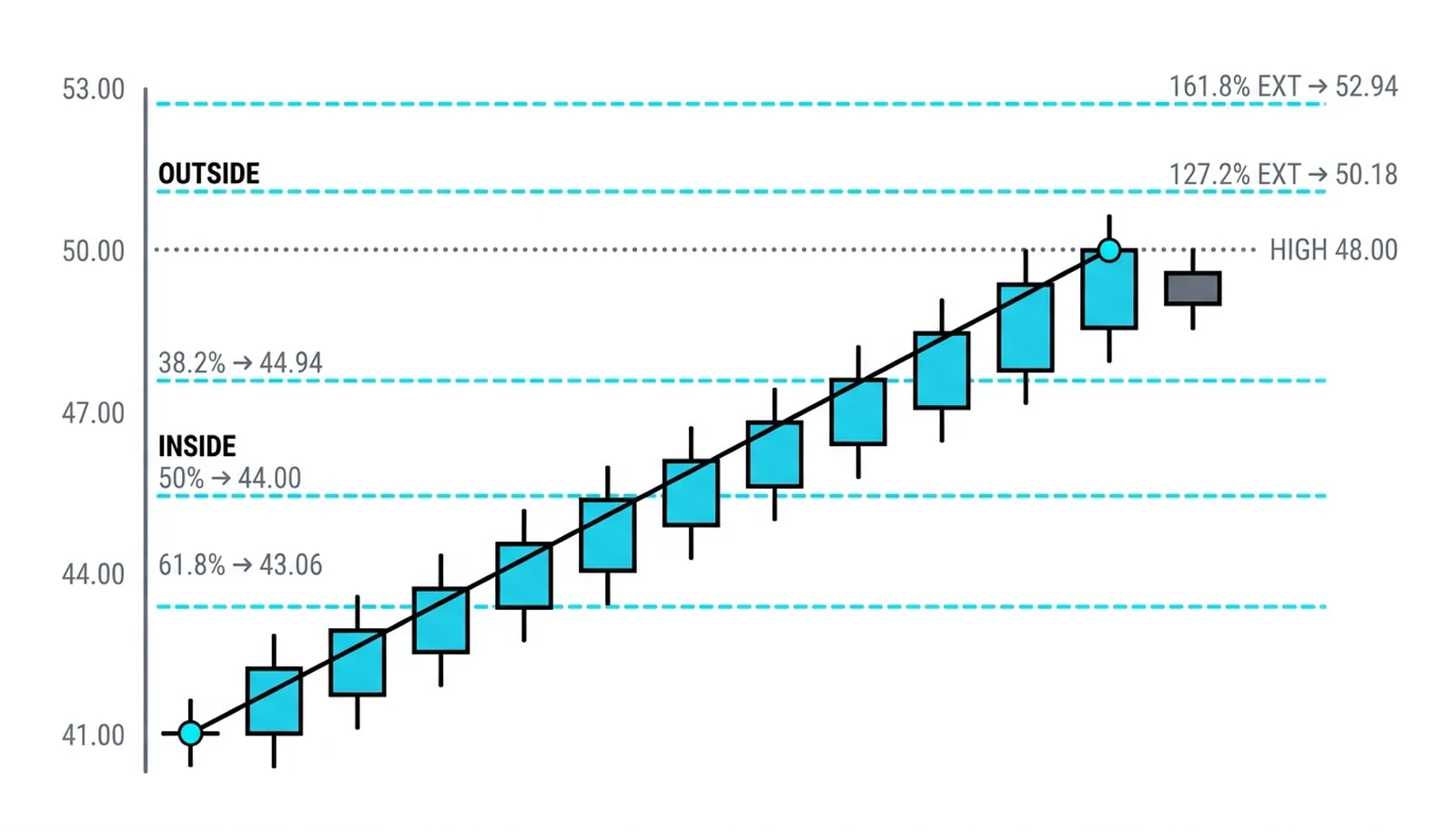
The difference is concrete. The retracement divides the leg's own height into fractions and plants its lines inside the range, the 38.2, the 50, and the 61.8 sitting between the low and the high. The extension multiplies the leg's height by ratios greater than one and plants its lines beyond the extreme. The 127.2 percent extension of an 8.00-point leg lands 10.18 points above the low, well past the high that ended the regulation.
The anchor convention differs too. Retracements run low to high in an uptrend so the lines project below the high. Extensions run the same anchors but project above it. A trader who understands one already understands half of the other.
The timing is where they truly split. Retracement lines matter before the high breaks. Extension lines mean nothing at all until it does. The break is the precondition that starts the overtime, and before that break, every line above the high is arithmetic without a trade attached to it.
Each measurement asks its own question. The retracement asks, where does the pullback end. The extension asks, once the old high gives way, how far can this leg run. Same swing, opposite direction of inquiry.
The Extension in Motion
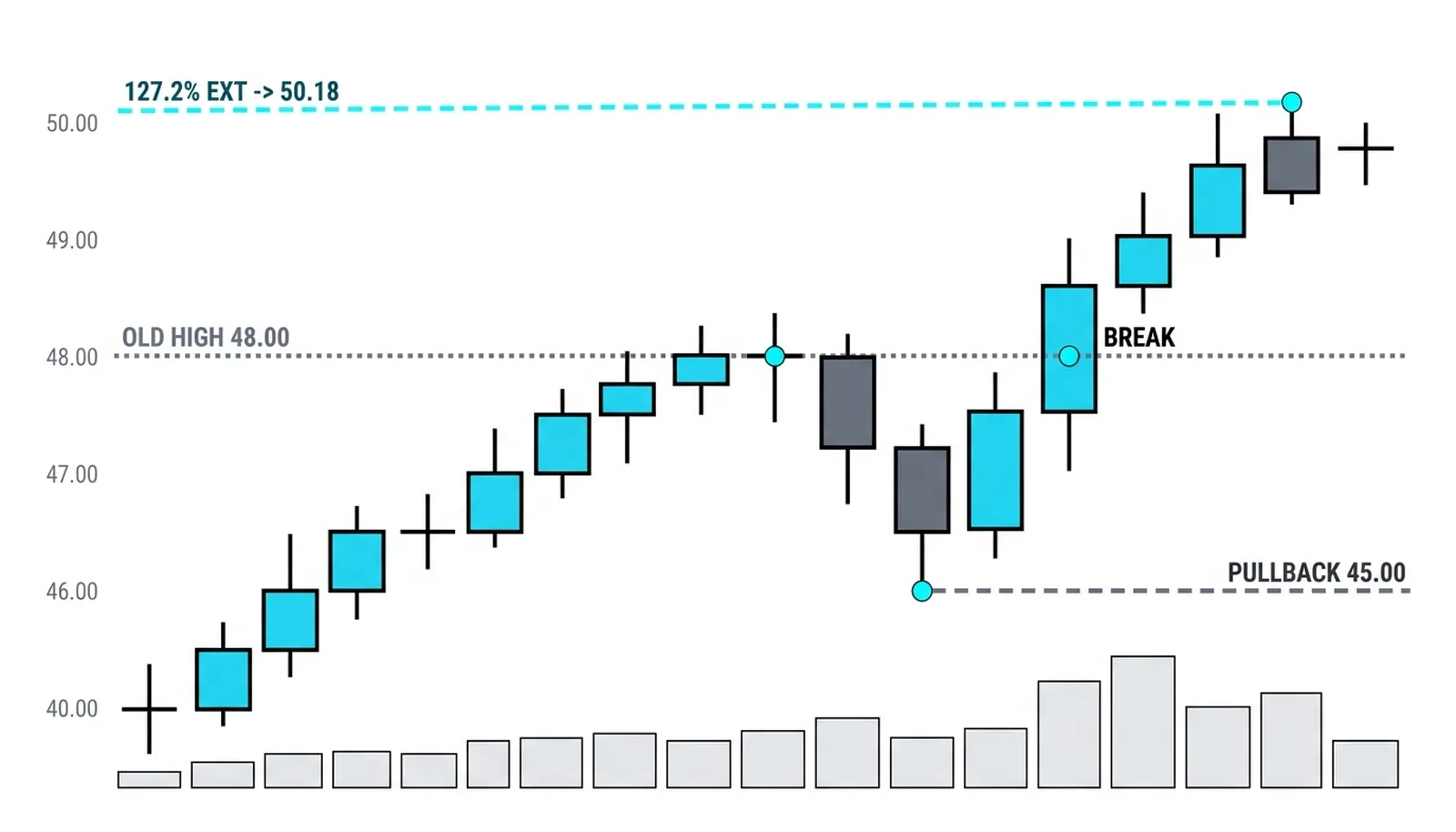
Nothing about an extension activates until the old extreme breaks. That single fact disciplines the whole tool. A chart can show a beautiful 127.2 line for weeks while price stalls under the high, and the line earns the trader nothing, because the projection only becomes relevant when the market accepts the overtime.
Once the break happens, the extension prices a repetition in advance. The price action canon rests a large part of the measured-move teaching on this tendency: markets repeat leg sizes, and the second leg often resembles the first. The extension is the tool that prices that repetition before it happens, so the trader holds a target instead of a hope.
Fibonacci cluster practice projects extensions from the same completed swings the retracements use, one measurement serving both questions. The swing that told the trader where the pullback might end is the same swing that says where the run might exhaust. No second drawing, no second guess at anchors.
This is why the extension belongs in the plan, not in the reaction. The trader who waits for the break and then scrambles for a target is late to a number that was computable from the first day the leg completed.
Trading the Extension
The extension is not an entry tool. It is a target tool, and the entry that owns it comes from the pullback. The trader buys the retracement, manages against the old high, and only then lets the extension lines matter.
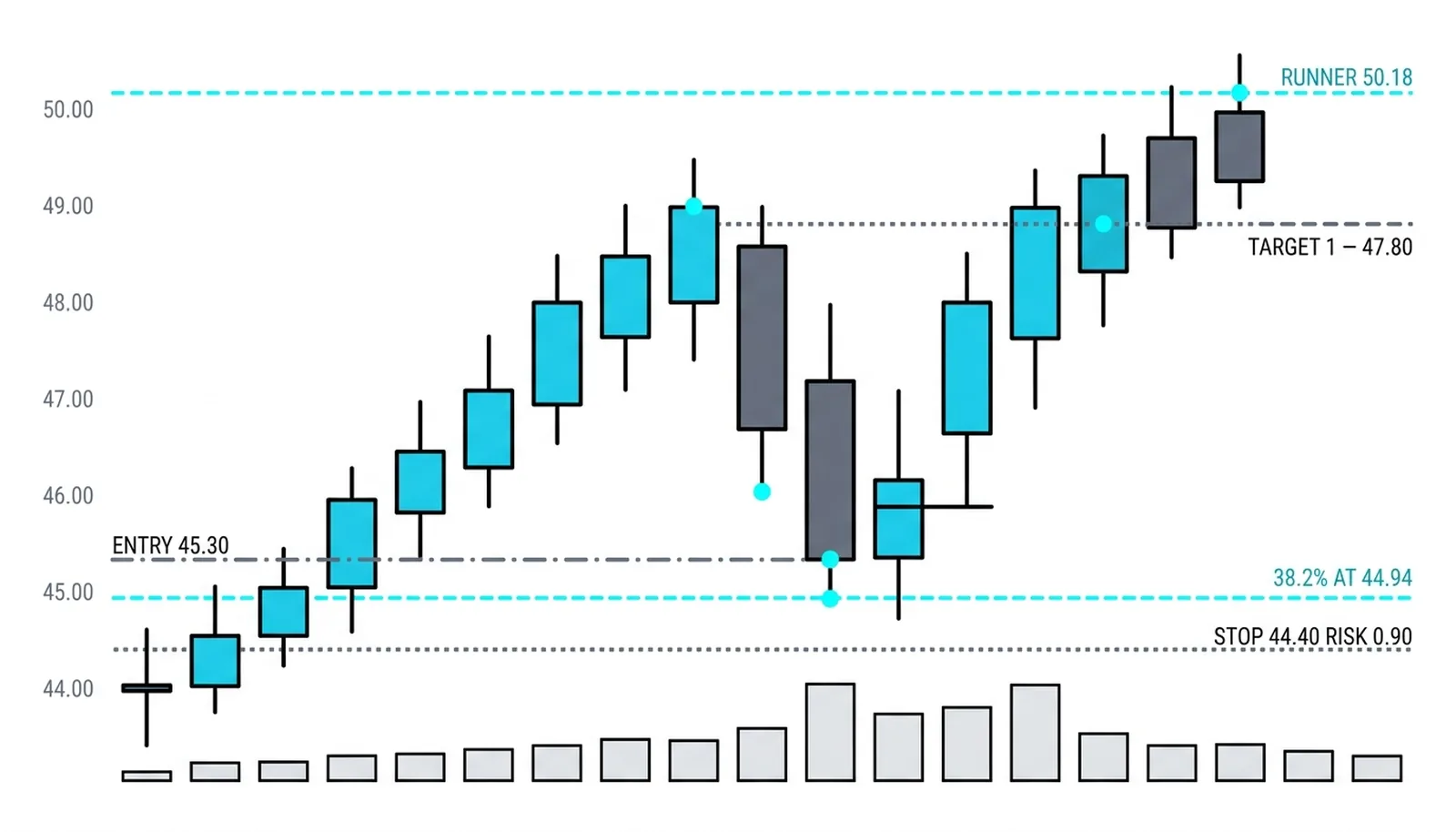
The structure runs in three parts. First, the pullback holds a retracement line and turns, and the long is taken on the turn with the stop under the retracement zone. Second, the first target sits just under the old high, because the high is resistance until proven otherwise, and that target pays the trade. Third, if the high breaks, the runner rides toward the extension, and the overtime pays what regulation never could.
Here is the honesty, stated plainly. The extension targets only existed because the break happened. A price that rolls over under the old high renders every line above it decoration. The first target is what makes this survivable: it pays the trade precisely so that the failed break costs nothing. Extensions are projections, not promises, and they are only owed to the trader whose entry survived the wait.
This is also why the extension should never be traded on its own. Nobody buys a market because a 127.2 line sits overhead. The line describes where a move might end. It says nothing about whether the move starts.
The Break at 48.00
A hypothetical leg runs 8.00 points, from 40.00 to 48.00. Every number below is invented to show the mechanics.
The retracement lines sit inside the leg at 44.94, 44.00, and 43.06. The extensions project above the high: the 127.2 percent extension at 50.18, the 161.8 at 52.94. One swing, both sets of lines, drawn before anything happens.
Price pulls back to 45.00, holds the 38.2 line, and turns. The long is taken at 45.30 on the turn. The stop sits at 44.40, risking 0.90. The first target is 47.80, just under the old high, worth 2.50, about 2.8 times the risk.
Price reaches 47.80 and the first target fills. The trade is paid. Whatever happens next is upside, not exposure.
Then price breaks 48.00. The overtime starts, and the runner rides to the 127.2 percent extension at 50.18. From the 45.30 entry, the runner collects 4.88, more than five times the original risk. The retracement could never describe that number. Only the extension could, and only because the break happened first.
Now the failed version. Price rolls over at 47.50, under the old high. The first target at 47.80 never fills, so the trader exits on the roll-over near breakeven or a small gain, and every extension line above 48.00 stays decoration. No break, no overtime, no extension owed. The tool kept its honesty because the plan never depended on it.
| The measurement | Where its lines sit | The question it asks | The answer it gives |
|---|---|---|---|
| Retracement | Inside the leg, between low and high | Where does the pullback end | 38.2, 50, 61.8 percent of the leg's height |
| Extension | Beyond the old extreme | How far can the next leg run | 127.2, 161.8 percent of the leg's height |
| Retracement timing | Active before the high breaks | Is the pullback holding | The entry and the stop location |
| Extension timing | Dead until the break, live after it | Where does the run exhaust | The runner's target, conditional on the break |
Extension Questions, Answered
What is a fibonacci extension?
A fibonacci extension is a projection of a completed leg beyond its own high or low, using ratios greater than one, such as 127.2 and 161.8 percent. It uses the same two anchors as the retracement but multiplies the leg instead of dividing it, and its lines sit past the old extreme rather than inside the range.
How is a fibonacci extension different from a retracement?
The retracement divides the leg's height into fractions and plants its lines inside the range; the extension multiplies the leg's height and plants its lines beyond the extreme. The retracement asks where the pullback ends and matters before the high breaks. The extension asks how far the next leg can run and matters only after the break.
How do you calculate the 127.2 percent extension?
Multiply the leg's height by 1.272 and add the result to the leg's starting point in an uptrend. For a leg from 40.00 to 48.00, the height is 8.00 points, 8.00 times 1.272 is 10.18, and 40.00 plus 10.18 gives 50.18. Most charting platforms draw this automatically once the two anchors are set.
When do fibonacci extensions matter in a trade?
Extensions matter only after the old extreme breaks, never before. Until the break, the lines above the high are decoration, and the trade lives or dies on the pullback entry and the first target under the high. After the break, the extension becomes the runner's target, the price where the overtime leg is statistically prone to exhaust.
The next lesson names the levels themselves: the 127.2, the 161.8, and the 261.8, each one further out, each one with its own reason for mattering.