VPOC Migration: Tracking Shifting Interest
VPOC migration is the drift of each session's fairest price, the volume point of control, across consecutive days, and a sequence of VPOCs stepping in one direction is the cleanest record that the market is accepting higher or lower prices. One VPOC tells you where a single day did its business. A line of them, read across a week, tells you whether the market keeps agreeing to the move or is quietly refusing to.

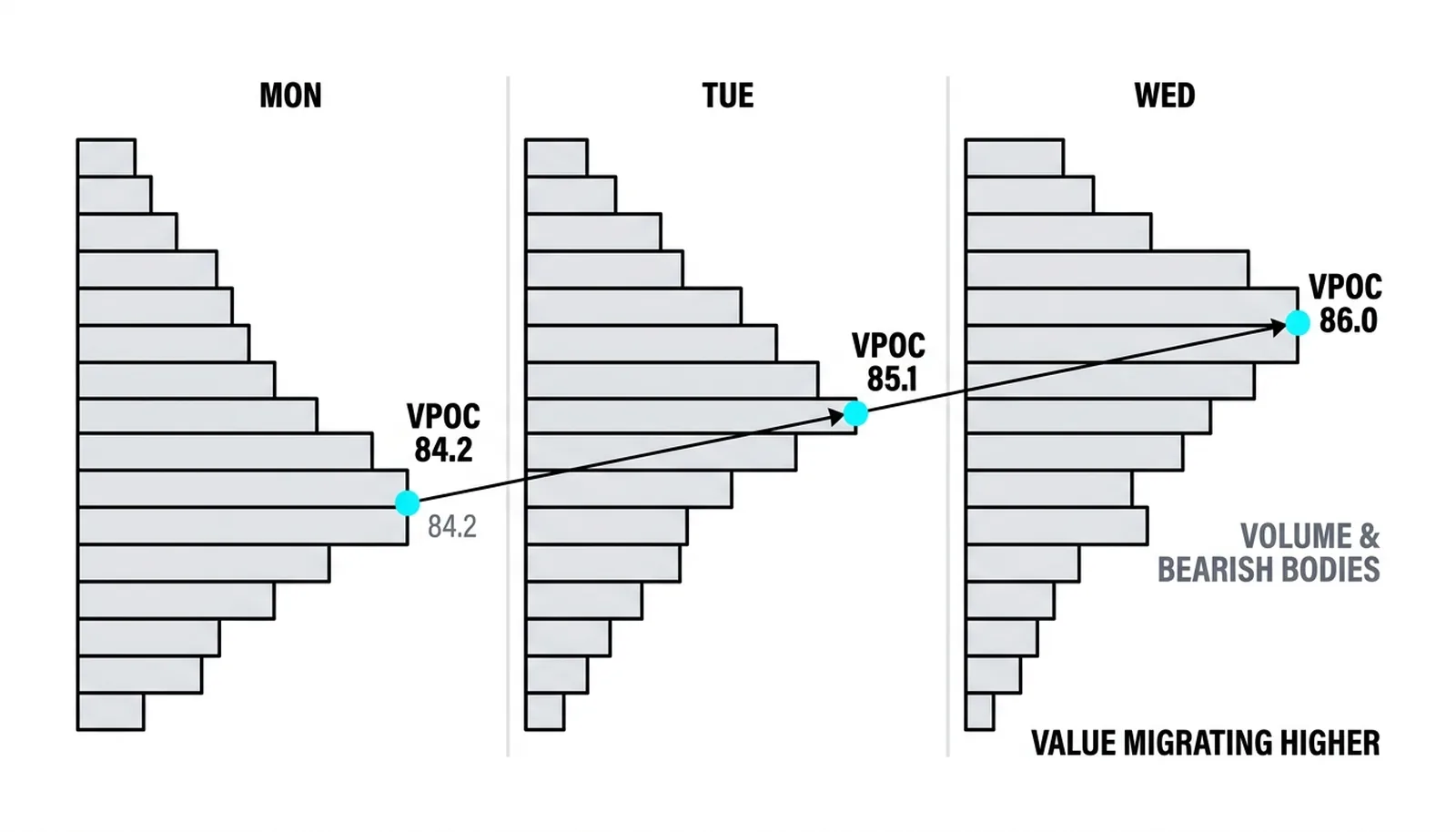
Think of the center flag in a tug of war, the little ribbon marking where the rope's balance point sits, shifting hand over hand as one side steadily gains. A flag that creeps the same way for three pulls in a row tells you which team is winning even without watching the faces. The earlier lessons in this block owned the single-session profile, its shape, its value area, its tails. This lesson tracks one line only: where the point of control prints today relative to yesterday, and the day before that.
What a Stepping VPOC Sequence Says
The VPOC is the price where the most transactions of the session happened. It is the market's fairest price for that day, the level where the most business was done and both buyers and sellers, in aggregate, agreed to trade. When that fairest price steps higher day after day, the market is not merely visiting higher prices. It is settling there.
The order flow framework's framing is the useful one here: a rising or falling point of control reflects a change in the market situation, a higher or lower price being accepted. Acceptance is the core idea. A spike can happen on thin volume and mean little. A VPOC that relocates means the bulk of the day's trade followed the move.
Three patterns are worth tracking.
- Stepping VPOCs with value following. Each day's point of control prints above the last, and the value area shifts up with it. This is trend acceptance, the strongest migration signal. Pullbacks into prior value are the standard entries.
- Clustered VPOCs. Several sessions print their point of control at or near the same level. The market is balanced, agreeing on a fair price. Trade the range, or wait for the cluster to break and a step to print.
- The divergence pattern. Price prints new highs or lows while the VPOC stalls. The move is being carried by fewer hands, and acceptance never followed. This deserves its own section below.
The naked point of control from the earlier lesson fits naturally here. A prior session's VPOC that was never revisited sits untested, and price has a well-documented habit of returning to it. In a migration series, yesterday's naked VPOC is often the draw that today's pullback reaches for. When the market fills that level and the next VPOC still steps in the trend direction, the sequence is healthy.
The Divergence Warning
The most valuable read in this entire lesson is the one where price and the VPOC disagree. Price makes a new high. The session's point of control does not. The bulk of the day's volume transacted at or below the prior fairest price, while the new high was printed on comparatively little volume.
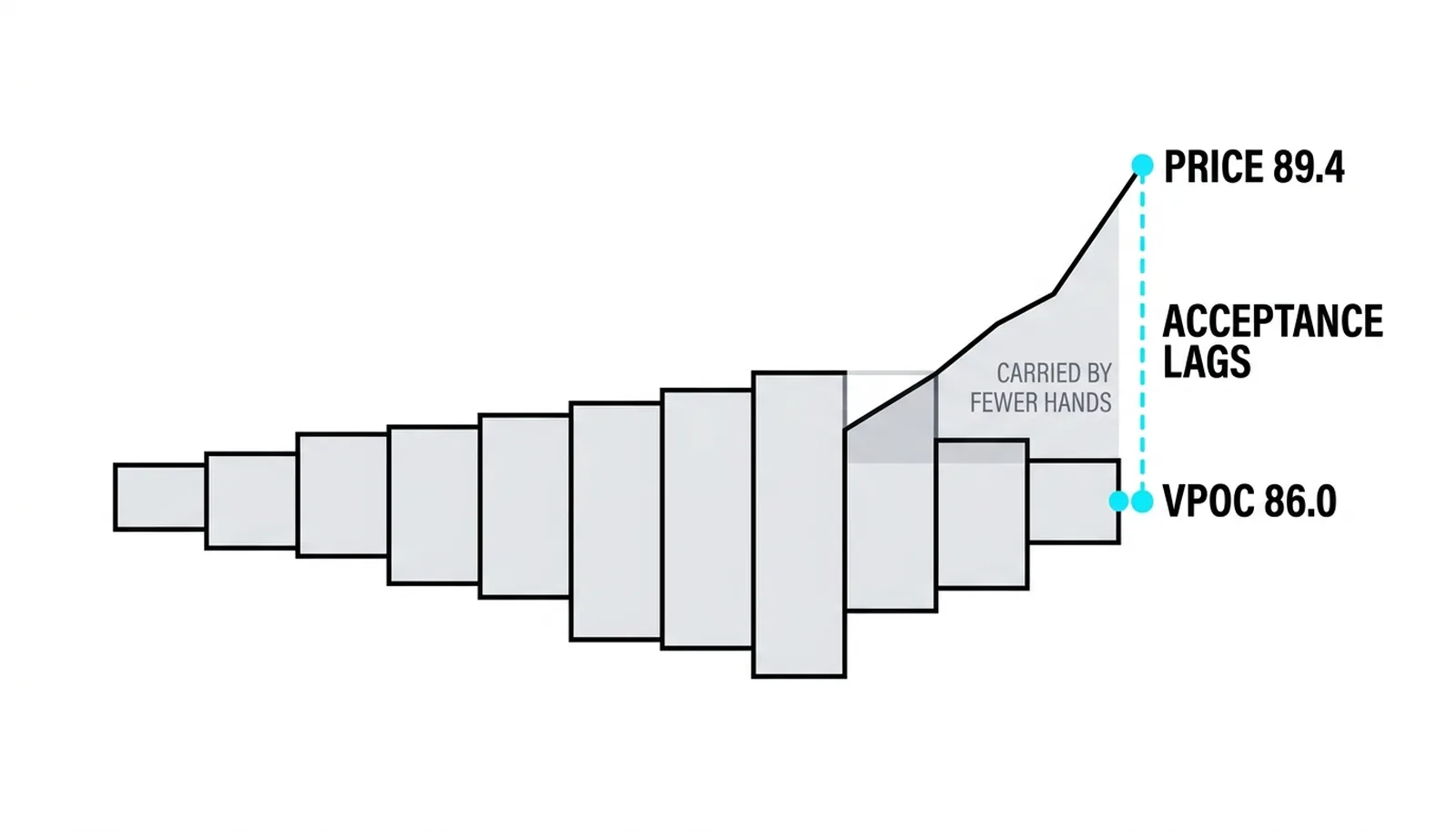
That means the rally is being carried by fewer hands. Late buyers pushed the extreme, but the day's real business stayed behind. Acceptance never followed price. A trend where the VPOC stops stepping is a trend running on momentum rather than agreement, and momentum without agreement is fragile.
The read is not "short immediately." It is a downgrade. Chasing the new high becomes a poor trade. Longs already held deserve tighter management. The honest question shifts from "how high can this go" to "where does acceptance actually sit if this pulls back," and the answer is usually the stalled VPOC or the one below it.
One stalled session is a warning, not a verdict. If the next session's VPOC steps up to meet price, acceptance arrived late and the sequence repairs itself. If a second session stalls, or the VPOC steps down while price holds highs, the divergence is confirmed and the burden of proof moves to the buyers.
Reading Migration Without Overclaiming
Two honesty beats belong in every discussion of this tool.
First, migration confirms rather than predicts. By the time three sessions of stepping VPOCs have printed, the move is already mature. The easy money in the trend happened before the sequence became readable. So the series is a hold-and-align tool: it tells you to stay with a trend, to choose pullbacks into prior value or naked VPOCs as entries, and to stop fighting the direction the flag is creeping. It is a poor tool for catching turns. Traders who wait for the VPOC sequence to flip before exiting a trend will give back a real chunk of the move, because the sequence only turns after price already has.
Second, the VPOC is platform-dependent. Bin size, session templates, and data feeds differ between tools, and two platforms can print different VPOCs for the same day. A migration series read across two charting setups is meaningless, because part of the "step" may be the software rather than the market. Read a migration series on one charting setup only, and never compare levels across tools.
Neither caveat kills the tool. They define its job. The VPOC sequence keeps you positioned with acceptance and warns you when acceptance stalls. It does not call tops, and it does not transfer between platforms.
Three Steps Up, One Warning
All numbers here are invented round figures for illustration. A trader tracks one market across a week on a single platform.
Monday. The VPOC prints at 84.2, with value from 83.2 to 85.0. Baseline session, nothing to compare yet.
Tuesday. The VPOC steps to 85.1, value 84.1 to 86.0. One step up, and value followed. Early acceptance. The trader notes Monday's VPOC at 84.2 is now below value and may act as a draw on any dip.
Wednesday. The VPOC steps to 86.0, value 85.0 to 87.2. Three sessions, three higher steps, value migrating up each time. This is the clean trend-acceptance pattern. The tactical read: dips toward prior value, roughly the 85.0 to 85.1 zone, are buyable within the migration.
Thursday. The session opens at 87.4 and pushes to 88.6, yet its own VPOC prints at 86.1. The sequence is intact, since 86.1 still sits above Wednesday's 86.0, but barely. Dips toward 86 remain buyable within the migration, though the trader notices the day's business clustered well below the push. Attention rises.
Friday. Price prints a new high at 89.4. The VPOC stalls at 86.0, the same level as Wednesday. Acceptance stopped following. The honest read downgrades chasing the new high: the move to 89.4 was carried by fewer hands, and the market's fairest price has barely moved in three sessions. Held longs get managed tighter; fresh breakout buys are skipped.
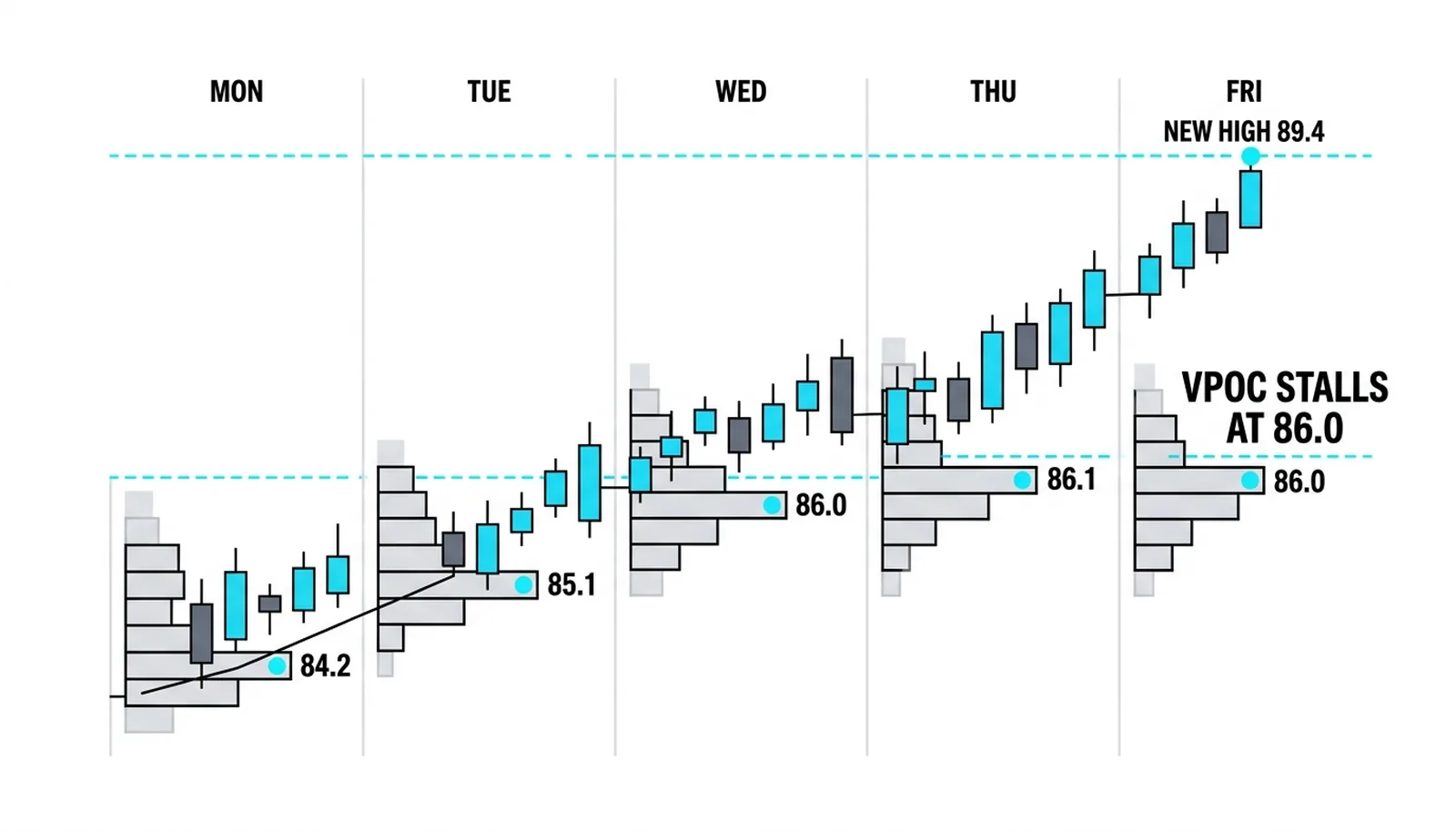
What would have changed the story? If any session's VPOC had printed back at 85.1 or below, Tuesday's level, the migration would be broken. That would say the market rejected the week's higher prices and re-accepted the old area, and the pullback-buying plan would be shelved until a new sequence established itself.
| VPOC pattern | What value is doing | The tactical bias | The trap |
|---|---|---|---|
| Stepping with the trend | Value area migrates the same direction | Hold, and buy or sell pullbacks into prior value | Arriving late and treating a mature trend as a fresh one |
| Clustered at one level | Value areas overlap heavily | Trade the range or wait for a step to break the cluster | Forcing trend trades inside balance |
| Stalled while price extends | Value lags behind the price extreme | Downgrade chasing; tighten management on existing positions | Confusing a momentum push with acceptance |
| Stepping back against the trend | Value re-accepts a prior area | Abandon the old direction; wait for a new sequence | Defending a bias the market has already voted against |
VPOC Migration, Answered
What is VPOC migration in trading?
It is the day-to-day movement of the volume point of control, the price where each session did the most business. Tracking that line across sessions shows whether the market is accepting higher or lower prices or holding a fair-price zone.
What does a rising VPOC mean?
A rising VPOC means each session's heaviest trading happened above the prior session's, so higher prices are being accepted rather than merely visited. When the value area rises with it, the trend has genuine participation behind it.
What does it mean when price makes new highs but VPOC does not?
It means the new high was printed on relatively low volume while the day's real business stayed lower. Acceptance never followed price, the rally is carried by fewer hands, and chasing the high becomes a poor trade until the VPOC steps up to confirm.
How many days of VPOC movement matter?
Three consecutive steps in one direction is the common working threshold for a readable migration, with the caveat that by then the move is mature. Fewer than three is noise; more than three is confirmation of a trend already underway.
The next lesson in this block moves from tracking one line to building the full decision: profile-based entries, exits, and stops, where the migration series becomes the filter that decides which setups are worth taking at all.