Session Opening Ranges
An opening range is the high and low set during the first stretch of a trading session, and those two lines become the reference the rest of the day is read against. Once the early extremes print, every push, pullback, and stall gets measured against them. Traders who skip this step spend the day reacting to noise. Traders who mark it spend the day reading a map.

Think of the open as rush hour at a single interchange: the shape of the first jam tends to set the traffic pattern for hours.
What an Opening Range Actually Is
When a session opens, a block of orders hits the books at once. Overnight positions get adjusted, new orders fire, and the market digests all of it in a short burst of two-sided trade.
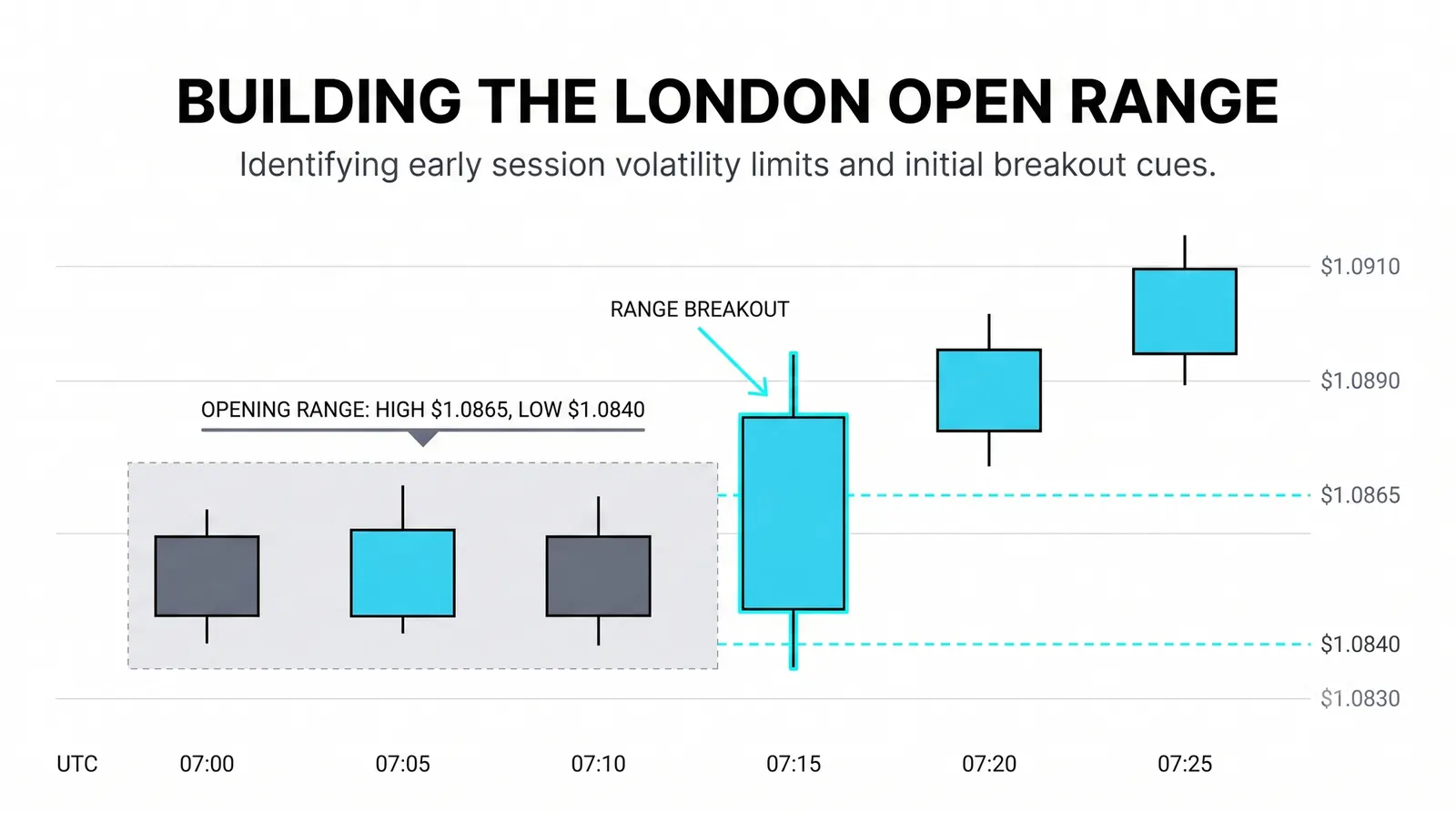
Out of that digestion, an early high and an early low form. Those two prices are the opening range.
Once set, the range becomes the day's baseline. It works the same way a level works on any chart: a reference price that future action gets judged against. A move above the range means buyers absorbed everything the open threw at them. A move below means sellers did. A market that keeps returning to the middle of the range is telling you neither side has taken control yet.
The range is not a prediction. It is a measuring stick.
One caution before anything else: the range only means something in context. Where it sits relative to older key levels, the ones from prior days and weeks, decides how much weight a break or a failure deserves. A range break straight into a weekly level is a different event from a range break into open space.
The London Open Range
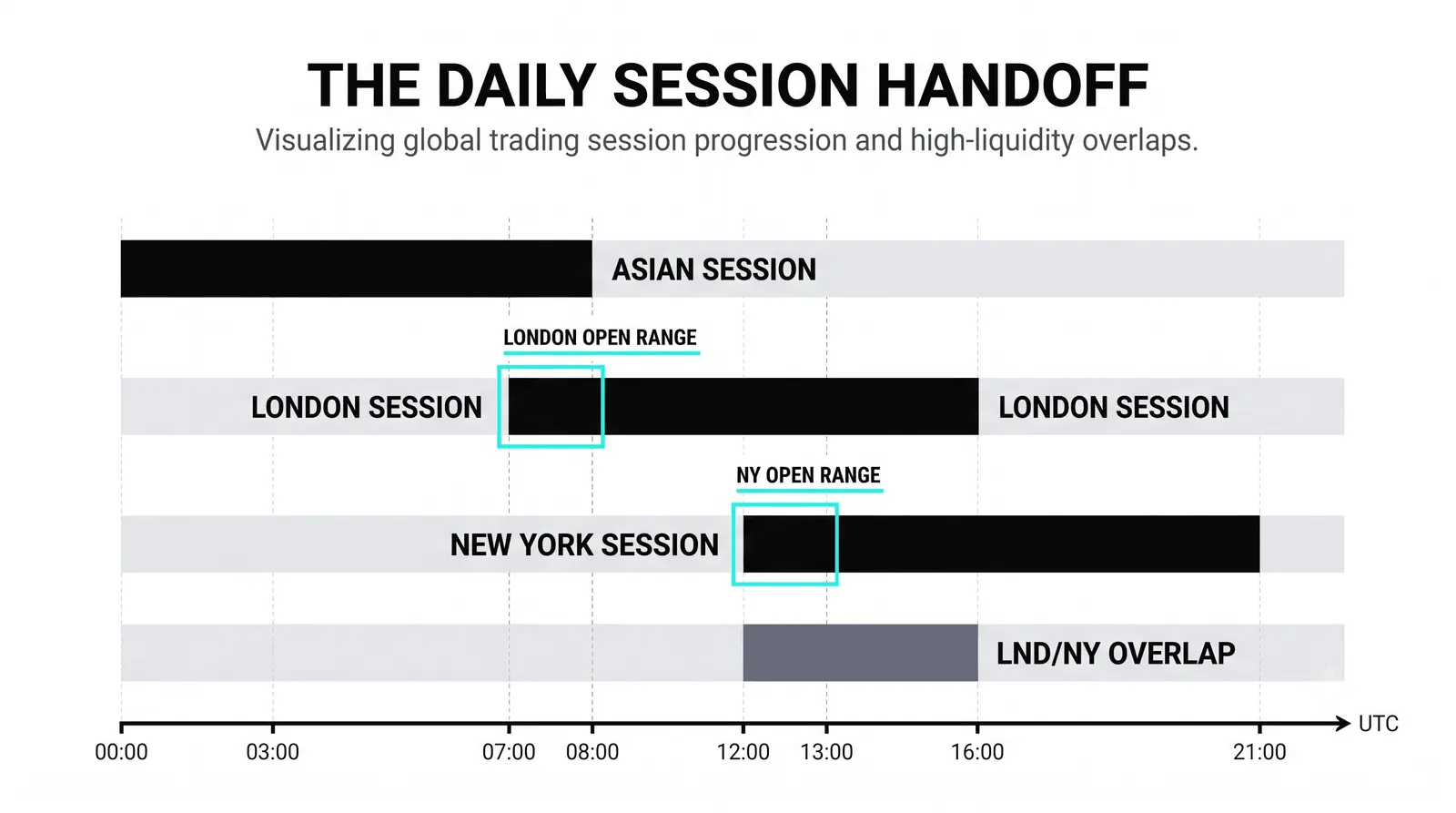
London inherits a specific handoff. The Asian session that came before it often trades quietly, and quiet sessions coil orders just outside their corridor. Stops, breakout entries, and pending flow stack up while price goes nowhere.
When London opens, that stored energy meets fresh European order flow. Two things can happen.
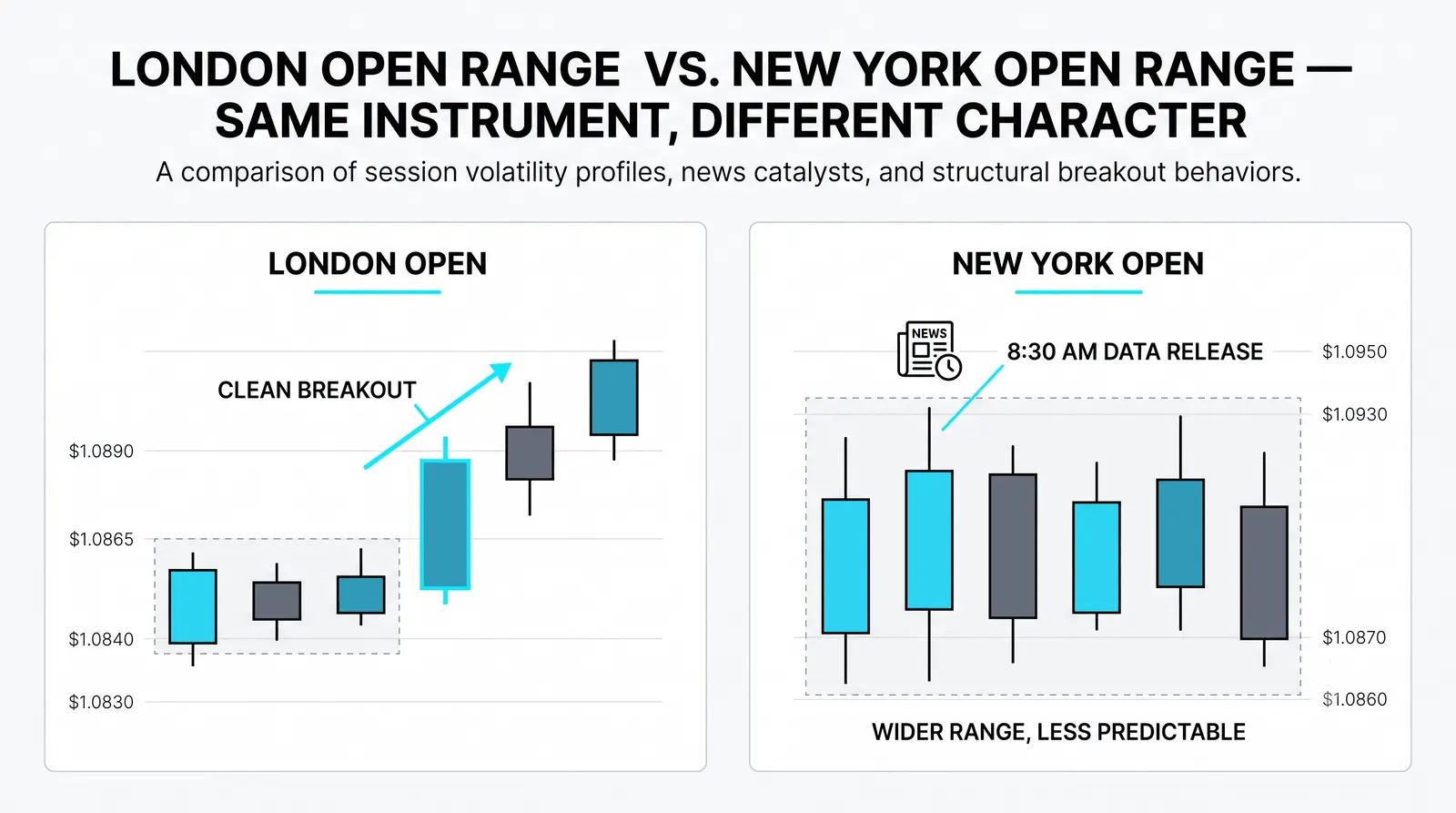
The first: the range forms tight, like a spring. Price compresses into a narrow band while both sides probe. A tight London range hints at fuel. The longer price stays coiled, the more orders accumulate at the edges, and the eventual break tends to travel.
The second: the first wave of European flow blows the range wide immediately. A wide London range hints at congestion. The early move already spent the available energy, and the rest of the morning often chops inside those extremes.
Neither shape is good or bad on its own. Each one tells you what kind of day you are likely dealing with, and your job is to match your expectations to it.
The New York Open Range
New York opens into a different environment. London is still fully active, so two major hubs trade at once. Volume is heavier, participation is broader, and the tape moves faster.
On top of that, high-impact news often lands right at the New York open. Rate decisions, employment data, inflation prints. The range forms under chaos.
Expect the boundaries to get swept more than once. Price pokes above the early high, snaps back, dips below the early low, recovers. This is normal for New York, and it punishes anyone who treats the first break as the real one.
Patience matters more here than in any other session. Let the range prove itself. A break that holds through a retest carries information. A break that lasts ninety seconds carries a lesson about stop placement.
Trading the Breakout Versus the Fade
Two basic plays exist once the range is set, and they are opposites.
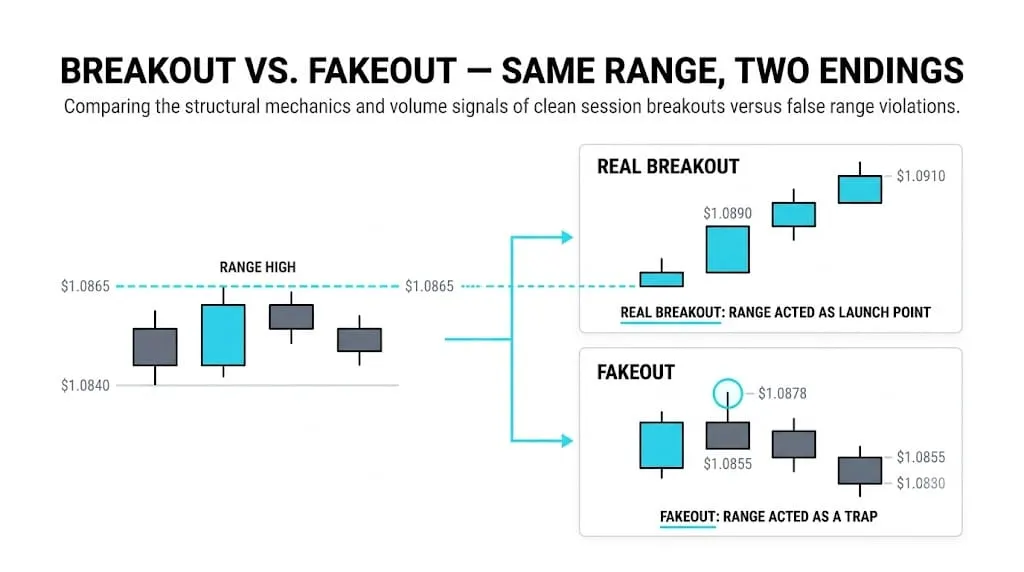
The breakout logic: a push beyond the range means one side took the day. You join that side, ideally on a retest of the broken boundary, and you are wrong if price falls back inside.
The fade logic: the push fails, volume thins, and price snaps back inside the range. You trade against the break, targeting the middle or the far side of the range, and you are wrong if the break starts holding.
Fakeouts happen for a simple reason. Early volume dries up after the opening burst, and a move that looked decisive runs out of fuel. The break was real orders, but there were not enough of them. Price drifts back inside and everyone who chased is trapped.
Context decides which play has the edge. Where the range sits relative to older key levels turns a break or a fade from a coin flip into a read. A break of a tight London range that also clears a daily level from last week deserves respect. A break that runs straight into a weekly level overhead deserves suspicion.
Ask three questions before committing:
- Is the range tight or wide relative to recent days?
- Does the break move into open space or into a known level?
- Is volume expanding on the break or thinning out?
Three answers pointing the same way is a read. Mixed answers is a coin flip, and coin flips are optional.
One Range, Two Sessions
Here is a hypothetical week, same pair, same tool, two very different outcomes.
Tuesday, London. EUR/USD opens and the first 30 minutes set a range from 1.0850 to 1.0870. Twenty pips, tight, after a dead Asian session. Mid-morning, price pops to 1.0878, eight pips above the range. Volume on the push is thin. The move stalls, and within the hour price fades back through 1.0860 toward the middle of the range. The fade was the trade. The break had no fuel, and the range held as the day's frame.
Thursday, New York. A rate decision lands at the open. The first stretch sprawls 120 pips wide as the market digests the number. Once the dust settles, price breaks above that wide range, pulls back to retest the boundary, holds, and runs. The breakout was the trade. The wide range looked like congestion, but the scheduled news repriced everything, and the retest confirmed real sponsorship behind the move.
Same tool, two verdicts. What differed was context: a quiet morning versus scheduled news, a thin break versus a retested one. The range never told you what to do. It told you what to measure.
Range Character at a Glance
| Range Type | Typical Character | What It Tends to Produce |
|---|---|---|
| London open | Forms after a quiet Asian session, often coiled | Clean breaks when tight, chop when blown wide early |
| New York open | Two hubs active, news at the open, heavy volume | Swept boundaries, fakeouts, strong moves once settled |
| Tight opening range | Compressed price, orders stacked at the edges | Stored fuel, breaks that tend to travel |
| Wide opening range | Early energy already spent | Congestion, fades back toward the middle |
Session Opening Ranges, Answered
How long should the opening window be?
Thirty to sixty minutes covers most sessions well. Shorter windows give you a range that gets swept constantly and means little. Longer windows blur the line between the open and the rest of the day. Pick one window per session, keep it consistent, and judge it over a sample of weeks rather than single days.
Does this work for stocks?
Yes, and the logic is identical. The equity open concentrates overnight orders into one burst, the early high and low form, and the rest of the session gets read against them. Stock index futures add a wrinkle because they trade nearly around the clock, so define which open you are measuring and stick to it.
What if the range is very wide?
Treat a very wide range as a warning, not an invitation. Wide ranges mean the early move already spent the day's energy, and breaks of a wide range fail more often than breaks of a tight one. If the width came from scheduled news, wait for the dust to settle and demand a retest before trusting any break.
How do I choose between breakout and fade?
Let context choose for you. Check where the range sits against older key levels, check whether volume expands or thins on the break, and check whether the session had scheduled news. When those three line up behind the break, trade the break. When they point at exhaustion, the fade has the edge. When they disagree, skip it.
Mark the range on your charts for the next two weeks without trading it. Watch how often the day's real move announces itself at those two lines, and note what separated the breaks that ran from the ones that snapped back. That observation habit is the foundation for the next lesson, where range behavior gets combined with level confluence into full session plans.