Key Levels vs Minor Levels
A key level is a price zone the market has turned on sharply and repeatedly, while a minor level is a pause the market barely respected once. The difference shows up in behavior at the approach, never in how the line looks on your screen. Two horizontal lines can appear identical, and one will move your account while the other does nothing.

Think of key levels as main roads and minor levels as alleys: both connect two points, but only one carries real traffic. Your job is to know which is which before price arrives.
The Test of Behavior
Watch what price does when it reaches the zone. That reaction is the entire classification system.
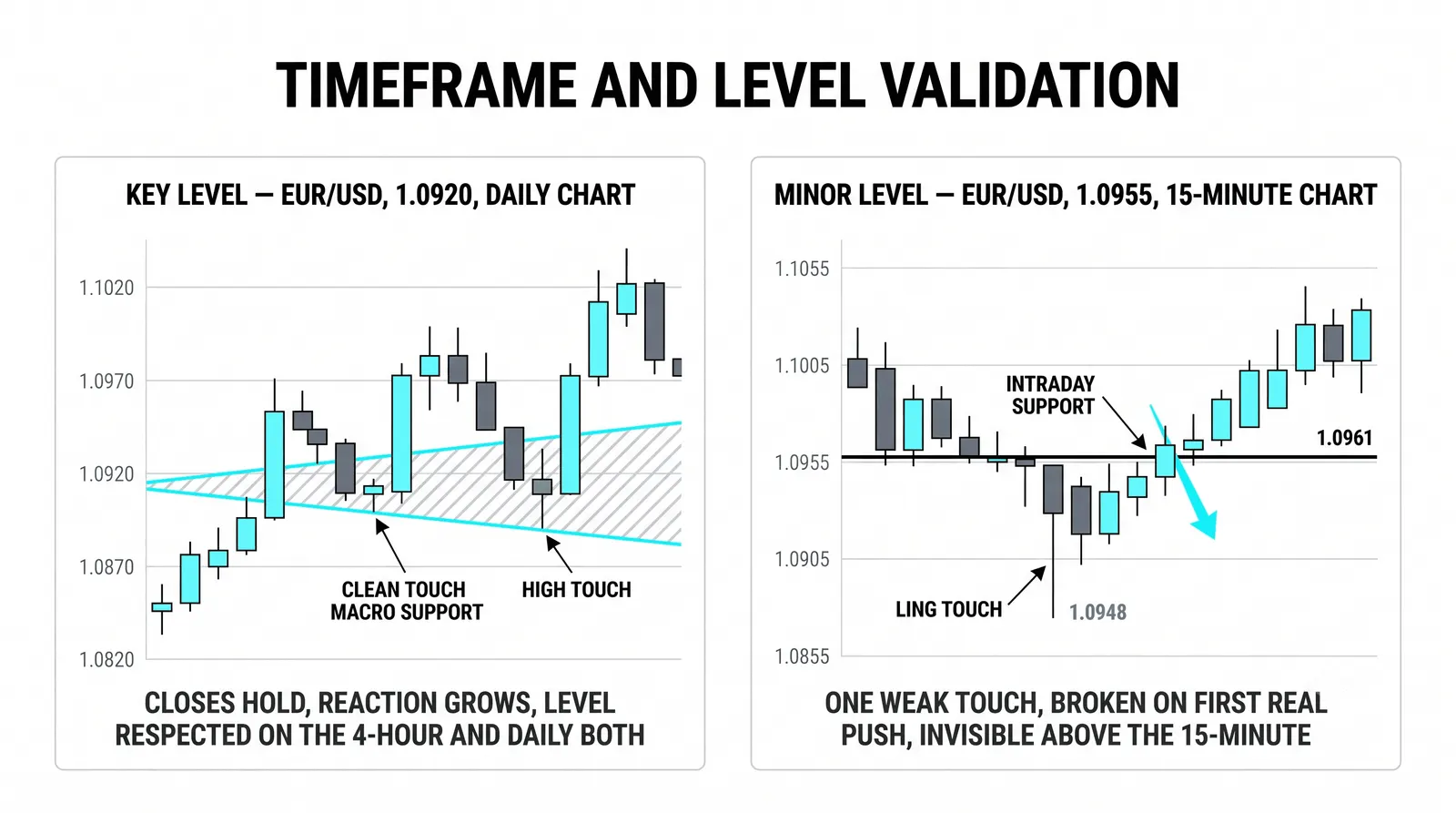
At a key level, the turn is sharp and fast. Price arrives, gets rejected within a candle or two, and leaves with momentum. The market treats the zone like a wall. At a minor level, price drifts through. It may slow down, print a small pause, then continue as if nothing was there.
Speed and violence of reaction are the tell. A level that produces a two-candle reversal with range expansion is doing real work. A level that produces three flat candles and a slow leak through it is decoration.
This means you cannot grade a level by looking at it. You grade it by watching the market vote at it.
How a Level Earns Key Status
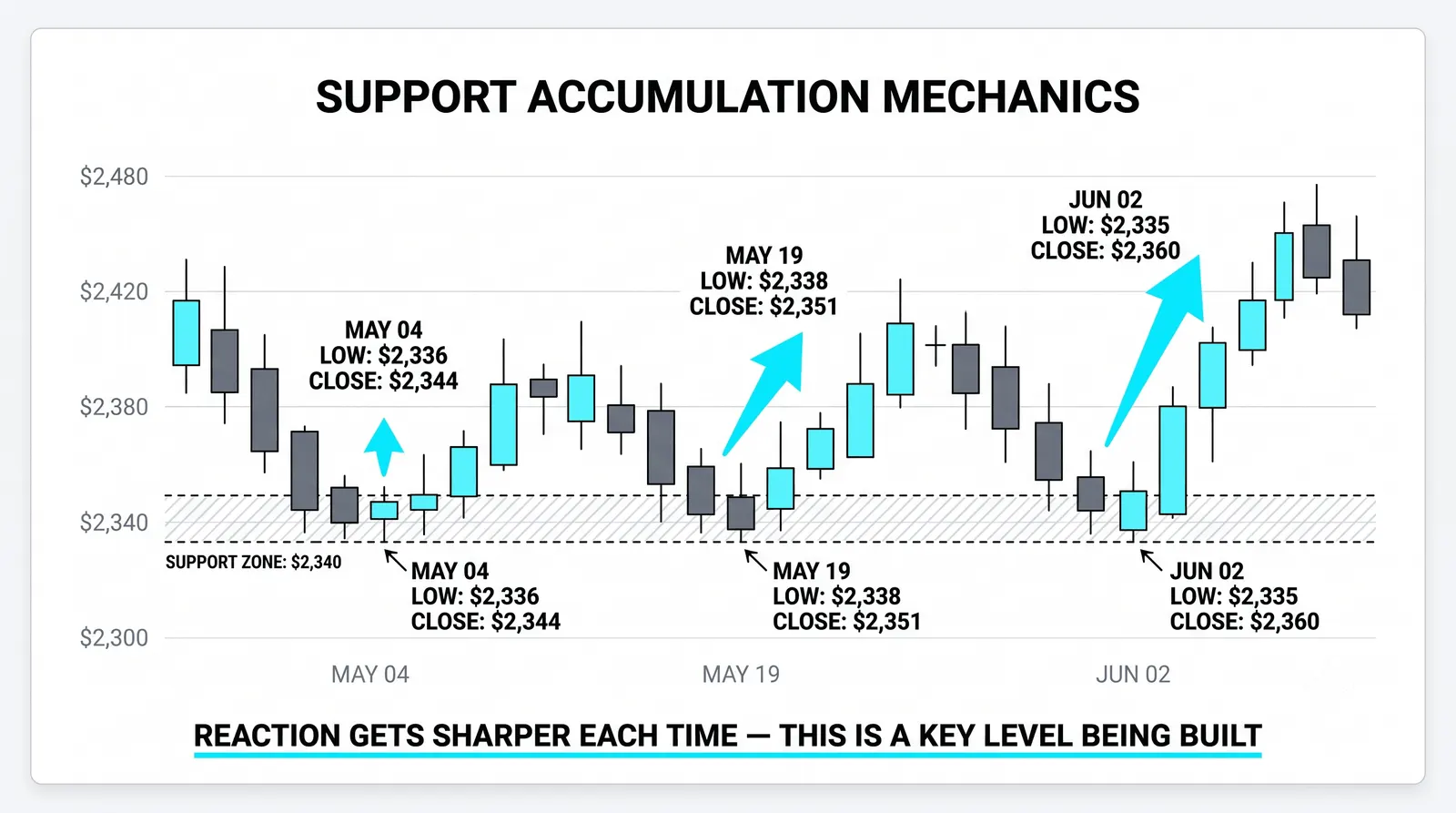
No level starts out key. It earns the label through repetition.
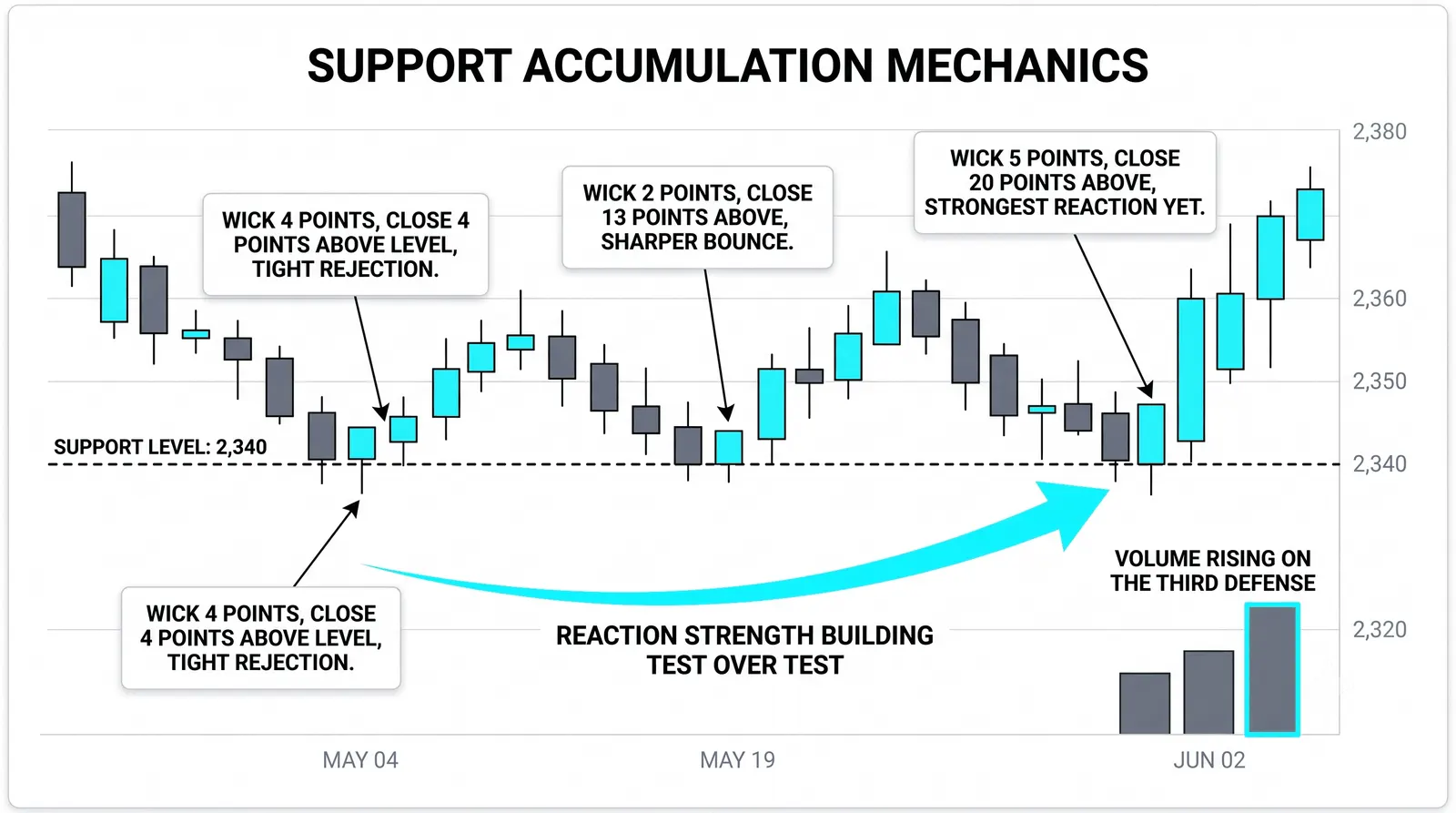
Each successful test with a sharper reaction recruits more attention. Traders who were turned away once come back with bigger size. Traders who missed the first turn mark the zone and wait for the second. Orders stack up at the same prices, and the level becomes self-reinforcing.
Confluence accelerates this. When a weekly swing point and a daily swing point sit at the same zone, two different crowds are watching the same price. Stacking levels across timeframes gets its own lesson in this level, so for now just note that agreement between timeframes raises a zone's rank.
Who is watching matters as much as how many. Higher-timeframe levels carry more capital behind them. A zone visible on the weekly chart is on the screens of funds and position traders, not only day traders. Their orders are larger and their defense of the level is more stubborn.
A round number can add to this, but only when structure agrees with it. A round number sitting alone in empty space is a number, not a level.
Why Most Levels on Your Chart Are Minor
New traders mark every pause. The result is a chart with twenty lines and no information.
Most pauses are breaths, not battlegrounds. Price stopped for an afternoon because a session ended, or because a news release was due, or because buyers simply got tired for an hour. Nothing was decided there. Nothing will be decided there next time either.
The clutter disease has a real cost. When every pause gets a line, every line looks equally important, and you start planning trades off zones the market does not respect. Your stops sit at meaningless prices. Your targets sit at other meaningless prices.
Three levels that matter beat thirty that do not. A clean chart forces you to wait for price to reach a zone that actually has a history of sharp turns. That patience is an edge by itself.
Delete a line whenever you catch yourself unable to explain what happened there. If you cannot describe the reaction, the market never cared.
Reading a Level in Real Time
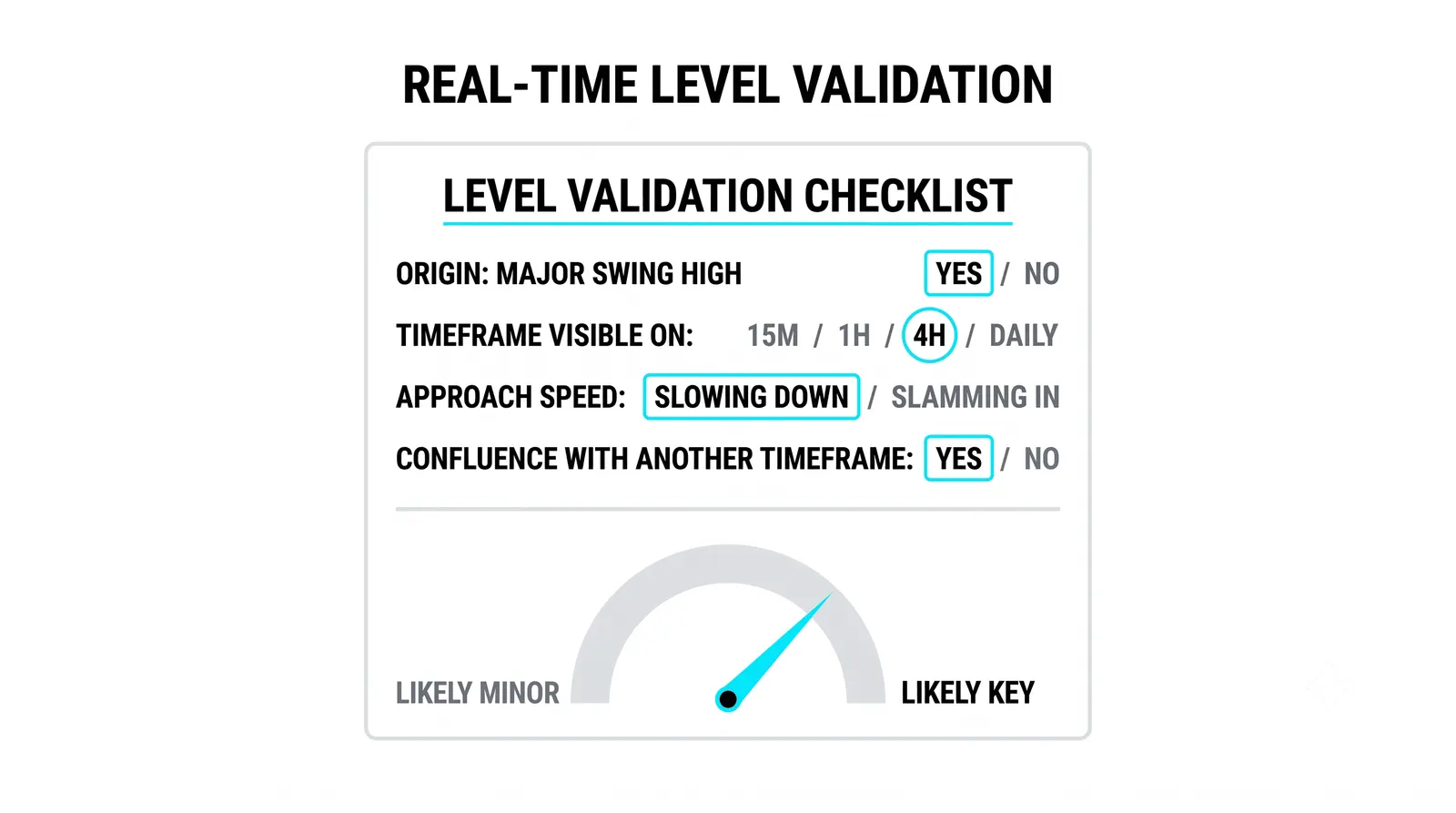
You will often meet a level without months of chart history in front of you. Two questions still let you grade it: where was it born, and how is price behaving as it arrives.
Origin first. A zone born at a major higher-timeframe swing outranks one born in an afternoon consolidation. The weekly swing low represents a real decision by real size. The afternoon consolidation represents lunch.
Approach second. Deceleration into the zone, shrinking candles, and rejection wicks all say the level is holding. Sellers or buyers are stepping in early, before price even touches the line. Large fast candles driving straight into the zone say the opposite. Momentum that does not slow down usually does not stop.
Read the approach before you commit. The level gives you the location; the approach tells you whether the location is working today.
Two Levels, One Chart
Here is a hypothetical stock with both kinds of level on the same chart. The numbers are round for clarity.
The key level sits at 120.00. It was born at a weekly swing low, and over five months price has tested it four times. Each test produced a sharp turn within a day or two. The minor level sits at 123.40, created by one afternoon of sideways consolidation three weeks ago.
Price rallies off a low and reaches 123.40 first. It hesitates for two candles, printing small bodies, then slices through in one more candle and keeps going. Nobody defended 123.40. The pause was a breath.
The next session, price pulls back toward 120.00. The approach changes character. Candles shrink as it nears the zone. Over three days it prints rejection wicks below 120.00, each one bought back up. Then it turns down from the zone and holds. Four tests, four sharp reactions, and now a fifth defense in progress.
The practical difference is concrete. The minor level at 123.40 earns no plan: no entry, no stop, no target. The key level at 120.00 earns one. A trader might take long interest near 120.00, place a stop at 118.90 below the zone, and set a first target at 126.00. The risk is defined by the level, and the trade exists because the level has a documented history of sharp turns. None of that is a promise of profit. It is a plan with a clear invalidation point, which is all a level can honestly offer.
| Attribute | Key Level (120.00) | Minor Level (123.40) |
|---|---|---|
| Origin | Weekly swing low | One afternoon consolidation |
| Test history | Four tests over five months | Never tested before |
| Reaction at approach | Deceleration, rejection wicks, sharp turn | Two flat candles, then a clean slice through |
| Deserves a plan | Yes: entry, stop, target defined | No: ignored for trade planning |
Key Levels vs Minor Levels, Answered
How many key levels should one chart carry?
Usually two to four per timeframe you trade. If you have more than five horizontal zones marked, some of them are minor levels dressed up as key ones, and the honest move is to delete until only the zones with sharp, repeated reactions remain.
How many tests make a level key?
Two strong reactions are the minimum, and three or more make it solid. One turn proves nothing, because any price can bounce once. Repeated sharp rejections at the same zone are what recruit the crowd of orders that give a level its power.
Does a key level stay key after it breaks?
Often yes, but with its role flipped. A broken support zone frequently acts as resistance on the way back up, because traders trapped on the wrong side sell at breakeven. Treat the first retest after a break as unproven, and demand the same sharp reaction before trusting it again.
Do minor levels ever matter?
They matter as information, not as trade locations. A drift through a minor level tells you momentum is healthy, and a stall at one can warn you a move is tiring. What they do not deserve is an entry, a stop, or a target built around them.
Once you can sort key levels from minor ones on sight, the next skill is drawing those zones with consistent rules, which is exactly where the next lesson in this level takes you.