Round Numbers as Psychological Levels
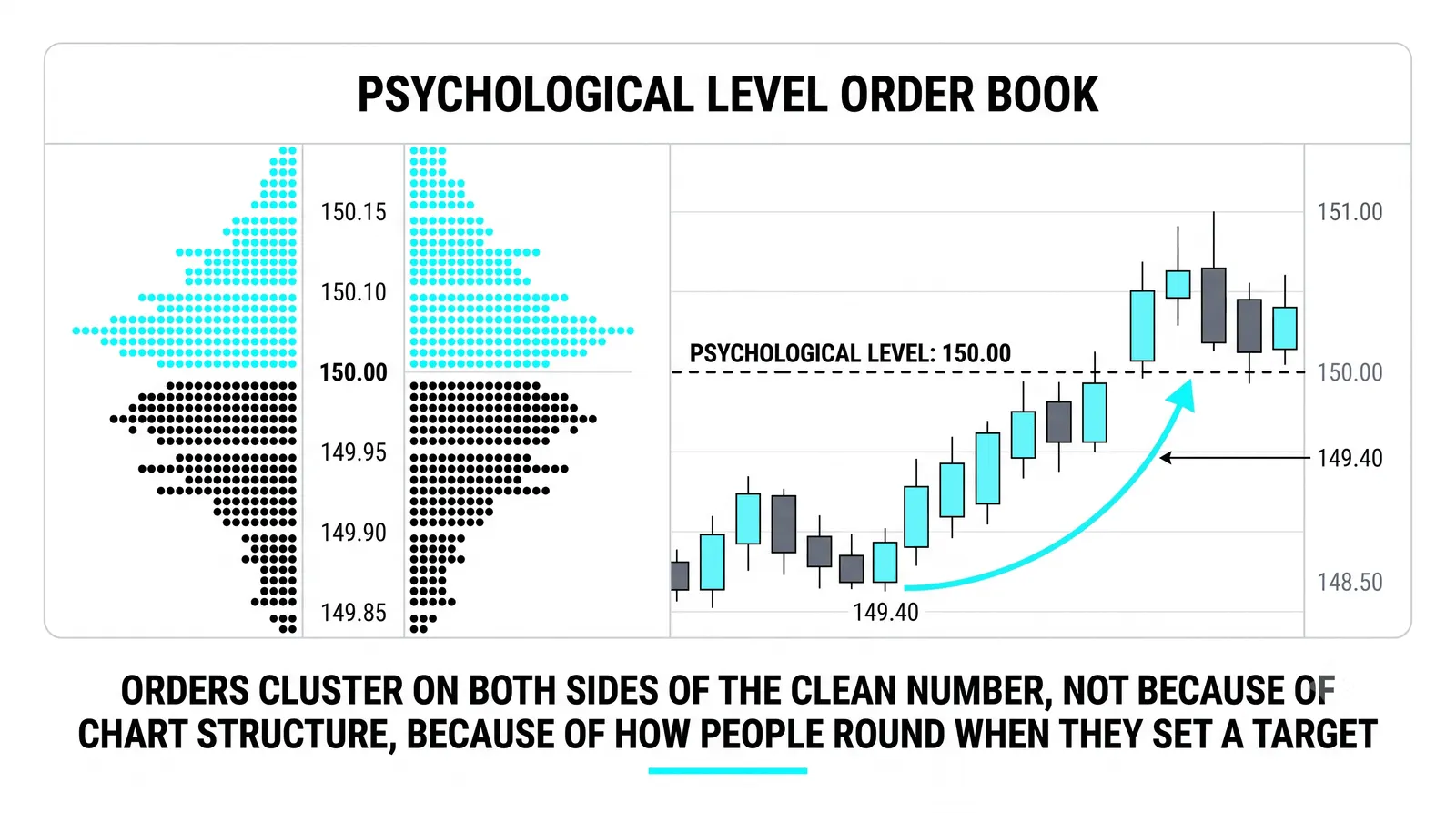
Round numbers are clean prices like 150.00 or 5,000 where orders pile up because people round, and that pile-up is the story: the cluster of orders is real, the wall is an illusion, and the cluster shapes behavior more reliably than it holds price. Traders call them psychological levels. Stores price things at 9.99 because shoppers round, and markets do the same in reverse, stacking orders at the cleanest number on the screen.

That distinction matters more than it sounds. A round number is not a level the market respects. It is a place where human habit concentrates orders, and concentrated orders attract attention from everyone watching the same chart.
Why Orders Pile Up at Clean Prices
Nobody enjoys typing 149.83 into an order ticket. Given a choice, a trader sets a profit target at 150.00, an entry at 5,000, a stop just past 100. Rounding is a simplification habit, and every market participant shares it.
Profit targets drift toward the clean value. Entries drift there too. Stops get tucked just beyond it, because traders assume the number will hold and want protection just past the supposed wall. Three different decisions, all pulled toward the same price.
Retail traders do this. So do bank algorithms, because the humans who design execution logic also think in round figures, and large institutional orders are often worked around big figures where clients expect fills. The result is that pending orders and stop orders stack on both sides of the number.
That stack is the only thing a round number truly offers. It tells you where liquidity sits. Liquidity is fuel, and fuel gets used.
Why They Break More Often Than Real Structure
A genuine support level exists because capital was committed there before. Buyers defended a price, real money changed hands, and the market remembers it. A bare round number has no such history. Nobody bought at 150.00 because 150.00 meant something. The number is a magnet, not a foundation.
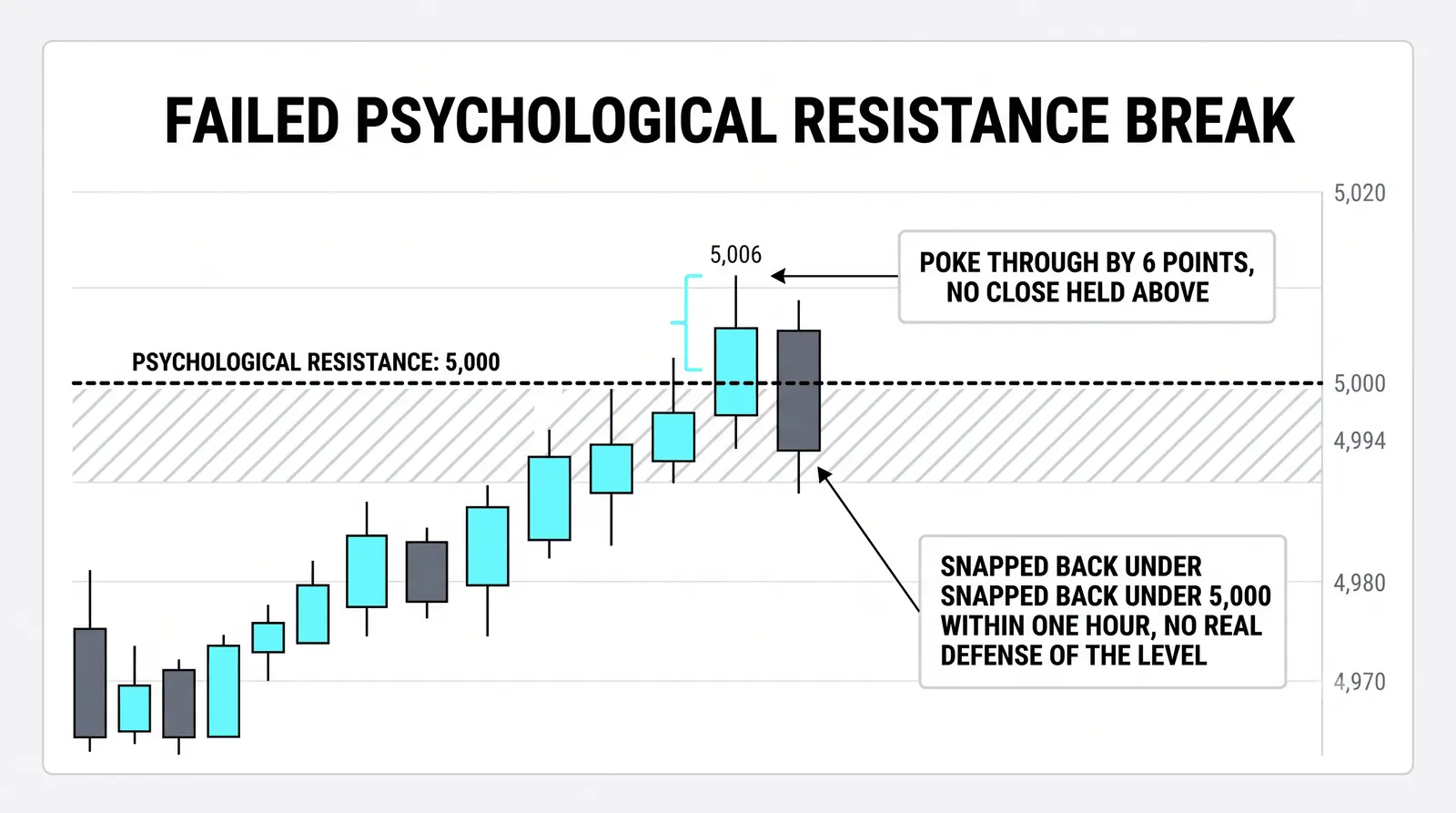
So the first test often slices straight through. Price pokes past the figure, triggers the stacked stops, fills the breakout orders, and then snaps back once that fuel is spent. Traders call this a sweep, and it happens at round numbers constantly.
The trader who sells the first touch blind gets caught in this repeatedly. The short looks perfect for a few minutes. Then the spike through the number takes the stop, and price collapses back down without them. The idea was right and the timing was punished.
This connects to something covered earlier in the course: crowds behave predictably at obvious prices, and that predictability gets exploited. The psychology lesson explained why. This lesson is about where it shows up on the chart.
Also keep the sibling lesson in mind: a round number earns attention only when real structure agrees with it. On its own, it is a minor level at best.
When a Round Number Actually Carries Weight
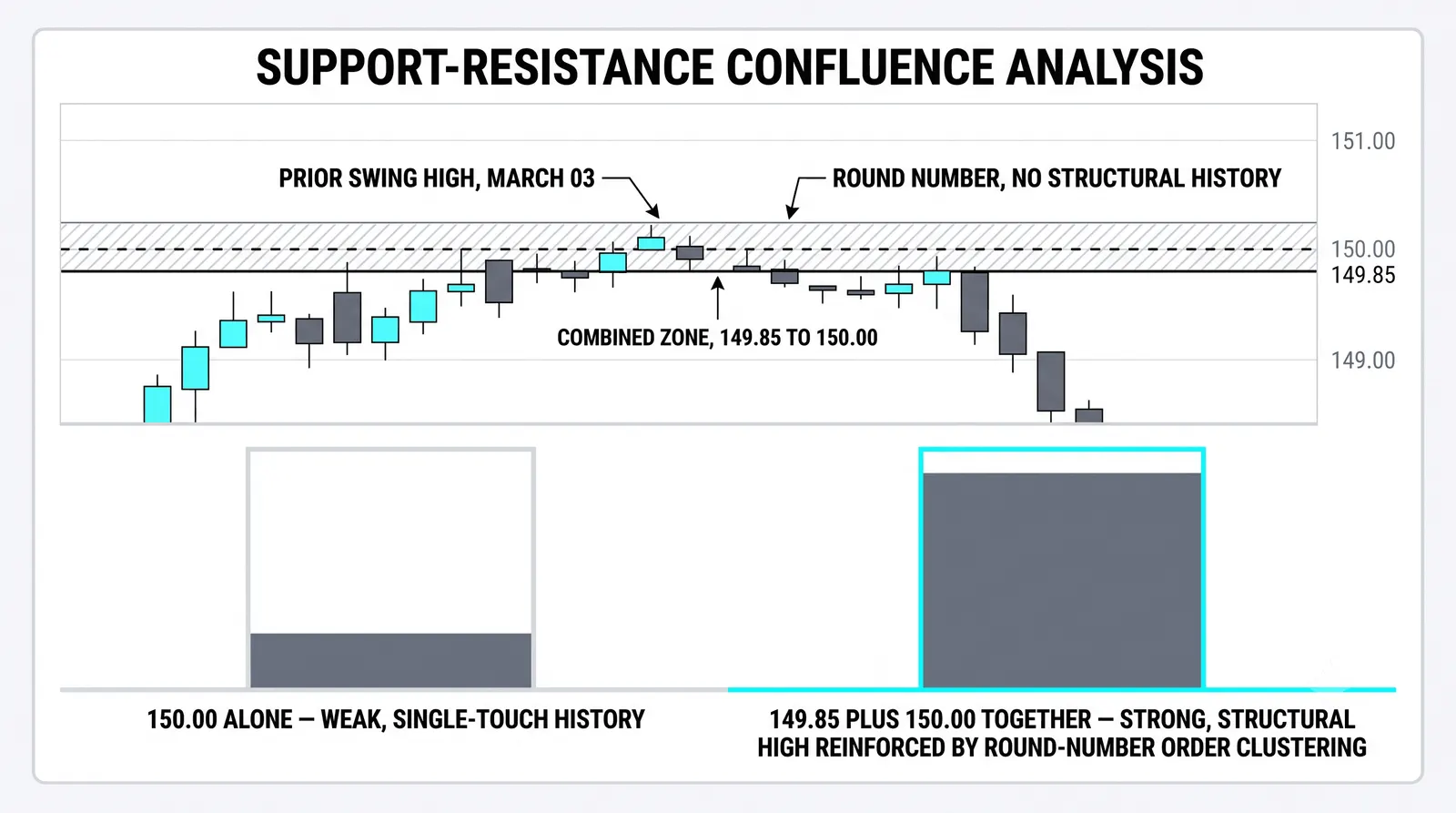
Confluence changes everything. When a prior swing high or low sits at or near the figure, the mental line becomes a real zone. Now you have habit and history pointing at the same price, and the level deserves respect.
Size matters too. Big figures like 150.00 or 2,000 attract far more attention than minor double-zero steps like 150.50 or 147.00. The bigger the number, the more orders cluster, and the more violent the sweep tends to be.
Thinner markets respect clusters more. In a quiet pair or an off-hours session, fewer orders exist overall, so the stack at the round number represents a larger share of available liquidity. Price reacts to it more visibly. In deep, fast markets, the same cluster is a speed bump.
Trading Around the Number Without Assuming It Holds
The practical rule is simple: react to closes, not wicks. A wick through the number tells you stops were triggered. A close beyond the number tells you buyers or sellers actually accepted the new price. A close back inside tells you the sweep failed and the move was a raid on liquidity.
Never place a stop directly on the number. That is where everyone else's stop sits, which makes it the single most likely price to get touched. Give the trade room past the cluster. If the sweep typically extends some distance beyond the figure, your stop belongs beyond that extension.
Patience does the heavy lifting here. Let the number get tested. Watch what the close says. Then decide.
The Sweep at 150.00
Here is a hypothetical. USD/JPY rallies toward 150.00, and a daily swing high sits at 149.85, just left of the big figure. That is confluence: structure and psychology in the same zone.
Price spikes to 150.18, clearing the stops parked above 150.00. Then it closes the day back at 149.60. The readable sequence is the sweep and the close-back. The market took the fuel above the figure and rejected it.
A hypothetical plan built on that failure: short interest with an entry near 149.60, a stop at 150.45 above the sweep high, and a first target at the next level near 147.80. That is about 0.85 risked against 1.80 gained, a reasonable ratio with structure behind the idea.
Now walk the other version. A trader shorts the first touch of 150.00 blind, stop at 150.20. The spike to 150.18 nearly takes them out, and a slightly wider push does. They were right about the direction and wrong about the sequence. The same analysis, the same chart, opposite results, decided entirely by whether they waited for the close.
Round Numbers at a Glance
| Situation | What Usually Happens | The Sensible Play |
|---|---|---|
| First test of a bare round number | Price slices through, triggers stops, often snaps back | Stand aside and watch the close |
| First test with structure behind it | Stronger reaction, but a sweep is still common | Wait for a close back inside before engaging |
| Stop placement | Stops on the number get hit by the sweep | Place the stop beyond the typical sweep extension |
| The confirmation to wait for | A close beyond the number or a close back inside | Trade the close, never the wick |
Round Numbers, Answered
If they are only psychology, why do they matter at all?
Because psychology is what places orders. The cluster of stops and entries at a round number is real liquidity, and liquidity drives short-term price movement even when the level itself has no structural basis.
Should my stop sit at the round number?
No. That is the most crowded price on the chart and the most likely to get swept. Place the stop beyond the cluster, past the distance a typical sweep extends.
Which round numbers matter most?
Big figures like 150.00 or 5,000 matter most, especially when a prior swing high or low sits nearby. Minor double-zero steps attract smaller clusters and weaker reactions.
Do round numbers work in crypto?
Yes, and often more visibly. Prices like 100,000 or 10,000 attract enormous attention, thinner weekend liquidity amplifies the cluster's effect, and sweeps through big figures are frequent.
Next, the course moves from individual levels to how session ranges frame them, because a round number inside the Asian range behaves differently from the same number tested during London. Keep the same habit there: watch the close, respect the cluster, and let the market show its hand first.