How Psychology Drives Price
Market psychology is the study of how fear and greed, acting through millions of individual decisions, push prices around. Every tick on your chart is a person choosing to buy, sell, or wait, and most of those choices are emotional. That is why the same patterns keep showing up decade after decade.

You already know how to read a chart. This lesson is about what the chart is actually recording. Once you see price as a record of human behavior, support, resistance, and blow-off tops stop looking like magic and start looking like memory.
Every Print Is a Vote
A price only exists because two people agreed to trade. One of them wanted out badly enough to accept the current offer. The other wanted in badly enough to pay it. Neither acted on pure math. Both acted on a feeling about the future, filtered through their position, their recent wins or losses, and their fear of being wrong.
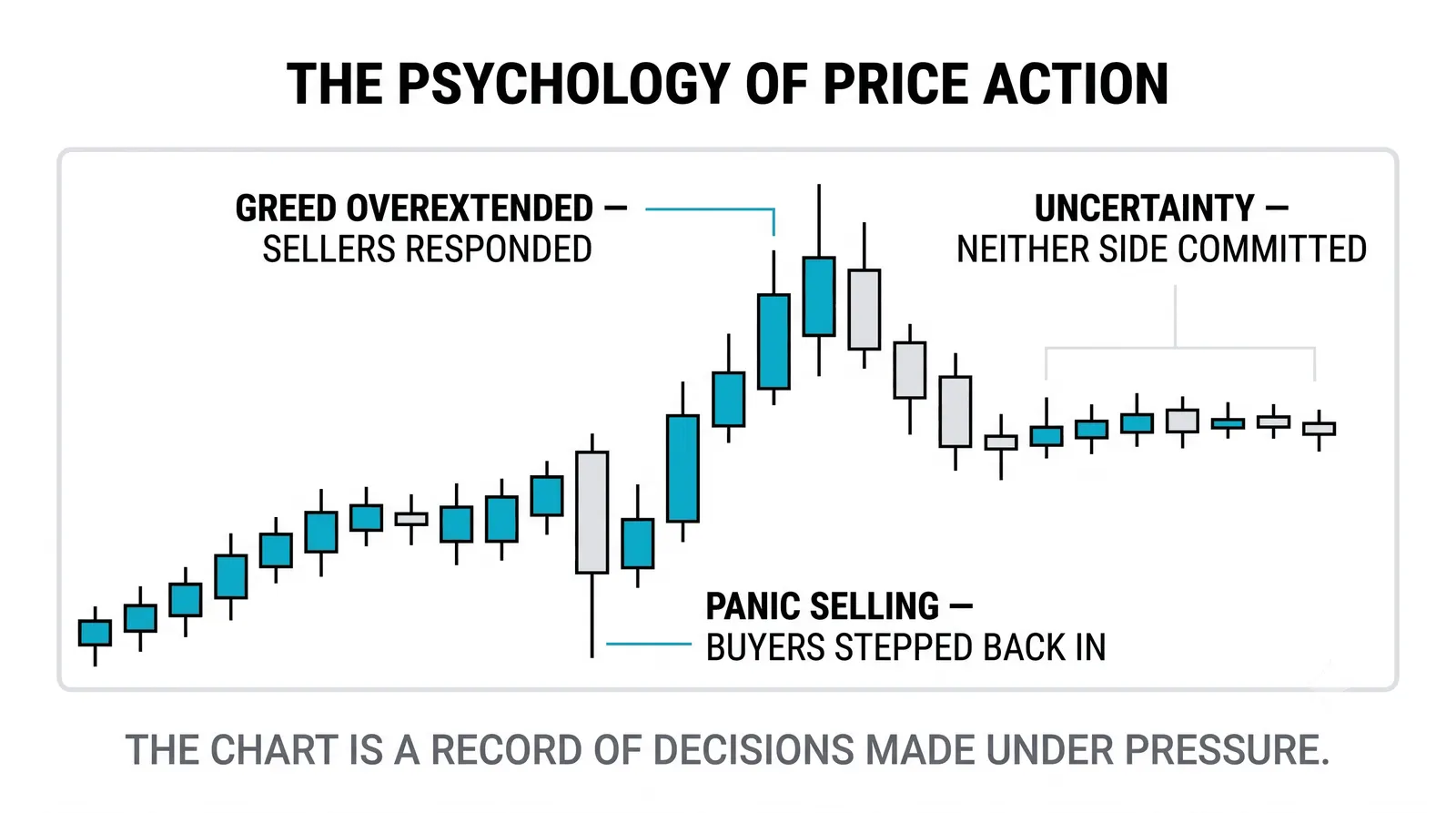
Multiply that by millions of participants and you get the tape. Price is not a measurement of value. It is a running tally of decisions made under pressure.
Think of the market like an auction where the bidders can see each other's faces. The bidding itself changes the bidding. A rising price makes watchers feel they are missing out, so they join, which pushes price higher, which pulls in more watchers. The loop runs until someone runs out of money or nerve.
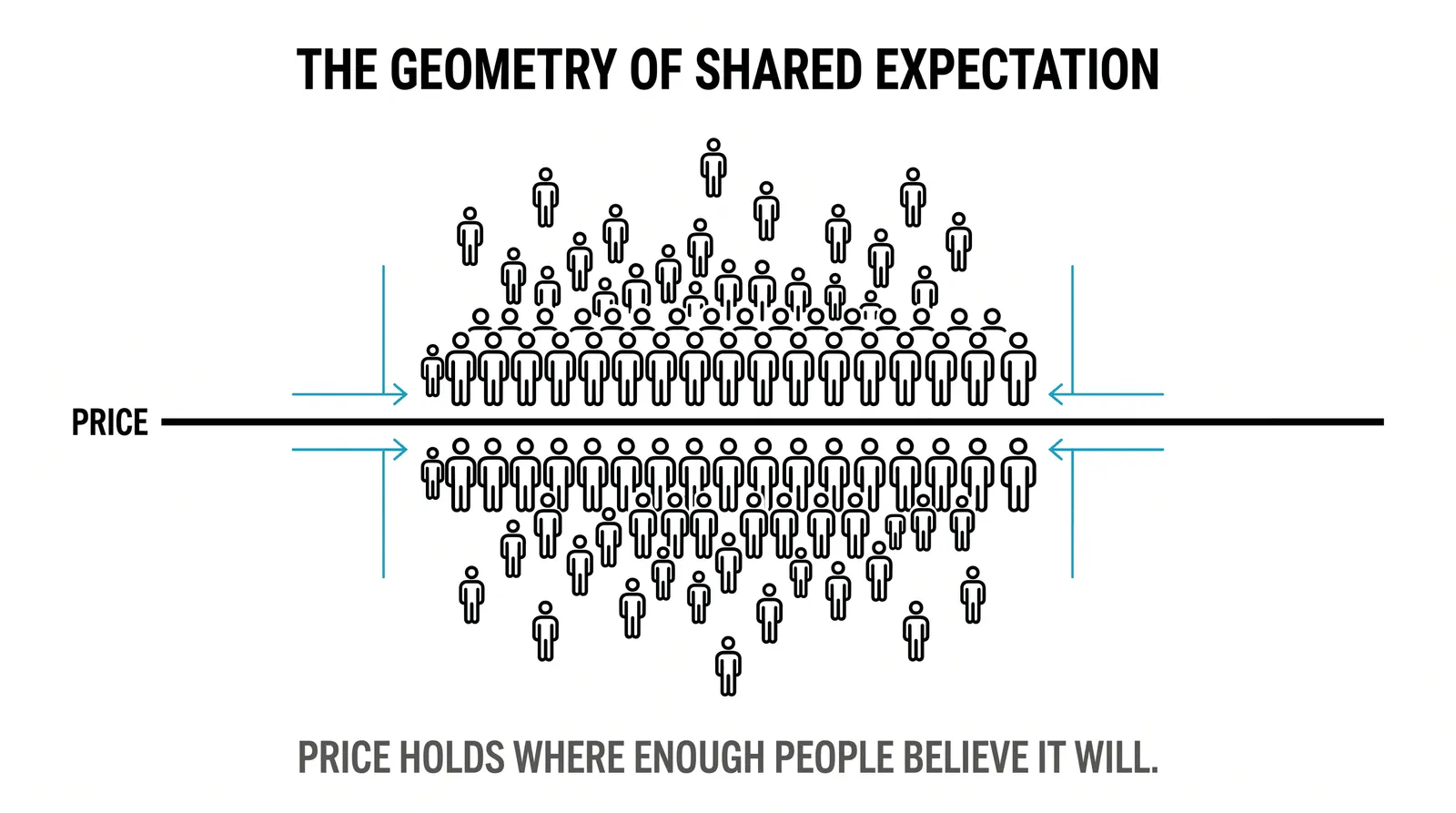
This is the core idea of the whole lesson. Charts are not pictures of companies or economies. They are pictures of crowds.
The Fear-Greed Cycle Across a Big Move
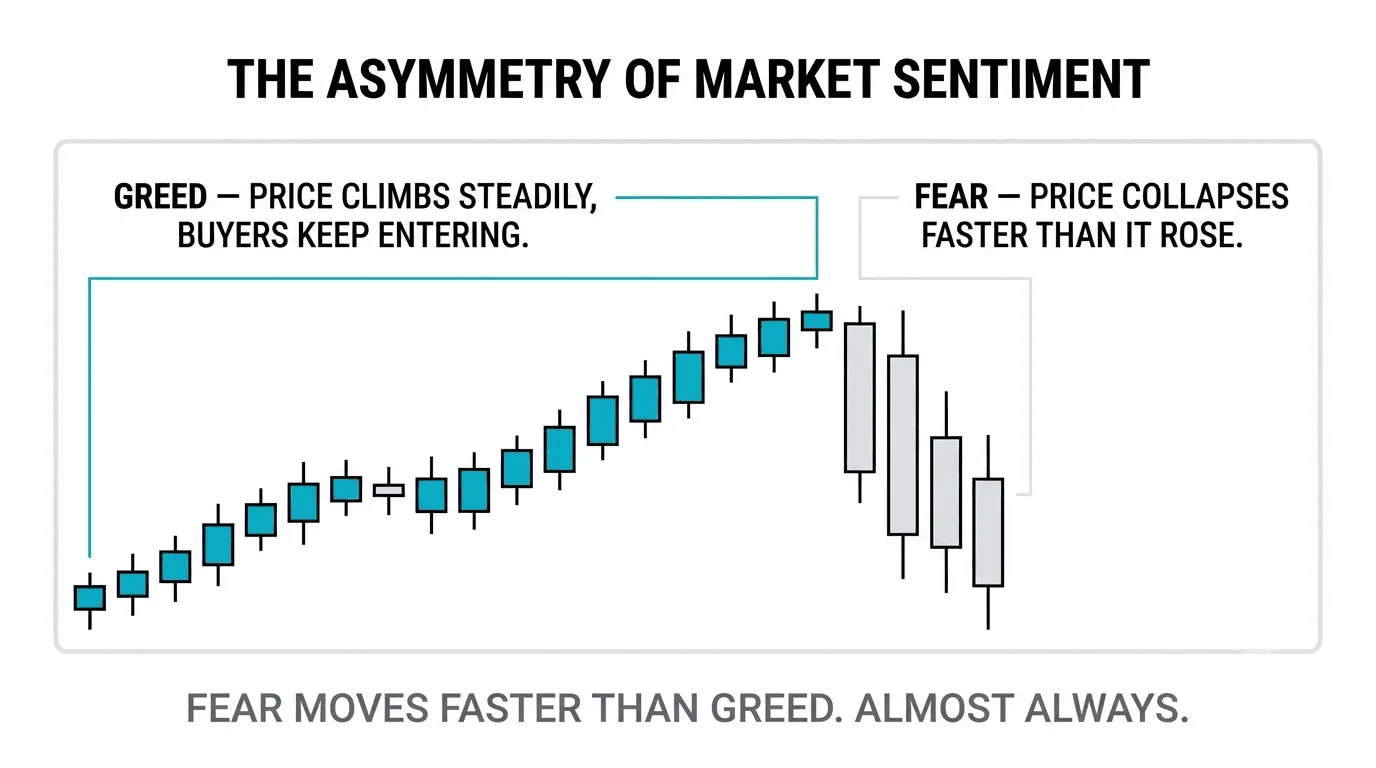
Watch any large rally and collapse, and the emotional sequence repeats with eerie consistency. The names and tickers change. The behavior does not.
It starts quietly. Price has fallen or gone flat for a long time, and early buyers step in while most people are still disinterested. This is hope. Volume is thin, and nobody is talking about the asset at dinner.
As price climbs, optimism spreads. Then comes euphoria, the most dangerous stage. At tops, you will see specific behaviors: people buying after a 300% run because "it always comes back," new traders quitting jobs, anyone urging caution getting mocked. Euphoria feels like certainty. That feeling is the signal.
When price first rolls over, the crowd does not panic. It denies. "Just a pullback." "Buy the dip." Early dips do get bought, which reinforces the belief, until one dip does not come back. Then anxiety turns to fear, fear turns to panic, and the same people who bought in euphoria sell at the bottom, swearing never to touch the market again. That capitulation, heavy volume and vertical drops, is often where the next cycle quietly begins.
The crowd is not stupid. It is simply feeling the same thing at the same time, and acting on it at the worst moment. The two big crowd states even name the market's moods: bull and bear markets.
Levels Are Shared Memory
Support and resistance work because people remember. Round numbers and old highs are not magical lines. They are prices where a lot of decisions were made, and the people who made them are still around, still anchored to those numbers.
Here is a worked example. Suppose a stock trades at 100, then runs to 140. Three groups now carry emotional baggage about the number 100:
- Traders who wanted to buy at 100, hesitated, and watched it run. They feel regret. Many of them have mentally promised themselves: "If it ever comes back to 100, I am buying."
- Traders who bought at 100 and sold at 120 feel smart, and would happily buy their winner again at the old price.
- Traders who bought at 130 or 140 are underwater. If price fell to 100 and bounced back to their entry, many would sell just to escape at breakeven.
Now flip it. Suppose price rallies to 100 and gets rejected twice. Sellers remember. The third time price approaches 100, those sellers place orders early, some at 99, some at 98, because they do not want to miss the exit again. The level weakens or holds based on which group's memory is stronger and which group has more money behind it.
This is why old highs matter, why 100 acts differently than 103.47, and why levels are zones rather than exact lines. You are trading against human memory, not geometry.
Crowd Emotion Versus Price Behavior
The five stages show up so reliably that you can map them. Use this table as a reference when you look at any big historical move.
| Stage | Dominant Emotion | Typical Price Behavior |
|---|---|---|
| Disbelief | Hope, caution | Slow grind up from lows, low volume, few believers |
| Optimism | Greed building | Steady uptrend, dips bought quickly, volume rising |
| Euphoria | Peak greed | Vertical moves, huge volume, wild intraday swings, blow-off top |
| Denial | Fear suppressed | Sharp drops bought back, lower highs begin, "healthy correction" talk |
| Capitulation | Panic | Vertical selling, volume spikes, then exhaustion and a base |
Notice that the extremes, euphoria and capitulation, come with the heaviest volume. Emotion at its peak produces the most trades. That is a clue you can actually use, and we will come back to it in the questions below.
Why the Crowd Is Not You
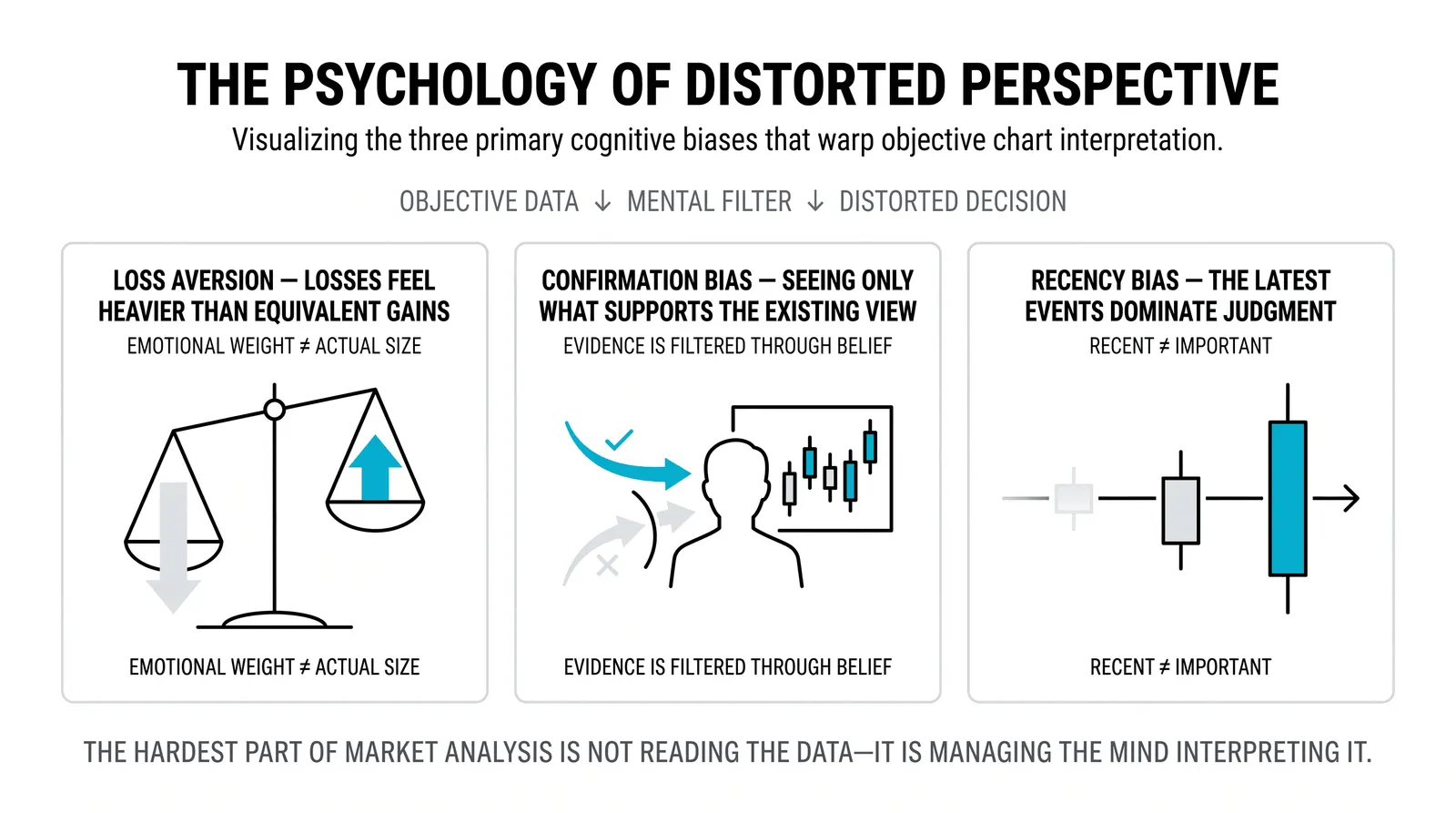
Reading about euphoria and panic is easy. Recognizing it while your own money is in the trade is a different skill entirely. Your brain runs the same hardware as everyone else's. When price is ripping, you will feel the pull to chase. When it is collapsing, you will feel the urge to dump everything. Knowing the cycle does not exempt you from it.
The solution is not stronger willpower. Willpower loses to adrenaline every time. The solution is to make your decisions before the emotion arrives.
A trading plan exists for exactly that reason. Entry, exit, and size, written down while you are calm, so that the version of you holding a position never has to improvise. A plan is a message from your rational self to your future emotional self.
Traders who skip this step end up as liquidity for traders who do not. The crowd's panic selling has to go somewhere, and it goes to the people with resting orders and predefined levels; the full roster is in key market participants. Be on the right side of that transfer.
Questions About Market Psychology
Can psychology actually be measured?
Not directly, but its footprints are measurable. You cannot put a number on fear, but you can see what fear does: volume spikes, sudden acceleration in price, and volatility expanding far beyond its recent average. A quiet market that suddenly trades five times its normal volume on a fast drop is showing you panic. You do not need a sentiment survey. The tape itself is the sentiment indicator.
Is the crowd always wrong?
No, and believing that will hurt you. The crowd is right for most of a trend. During the optimism stage, buying with the crowd is exactly what works. The crowd is wrong specifically at turning points, at euphoric tops and panic bottoms, where emotion peaks and the last buyer or seller has already acted. Your edge is not fading the crowd. It is recognizing when the crowd has reached an emotional extreme.
Do institutions feel fear too?
They feel risk limits, which produce the same footprints. A fund does not panic emotionally, but it has drawdown rules, margin requirements, and clients who redeem at the worst times. When those limits trigger, the fund sells mechanically, just like a panicking retail trader, only bigger. That is why institutional markets still show the same cycle. The emotion is replaced by rules, but the behavior stays patterned.
How do I stop my own emotions from pricing my trades?
Write the plan before the position. Decide your entry, your invalidation point, your target, and your size while the chart is not moving against you. Then your only job during the trade is execution, not decision-making. If you find yourself staring at the screen asking "should I get out," that question should have been answered before you got in. Journaling your emotional state at entry and exit also helps, because after twenty trades you will see your own personal fear-greed cycle in writing. If you have not reached a live account yet, rehearse the plan-writing on a demo account, where the tuition is free.
Next, put this into practice: pull up a chart of any major boom and bust, mark the five stages from the table, and note what volume did at each one. Then study how support and resistance form at levels where that emotion ran hottest, because that is where psychology turns into levels you can trade.