Reversal Candles vs Continuation Candles
A continuation candle tells you the move you are watching still has control, while a reversal candle warns that control is slipping. That single distinction is what separates reading candles as decoration from reading them as decisions. Most traders can name a dozen patterns. Far fewer can say, in the moment, whether the candle in front of them is asking them to enter, hold, or get out.

Think of a junction light. One light tells you the direction is changing, another tells you to keep driving. The light itself is neutral. The direction you were already traveling is what gives it meaning.
This lesson does not re-teach the shapes. You already know them. What follows is the classification: what each family of candles claims, where each tends to appear, and how your response should differ.
What Each Family Claims
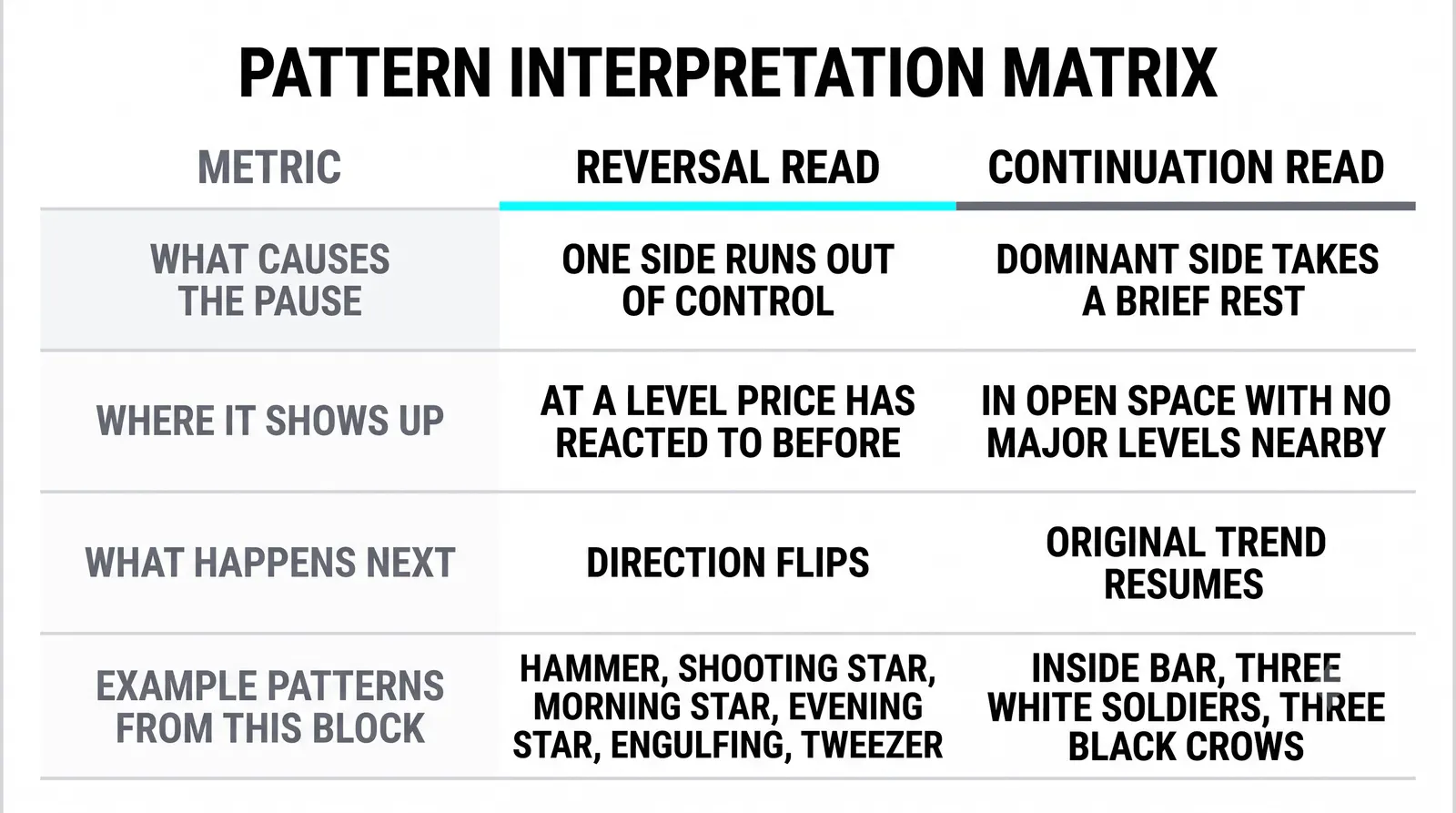
A reversal candle makes one claim: the current move's fuel is spent. Buyers or sellers have pushed as far as they can, and the other side is starting to take the wheel. The family includes the hammer, the shooting star, the engulfing patterns, the doji at extremes, and the evening and morning star formations.
A continuation candle makes the opposite claim: the pause is over and the move resumes. The trend took a breath, weaker hands exited, and the dominant side is back in control. This family includes the rising and falling three methods, the marubozu in trend direction, and strong-bodied candles that close out of a pullback or a tight consolidation.
Notice what neither family claims. Neither predicts a target. Neither guarantees follow-through. Each is a statement about control, nothing more.
That is the job of classification: before you ask "is this a good candle," ask "what is this candle claiming."
Where Each Tends to Form
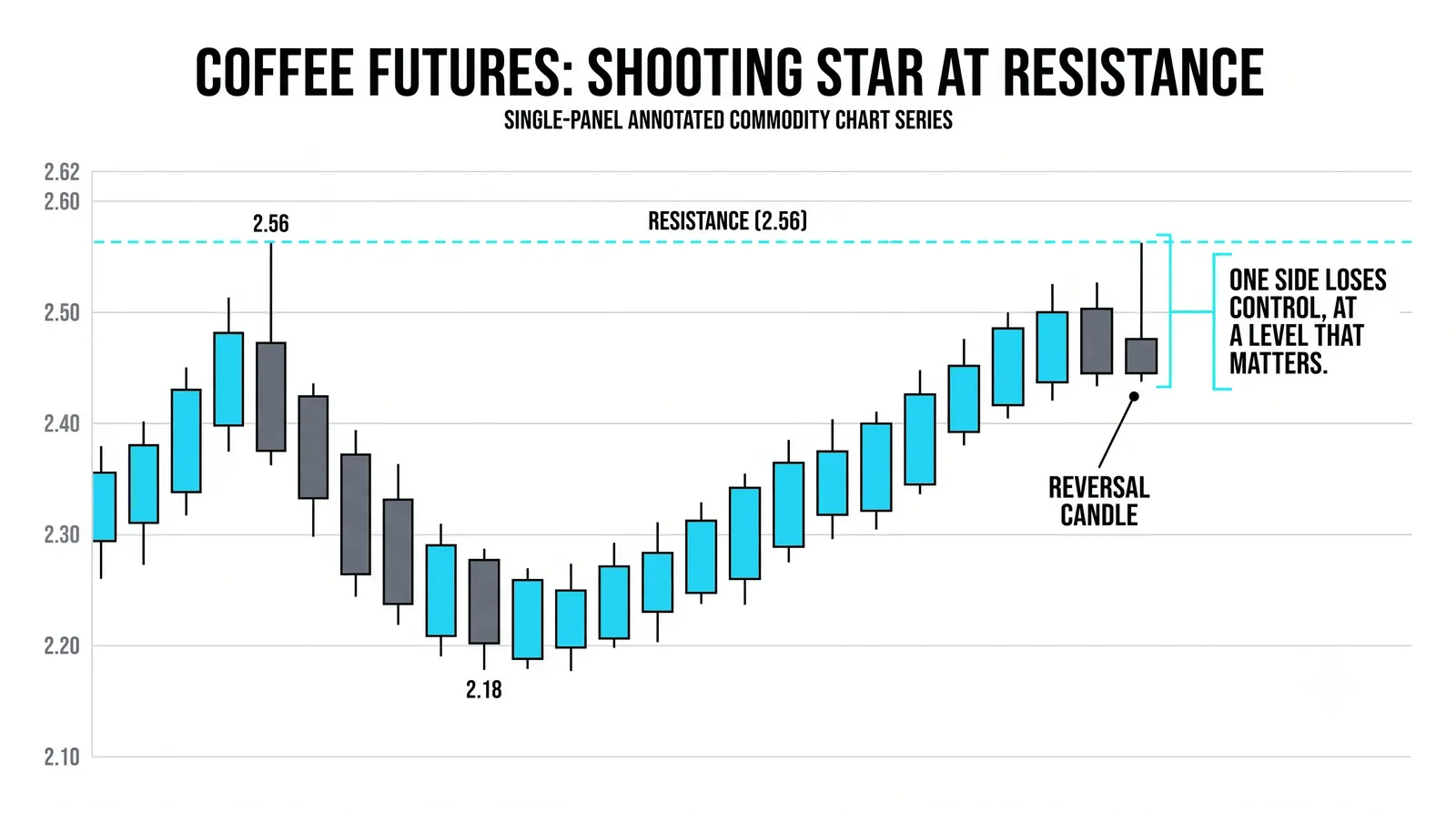
Reversal candles cluster at extremes. They show up at test levels, at swing highs and lows, and after extended runs where one side has been winning for a long stretch. The further price has traveled without a meaningful pause, the more weight a reversal signal carries.
Continuation candles cluster mid-trend. They appear at the end of pullbacks, inside consolidations, and at pauses near old breakout zones where price is digesting a prior move. The trend is intact, price has rested, and the candle marks the moment the rest ends.
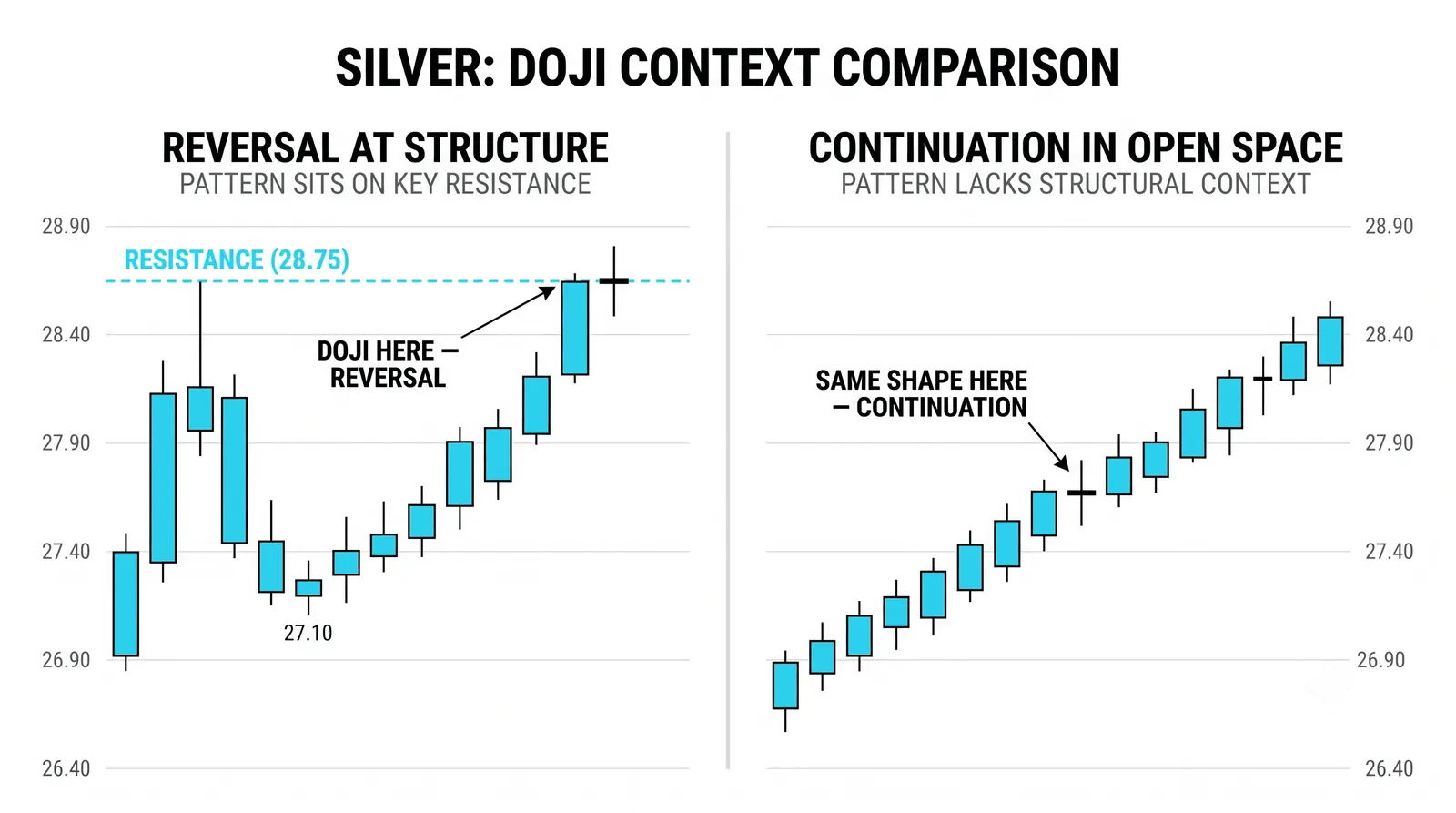
Location is not a minor detail. It is most of the signal. A reversal pattern printed in the middle of nowhere, halfway between support and resistance with no extreme in sight, is usually noise. A continuation candle printed against the trend, at a stretched extreme, is often a trap.
Why the Same Candle Can Be Either
Here is the uncomfortable part. The candle does not carry its own label.
Take a strong bullish candle with a solid body and a close near its high. Print it near a low after a sustained decline, and it is a candidate reversal: buyers are seizing control from sellers for the first time in a while. Print the identical candle mid-uptrend, at the end of a shallow pullback, and it is a continuation signal: buyers never lost control and are now resuming.
Same shape. Opposite jobs. The classification comes entirely from the surroundings: where price sits relative to the trend, how far the move has run, and what level is nearby.
This is why memorizing shapes in isolation fails traders. The chart around the candle carries the meaning, and it comes first.
The Response Test
The cleanest way to keep the two families straight is to ask what each one wants you to do.
A reversal candle changes what you do with a position you already hold. It is a management signal. Your options are to trim some size, tighten your stop, or stand down entirely. It is not automatically an instruction to flip direction, and treating it as one is how traders get chopped up shorting every shooting star in an uptrend.
A continuation candle is an entry signal. It marks a spot to open a new position in the trend's direction, with a logical invalidation point nearby, usually below the pullback low or the consolidation floor.
Two different jobs, two different risk calculations. The reversal read risks giving back open profit. The continuation read risks fresh capital on a new entry. Mixing them up, entering aggressively on what was actually a warning, or dumping a good position on what was actually a pause, is the most expensive classification error a candle reader makes.
The Classification in Action
Here is a hypothetical walkthrough with round numbers. Nothing here is a recommendation; it is an illustration of the decision process.
A stock climbs from 100 to 112 over a few weeks. The trend is up, with higher highs and higher lows. Then price pulls back for three sessions, drifting down to 110.50 on shrinking momentum. The decline looks like a pause, not a collapse, because it is shallow and sits well above the prior swing low.
On the fourth session, a strong bullish candle prints and closes at 111.80. Classify it. Mid-trend, at the end of a pullback, above intact structure. This is a continuation candle. It claims the rest is over and the uptrend resumes. The natural response is a long entry, with a stop at 110.20, just below the pullback low. Risk per share is about 1.60, and the invalidation is clean: if price breaks the pullback low, the pause was not a pause.
Now fast forward. The stock pushes on to 113, which sits right under old resistance from a prior high. There, a long-wicked bearish candle prints: price poked above 113, got rejected, and closed near its low. Classify it. At an extreme, after an extended run, directly under a known level. This is a reversal candle. It claims the buyers' push is stalling.
Your response is completely different. You are already long from 111.80. You do not need a new entry; you need to protect the one you have. Tighten the stop, or trim part of the position. The next session closes lower, confirming the warning, and tightening further is reasonable.
Same trader, same stock, same week. One candle said "join the move." The other said "defend what you have." The shapes alone never told you that. The surroundings did.
Side by Side
| Reversal Candles | Continuation Candles | |
|---|---|---|
| What they claim | The current move's fuel is spent; control is changing hands | The pause is over; the existing move resumes |
| Where they form | At extremes: test levels, swing highs and lows, after extended runs | Mid-trend: pullback ends, consolidations, pauses near old breakout zones |
| Natural response | Manage an existing position: trim, tighten, or stand down | Enter a new position in the trend's direction with a defined stop |
Your Questions About Candle Types
Can a continuation candle appear at a top?
It can look like one, and that is the trap. A strong trend-direction candle printed at a stretched extreme, right into resistance, often fails. The shape says continuation, but the location argues exhaustion. When the two disagree, trust the location and demand confirmation before entering.
What turns a reversal signal into a trade?
Confirmation and structure. A reversal candle at a level becomes tradable when the next session or two confirms the shift, a lower close after a bearish warning, for example, and when a logical stop placement exists nearby. Without confirmation, you are acting on a warning as if it were a verdict.
Do reversal candles work in strong trends?
Poorly, most of the time. In a strong trend, reversal signals against the trend fail far more often than they succeed, because the dominant side keeps absorbing the counter-move. In that environment, treat reversal candles as reasons to manage your position, not as reasons to fade the trend.
How do I practice telling them apart?
Replay old charts and classify before you look ahead. Cover the right side of the chart, find a notable candle, and write down two things: what family it belongs to and what evidence from the surroundings supports that call. Then scroll forward and grade yourself. Fifty repetitions of that drill will teach you more than rereading any pattern catalog.
Once classification becomes automatic, the next skill is judging the quality of the level the candle forms at, because a strong signal at a weak level still loses. That is where structure reading takes over, and it is where the next lesson begins.