Initiative vs Responsive Activity
Initiative and responsive activity are the two kinds of trade that happen around value, and telling them apart is the core skill of this lesson. Initiative activity is trade that pushes price away from value: buying above the value area, or selling below it. Responsive activity is trade that pulls price back toward value: selling above it, or buying below it. When you know which one is moving the tape, you know whether a move is a repricing or a round trip.

Think of pioneers and settlers. Pioneers break ground beyond the edge of town; settlers farm ground that is already proven. A town only grows when the pioneers' claim turns out to be worth farming. Price works the same way: initiative trade stakes a claim outside value, and only if responsive trade accepts that ground does the market hold there.
The previous lessons built the reference line. The value area and the point of control tell you where the market agreed to do business. Everything in this lesson is measured against that line. A trade is not initiative or responsive because of how it looks on a candle; it is initiative or responsive because of where it happens relative to value.
Initiative: Leaving Value Behind
Initiative activity is directional conviction expressed at prices the market has not yet accepted. Initiative buyers pay up above the value area. Initiative sellers hit bids below it. They are not waiting for a bargain. They are saying the old agreement is wrong and forcing the market to reprice.
The anatomy has three parts, and you want all three before you believe the move.
- Expanding volume on the push away. Initiative trade shows up as heavy participation while price leaves a known area. The market is not drifting out of value; it is being driven out.
- Follow-through. The move holds its gains after the first burst. Pullbacks are shallow, and price does not slip back inside the old area.
- Value steps up behind the move. This is the decisive one. As the session or the week develops, the new developing value area migrates in the direction of the drive. The market accepts the new ground.
That third element is the verdict. Initiative trade that cannot drag value behind it is a claim nobody farmed. The drive happens, the volume spike prints, and then the market quietly walks back home.
The same shape exists on the downside. Initiative selling below value looks like expanding volume on the break, follow-through lower, and value stepping down behind the decline. Mirror image, same logic.
Responsive: The Trade Back to Value
Responsive activity is the counterparty of the auction. Responsive sellers fade strength above value. Responsive buyers step in under it. They are betting the excursion is temporary and that price will return to the area where business was already agreed.
The anatomy of a responsive fade above value has its own three tells.
- Selling into strength at a known premium. The responsive seller is not chasing. They offer into the rally at prices the market previously rejected or never visited.
- Volume that dries as the move extends. Each new high attracts less participation. The drive is running out of buyers willing to pay up.
- A return toward the area. Price rotates back to value, and often through it. The excursion ends where it started.
Responsive trade is the norm inside balance. In a balanced market, most participants agree on value, so every push away from the area meets someone willing to take the other side. That is why ranges persist. The responsive players are the gravity of a balanced auction, and they win most of the days that the market spends in balance.
Below value, the mirror holds: responsive buyers absorb weakness, selling dries up on each new low, and price rotates back up into the area.
Why the Distinction Pays
Each side sets a trap for the other. Initiative trade traps responsive traders who keep fading a genuine repricing; they sell strength at 264, cover at 268, and sell again at 270 until the account is gone. Responsive trade traps initiative traders who chase every push out of a range that never actually breaks; they buy the high tick of a rotation, over and over.
The diagnostic that separates the two is the direction value migrates behind the move. Initiative leaves value and drags it. Responsive visits away from value and comes home. Watch where the developing value area sits an hour after the drive, or a day after the breakout. If value followed, the pioneers won. If value stayed put, the settlers won, and the excursion was a fade.
Two honesty beats before you trade this.
First, the label attaches to the address, not the candle. A strong rally above old value is initiative. The same rally, measured against a higher value area the market has already built, can be responsive, a rotation back up through accepted prices. Same candle, different answer, because value moved. You cannot classify trade without knowing where value sits first.
Second, alignment with the higher-timeframe campaign changes the trade's quality. Initiative in the direction of the larger campaign is the aligned trade from the multiple-timeframes work: the higher timeframe wants the repricing, and your timeframe is executing it. Initiative against the higher campaign is a counter-trend trade. It can work, but it must be sized smaller and judged faster, because the bigger campaign usually eats the smaller one.
One historical note: the auction tradition that formalized this vocabulary grew out of the classic accumulation and distribution framework, where the central question was always who is doing the trading and at what prices.
One Drive, One Fade
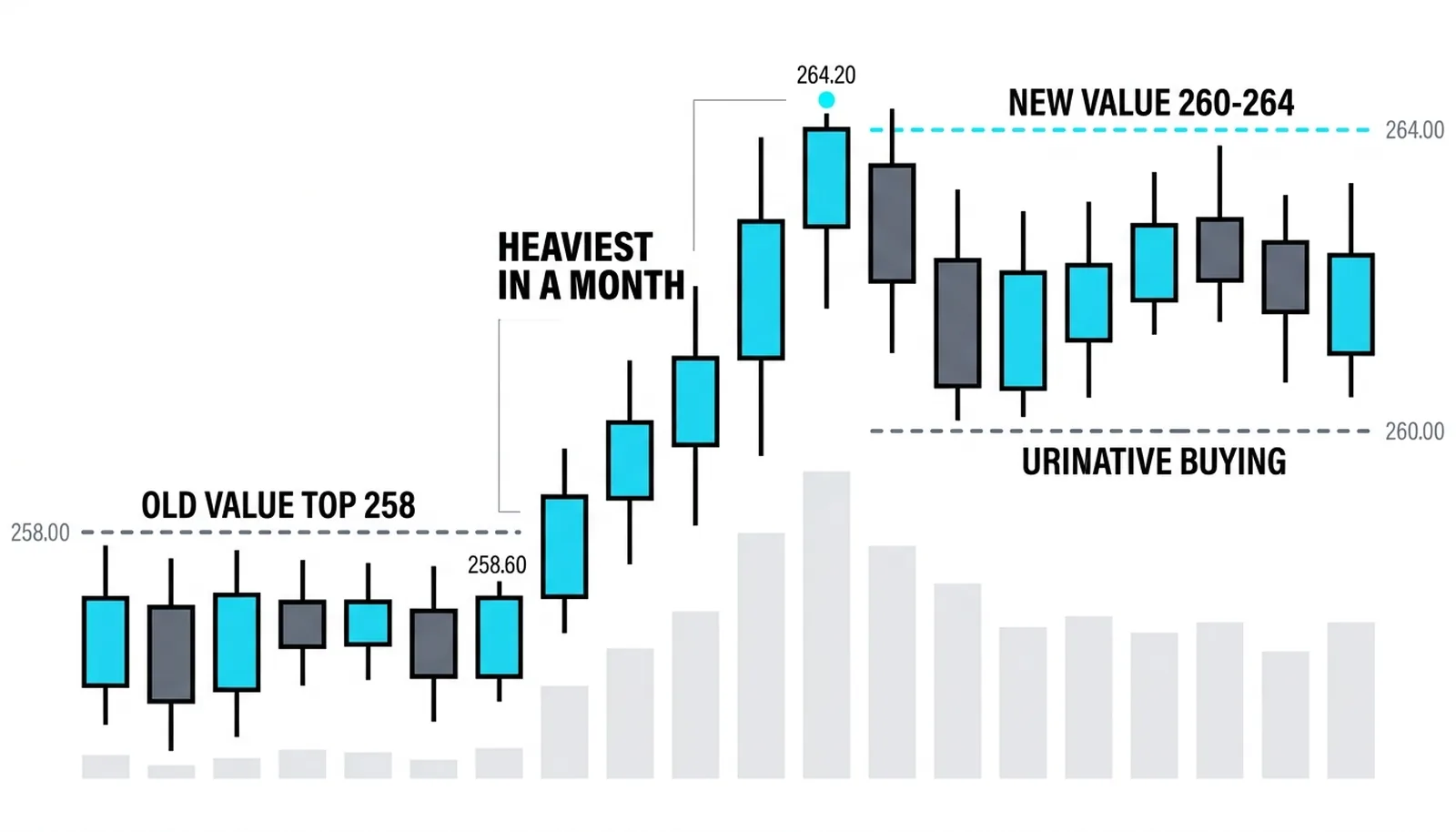
A hypothetical stock has spent two weeks trading in a value area from 252 to 258. The market knows this ground well.
One morning it opens at 258.6, just above the area. Buying hits immediately and drives price to 264.2 on the heaviest volume in a month. That is textbook initiative buying: participation expanding as price leaves known value.
By midday, the developing value area has stepped up to roughly 260 to 264. Value is following the drive. The claim is being farmed.
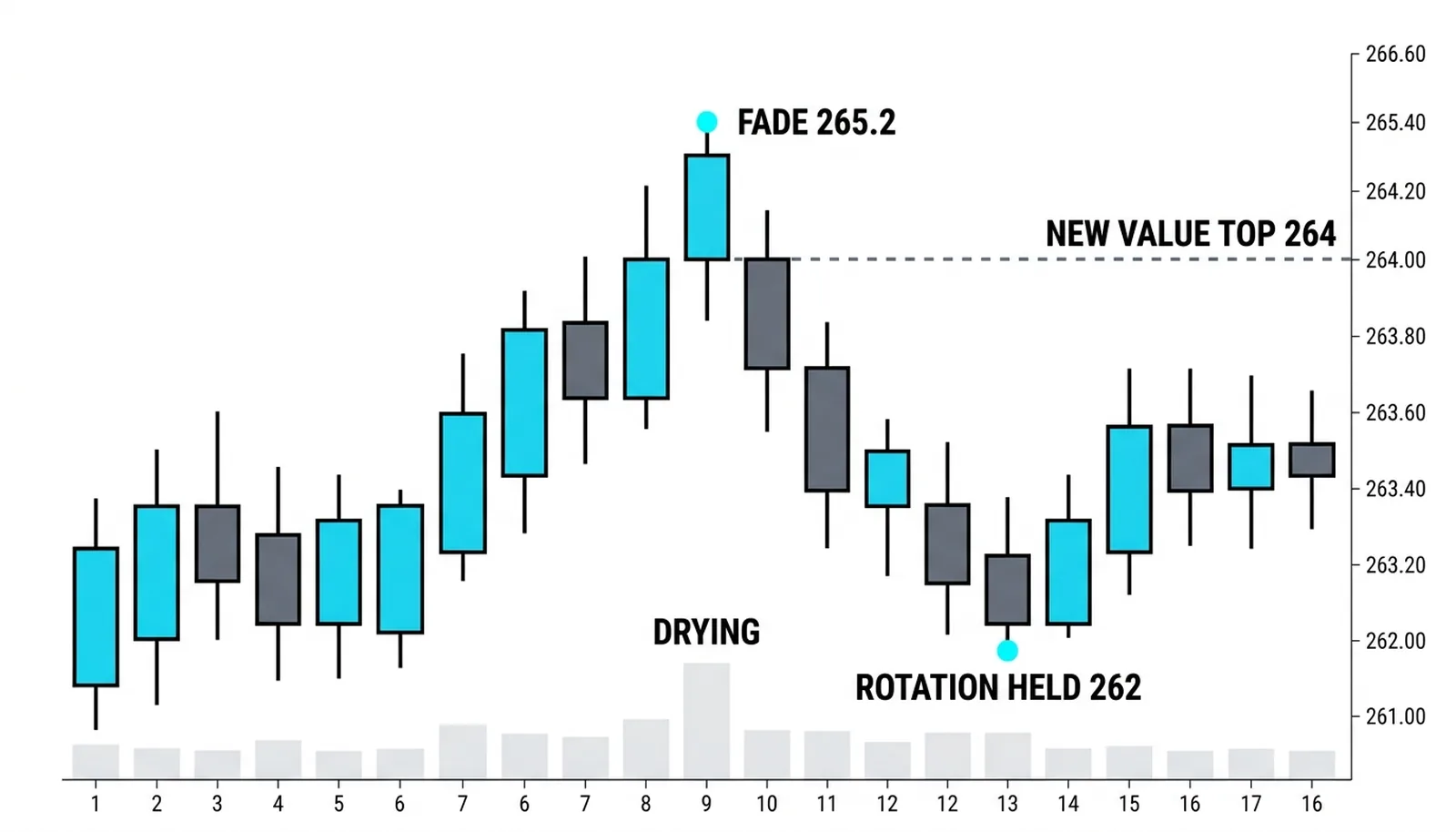
A responsive seller fades the afternoon high at 265.2. The trade works, but only back to 262, which is inside the new value area. The fade paid a rotation, not a reversal. The market closes at 263.4, above the old area. Initiative won the day; responsive won a scalp inside it.
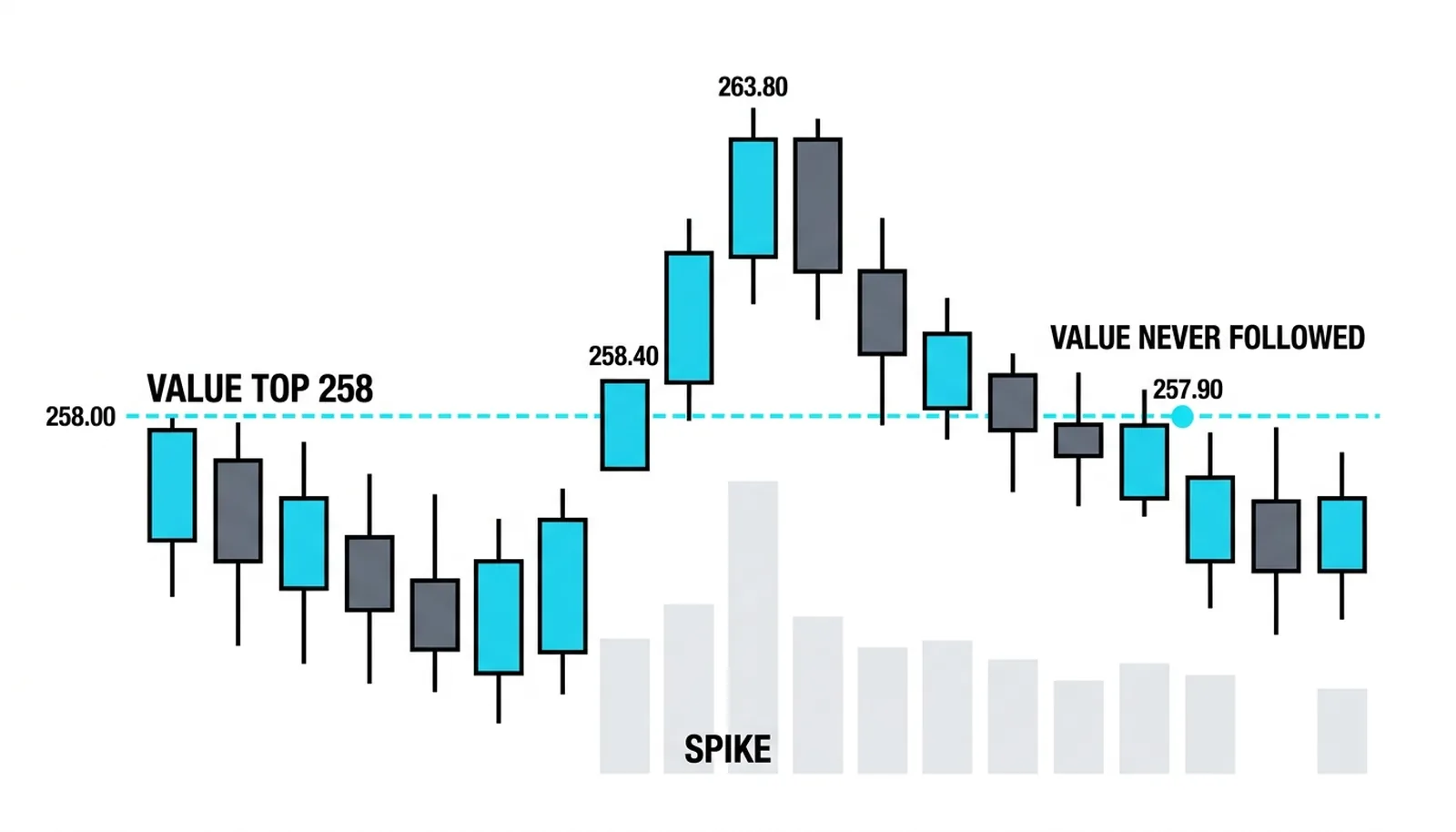
Now the failed case. A month earlier, the same stock printed an almost identical drive, reaching 263.8 on a volume spike. But the developing value never stepped up. By the close, price was back at 257.9, inside the old area. That day, responsive sellers owned the tape, and every initiative buyer who chased the breakout paid for the lesson. Same candle shape, opposite outcome, decided entirely by what value did behind the move.
| Behavior | Who acts | The evidence | The trap |
|---|---|---|---|
| Initiative buying | Buyers paying above value | Expanding volume, follow-through, value steps up | Chasing a breakout value never confirms |
| Initiative selling | Sellers hitting below value | Expanding volume on the break, value steps down | Shorting a breakdown that snaps back |
| Responsive selling | Sellers fading strength above value | Drying volume on new highs, rotation back to the area | Fading a genuine repricing again and again |
| Responsive buying | Buyers absorbing weakness below value | Selling dries up on new lows, return toward the area | Catching a real markdown too early |
Initiative and Responsive Activity, Answered
What is initiative activity in trading?
Initiative activity is trade that pushes price away from the accepted value area: buying above value or selling below it. It signals that a participant believes the current agreement is wrong and is willing to pay to reprice it. It is confirmed only when value migrates in the direction of the move.
What is responsive activity?
Responsive activity is trade that pulls price back toward value: selling above the area or buying below it. It treats excursions as temporary and bets on a return to accepted prices. Inside a balanced market, responsive trade is the dominant behavior.
How do you tell initiative from responsive buying?
Watch volume and value, not the candle. Initiative buying comes with expanding volume, follow-through, and a developing value area that steps up behind the move. Responsive buying appears below value, absorbs weakness on drying volume, and rotates price back up into the existing area.
Which is better to trade, initiative or responsive?
Neither is better in the abstract; each fits a different market state. In balance, responsive fades of the extremes are the higher-probability trade. When value is migrating, initiative in the direction of the migration, aligned with the higher-timeframe campaign, is the trade to press. The skill is reading which regime you are in before choosing a side.
Next, this block closes with balance versus imbalance: how to recognize when the auction is rotating quietly and when it is repricing in earnest, and why almost every decision in this level reduces to that one read.