Hawkish vs Dovish: What They Mean
When a central bank is called hawkish, it means the bank is leaning toward tighter policy and higher rates to fight inflation; when it is called dovish, it means the bank is leaning toward looser policy and lower rates to protect growth and employment. These two words carry trillions. A single sentence in a policy statement, read as a shift from one leaning to the other, can re-price a currency, a bond market, and a stock index within minutes.

Think of the policy stance as a volume knob for the economy: hawkish turns it down to quiet inflation, dovish turns it up to wake growth. The major central banks were covered in the previous lesson, and this stance is the language those institutions speak. Interest rates and asset prices were covered earlier this level, and the stance is the steering of that mechanism. Learn to hear the lean, and you can anticipate how markets will read the next statement before the headlines finish loading.
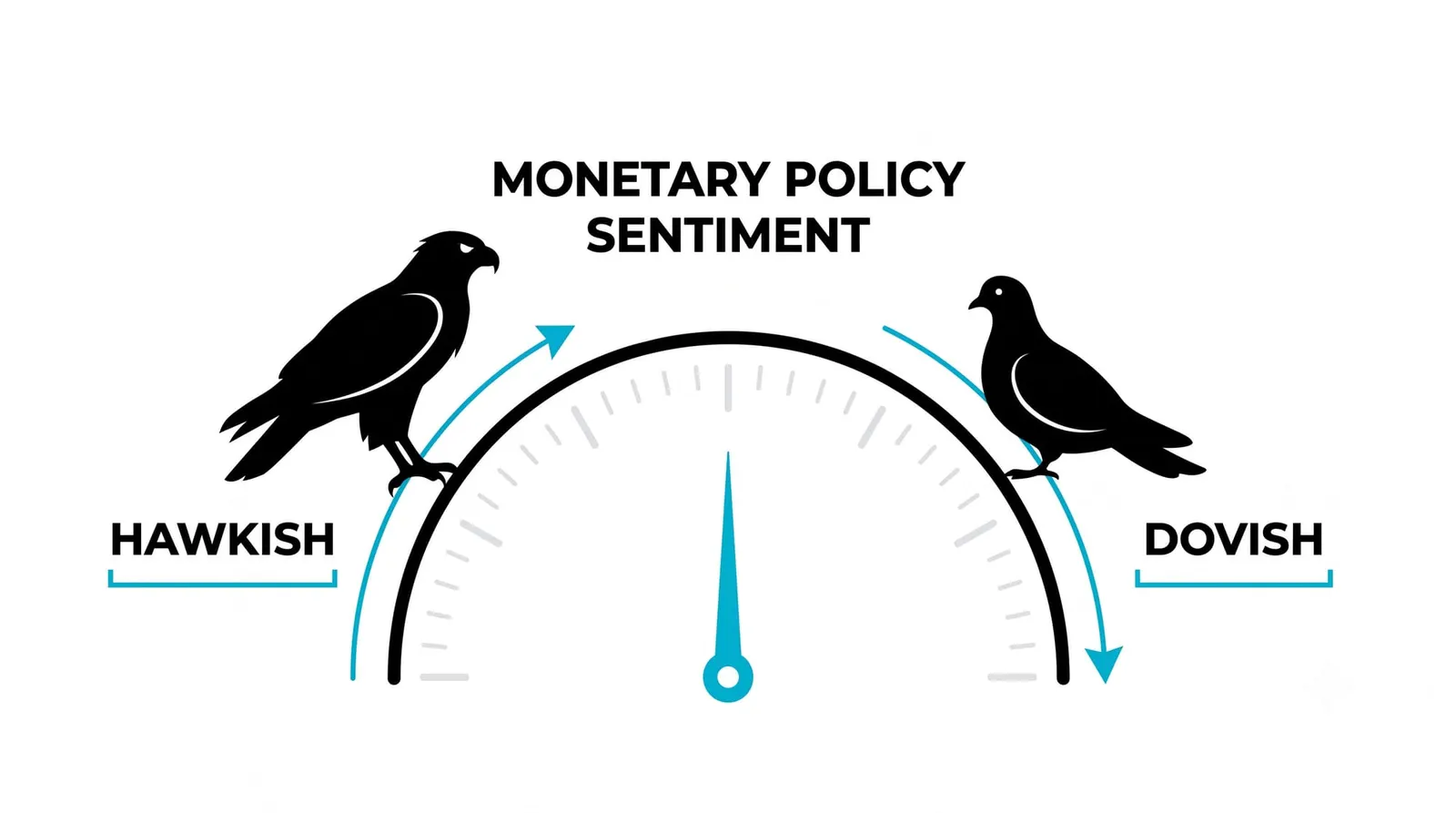
What Hawkish Actually Means
A hawkish central bank treats inflation as the primary threat. Its priority is keeping price growth under control, even if that means slower economic activity, weaker hiring, or a hit to asset prices.
Concretely, hawkish policy looks like raising the policy rate, holding it at a high level longer than expected, shrinking the balance sheet, or signaling that any of those moves is likely. A hawkish central bank is willing to tolerate economic pain as the cost of restoring price stability.
The language gives it away. A hawkish statement sounds firm on inflation and casual about growth. It uses phrases like "inflation remains elevated," "the committee remains highly attentive to inflation risks," "further tightening may be required," or "policy will need to remain restrictive for some time." The emphasis sits on the risk of doing too little, not too much.
Watch the verbs. Hawkish statements commit, warn, and resolve. They describe inflation as persistent and the bank as prepared to act. When you read a statement where every paragraph circles back to prices, you are reading a hawkish document regardless of what the rate decision itself was.
A bank can even cut rates and still sound hawkish, if the cut comes with warnings that inflation is not beaten and no further cuts are promised. The action and the tone are separate channels. Markets listen to both.
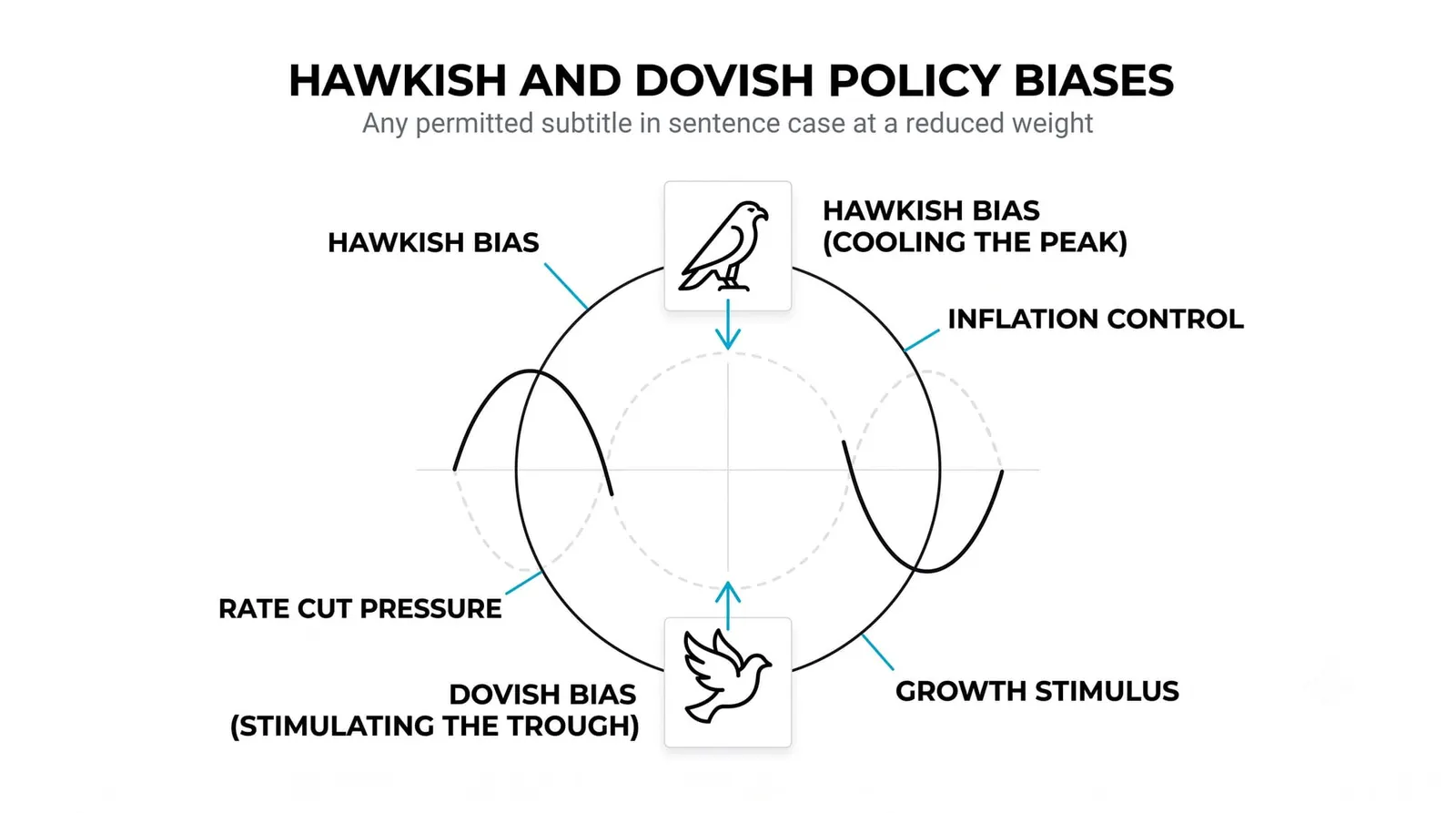
What Dovish Actually Means
On the other side, a dovish central bank treats weak growth and rising unemployment as the bigger dangers. Its priority is supporting economic activity, even if that means accepting somewhat higher inflation along the way.
Dovish policy looks like cutting the policy rate, holding it low, expanding the balance sheet, or signaling readiness to do so. A dovish bank worries that policy is too tight and that the economy needs relief.
The language shifts accordingly. A dovish statement sounds concerned about the downside. It uses phrases like "the committee judges that the risks to growth are tilted to the downside," "the labor market has cooled," "the committee stands ready to support the economy," or "policy remains appropriately positioned to respond to weakening conditions." The emphasis sits on flexibility and insurance.
Dovish statements hedge their inflation language. Prices are described as "moving toward target" or "expected to moderate," which gives the bank room to ease. When a statement spends more time on employment risks than on price risks, you are reading a dovish document.
Again, action and tone can split. A bank can hold rates steady and still sound dovish if the statement opens the door wide to future cuts. Traders who only read the rate headline miss half the signal.
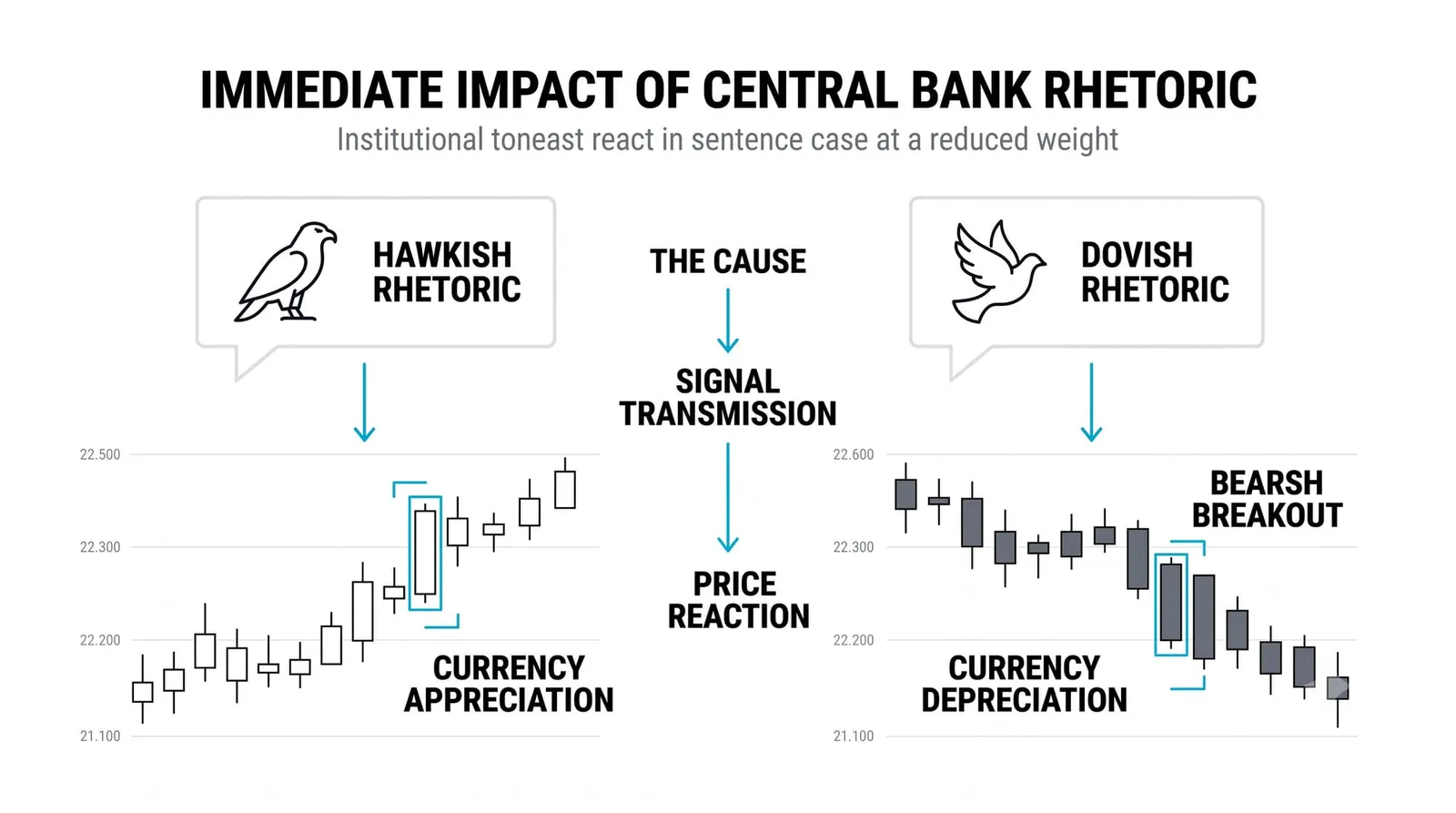
Why the Words Move Markets
Markets do not price the current rate. They price the expected path of rates over the coming meetings and years. That expected path is what sits inside bond yields, currency exchange rates, and equity valuations.
Language shifts move the expected path. When a statement turns more hawkish, traders push out or raise their expectations for future rates. When it turns dovish, they pull cuts forward. The rate today may not have moved at all, but the forecast did, and prices follow the forecast.
This is the surprise mechanic from the data-release lesson applied to words. A data release moves markets when it lands away from consensus. A central bank statement works the same way: the market prices in an expected tone before the release, and the gap between expected tone and delivered tone is what trades.
That is why a rate hike can sink a currency if the statement sounded less hawkish than feared, and why an unchanged rate can send a currency soaring if the statement sounded tougher than expected. The decision is the headline. The tone is the trade.
The transmission runs everywhere at once. A hawkish surprise lifts bond yields, which pressures equity valuations and supports the currency. A dovish surprise does the reverse. One paragraph, three asset classes, same minute.
The Gray Zone Between the Two
Most real statements live in the middle. A pure hawkish or pure dovish document is rare, because central banks want flexibility and markets punish over-commitment.
The neutral stance is deliberate. A bank that sees balanced risks will describe inflation as a concern and growth as a concern, refuse to pre-commit, and stress that decisions will be made meeting by meeting. This is called data dependence: the bank is telling you the next data prints will decide, not the bank's own bias.
Data dependence sounds like a non-answer, and it is. But it is informative, because it tells you which releases now carry the most weight. When a bank goes data-dependent, the inflation and employment reports on the calendar become the real policy events.
Your job as a reader is to grade the tone on a spectrum, not sort it into a bin. Ask three questions of every statement. Which risk got more sentences, inflation or growth? Did the language about future action get firmer or softer than last time? Did any phrase appear or disappear? The answers place the statement somewhere between the two poles, and the shift from the previous statement is usually more informative than the absolute level.
Small edits matter. Central bank statements are drafted with extreme care, so a changed word is a deliberate signal. Experienced rate traders compare the new statement against the old one line by line, exactly for this reason.
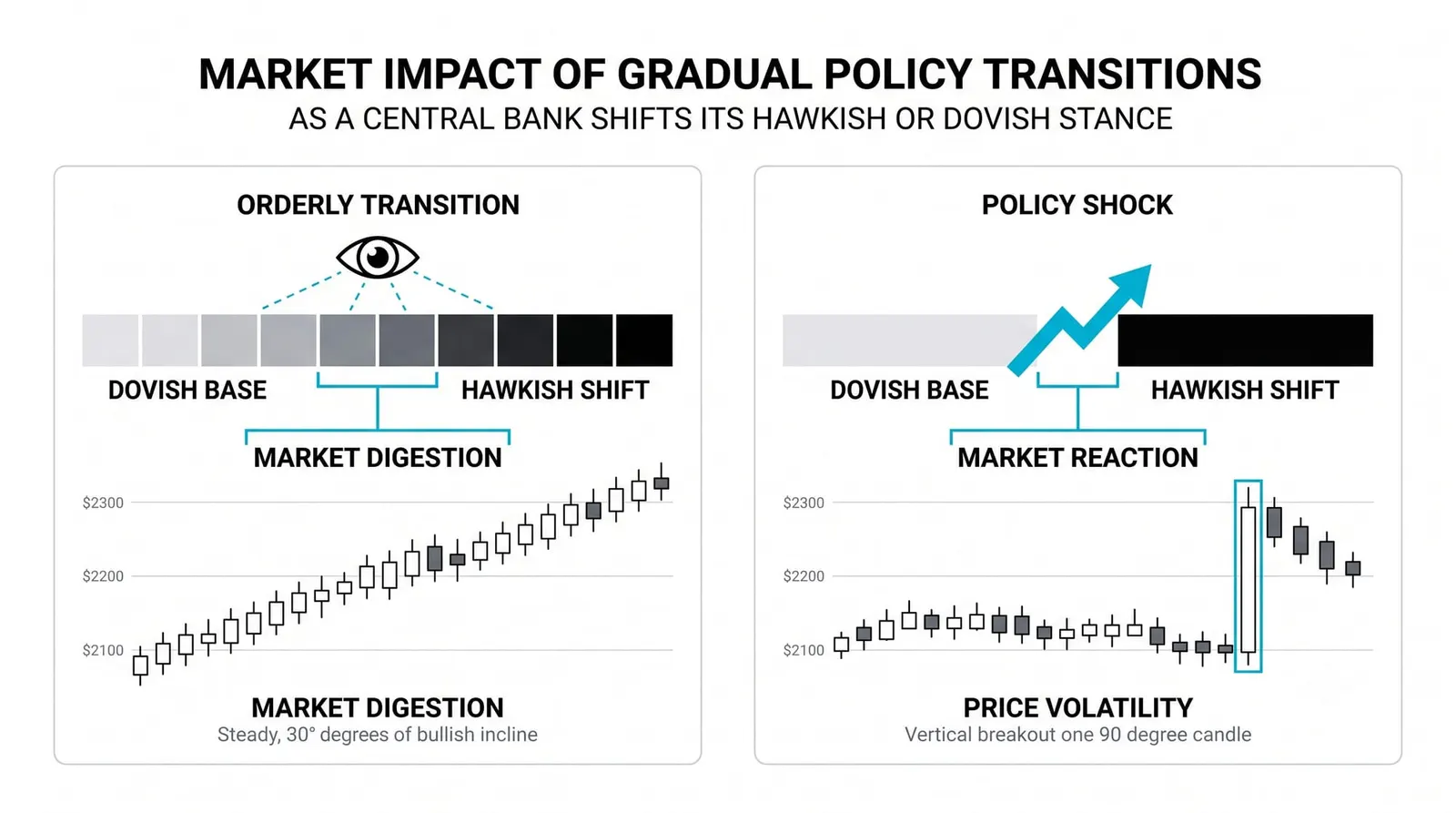
One Sentence, Two Markets
Here is a fully hypothetical illustration with invented round numbers. Imagine a central bank holds its policy rate at 4 percent, exactly as every forecaster expected. The decision itself is a non-event.
But the statement changes one phrase. Last time, the bank said it "stands ready to act against inflation." This time, it says it "stands ready to support growth." Everything else is identical.
A hawkish reader concludes the bank has dropped its inflation guard. Removing the commitment to act against inflation, while the rate sits unchanged, reads as a quiet pivot. This reader now expects cuts sooner and prices them in.
A dovish reader reaches the same destination by a shorter road. A promise to support growth is an easing signal on its face. Both readers agree: the expected path of rates just tilted downward.
Now walk the repricing. Traders mark the probability of a cut at the next meeting from 30 percent up to 70 percent. The currency falls a full percent against its major peers within the hour, because lower expected rates reduce the return on holding it. Bond prices rise as yields fall toward the new expected path. Equities climb as the discount rate on future earnings drops and cheaper policy supports the outlook. One swapped phrase, three markets, all moving on the same signal.
The rate never changed. The words did the work.
| Stance | What it signals | What usually re-prices |
|---|---|---|
| The hawkish lean | Inflation is the priority; rates stay high or go higher | Currency up, bond yields up, equities under pressure |
| The dovish lean | Growth is the priority; cuts are coming or likely | Currency down, bond yields down, equities supported |
| The neutral middle | Risks are balanced; data will decide | Muted reaction; attention shifts to the next data releases |
| The surprise shift | The tone moved away from what was priced in | Fast repricing across currency, bonds, and equities at once |
Hawkish and Dovish, Answered
Can a central bank be hawkish and dovish at the same time?
Yes, and it happens often. A bank can deliver a hawkish action, like a rate hike, wrapped in dovish language about future cuts, or hold rates steady with a hawkish warning about inflation. The action and the tone are separate channels, and markets weigh both. When they conflict, the tone usually carries more weight because it speaks about the future path.
Which is better for stocks?
Dovish policy is generally friendlier to equities because lower rates reduce the discount applied to future earnings and ease financial conditions. But context matters. A dovish turn driven by a collapsing economy can sink stocks even as rates fall, because earnings expectations fall faster than the discount rate. The reason behind the stance matters as much as the stance itself.
Why does hawkish news strengthen a currency?
Because higher expected rates raise the return on holding that currency. Global capital flows toward higher-yielding currencies, and the demand lifts the exchange rate. The mechanism runs through the expected path, not the current rate, which is why a hawkish statement with no rate change can still move the currency sharply.
How quickly do markets react to tone changes?
Within seconds for the first move, minutes for the bulk of it. Algorithms parse statements instantly, and the initial repricing in currencies and bond futures is nearly immediate. The fuller adjustment plays out over hours and days as analysts publish interpretations and positions get rebuilt. The press conference that follows a statement can move markets again, sometimes reversing the first reaction.
You now have the vocabulary and the reading method. The next lesson puts them to work on the rate decision itself: how the announcement is structured, what the vote split tells you, and how to read the projections that come with it.