The Four Market Profile Day Types
Market Profile sorts sessions into recurring day types, and naming the day correctly decides which tactics are allowed. The classic catalogue has four shapes: trend, normal, neutral and non-trend. Each carries a different psychology, and each rewards a different trader. The trend-follower who thrives on Monday gets shredded on Wednesday. The fade-the-extremes trader who prints money in a normal day donates it all back in a trend day.

Think of four regulars at an inn: the one who strides straight through without stopping, the one who arrives early, claims a table and never leaves it, the one who tours both ends of the bar and settles mid-room, and the one who checks in, wanders once and then sits. Those four behaviors map cleanly onto the four day types, and once you see them, you stop being surprised by sessions that used to feel random.
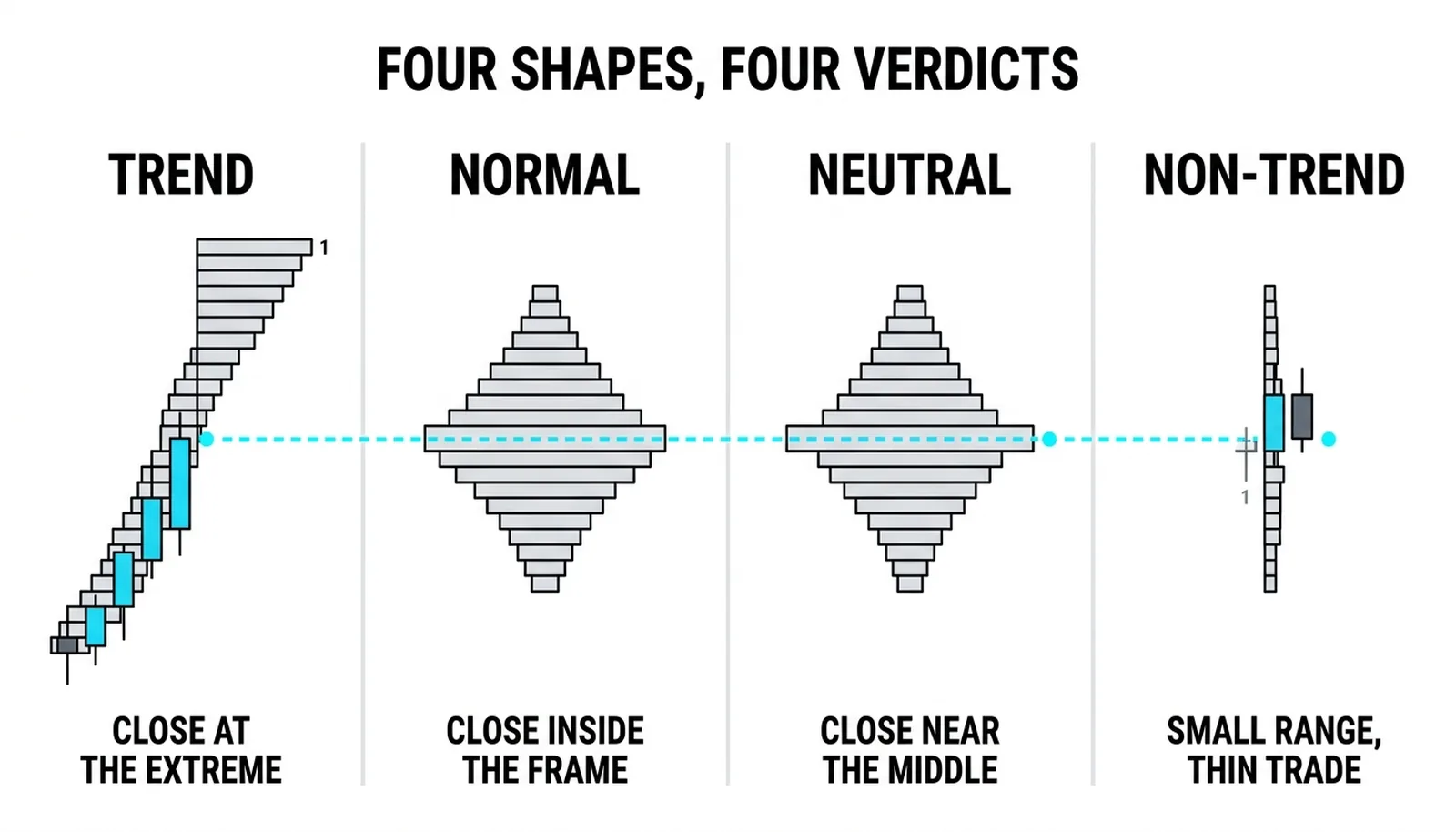
The previous lesson covered the moving parts: initial balance, range extension and settlement. This lesson assembles those parts into the day-type catalogue the original market profile work assembled when the tool was formalized in the early nineteen-eighties. The three acts of the day now become four finished scripts.
The Trend Day: One Side Owns the Session
A trend day starts with a narrow initial balance. The first hour carves out a small range, and then one side takes over and never gives the market back.
The signature is directional half-hour periods stacking on top of each other. Each new period prints a higher high and a higher low on an up day, or a lower low and lower high on a down day. Extensions keep coming on one side only. The close lands near the extreme of the range, often within a tick or two of it.
The psychology is one-sided conviction with longer-timeframe participation. The big money is not scalping; it is re-pricing the market. That is why price travels so far from the open and why pullbacks stay shallow. Short-term traders who try to fade the move get run over repeatedly.
The trend day rewards exactly one trader: the one who got on early and held. It punishes everyone who kept selling strength or buying weakness against the move.
Now the caution, and it matters. A trend day exhausts the winning side. By the close, the directional players have committed their capital, and the following session rarely cooperates with chasers. Late entries at the close of a trend day often meet a flat or retracing next morning. The move happened. Treat a trend day close as information about the day that just ended, not a promise about tomorrow.
The Normal and Neutral Days: Two Very Different Stalemates
These two day types get confused constantly, and the difference is worth learning cold.
The normal day opens with a wide initial balance. The first hour establishes most of the day's range, and from there you get a modest extension on one side, or none at all. Short-term traders are in control. Locals and day traders sell the top of the frame and buy the bottom, and the longer-timeframe money sees fair prices and stays out. Trade is two-sided inside the frame. The normal day rewards the range trader who fades the edges and takes profits in the middle.
The neutral day looks superficially similar but has a different engine. It produces extensions on both sides of the initial balance. Buyers push price up, sellers push it down, and the moves net out to almost nothing. The profile ends up near-symmetric, and the close lands near the middle of the range.
That symmetry tells you who was fighting. Longer-timeframe buyers and longer-timeframe sellers were both active, pulling against each other to a standstill. One side thought price was cheap, the other thought it was expensive, and neither won. The neutral day rewards the nimble two-sided trader who plays both extensions, and it frustrates anyone holding a directional opinion.
So the split is this: the normal day is short-term traders agreeing on value, the neutral day is bigger players disagreeing about it.
The Non-Trend Day and the Label Trap
The non-trend day is the quiet one. The profile is narrow and elongated, the range is small, and participation is thin. Nobody with real size shows up. The market is resting, often ahead of news, after a big move, or simply because no one has a reason to act. There is little to do, and the honest tactic is usually to do nothing.
Now two honesty beats, because the catalogue gets misused in predictable ways.
First, the day types are a taxonomy of finished sessions. Naming the day early is a bet, not a fact. A session that looks like a non-trend morning can extend into a trend afternoon when the bigger players finally arrive. If you commit to the label at 11 a.m. and size accordingly, the afternoon can hurt you. Hold the label loosely and let the extension behavior settle it. The label becomes reliable only as the day matures.
Second, the in-between days dominate real markets. Normal variation days that double the initial balance, hybrids that mix a neutral morning with a trend afternoon, sessions that fit no box cleanly. Forcing every session into one of four categories manufactures false precision. The labels are guides to tactics, not verdicts on the day. When a session fits nothing, the correct read is that the market is undecided, and your tactics should be small.
Four Days, Four Verdicts
All numbers below are invented and hypothetical, one instrument across four sessions, purely to show the shapes.
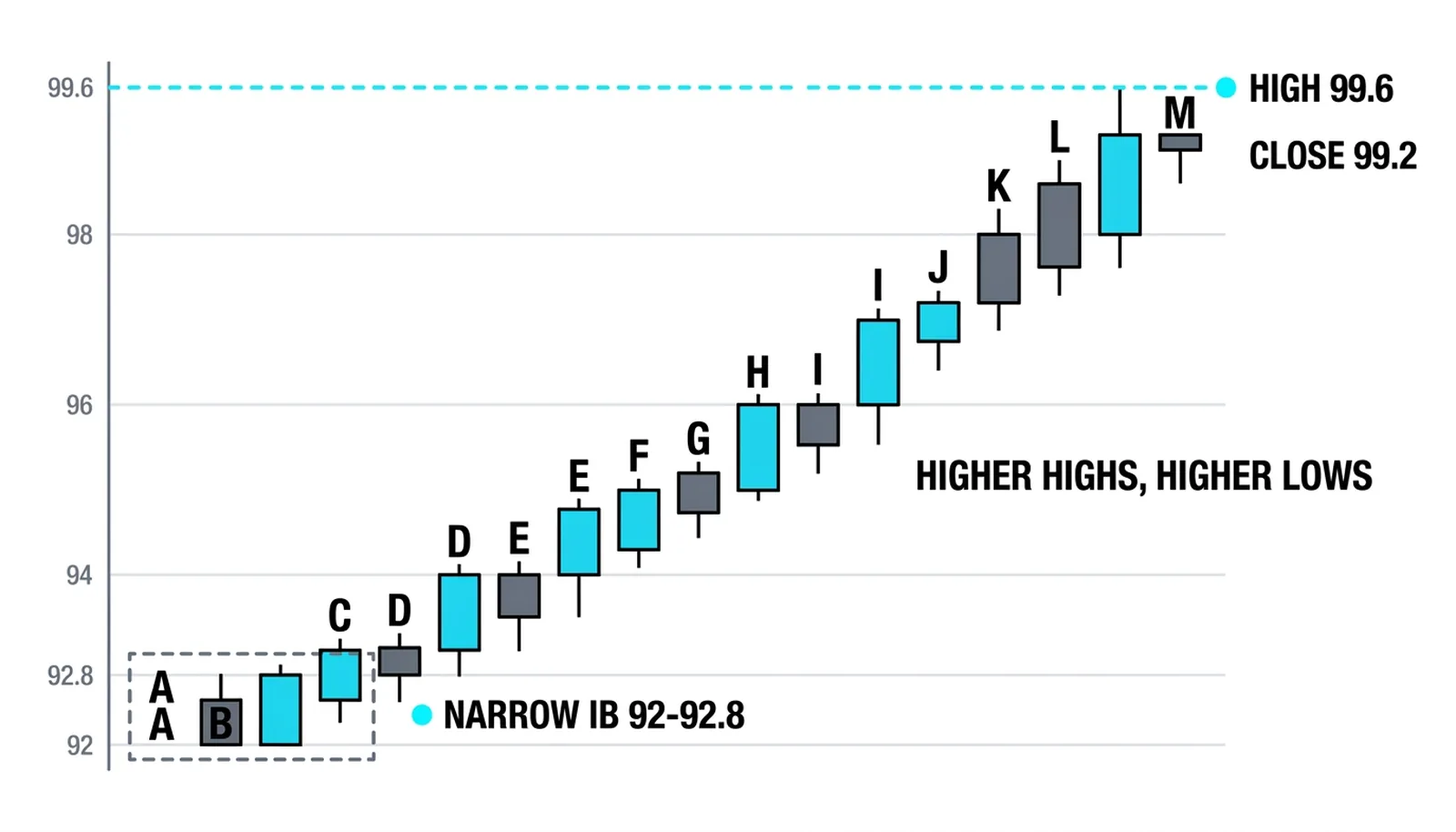
Monday, trend day. The opening balance runs 92 to 92.8, a narrow first hour. Then the periods stack: higher highs, higher lows, extension after extension to the upside. The day prints a 99.6 high and closes at 99.2, within a whisker of the extreme. Verdict: one side owned it. Rewarded: the early long who held. Setup for Tuesday: exhaustion risk, so chasing the close is a poor trade.
Tuesday, normal day. Initial balance spans 84 to 86, wide and established early. A single extension pokes to 87.2, fails to follow through, and the day closes at 85.4, back inside the frame. Verdict: short-term traders controlled a two-sided auction. Rewarded: the range trader fading the edges. Setup for Wednesday: the market found fair value, so a break of the frame would need new information.
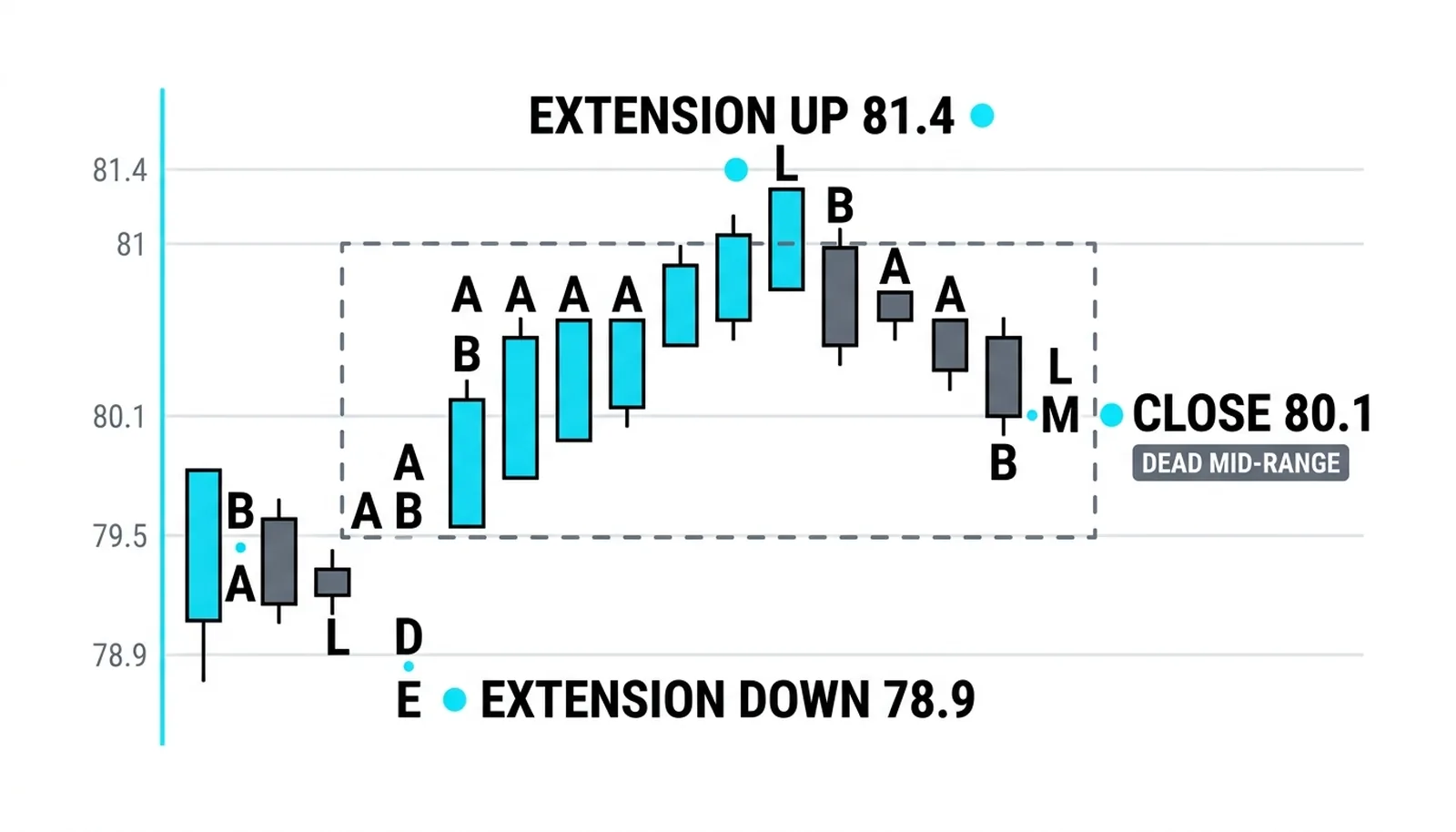
Wednesday, neutral day. Price extends down to 78.9, then extends up to 81.4, and closes at 80.1, almost dead mid-range. Verdict: longer-timeframe buyers and sellers fought to a draw. Rewarded: the two-sided scalper. Setup for Thursday: unresolved conflict, so the next directional extension carries extra weight.
Thursday, non-trend day. The entire session fits inside 55 to 56.5 on the thinnest participation of the week. Verdict: the market rested. Rewarded: nobody, and that is fine. Setup for Friday: a compressed, low-participation day often precedes a session with real movement, so prepare levels rather than force trades.
| Day Type | Initial Balance | Extension Behavior | Close Location |
|---|---|---|---|
| Trend | Narrow | Repeated, one side only | At or near the extreme |
| Normal | Wide | Modest, one side, or none | Inside the frame |
| Neutral | Moderate | Both sides, roughly symmetric | Near the middle |
| Non-trend | Narrow | None of consequence | Inside a small range |
The Four Market Profile Day Types, Answered
What are the Market Profile day types?
They are four recurring session shapes: trend, normal, neutral and non-trend. Each describes a different balance of power between short-term and longer-timeframe participants, and each rewards a different set of tactics.
What is a neutral day in Market Profile?
A neutral day extends the initial balance on both sides and closes near the middle of the range. It signals longer-timeframe buyers and sellers pulling against each other to a standstill, and it suits two-sided short-term trading.
What is a non-trend day in trading?
A non-trend day is a narrow, low-participation session with little directional movement. The market is resting, and the correct response is usually patience rather than activity.
How do you know what day type is forming?
You watch the initial balance width and the extension behavior as the day develops. A narrow first hour with one-sided extensions points to trend; a wide first hour with contained trade points to normal; extensions on both sides point to neutral; no extensions at all point to non-trend. Confirm with the close, and hold any early label loosely.
The next lesson in this block moves from naming days to reading what the shape of the profile itself, its bell curves, tails and single prints, says about who was in control.