Market Profile Structure: Reading the Day
Every Market Profile day has a structure, and it plays out in three acts. The opening hour builds an initial balance, the middle of the session either respects that frame or breaks it with a range extension, and the close settles the argument. Read the three in order and the day narrates itself.

Think of a meeting that opens by agreeing an agenda window, runs into a late item someone pushes past that window, and ends wherever the discussion finally settles. The whole character of that meeting is legible from those three moments. A trading day works the same way.
The previous lessons covered the tool itself, the TPO letters and how the chart is built. This lesson is about what the built chart means as a story. You already know how to read the letters. Now you read the architecture they form.
The Initial Balance: The Opening Hour's Working Range
The initial balance is the range printed by the first two half-hour periods of the session, the A and B periods on a standard profile. During that opening hour, short-term traders, the locals and day traders who need to do business early, trade back and forth until they agree on a working fair price. The high and low of that first hour mark the edges of their agreement.
J. The original market profile framework built the Market Profile around this idea: the opening auction is where the market first tests what fair value might be, and everything after is a commentary on that first attempt.
The width of the initial balance is the day's first clue. A wide opening range tells you the short-term traders already explored a lot of ground. They found both edges quickly, and the day may already have most of its range printed. Days like that often rotate inside the frame for hours.
A narrow initial balance says the opposite. The opening hour barely explored anything. The day's real range is probably still out there, waiting for someone with a longer timeframe to come claim it. Narrow opening balances are the sessions most likely to produce a genuine extension later.
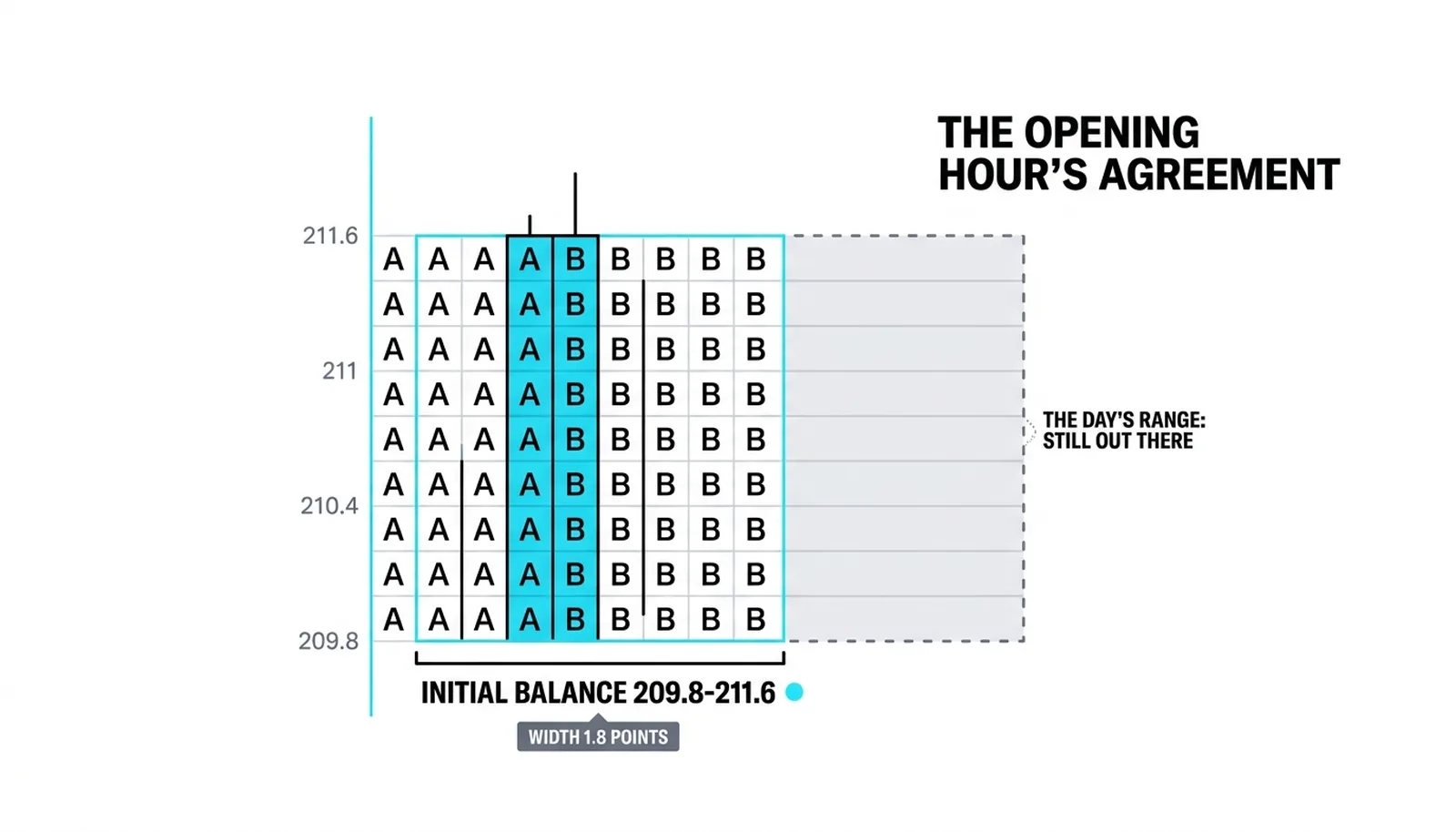
Here is the first honesty point. The initial balance is a working hypothesis, not a boundary. Traders who treat its edges as walls get run over on extension days, selling the top of the frame or buying the bottom right as the real move begins. The frame exists to be tested. Sometimes the test fails and price rotates back inside. Sometimes the test succeeds and the frame becomes a memory. Your job is to watch the test, not to assume its outcome.
The Range Extension: Who Broke the Frame
A range extension is any move that carries price beyond the initial balance high or low. This is the moment longer-timeframe traders tip their hand. The short-term crowd built the frame. The bigger money decides whether to accept it or push through it.
Direction and size carry the information. A small probe beyond the frame, a period or two poking a few ticks past the edge and then stalling, is a test. Someone is checking whether buyers or sellers actually live out there. A drive is different. When price extends well beyond the frame and keeps printing letters in the new territory, that is a statement. Longer-timeframe traders have committed, and they are moving the market, not sampling it.
The original market profile framing cuts both ways here, and this is the second honesty point. A little push from longer-timeframe traders moves price a little. A big push moves it a lot. But the profile cannot tell you in advance which push is coming. The extension only certifies the push after it happens. You read conviction from what printed, not from what you hoped would print.
Rejection leaves a signature at the extremes. When price touches a level and gets turned back immediately, the profile shows it as single letters hanging alone at the edge, one TPO period printed where the market refused to stay. That lonely letter is evidence that someone defended that price the instant it appeared. A tail at the low says buyers struck fast. A tail at the high says sellers did.
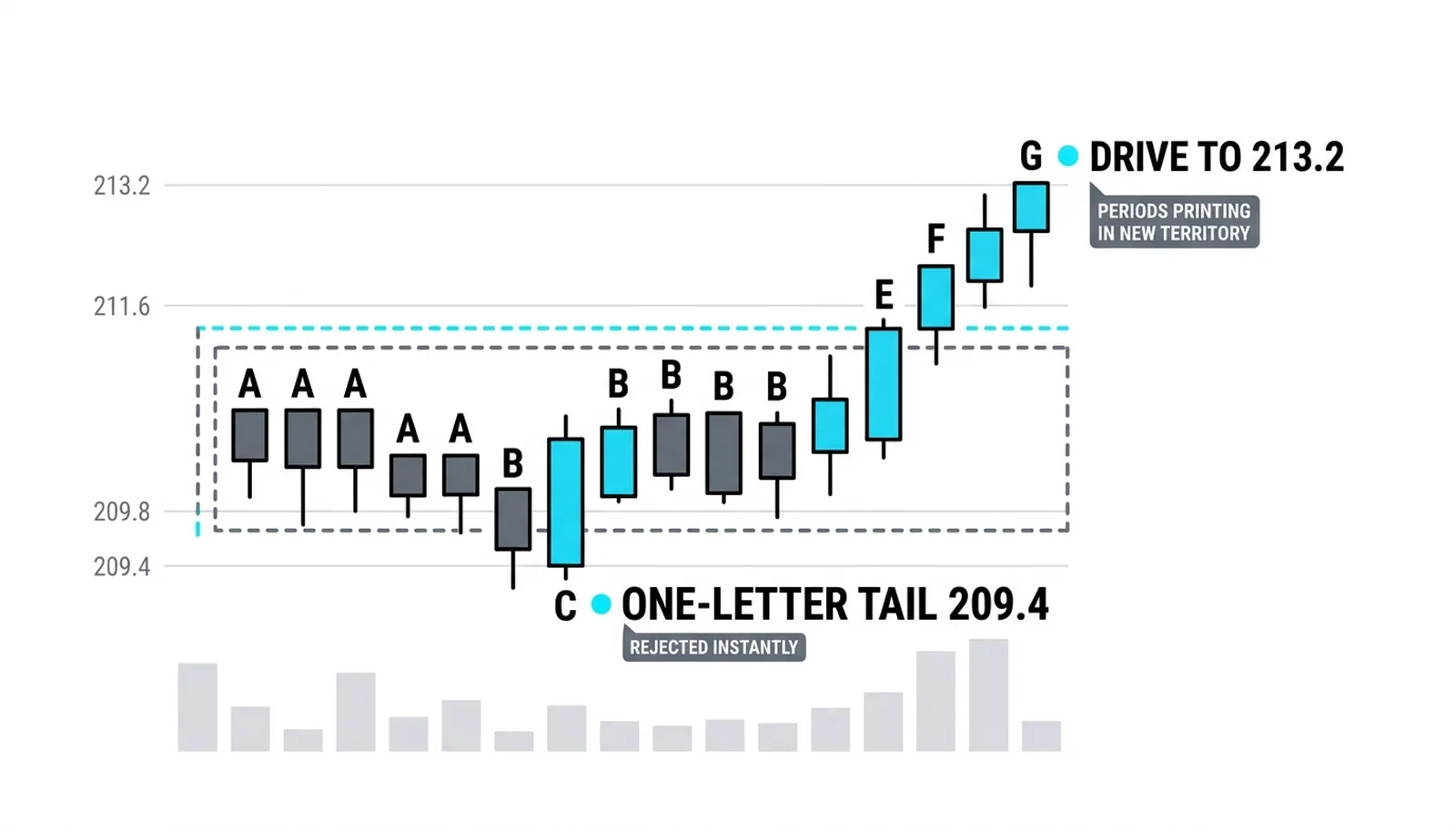
So when you read the middle act, ask three questions. Did price leave the frame at all? If it did, was the move a probe or a drive? And if it got turned back, did it leave a tail as proof? Those three answers tell you who showed up and how serious they were.
Settlement: Where the Day Casts Its Vote
The close is the day's verdict on everything the session argued about. All the probing, driving, and rotating gets compressed into one final question: where did price settle relative to the initial balance and the extension?
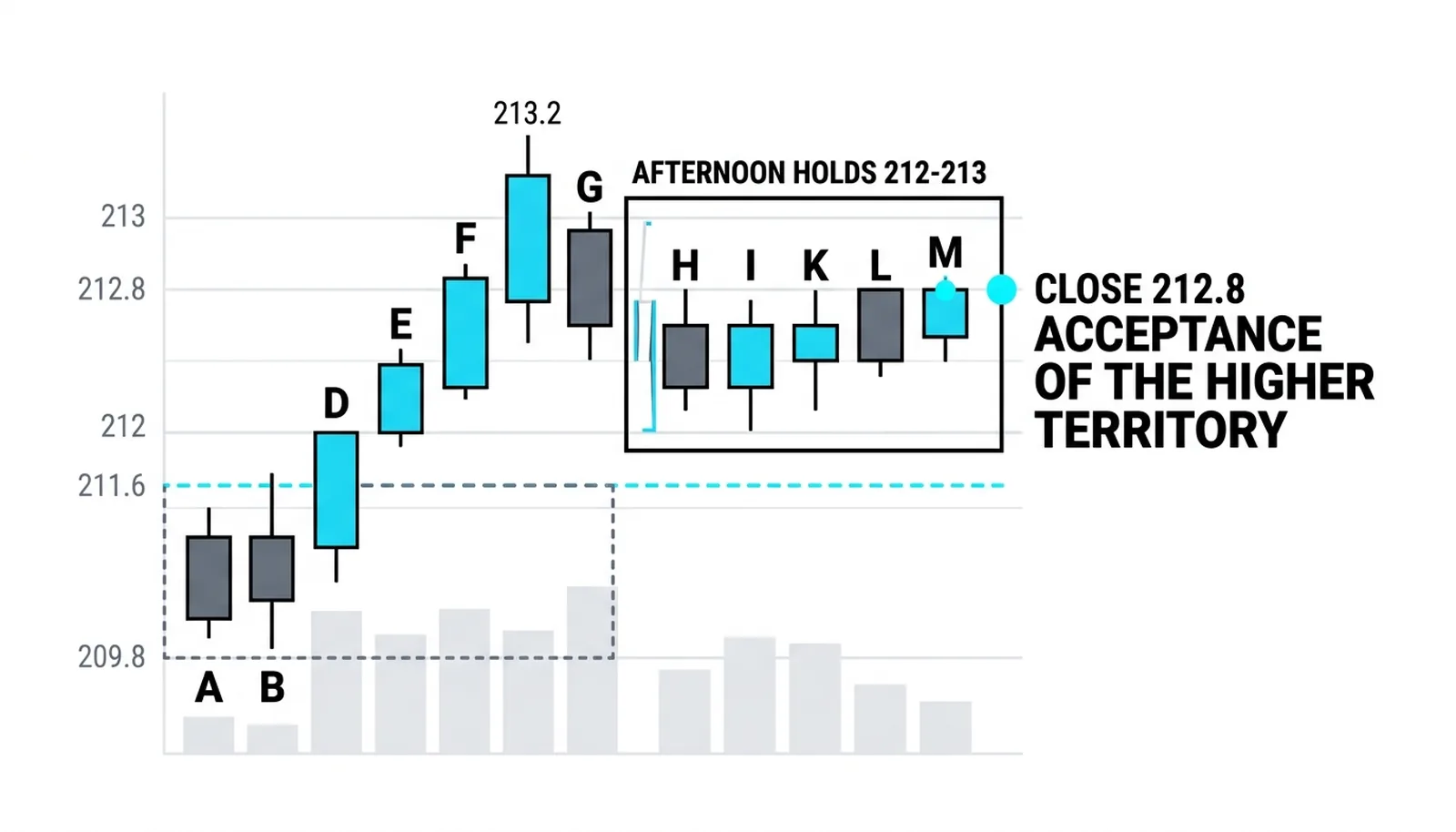
A close above the frame, out in the territory the extension claimed, is acceptance. The market explored higher, found trade there, and stayed. That is a session that ended in agreement with the move. A close back inside the initial balance after an extension is rejection. The market traveled, found nothing worth keeping, and came home. The extension was real but the conviction was not.
The same logic applies to the downside. A close below the frame after a downward extension accepts the lower prices. A close back inside the frame after a downward probe tells you the selling failed and the opening range still holds as fair.
Pay attention to how the close happens, not only where. A day that drifts to its final price in thin trade says less than a day that holds its level through the last hour against attempts to move it. Settlement is the vote, but a contested vote carries more information than a sleepy one.
One Day, Three Acts
Here is a full session, all numbers hypothetical and round, read the way this lesson teaches.
A stock opens at 210.4. The first two half-hour periods, A and B, trade between 209.8 and 211.6. That is the initial balance: a width of 1.8 points, modest rather than wide. Modest width says the opening hour explored some ground but probably did not finish the job. The day's full range is likely still unprinted.
Period C probes down to 209.4, below the frame, and gets rejected immediately. The profile shows a one-letter selling tail at 209.4. That is the first clue of the day: someone pushed below the opening range, and buyers turned it back on the spot. Downside was offered and refused.
Period E then extends the range upward through 211.6, and the move keeps going. By period G, price has driven to 213.2. This is not a probe. Multiple periods printing in new territory, well beyond the frame, is longer-timeframe money making a statement. The rejected downside probe plus the committed upside drive now fit together: the sellers tested first, failed, and the buyers took over.
The afternoon holds between 212 and 213. Price never comes back to the initial balance. The day closes at 212.8, near the high, well above the opening frame.
Now read the three acts as one story. Act one set a working fair price around 210 to 211. Act two tested below it, got rejected with a tail as proof, then broke above it with a genuine drive. Act three settled the argument: the close at 212.8 is acceptance of the higher territory. The verdict matches the extension. Nothing in the afternoon contradicted it.
The traps were there too. Selling the top of the initial balance at 211.6, treating the frame as a wall, would have put you short directly in front of the drive to 213.2. And assuming the period C probe meant weakness, without waiting to see the rejection, would have put you short at the exact low of the day.
| Act | When it happens | What it tells you | The trap |
|---|---|---|---|
| Initial balance | First two half-hour periods | The short-term traders' working fair price; width hints whether the range is done | Treating the edges as walls instead of a hypothesis |
| Range extension | Middle of the session | Whether longer-timeframe traders accept the frame or break it, probe versus drive | Confusing a small probe with a committed move |
| Tails at extremes | During probes and tests | Where price was rejected instantly, single letters as proof of defense | Ignoring the tail and trading toward the rejected price |
| Settlement | The close | Acceptance or rejection of everything the session explored | Reading the extension and skipping the verdict |
Market Profile Structure, Answered
What is initial balance in Market Profile?
The initial balance is the range printed by the first two half-hour periods of the session, the opening hour. It represents the working fair price that short-term traders agree on while they do their early business. Its width is the day's first clue: wide suggests the range may already be set, narrow suggests the real range is still coming.
What is a range extension in trading?
A range extension is any move that carries price beyond the initial balance high or low. It signals that longer-timeframe traders have entered with an opinion. A small poke past the edge is a probe, a test of whether business exists out there. A sustained move printing period after period in new territory is a drive, a committed statement.
What does settlement mean in Market Profile?
Settlement is where the day closes relative to the initial balance and any extension. A close outside the frame, in the territory the extension claimed, is acceptance of the move. A close back inside the frame is rejection. The close is the day's final verdict on everything the session argued about.
Why is the first hour of trading important?
The first hour is when short-term traders establish the day's working fair price, and that range becomes the reference point for everything after. Its width hints at whether the day's range is already printed, and its edges become the levels the rest of the session will test. Every later act of the day is read against what the opening hour built.
With the three acts in place, the next step is pattern recognition at the day level. Different combinations of balance width, extension direction, and settlement produce recurring shapes, and the Market Profile tradition sorts them into four classic day types. That classification is where this block goes next.