Low Volume Nodes: Where Price Moves Fast
A low volume node is a band of prices where almost nothing traded, the thin waist or deep indentation in an otherwise full profile, and it matters for one reason: price moves through it fast, both leaving it and returning to it. When you rotate the chart and look at volume by price instead of by time, these gaps stand out immediately. Fat shelves where the market spent hours, then a narrow pinch where it spent almost nothing.

Think of a moving walkway: nobody stands on it, everybody rides it through, and the crowds only gather again where it ends. Price treats a thin zone the same way. It passes through, then slows down where the volume lives again.
The earlier lessons in this block covered whole-profile shapes and the value area, the balanced day, the heavy zones that anchor a session. This lesson owns the thin lanes inside the profile, the places where the profile nearly touches zero.
How a Thin Zone Forms
Thin zones form when an aggressive initiative move pushes price through a range so fast that neither side has time to transact there. Sellers hit bids relentlessly, or buyers lift offers relentlessly, and the market skips whole price levels the way a stone skips water. By the time anyone thinks about trading at those prices, price is already somewhere else.
The market profile tradition calls these bands single prints, a column of one-letter prints with nothing beside them. The volume profile tradition calls the same thing imbalance, a stretch of prices where the volume bars are a fraction of the bars around them. Two vocabularies, one observation: the market refused to do business here.
Order flow analysis, writing on auction theory, framed these bands as evidence of urgency, the fingerprint of a participant who valued speed over price. That framing is useful because it tells you who built the thin zone. Not a crowd. A few aggressive hands in a hurry.
Placement follows a pattern. Thin zones most often sit at the edges of heavy zones, marking the exact price where acceptance ended and rejection began. They also appear in the waist between two fat distributions, the no-man's-land separating an upper and a lower balance area. In both cases the message is the same: the market was here briefly, on its way somewhere it preferred.
What Price Does on the Return
Prices nobody accepted have nobody defending them. A heavy zone holds resting interest because thousands of shares or contracts changed hands there, and some of those holders still care about that price. A thin zone has no such population. Nobody bought there, nobody sold there, so nobody has a reason to fight for it.
So when price revisits a thin band, it transits in minutes. The move that took an hour through a heavy zone takes a handful of bars through a thin one. Then the market rediscovers congestion at the next heavy zone, and the rhythm slows back down.
This gives you three practical uses. First, diagnosis: when a move suddenly accelerates for no visible reason, check the profile. Price probably entered a thin band and simply had no traffic to fight. Second, anticipation: when price re-enters a known thin zone, expect the fast stretch and do not mistake speed for fresh conviction. Third, targeting: use the far edge of the low volume area as the objective, not the middle of it. The middle of a thin zone is the least likely place for price to stop, because stopping requires participants and the thin zone has none.
The fast transit is a tendency, not a law.
Using Thin Zones Without Overtrusting Them
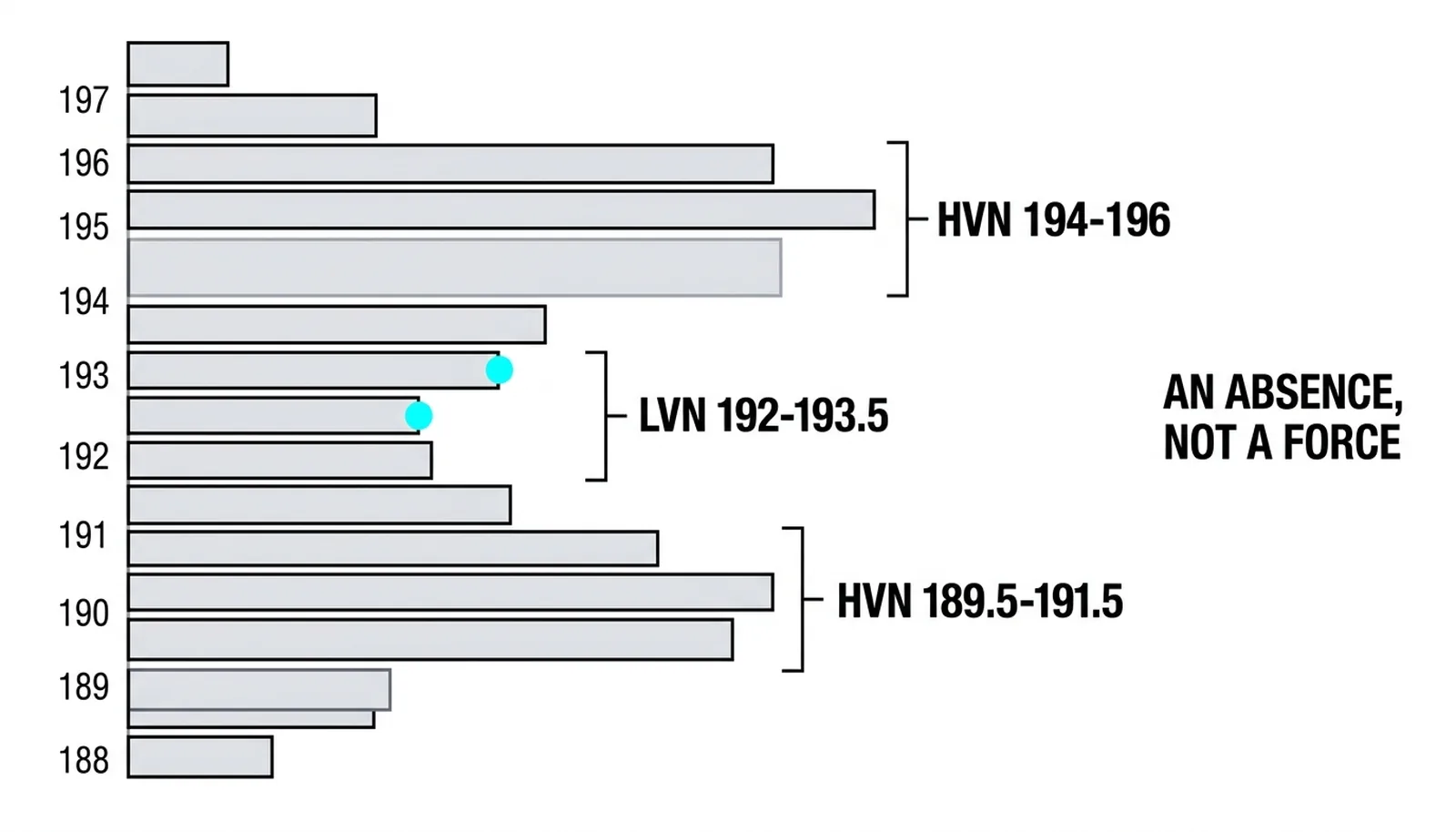
Two honesty checks keep this tool honest. The first is about what a thin zone actually is. A low volume node is an absence, not a force. There is no crowd inside the band pulling price toward it. The so-called pull is simply that no defenders live there, so once price enters, nothing slows it down. And the fast-transit read fails whenever the next heavy zone defends first. If price approaches the thin band and the heavy zone in front of it absorbs the move, the band never gets tested at all.
The second check is session context. Thin bands formed during overnight drift or the lunch-hour lull carry no information, because almost nobody was participating when they printed. A thin zone at 3 a.m. means nobody was awake, not that the market rejected those prices. Only thin zones printed during liquid, high-participation hours earn the read. Filter by the clock before you trust the shape.
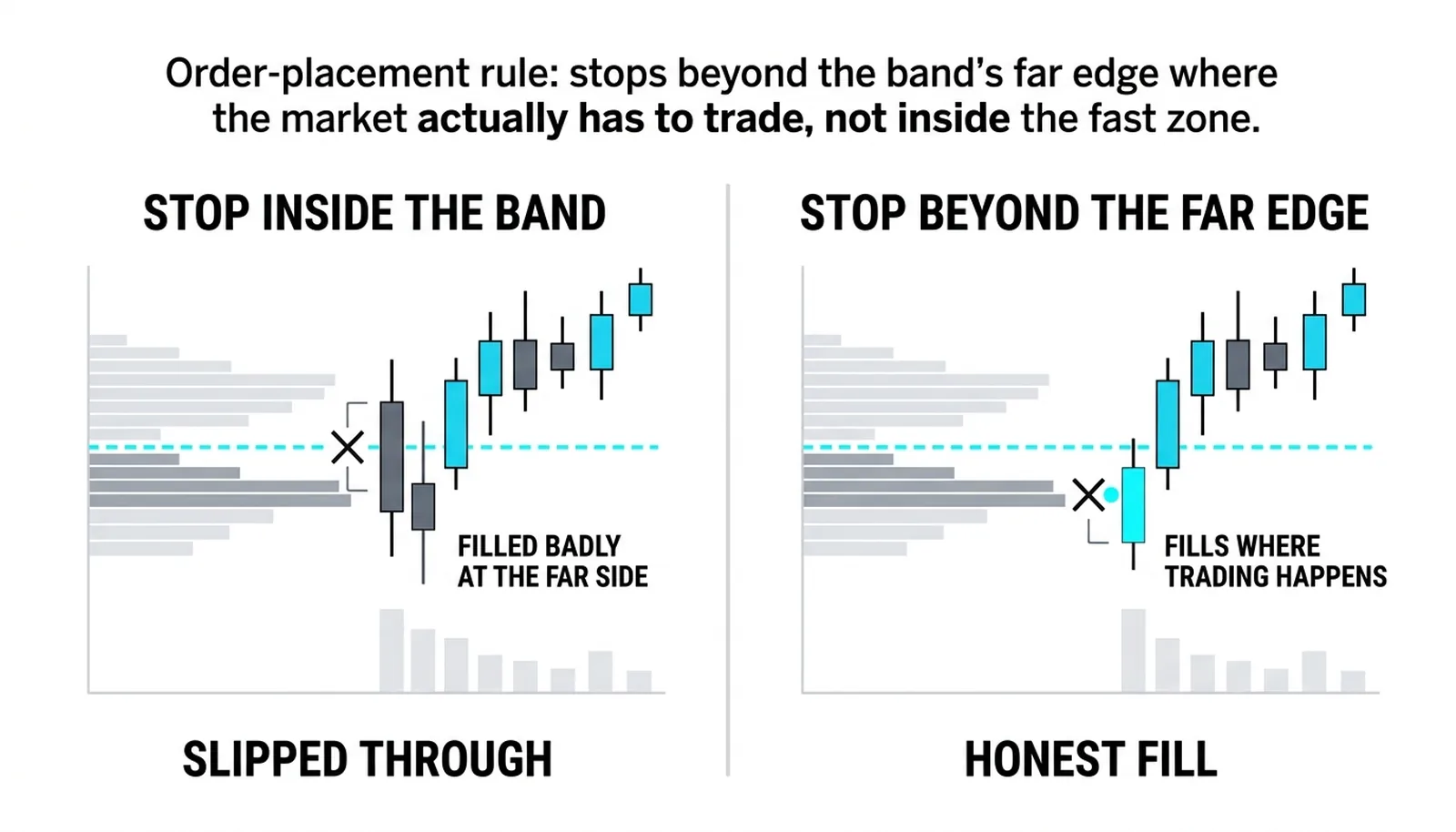
Stops deserve their own rule here. A stop parked inside a thin band fills badly, because price crosses the band so quickly that your order executes at the far side of it, or worse. Place protective orders beyond the band's far edge instead, at the heavy zone where the market actually has to trade. If that distance makes the position size too small, the trade was too large for the structure.
Four Minutes Through the Thin Zone
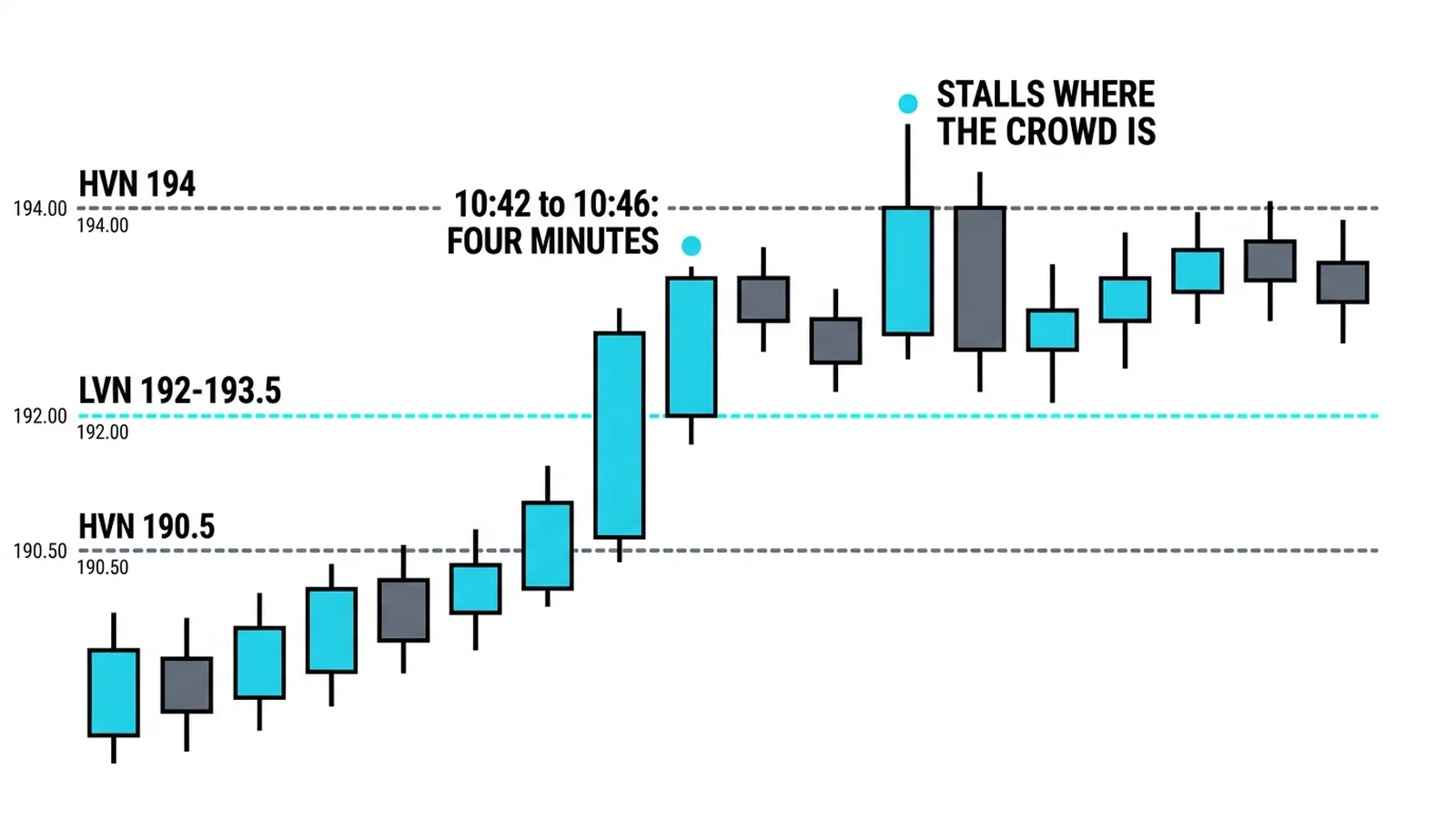
Picture a hypothetical stock. Round numbers, invented for illustration. Between 10:05 and 10:25, heavy initiative selling drives it from 196 down to 189. The profile afterward shows two heavy zones, 194 to 196 above and 189.5 to 191.5 below, with a thin band between 192 and 193.5 where the volume bars nearly vanish. The sellers were in a hurry, and 192 to 193.5 paid the price for it.
The next day, the stock rallies back. Here is how the revisit reads, stage by stage.
Price climbs out of the 189.5 to 191.5 heavy zone slowly, taking most of the morning, because that zone is full of participants who traded there yesterday. At 10:42 it touches 192, the lower edge of the thin band. By 10:46 it is at 193.5, the far edge. Four minutes to cross a band that took the heavy zone below it most of a session. No defenders lived there, so nothing slowed the transit.
Then price enters the 194 to 196 heavy zone and stalls, exactly where the volume lives. The rally's speed dies on contact with real participation.
A trader who tried to sell the first touch of 192 got no honest fill, because the market never rested there long enough to trade. A trader who targeted the heavy zone above watched the stall arrive at 194 to 196, precisely where the profile said the crowd was waiting. Same move, two outcomes, decided entirely by which zone the order sat in.
| Zone type | Volume there | Who was present | What price does on revisit |
|---|---|---|---|
| Upper heavy zone (194-196) | High | Active two-sided trade | Slows, stalls, often rejects |
| Thin band (192-193.5) | Minimal | Almost nobody | Transits in minutes |
| Lower heavy zone (189.5-191.5) | High | Active two-sided trade | Slows, builds, often holds |
| Overnight thin band | Minimal | Nobody, market was asleep | No reliable behavior, ignore it |
Low Volume Nodes, Answered
What is a low volume node in trading?
A low volume node is a band of prices where very little volume traded, visible as a thin waist or deep indentation in the volume profile. It marks prices the market passed through without accepting, usually during a fast initiative move.
Why does price move fast through low volume areas?
Because nobody traded there, nobody has a position to defend there. Heavy zones slow price because their participants react when price returns. A thin zone has no such population, so price crosses it with almost no resistance.
Do low volume nodes pull price toward them?
No. A thin zone is an absence, not a force. Price moves quickly through it when it arrives, but nothing inside the band draws price in. The apparent pull is just the lack of defenders, and the read fails whenever the next heavy zone defends first.
Where should a stop go relative to a low volume node?
Beyond the band's far edge, at the next heavy zone. A stop inside a thin band fills badly because price crosses the band too fast for a clean execution. The heavy zone is where the market actually has to trade, so that is where protection belongs.
Next in this block, the profile's busiest single price gets its own lesson: the VPOC, and what it means when that point of maximum acceptance migrates from one session to the next.