Liquidity and Volatility Differences Across Assets
Liquidity and volatility are the two properties that decide whether a market will actually let you trade the way you want to trade. Liquidity is how easily you can move real size in and out without moving the price. Volatility is how far the price moves. Every asset class offers a different mix of the two, and that mix decides which trading styles can survive there.

Think of liquidity as the width of the door and volatility as the speed of the crowd: you want a wide door, and you want a crowd that actually shows up.
What Liquidity Actually Is
Liquidity is not the price you see on the screen. It is the stack of real orders sitting behind that price, waiting to buy and sell at nearby levels. The deeper that stack, the more size the market can absorb without flinching.
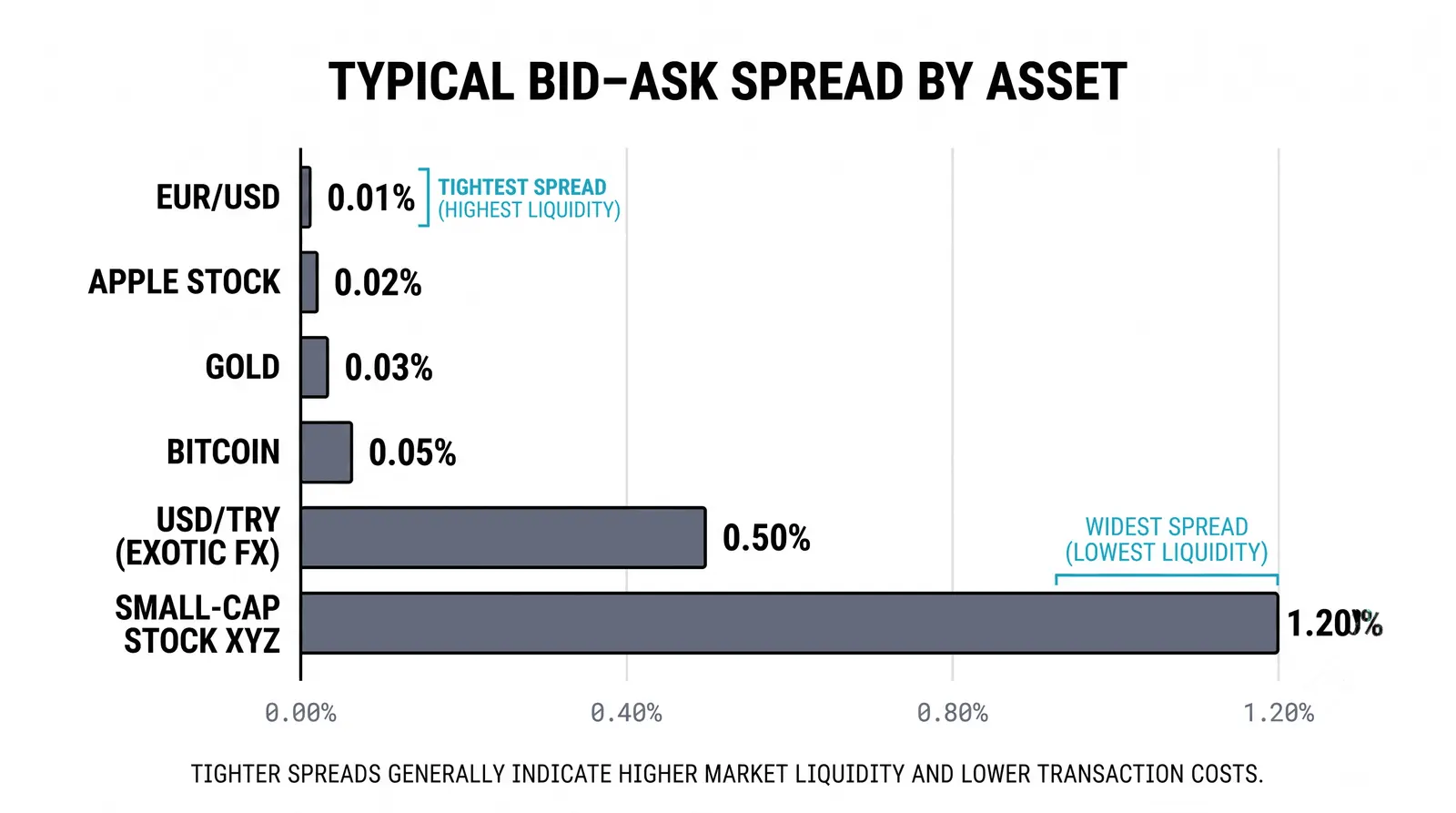
You feel liquidity through two things. The first is the spread, the gap between the buy and sell quote. The second is slippage, the difference between the price you saw when you clicked and the price you actually got filled at.
A market can be quoted and still be thin. The screen shows a price, but there are only a handful of contracts behind it. Your order walks through the book, filling at worse and worse levels, and by the time you are done you have moved the market yourself.
Depth is what you are really buying when you choose a liquid market. You are paying a tiny spread in exchange for the certainty that the door will be open when you need it.
What Volatility Actually Is
Volatility is the size of the swings, not their direction. A market that moves 2 percent a day in either direction is volatile. A market that drifts 0.2 percent a day is calm, even if it trends beautifully.
Direction is a separate question. Traders confuse the two constantly, because a strong trend feels exciting and a choppy range feels dead. But a slow grind and a violent chop can both make or lose you money depending on how you are positioned.
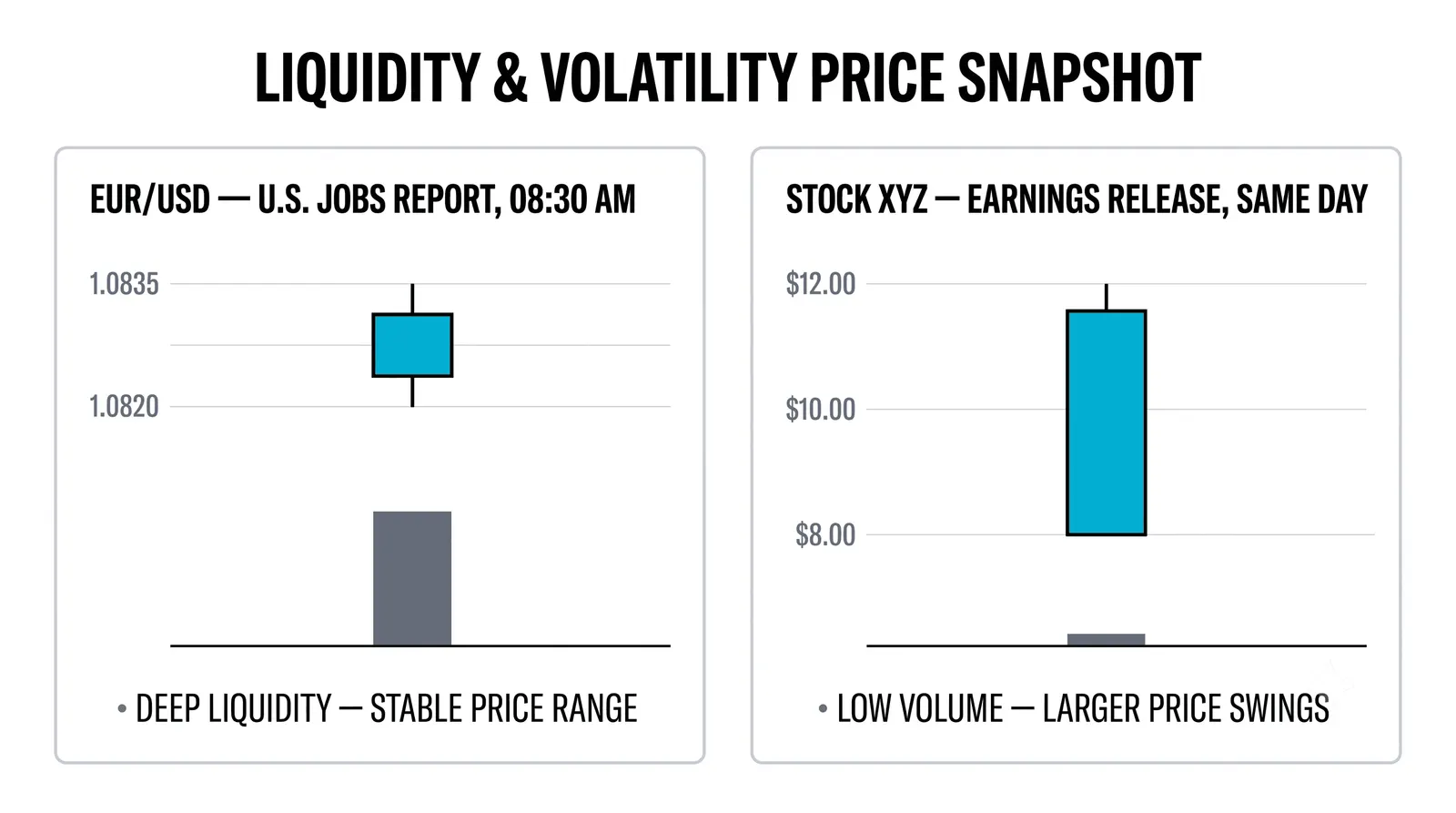
A market can be calm and treacherous, or wild and perfectly tradable. What separates the two is what sits underneath the moves. Wild swings on a deep book are just big candles. Wild swings on an empty book are traps.
The Trade-Off Across Asset Classes
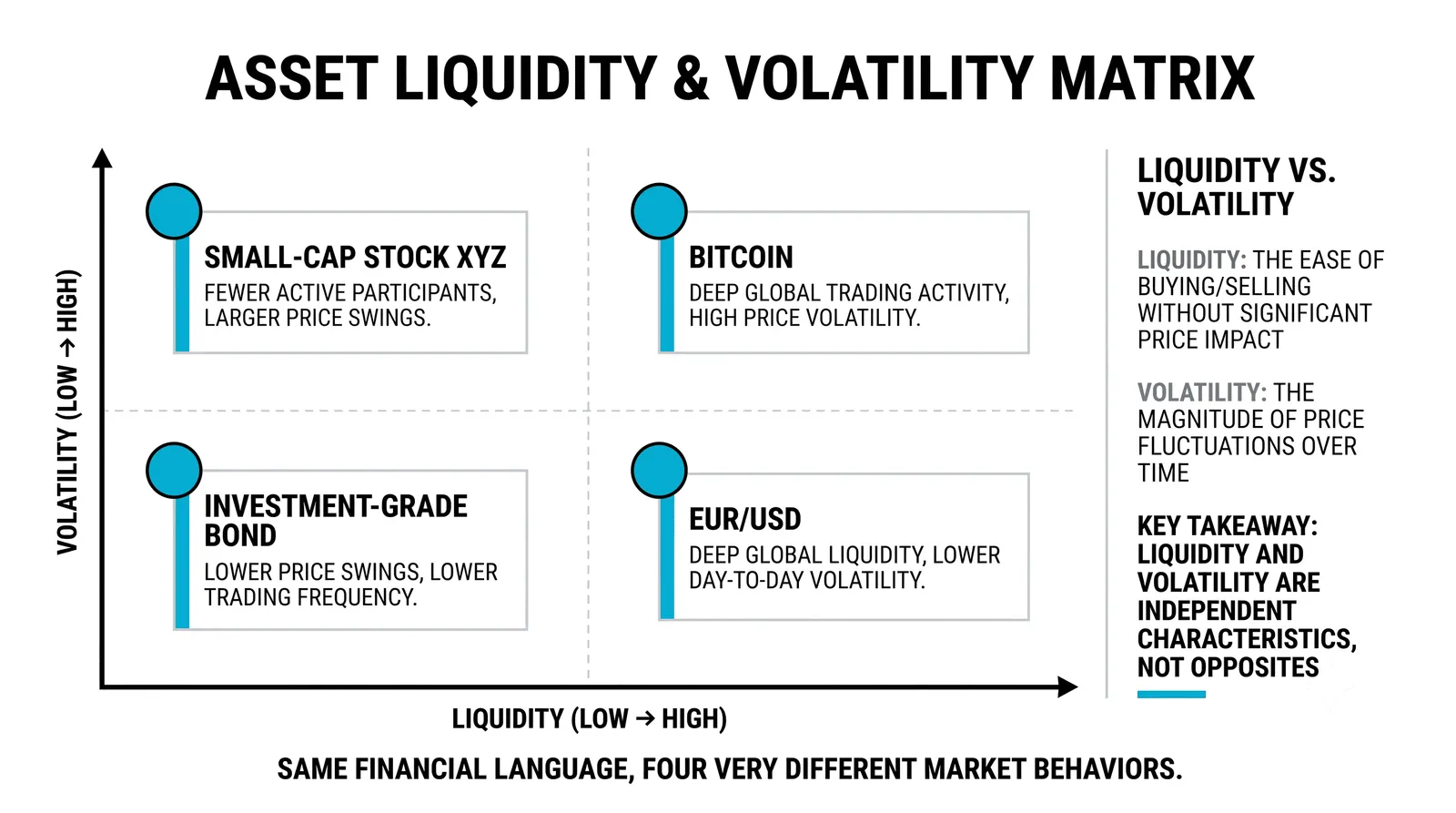
Each asset class lands in a different spot on the liquidity-volatility grid. The pattern matters more than any single example.
Major currency pairs sit at one extreme: enormous liquidity, modest daily ranges. The euro-dollar market absorbs enormous size without blinking, but a big day might be one percent.
Large-cap stocks sit in the middle. Strong liquidity during market hours, moderate swings, and a defined session that concentrates the activity.
Small-cap stocks and small coins sit at the dangerous corner. Thin books, violent moves, and spreads that widen the moment anything interesting happens.
Commodities vary contract by contract. Crude oil and gold are deep and active. An obscure agricultural contract can be so thin that a single commercial hedger sets the tone for the day.
The general rule: the further you move from the biggest, most-watched markets, the more volatility you get and the less liquidity you get to handle it with.
When the Two Collide
Volatility without liquidity is the dangerous combination. This is where accounts get hurt.
At the worst moments, the two arrive together. News breaks, the price jumps, and at the same instant the resting orders pull back. Spreads widen. Slippage explodes. Gaps appear where no trades print at all.
This happens exactly when you most want out. The door narrows precisely when the crowd rushes for it.
Your stop loss is not a guaranteed price. It is an order that executes at whatever liquidity exists when it triggers. In a deep, calm market that is nearly the same thing. In a thin, panicking market it is not.
This is why the same strategy can be safe in one asset and reckless in another. The setup is identical. The exit conditions are not.
A Worked Example
Here is a hypothetical with round numbers. You hold a position worth 5,000 units of exposure and you want to close it.
In a major currency pair at the London open, that order is a rounding error. It fills invisibly, within a fraction of a pip of the quoted price. Your cost of exit is effectively zero.
Now take the same 5,000 position in a thin small-coin market on a Sunday night. The book is nearly empty. Your first sell fills near the quote, but each subsequent fill is worse. By the time you are half done, you have pushed the price 2 percent against yourself. Your exit cost is 100 units, paid to slippage alone.
The strategy was identical. The door was different.
Same idea, same size, same decision. One market absorbed you. The other charged you for the privilege of leaving.
Matching the Mix to Your Style
Different styles need different mixes, and this is where the comparison becomes practical.
- Scalpers need liquidity first. Their entire business is the spread and slippage. A few ticks of cost per trade, multiplied by hundreds of trades, is the whole profit margin. They belong in the deepest markets that exist.
- Swing traders can accept thinner markets. Holding for days means the spread is a small fraction of the target. But they must size down for gap risk, because overnight and weekend moves can jump straight past a stop.
- Position traders mostly need the market to exist for years. They care about survival of the asset, not the spread. A wide spread paid once a quarter is irrelevant.
The mistake is importing a style into the wrong mix. Scalping a thin small-cap is paying the market to take your money. Position trading a hyper-volatile coin with full size is volunteering for a margin call.
The Comparison at a Glance
| Asset Class | Typical Liquidity | Typical Volatility | Best Fit |
|---|---|---|---|
| Major forex pairs | Extremely deep | Low to moderate | Scalpers, day traders |
| Large-cap stocks | Deep (session hours) | Moderate | Day and swing traders |
| Major indices | Very deep | Moderate | Day and swing traders |
| Major commodities | Deep, varies by contract | Moderate to high | Swing traders |
| Small-cap stocks | Thin | High | Small-size swing traders |
| Small cryptocurrencies | Very thin | Very high | Speculators with tiny size |
Read the table as a matching exercise, not a ranking. There is no best row. There is only the row that fits how you trade and how much size you carry.
Questions About Liquidity and Volatility
Is high volatility good for trading?
Only if the liquidity comes with it. Volatility creates opportunity, but liquidity determines whether you can capture it at a fair price. High volatility on a thin book usually means you watch the move happen and pay a fortune to participate.
Which asset class is the most liquid?
The major currency pairs, led by euro-dollar, are the deepest markets in the world by daily turnover. Trillions of dollars change hands each day, and even large orders fill with minimal slippage during active hours.
Why do spreads widen at news events?
Because the people providing liquidity pull their orders when uncertainty spikes. Market makers will not quote tight prices when they cannot predict the next tick, so the book thins and the spread widens until the information is digested.
Can a market be too liquid?
Not in any way that hurts you directly, but extreme liquidity usually comes with low volatility. The euro-dollar is so deep that daily ranges are small, which means traders often reach for leverage to make the moves meaningful. That is a sizing decision, not a flaw in the market.
Now that you can read the liquidity-volatility mix of any market, the next step is seeing how trading costs stack on top of it, because spreads, commissions, and slippage together decide what a strategy actually keeps.