Leverage — How It Really Works
Leverage is trading with borrowed size: you post a small deposit, the broker lets you control a much larger position, and both your gains and your losses are calculated on the full size, not the deposit. That single fact explains almost everything else in this lesson. If you understand it, you understand why leverage is neither a gift nor a trap, but a setting you control.

Think of leverage as a steering wheel with a turbo pedal bolted next to it: it does not change where the road goes, only how fast everything arrives.
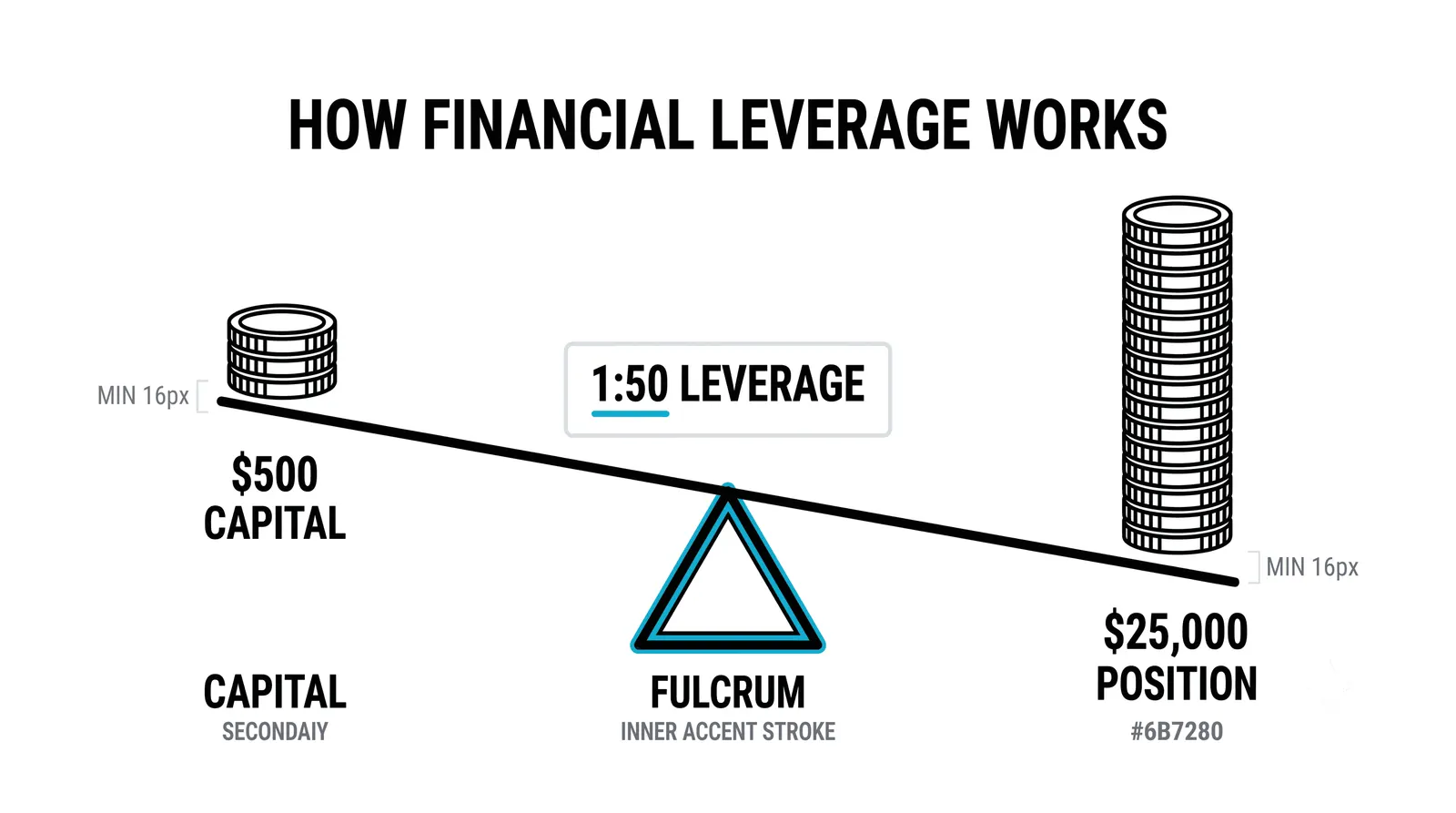
What Leverage Actually Is
When you open a leveraged trade, you put down a margin deposit. The broker then lets you control a position many times larger than that deposit. The ratio describes the relationship: at 30:1, a 100 deposit controls a 3,000 position. At 100:1, the same 100 controls 10,000.
The deposit is a performance bond, not the price of the position. You have not bought 3,000 of something for 100. You have posted 100 as collateral, and your profit or loss is calculated on the full 3,000 of exposure. That exposure is called the notional value, and it is the number that matters.
Your account balance moves with the notional, tick by tick. If the position loses more than your deposit can cover, the broker closes it for you. That is the margin call, and it is not a courtesy. It is the broker protecting the money it lent you.
What It Changes and What It Does Not
Leverage multiplies the size of your outcomes. Both of them. It also multiplies the speed at which they arrive, because a small market move now maps to a large account move.
Here is what it does not do: it does not improve your odds of being right. A 50 percent win rate stays a 50 percent win rate at 1:1 and at 100:1. The market does not know or care how much margin you posted. Your analysis, your entry, and your exit are identical either way.
This is the part the advertising skips. Leverage changes the consequences of your decisions, never the quality of them. If your decisions are good, leverage makes the good results bigger. If your decisions are average or worse, it makes the bad results arrive faster than you can learn from them.
What the Ratio Really Means
Traders read 30:1 and think "thirty times the profit." Read it differently. At 30:1, a 1 percent move in the market is a 30 percent move on your margin. A move of about 3.3 percent against you erases the deposit entirely.
Now ask a practical question: how often does your market move 3.3 percent? In major forex pairs, that can take weeks. In a stock index during a volatile stretch, it can happen in a day. In crypto, it can happen before lunch. The ratio converts ordinary market noise into account-ending events, and the higher the ratio, the smaller the noise required.
The ratio is a measure of fragility. That is the honest translation.
A Worked Example With Round Numbers
Suppose, purely as a hypothetical, that you have a 1,000 account and you open a 10,000 position. That is 10:1.
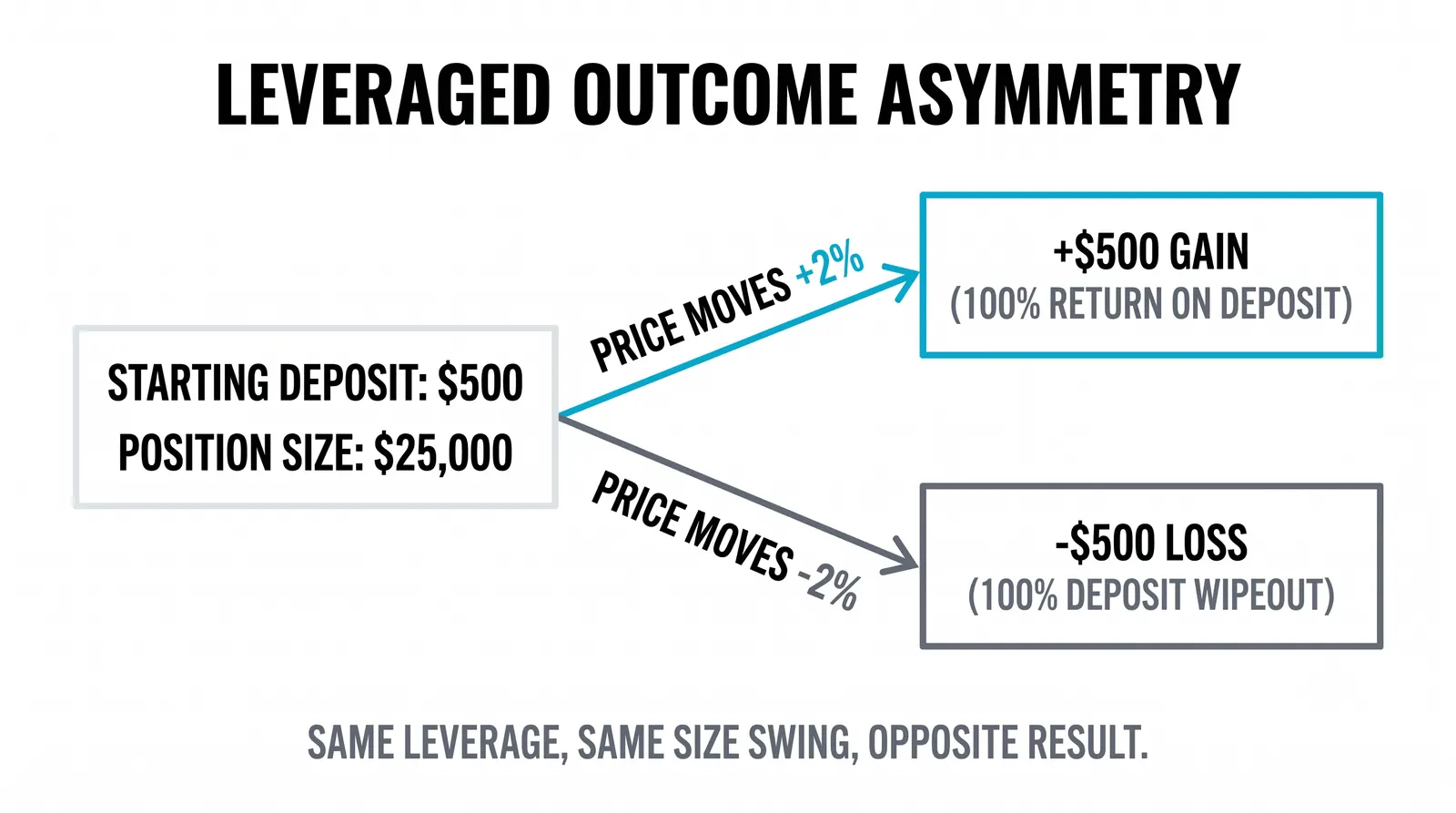
The market moves 2 percent in your favor. Two percent of 10,000 is 200, so your account grows to 1,200. That is a 20 percent gain on the account from a 2 percent market move. This is the part that feels like magic.
Now run it the other way. The market moves 2 percent against you. You lose 200, a fifth of the account, from one ordinary fluctuation. And if the market moves 10 percent against you, the loss is 1,000, the entire account, at least on paper before the broker closes the position somewhere along the way.
Same market. Same skill. Same analysis. The only difference between a trader who survives a bad month and one who does not is often the number they chose on this dial.
Why Beginners Reach for It, and Why That Is Backwards
The appeal is obvious. A small account produces small absolute gains at low leverage, and small gains feel pointless. Leverage promises to make a 500 account behave like a 5,000 account, and that promise is technically true. It behaves like a 5,000 account on the way down too.
The problem is timing. Beginners are wrong often, because being wrong often is what being a beginner means. Every trader pays tuition in losses while they learn. Leverage shortens the time available to be wrong, which means it shortens the apprenticeship. Many accounts do not survive long enough for the trader to become the person who could have traded them well.
Professionals use far less leverage than the marketing implies. Many trade at effective ratios in the low single digits, because their job is to still be in the game next year. The maximum a broker offers and the amount a careful trader uses are very different numbers, and the gap between them is where most blown accounts live.
The Honest Way to Use It
Leverage is a dial, not a requirement. A 100:1 account does not force you to trade at 100:1. If you have 1,000 in the account and open a 2,000 position, your effective leverage is 2:1, whatever the account maximum says. You choose the effective ratio every time you size a position.
This is why position sizing and leverage are the same conversation. The formula runs backwards from risk: decide how much of the account you are willing to lose on the trade, place your stop, and let those two numbers determine the position size. The leverage that results is whatever it is. Usually it is far below the maximum.
The survivable choice is almost always smaller than the allowed one. Brokers set the ceiling. You set the floor you actually stand on.
One Market Move, Three Different Accounts
The table below uses the same hypothetical 1,000 account and the same 2 percent adverse move. Only the position size changes.
| Effective leverage | Position size | Loss from a 2% adverse move | Account after the trade | Consecutive losses the account survives |
|---|---|---|---|---|
| 1:1 | 1,000 | 20 | 980 | Roughly 50 |
| 10:1 | 10,000 | 200 | 800 | About 5 |
| 30:1 | 30,000 | 600 | 400 | Fewer than 2 |
Read the last column slowly. At 1:1 you can be wrong dozens of times while you learn. At 30:1, a bad afternoon ends the experiment. Nothing about your analysis changed across those three rows. Only the room you left yourself to be wrong.
Questions About Leverage
How much leverage should a beginner use?
As little as possible, and effective leverage of 1:1 to 3:1 is a sensible starting range for most new traders. At those levels, normal market noise cannot destroy the account, and you get to make your beginner mistakes at beginner prices. Raise the dial later only if your results, over a large sample of trades, say you have earned it.
Is high leverage always bad?
No. High available leverage is a tool, and it has legitimate uses, such as running small positions efficiently without tying up a large deposit. The problem is not the ceiling the broker offers. The problem is trading near that ceiling, which turns routine losing streaks into fatal ones.
Why do brokers offer so much of it?
Because it attracts customers and because larger positions generate more spread and commission per trade. High maximum leverage is a marketing feature as much as a trading feature. Regulators in many regions cap it for retail clients precisely because the losses were so predictable.
Does leverage change my win rate?
No. Your win rate comes from your method and your execution, and leverage touches neither. It changes the size of each win and each loss, and how many losses you can afford to take. A trader who wins half the time at 1:1 wins half the time at 50:1. The second one just finds out their long-term results much faster.
With the mechanics of leverage clear, the next step is the number that ties everything together: position sizing, where you turn a risk percentage and a stop distance into an exact trade size every time.