Leading vs Lagging Indicators
Leading indicators try to flag a price turn before it finishes, while lagging indicators confirm a trend after it has begun. The real difference between the two families is timing, and timing is always paid for in reliability. Every indicator you will ever study sits somewhere on this line, so learning to place each one is more useful than memorizing what it computes.
Think of driving at night: headlights show what is coming, taillights show where something has already gone, and a chart needs both reads while confusing them at its peril. The earlier lesson in this level said lag is built into the arithmetic of indicators. This lesson gives that lag a name, and a tradeoff.
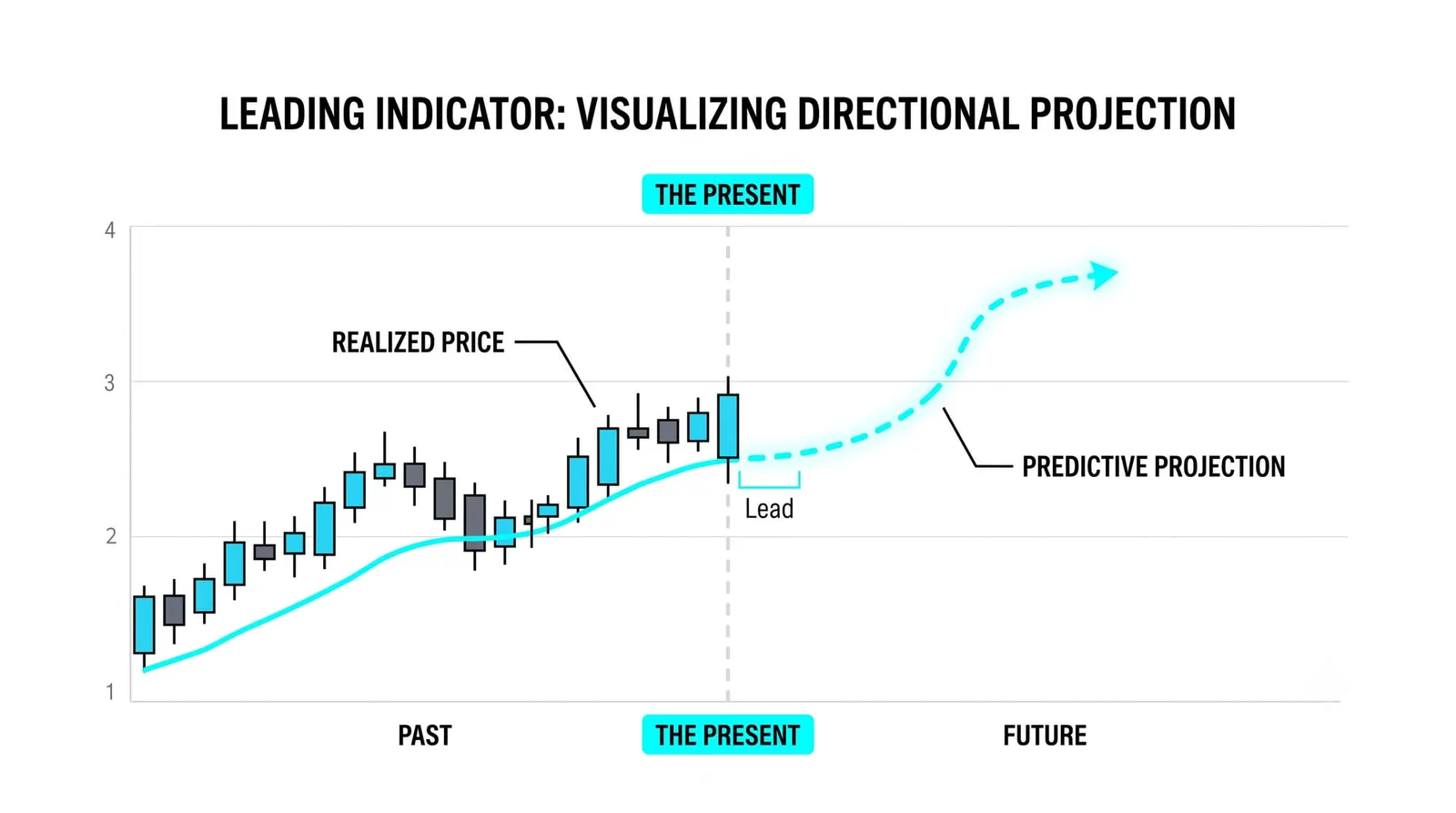
What Leading and Lagging Actually Mean
A leading indicator attempts anticipation. It is built to change direction before price does, or at least before the crowd agrees price has. Oscillators are the classic example: they compress recent price behavior into a bounded scale and roll over while price is still rising. Divergences belong here too, where price makes a new high but the indicator makes a lower one, hinting that the push is thinning out.
A lagging indicator confirms by construction. Moving averages wait for enough closes to stack up before they bend. A crossover cannot happen until the trend has already moved far enough to drag the fast average through the slow one. That delay is not a flaw in the design. It is the design.
Neither label is a compliment or an insult. Leading does not mean smarter, and lagging does not mean broken. The words describe intent and mechanics: what the tool is trying to do, and how its math forces it to behave. No indicator is a crystal ball, in either direction.
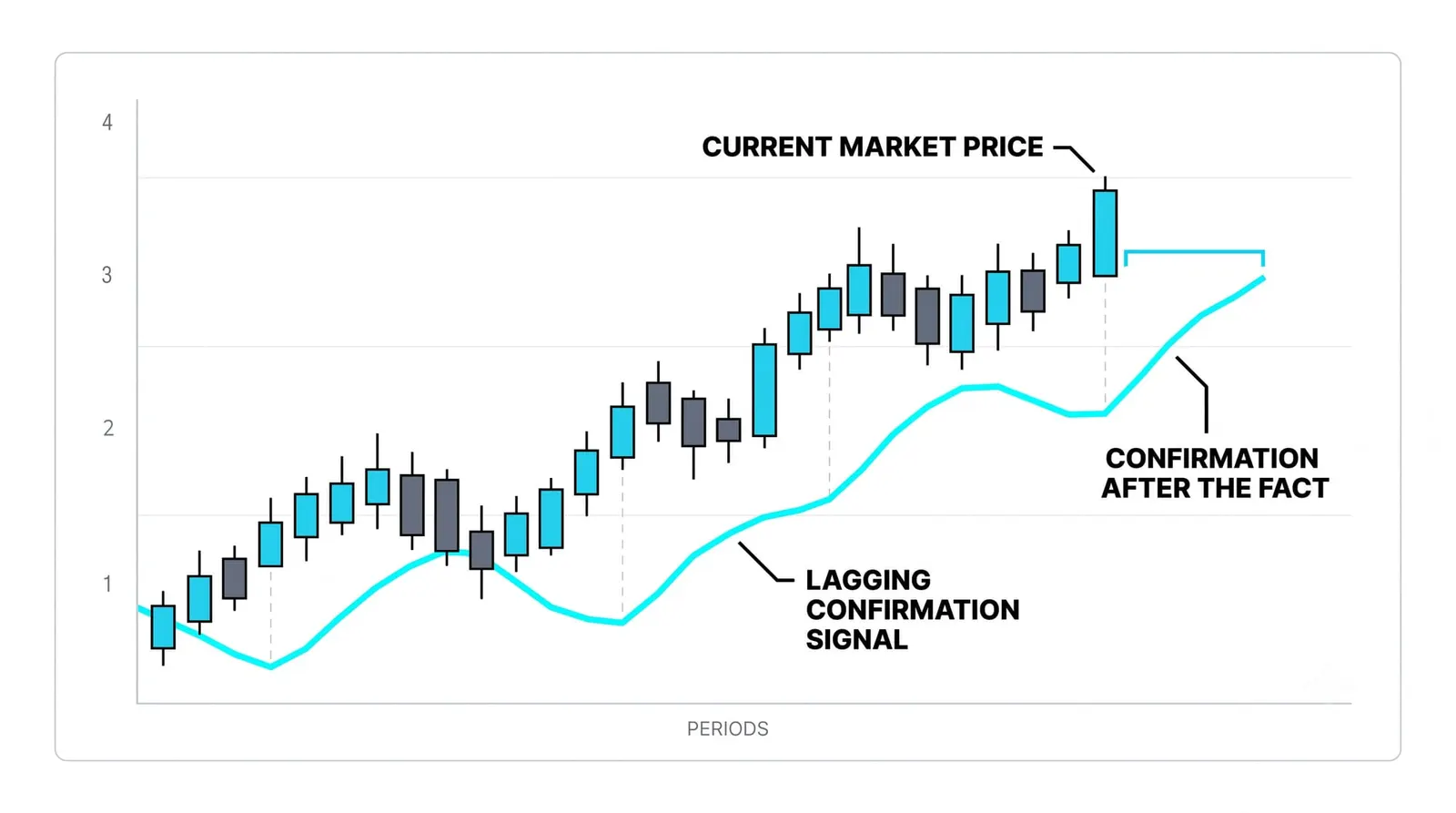
The Trade: Speed Versus Reliability
Early signals fire on turns that never happen. That is the cost of being first. An oscillator can roll over, flash weakness, and then watch price grind higher for weeks. Every point of earliness you buy is paid for in false alarms.
Late signals arrive with the move partly spent. By the time a crossover confirms a downtrend, price has already fallen some distance from the top. You skip the false alarms, but you donate the first slice of every move to the confirmation process.
No tool escapes this tradeoff, because the tradeoff is arithmetic. A formula that reacts to little data is fast and jumpy. A formula that digests a lot of data is smooth and slow. You choose where on that dial each tool sits, but you cannot have both ends at once.
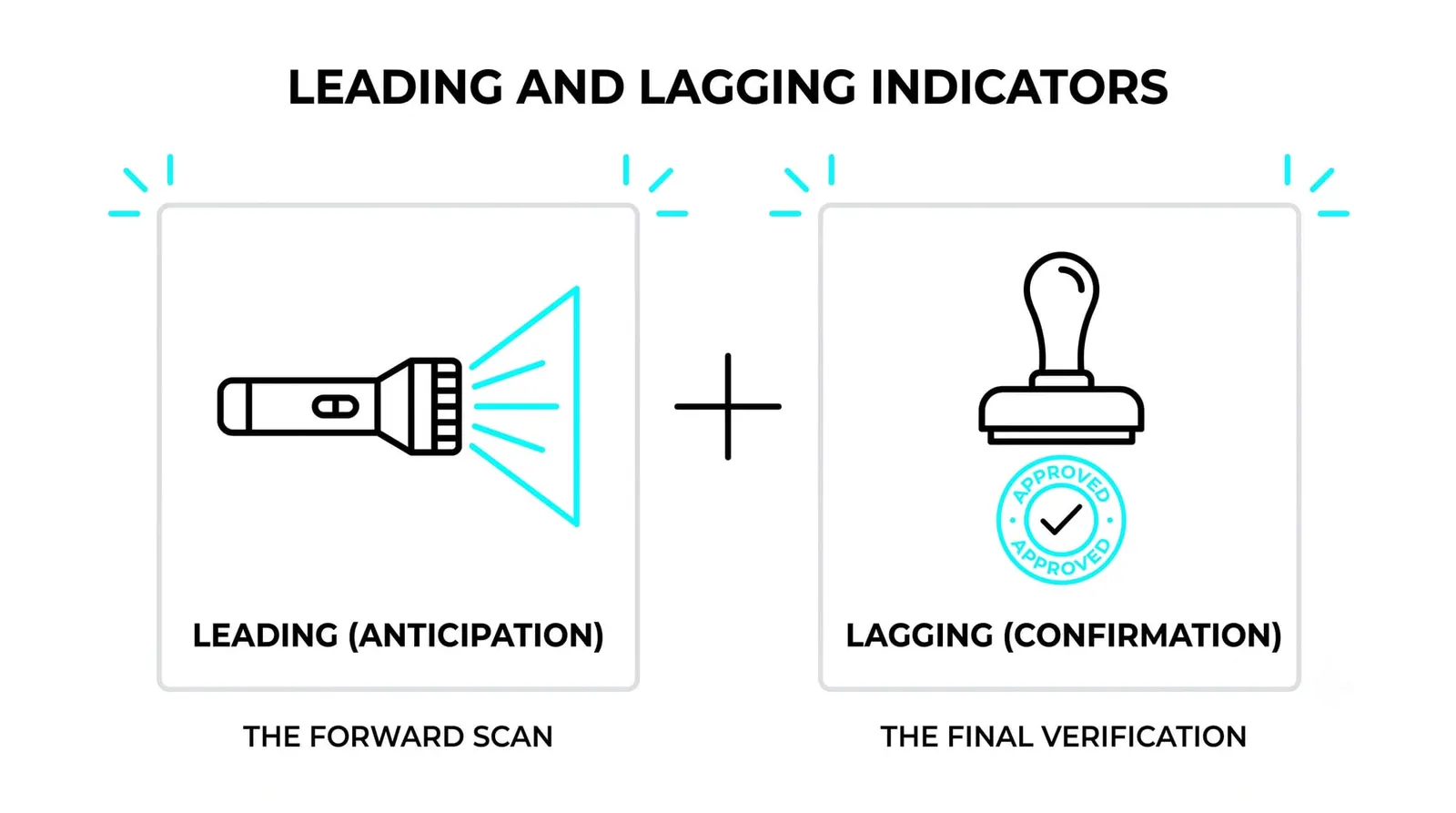
Examples From This Level
You have already met both ends of the spectrum in this level, even before they had names.
The 200-period moving average is the slowest confirmer on the list. It takes months of price action to turn it, which is exactly why traders treat a break of it as significant. It says almost nothing early and says it with weight.
The MACD signal-line crossover is a confirmer too. The cross only prints after momentum has shifted far enough to drag the MACD line through its own average. It arrives late, on purpose, and filters out much of the noise a raw MACD line would produce.
The histogram shrink is the earlier, noisier read from the same family. When the bars stop growing and start contracting, momentum is fading before any crossover has occurred. That is a leading-style hint sitting inside a lagging tool, and it whipsaws constantly.
Divergences are the purest leading signal you have met so far. Price makes a new high, the indicator refuses to, and the warning appears before any turn. Some of those warnings mark real tops. Many mark nothing at all.
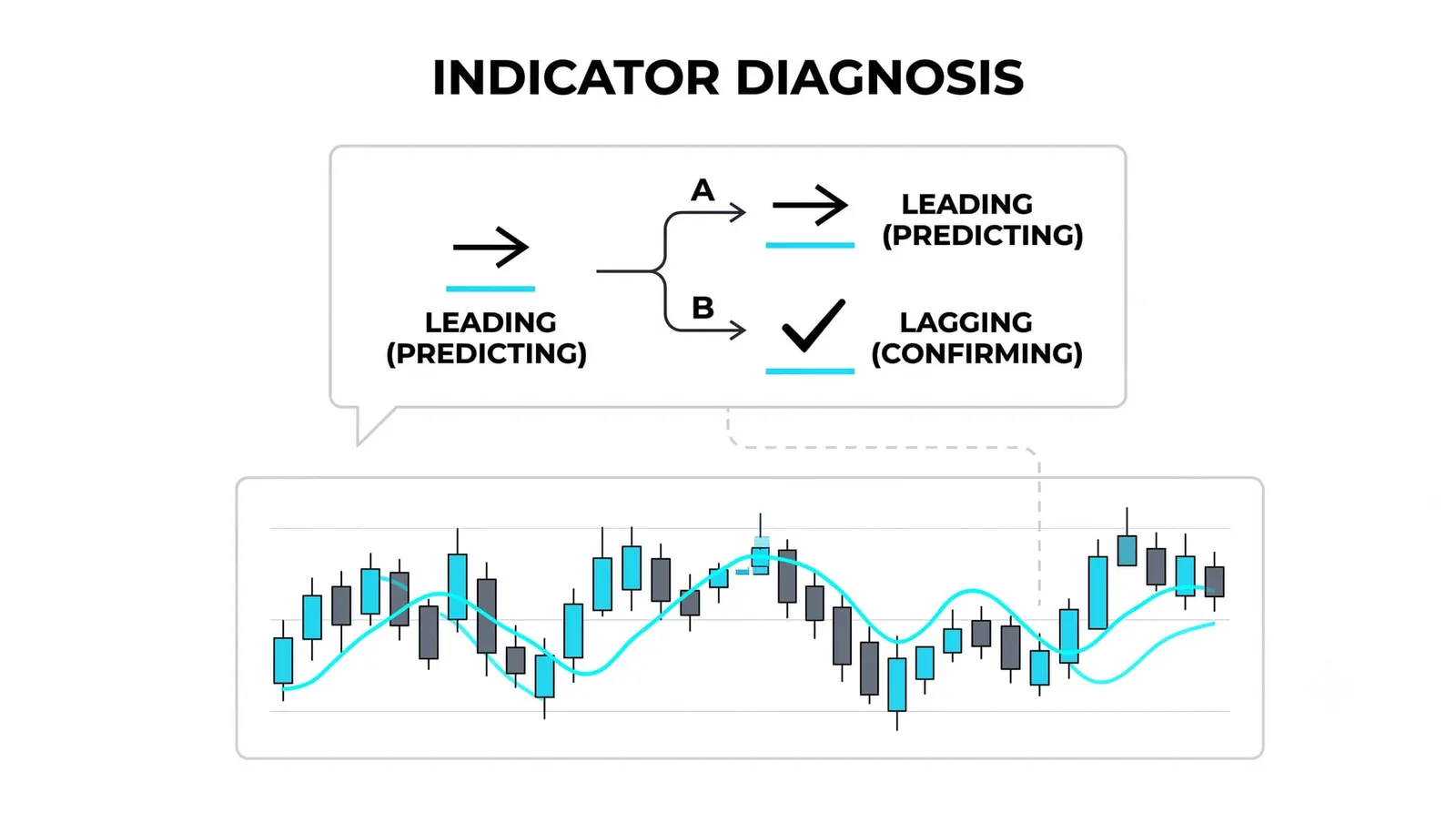
How Traders Pair Them
The standard approach uses one of each. A lagging read defines the regime: is the broad trend up, down, or flat. Then a leading read handles timing inside that regime: where, within the confirmed direction, a pullback is exhausting itself.
The pairing rule is plain. Let the slow tool choose the battlefield, and let the fast tool choose the moment. A trader might require price above a rising long-term average before taking any long signal, then use an oscillator turning up from a low reading to time the entry.
What you avoid is doubling up on one type. Two lagging tools just confirm each other late. Two leading tools just agree to be early and wrong together. The pairing works because each tool covers the other's weakness.
One Top, Two Signals
Here is a hypothetical illustration with invented round numbers. A stock rallies and tops at 62. Watch how the two signal types behave around that single high.
Three sessions before the top, the MACD histogram starts shrinking: 0.6, then 0.4, then 0.2, even while price pushes to one last high at 62. That shrink is the leading read. A trader acting on it exits near 61 or 62, close to the peak.
Four sessions after the top, the 20-period moving average crossover finally confirms the turn, with price at 59. That is the lagging read. A trader waiting for it exits at 59.
The early read offered roughly 3 points more of the move. What it risked was fading a trend that sometimes resumes: in plenty of cases the histogram shrinks, price pauses, and then rallies to new highs while the early seller watches from the sidelines.
The late read gave up those 3 points. What it guaranteed was that a real turn had already occurred before the trader acted. It traded profit for proof. Neither choice is correct in general; each is a deliberate purchase of one thing at the price of the other.
| Signal | Lean | Typical failure mode |
|---|---|---|
| Moving average crossovers | Lagging | Confirms after much of the move is gone; whipsaws in flat markets |
| MACD histogram shrink | Leading | Fades momentum that then re-accelerates |
| Divergences | Leading | Warns of turns that never come, sometimes repeatedly |
| The average's slope | Lagging | Turns only after a trend is well established |
Leading and Lagging, Answered
Are leading indicators better than lagging ones?
No. They are earlier, and earliness is bought with false signals. A leading tool that catches every top also flags many tops that never form. Which type serves you depends on whether your approach tolerates frequent small mistakes or prefers fewer, later decisions.
Can an indicator be both?
Yes, depending on how you read it. MACD is the clearest case from this level: the histogram shrink behaves like a leading hint, while the signal-line crossover is a lagging confirmation, and both come from the same calculation. The label attaches to the signal you use, not the tool's name.
Why do lagging indicators still matter if they are late?
Because confirmation has value. A lagging tool keeps you aligned with the established trend and filters out the constant noise that leading tools react to. Many durable trading approaches are built almost entirely on slow, late, reliable reads.
Which should a beginner start with?
Start with a lagging tool, such as a long-period moving average, to learn trend identification first. Lagging signals are slower and less exciting, which is exactly why they teach discipline. Add a leading read for timing only after you can read the trend without one.
Next in this level, the four indicator categories organize every tool you have met, and the ones still ahead, by the job each one actually does.