Technical vs Fundamental Analysis
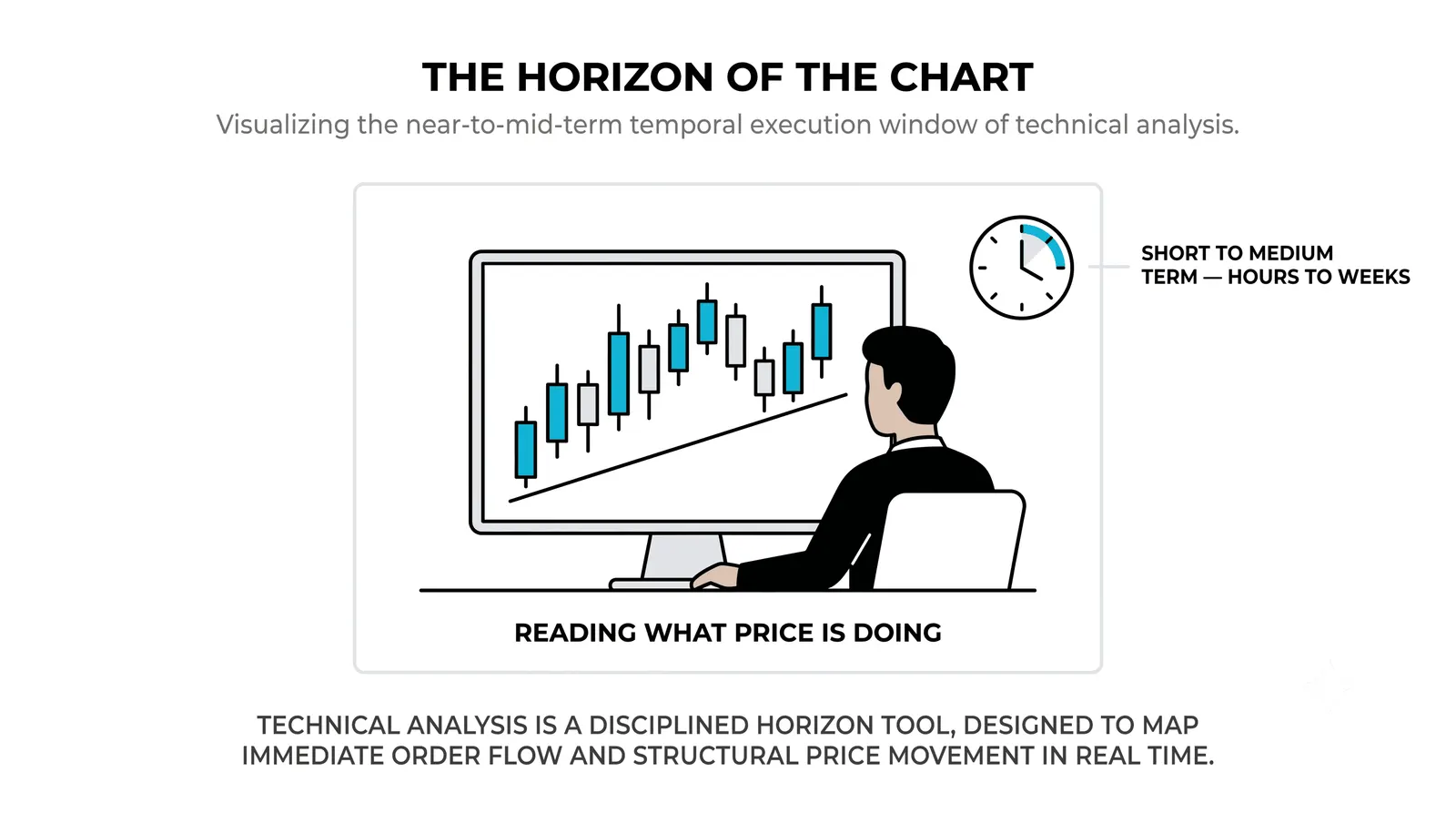
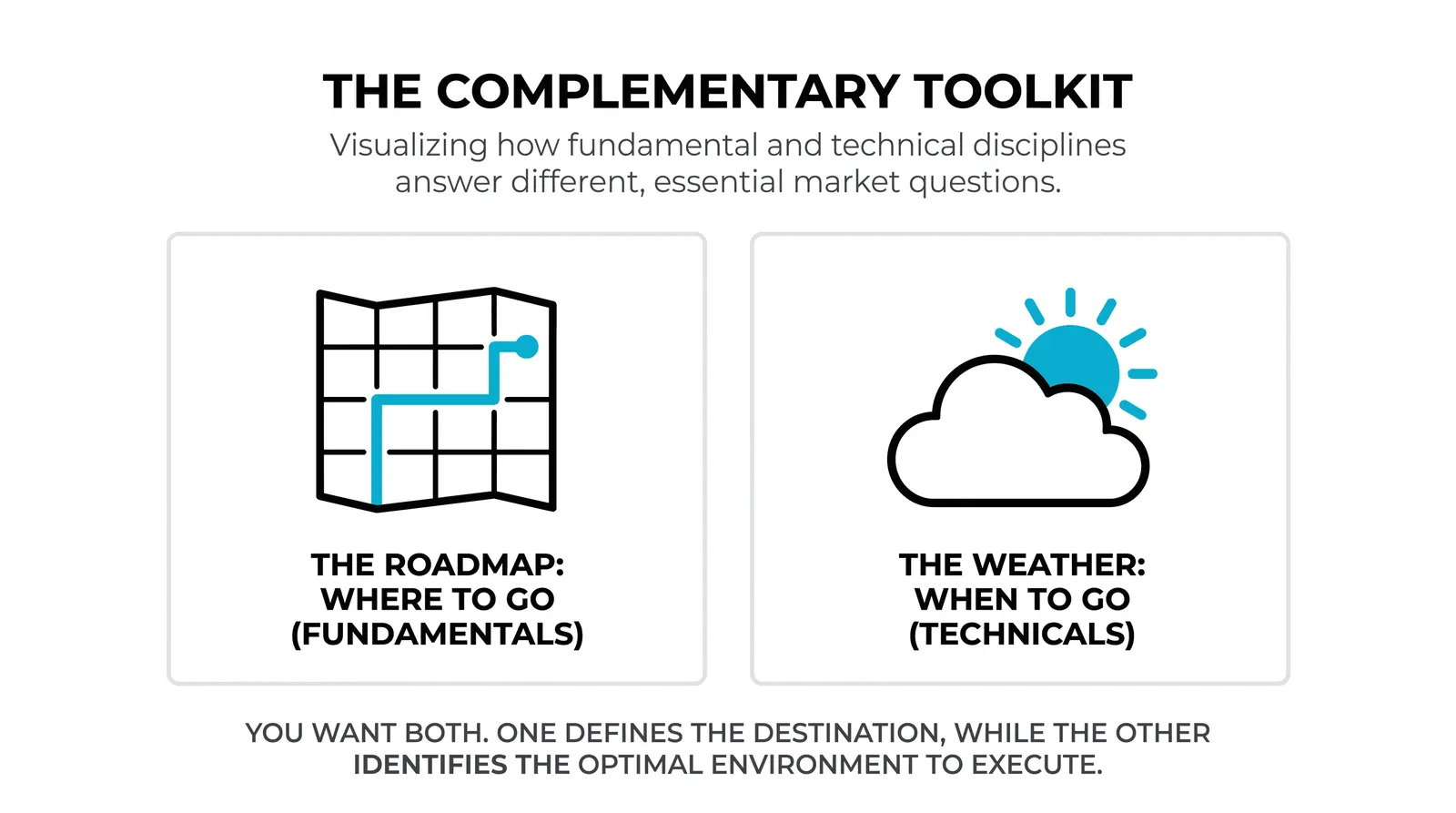
The debate over technical vs fundamental analysis is one of the oldest arguments in trading, and it is mostly a waste of time. Technical analysis studies what price is doing. Fundamental analysis studies what the thing behind the price is worth. They answer different questions, so asking which one is "better" is like asking whether a thermometer is better than a map.

Think of two scouts watching the same battlefield from different hills. Each sees what the other cannot. Neither is lying. Neither has the full picture. The two disciplines each have their own lesson: what technical analysis is and what fundamental analysis is.
By the end of this lesson you will know what each discipline actually assumes, when each one earns its keep, and how to combine them without turning your process into mush.
What Each Discipline Assumes
Every method rests on a belief. If you do not know the belief, you cannot know when the method breaks.
Technical analysis assumes that everything the market knows, fears, and hopes already shows up in price. Earnings, wars, central bank decisions, rumors: all of it gets processed by millions of buyers and sellers and printed on the chart. The technician's job is to read crowd behavior, because crowds repeat themselves. Trends persist. Support holds until it does not. Breakouts either follow through or fail, and both outcomes carry information.
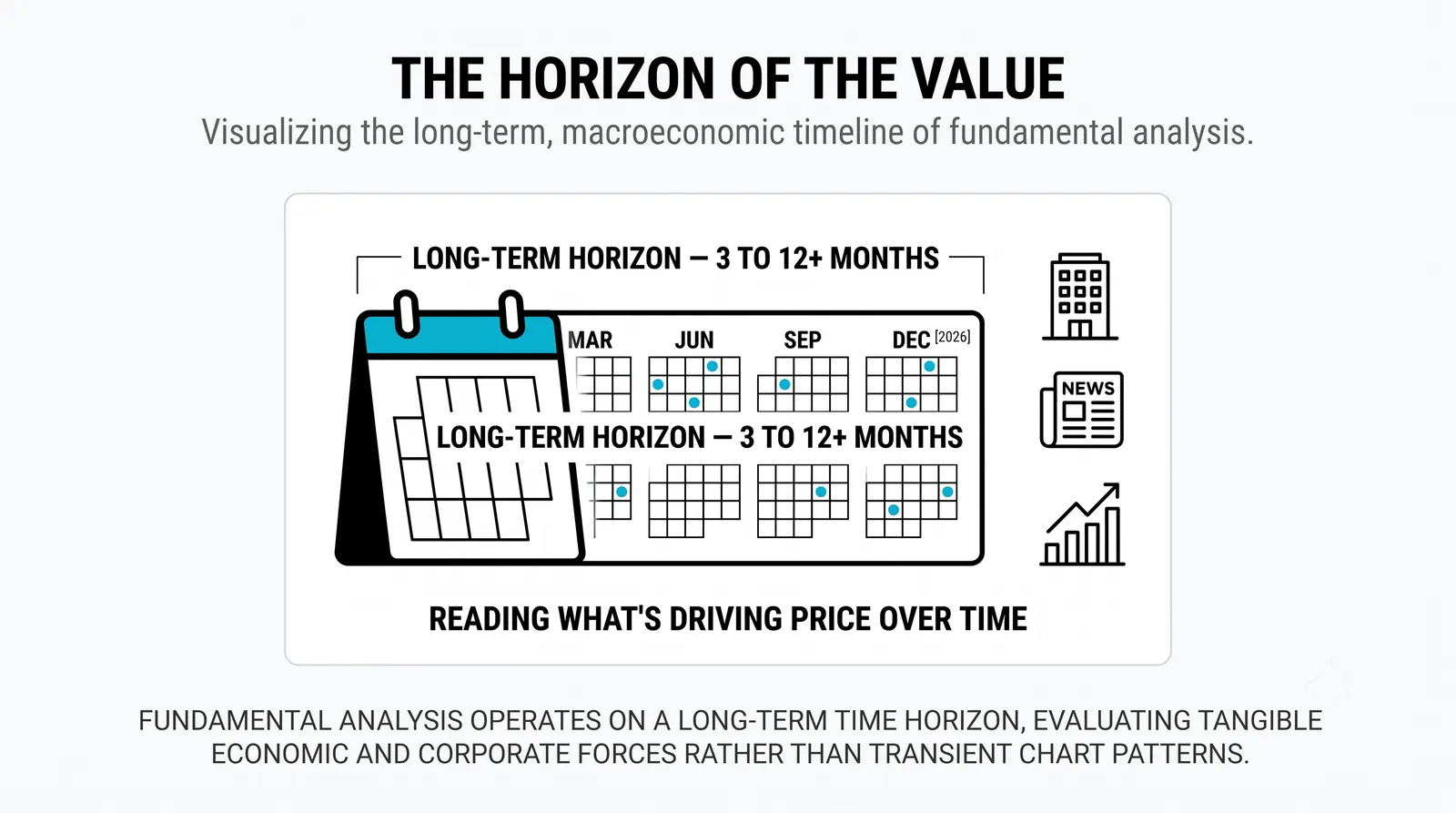
Fundamental analysis assumes something almost opposite: that value exists independently of today's mood. A currency, a stock, a commodity has an underlying worth driven by rates, earnings, supply, demand, and growth. Price can wander away from that value for a long time, but eventually the gap matters. The fundamentalist's job is to estimate value and wait for price to come to it, or to avoid assets whose price has run far ahead of reality.
Notice the tension. The technician says the crowd is the signal. The fundamentalist says the crowd is often wrong. Both are right, on different clocks.
The Same Event, Two Lenses
The clearest way to see the difference is to run one headline through both minds. The table below does that for three events you will meet constantly.
| Market event | What the technician sees on the chart | What the fundamentalist checks in the numbers |
|---|---|---|
| A central bank cuts interest rates | Price broke out of a multi-week range with strong momentum; watch whether the retest of the old range holds | Why the cut happened; what it signals about growth and inflation; how rate differentials will pull capital between currencies over coming quarters |
| A company reports a big earnings beat | Gap up at the open; whether buyers defend the gap or price fades back into the prior range | Whether the beat came from real revenue growth or one-off items; whether margins and guidance justify a higher valuation |
| A sudden geopolitical conflict | Volatility spike; price gapping through levels; waiting for structure to form before trusting any move | Which economies, supply chains, and commodity flows are actually exposed, and whether the market's first reaction matches the real damage |
Same event. Same minute, even. One mind asks "what is price telling me about positioning right now?" The other asks "what does this change about worth over time?"
When Each One Wins
Timeframe decides the winner more than intelligence does.
On fast, tradable moves, technicals dominate. On a rate-decision day, nobody is recalculating a valuation model between the headline and the first five-minute candle. Price is moving on positioning, stops, and crowd reaction. The trader who reads structure, momentum, and levels has the edge. The trader who insists the market "should" go the other way because of value gets run over.
On slow horizons, fundamentals dominate. Over a decade, a stock's return tracks its earnings power far more than any pattern on its chart. A currency's long arc follows growth, inflation, and capital flows. No candlestick pattern survives contact with ten years of compounding.
Here is the blunt version: the shorter your holding period, the more the crowd matters; the longer your holding period, the more the business or economy matters.
There is also a difference in failure modes. Technicals fail fast and tell you quickly, because your stop is hit. Fundamentals fail slowly and quietly, because a cheap asset can get cheaper for years while you wait. Neither failure is pleasant. Know which one you are signing up for.
A Worked Example: One Rate Cut, Two Plans
Imagine a hypothetical central bank cuts its benchmark rate from 4.00% to 3.75%, and the market expected no change. The currency drops hard. These numbers are invented for illustration, not drawn from any real event.
The technician's read: the pair had been stuck in a range between 1.1000 and 1.1200 for six weeks. On the news, price slices through 1.1000 with heavy volume and closes near 1.0900. That is a range break with follow-through. The plan is mechanical: wait for a retest of the broken floor near 1.1000, and if sellers defend it, look short with a stop back inside the old range, say above 1.1050, and a first target near 1.0800. Risk 50 pips to make 200. The technician does not care why the bank cut. The chart already voted.
The fundamentalist's read: the cut itself matters less than the reason. Is the bank responding to slowing growth, which could mean more cuts ahead and sustained weakness in the currency? Or is it a one-off insurance move in an otherwise strong economy, which might mean the sell-off overshoots? The fundamentalist checks inflation trends, employment data, and how the new rate differential compares with other economies. The conclusion might be "this currency stays under pressure for two or three quarters" or "this dip is a buying opportunity within a year." Either way, the horizon is months, and the position is sized to survive the noise in between.
Same headline. Same price. Two valid plans, each coherent on its own clock. The disaster is mixing them: taking the technician's entry with the fundamentalist's patience, or the fundamentalist's conviction with the technician's stop.
The Honest Synthesis
You do not need to pick a tribe. You need to know which tool owns which decision.
A practical split that works for many traders:
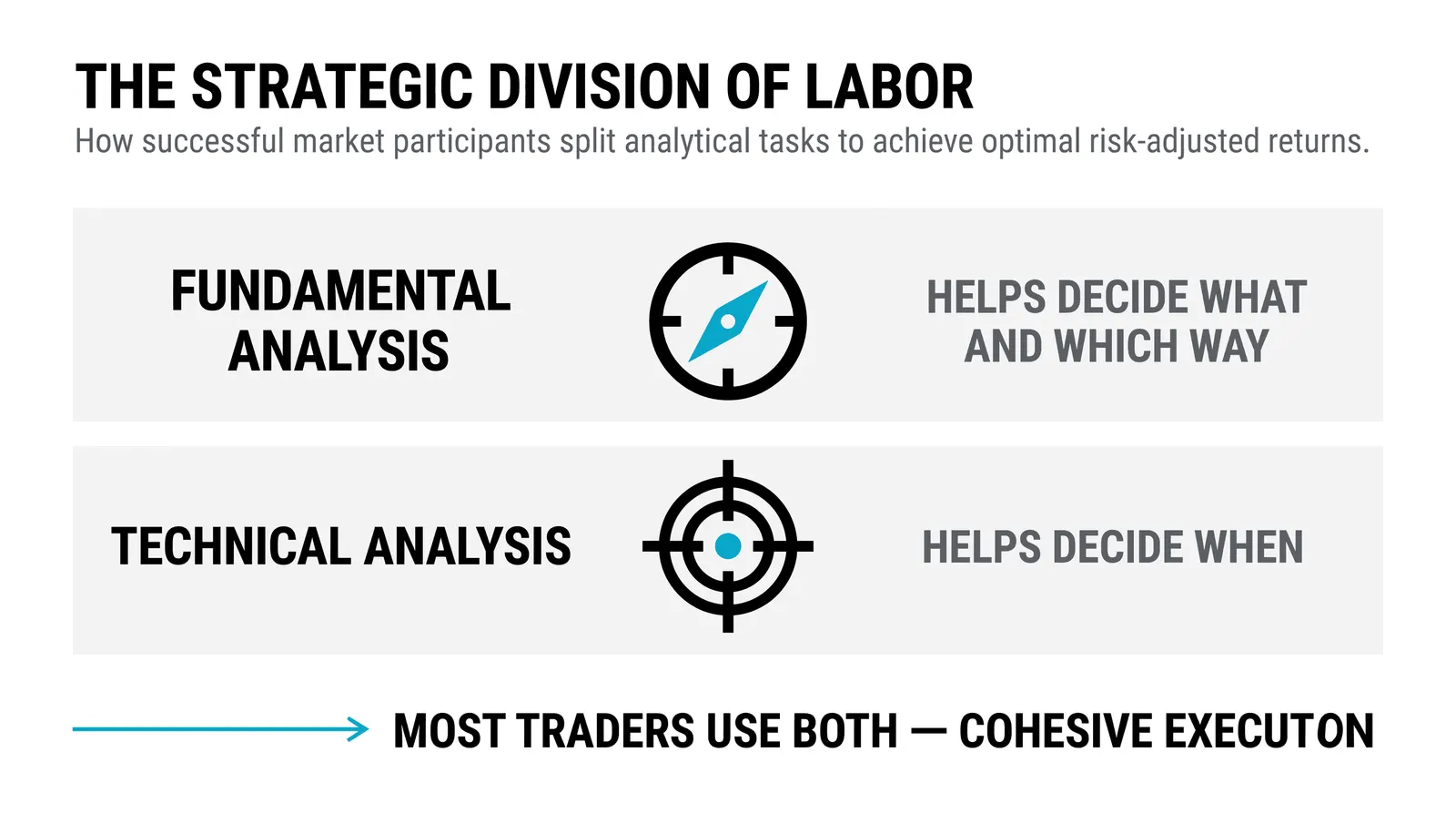
- Fundamentals own the "what" and the "whether." Which markets deserve your attention at all? Is this asset broadly cheap, expensive, or fairly priced? Is the wind at your back or in your face over the coming quarters?
- Technicals own the "when" and the "how much." Where do you enter, where is your idea proven wrong, how big is the position, and when do you take profit?
Even a pure short-term trader benefits from knowing the fundamental calendar, because a rate decision or earnings release can turn a clean setup into a coin flip. Even a long-term investor benefits from a glance at the chart, because buying a great asset at a moment of obvious mania costs years of returns.
What you should not do is use one discipline to rationalize the other's losing trade. If your technical setup failed, exit. Do not suddenly discover the fundamentals are great. That is not analysis. That is hope borrowing a plan's clothes.
Questions About Technical vs Fundamental Analysis
Can a trader ignore fundamentals entirely?
Mostly yes, if the timeframe is short, but never the calendar. A day trader does not need a valuation model, yet must know when major data and rate decisions hit, because those events change volatility and can invalidate any setup in seconds.
Can an investor ignore charts?
Largely yes, but at a cost. A long-horizon investor who never looks at price will occasionally buy into obvious euphoria or sell into obvious panic. Even a basic awareness of trend and extremes improves entry timing without turning investing into trading.
Which approach is older?
Fundamental thinking is older in spirit, since merchants have always weighed harvests, debts, and demand. Formalized technical analysis is younger, developing alongside organized exchanges and printed price data in the late nineteenth and early twentieth centuries. Both have over a century of serious practice behind them.
Which fits a part-time learner better?
Technical analysis usually fits part-time learners better, because the skills are rule-based and practiceable on historical charts in small sessions. Fundamental analysis demands ongoing reading of economic data and reports, which rewards consistency over intensity. Many part-timers learn technicals first and layer in fundamental awareness as their screen time grows.
Your next step is practical: pick one upcoming scheduled event, write down what a technician would watch and what a fundamentalist would check, then compare your notes with what price actually did. That exercise, repeated a few times, teaches the difference faster than any definition. The lessons that follow will build the technical side of that skill, one tool at a time.