How to Read a Candlestick
Learning how to read a candlestick comes down to one fact: every candle reports four numbers for its period, the open, the high, the low, and the close. Everything else you see on the chart, the body, the wicks, the color, is just those four numbers drawn as a picture. The skill is learning what that picture says about who won the period.

Think of a candle as a boxing scorecard compressed into one glance: who pushed, who answered, and how close the round was. Once you can read one candle honestly, you can read ten thousand of them. This lesson covers single-candle anatomy only. Named patterns like hammers and engulfing bars get their own lesson, and they mean little until this part is automatic.
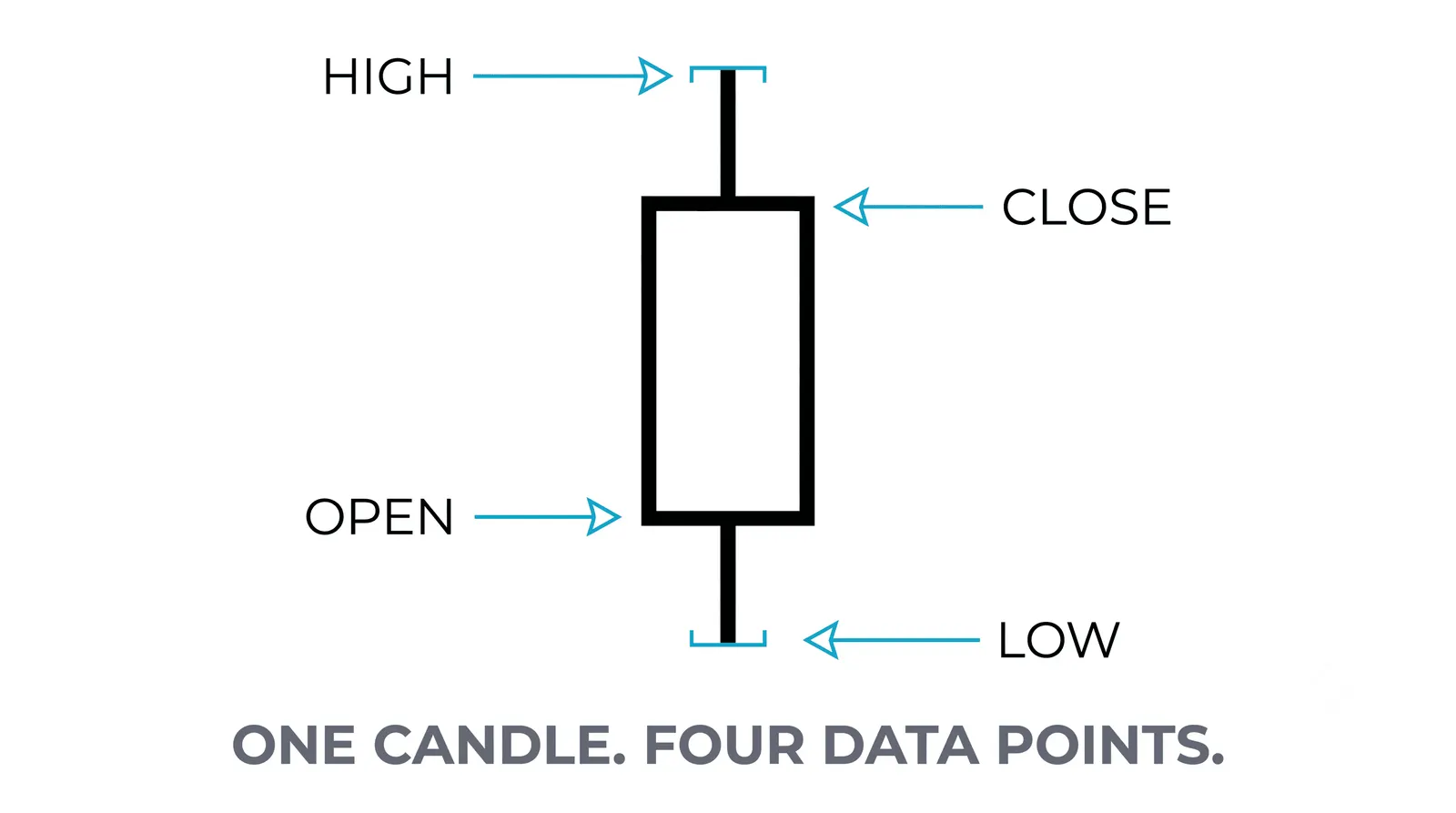
The Body: Open to Close
The body is the thick part of the candle. Its top and bottom are the open and the close, whichever is higher sits on top. The definition is that small.
The body answers one question: how far did price travel between the start of the period and the end of it? A long body means one side dominated. Buyers or sellers pushed price a long way and held the gain when the period closed. A small body means the period ended near where it started. Neither side kept control.
Read the body as a statement of net progress. A candle can have a wild period, spiking up and down, and still close with a tiny body. That tells you the fight happened but nothing was settled. Net progress is what the body measures, and nothing else.
One caution. Body size is relative to the chart you are looking at. A body that looks long on a quiet stock may be average on a volatile one. Judge each candle against its recent neighbors, not against some fixed idea of big and small.
The Wicks: Where Price Was Rejected
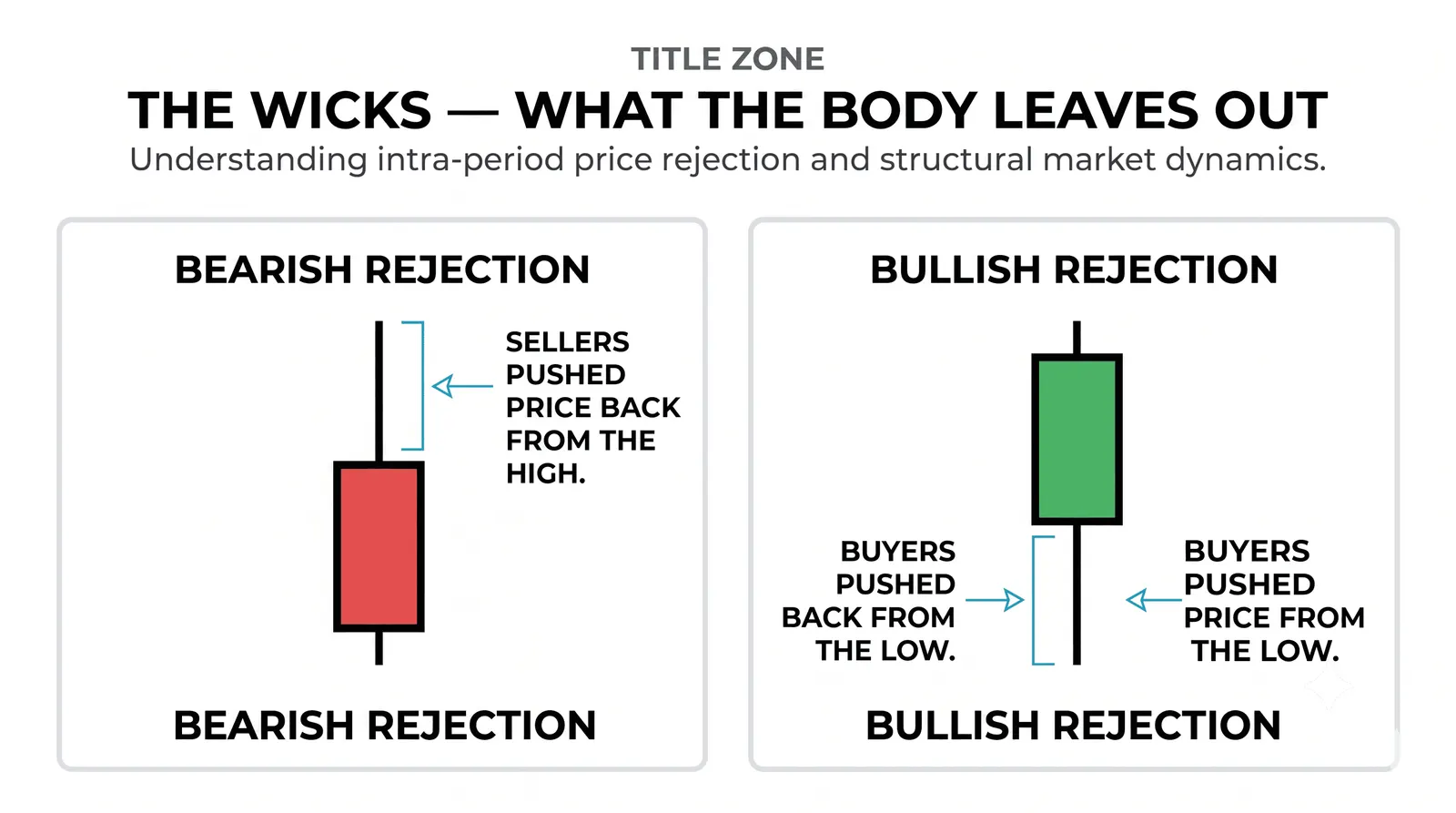
The thin lines above and below the body are the wicks, sometimes called shadows. The upper wick runs from the body to the high of the period. The lower wick runs from the body to the low.
Wicks record rejection. Price went to that level, and the market pushed it back. A long lower wick means sellers drove price down during the period and buyers answered, forcing it back up before the close. A long upper wick means buyers pushed up and sellers answered.
This is the part beginners skip, and it is often the most informative part of the candle. The body tells you where price settled. The wicks tell you where price tried to go and failed. A period with a small body and long wicks on both sides was a real battle with no winner. A period with no wicks at all was a march in one direction from start to finish.
Blunt truth: a candle with no lower wick and a long red body means sellers controlled the entire period and closed at the low. There is no bullish story in that candle, no matter how much you want one.
Color: Direction at a Glance
Color is the simplest part. A green or white candle closed above its open. A red or black candle closed below its open. That is all color means.
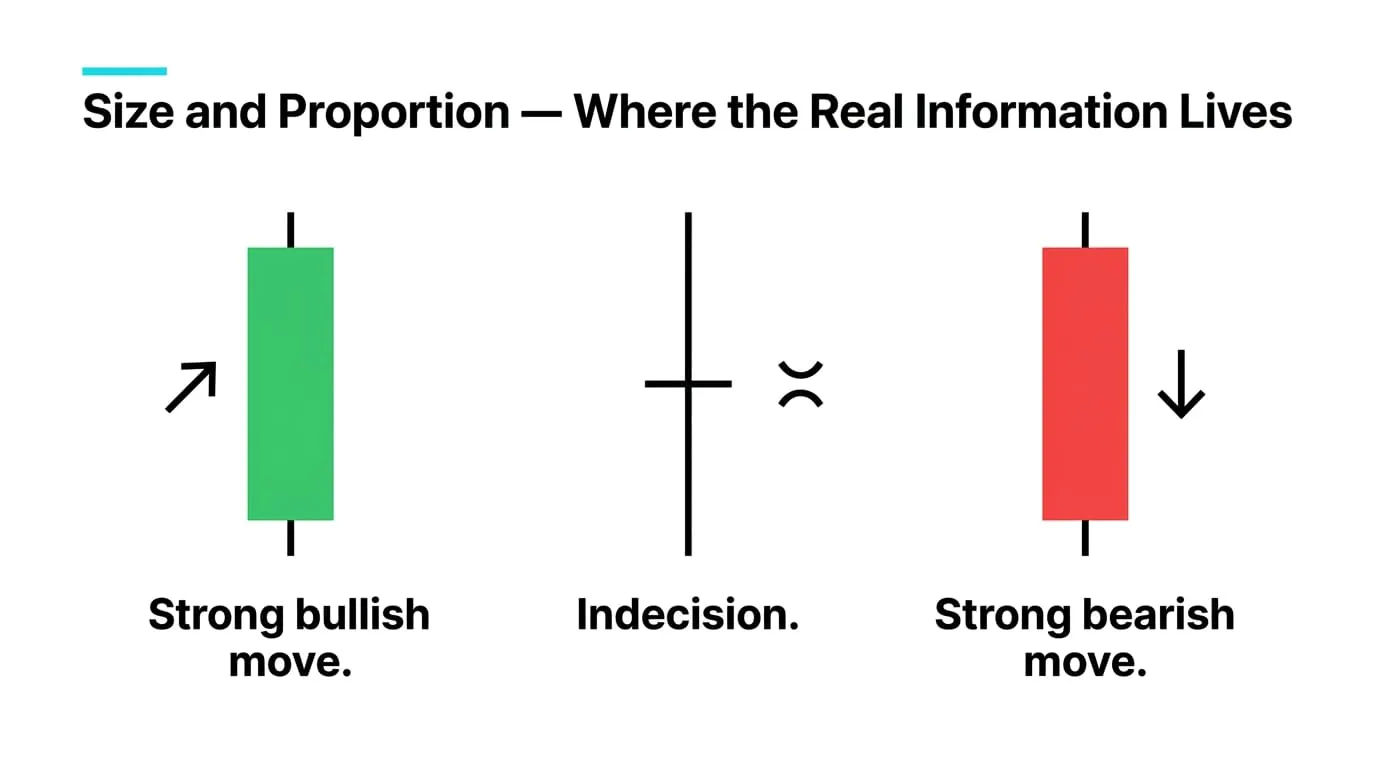
Color gives you direction instantly, which is useful when you scan a chart of two hundred candles. But color alone tells you nothing about conviction. A green candle with a tiny body and long wicks was a weak, contested period that happened to close slightly up. A red candle with a huge body and no wicks was a rout.
So use color as a first filter, never as a conclusion. Direction is the headline. Size and shape are the article.
Size and Proportion: Where the Body Sits
Two candles can have identical bodies and mean different things. What separates them is where the body sits inside the full range from high to low.
A small body at the top of a large range, with a long lower wick beneath it, says sellers spent the period pushing price down and lost all of it by the close. The same small body in the middle of the range, with wicks on both sides, says both sides pushed and both were answered. Same body, different story.
Get in the habit of reading three proportions before anything else:
- Body versus total range. A body that fills most of the range shows control. A body that is a small fraction of the range shows indecision.
- Upper wick versus lower wick. Whichever side has the longer wick is the side that got rejected.
- Close location. A close in the top quarter of the range favors buyers for that period. A close in the bottom quarter favors sellers.
These three checks take two seconds once practiced. They turn a shape on a screen into a sentence about supply and demand.
A Worked Example With Round Numbers
Here is a hypothetical candle from a single one-hour period. The candle opens at 50. During the hour, price sinks to a low of 47. Then buyers step in and drive it back up. The hour closes at 52, after touching a high of 52.5.
Now read it with the four numbers. The open is 50, the close is 52, so the body runs from 50 to 52 and the candle is green. The lower wick runs from 50 down to 47, a length of 3. The upper wick runs from 52 to 52.5, a length of 0.5. The total range is 47 to 52.5, or 5.5 points.
What does it say? Sellers controlled the first part of the hour and pushed price three points below the open. Buyers answered, erased the entire decline, and closed price near the top of the range. The body sits in the upper half. The long lower wick shows exactly where sellers were rejected. The tiny upper wick shows almost no resistance at the top.
One sentence summary: sellers had their period and lost it. That reading came entirely from four numbers and their proportions. No indicator, no pattern name, no forecast. Just an honest account of what happened in that hour.
Notice what the candle does not tell you. It does not tell you what the next hour will do. A strong candle is evidence about the period that just ended, not a promise about the next one.
Body, Wicks, and What Each One Tells You
The table below compresses the anatomy into a reference. Use it until the readings become reflex.
| Feature | What it looks like | What it says | When it means most |
|---|---|---|---|
| Long body | Thick candle, small or no wicks | One side dominated the whole period | After a quiet stretch, when it breaks the calm |
| Small body | Thin body, range mostly in the wicks | Period ended near where it started; no winner | After a long run, when it signals fading drive |
| Long wick | Shadow much longer than the body | Price went there and was pushed back | At obvious support or resistance, where rejection is tested |
None of these rows is a trading signal by itself. Each is a piece of evidence. A long lower wick at a support level you already marked carries more weight than the same wick in the middle of nowhere. Context decides how much any single candle matters.
Questions About Reading Candlesticks
What is more important, the body or the wicks?
Neither ranks above the other; they answer different questions. The body tells you the net result of the period. The wicks tell you what was attempted and rejected. A full reading needs both, which is why the proportion checks matter more than any single feature.
Does color mean the same thing on every platform?
The meaning is the same everywhere: one color for a close above the open, another for a close below it. The actual colors vary. Most platforms default to green and red, some use white and black, and many let you customize. Check your platform settings once so you never misread direction out of habit.
How long does a wick have to be to count as long?
There is no fixed number; length is relative. A practical rule is that a wick counts as long when it is clearly bigger than the body, roughly twice the body or more, and when it stands out against recent candles on the same chart. Precision matters less than consistency in how you judge it.
Should I make decisions from a single candle?
No. A single candle is one period of evidence, and one period can be noise. Candles become useful in sequence and in location: what the last few candles did together, and where they formed relative to support, resistance, and trend. Treat each candle as a sentence, and wait until you have read the paragraph.
Your next step is deliberate practice. Open any chart, cover everything to the right, and read one candle at a time out loud: open, high, low, close, body, wicks, who won. Do fifty a day for a week. Once single candles read themselves, you are ready for the patterns lesson, where these same building blocks start forming recognizable combinations.