How to Choose the Right Market to Trade
The market to trade is the one that passes four filters: the hours you can actually be present for it, what it costs you to trade it, how much it moves, and how well you understand what moves it. Everything else is marketing. The right market fits your schedule, your capital, and your temperament. It is rarely the one that looks the most exciting.

Picking a market for its excitement is like picking a car for its paint; the paint does not drive.
The Decision Most Traders Make Backwards
Most new traders never choose a market. They inherit one. They saw a forex ad, or a friend trades crypto, or a stock ran 40 percent last month and made the news. So they open an account there and start.
Then the friction shows up. The forex trader works a day job and can only watch charts during the quietest session of the day. The stock chaser buys after the move is over and sits through the pullback. The crypto trader discovers the market moves hardest at 3 a.m. their time.
The market is not broken. The fit is broken. A market that fights your life will beat you before your strategy ever gets tested, because you will be absent when it matters and present when nothing is happening.
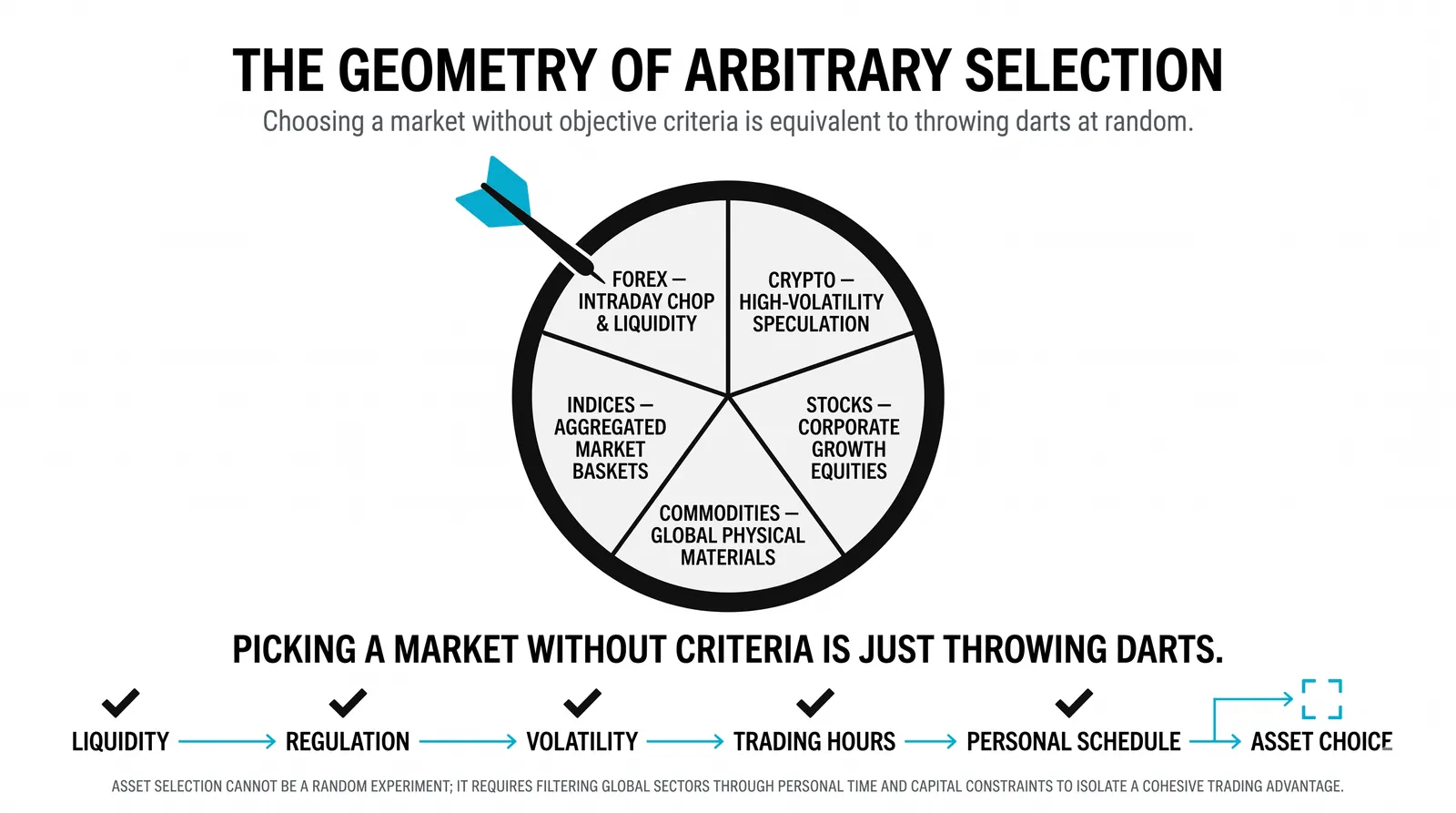
Choose deliberately. Run every candidate through the four filters below, in order.
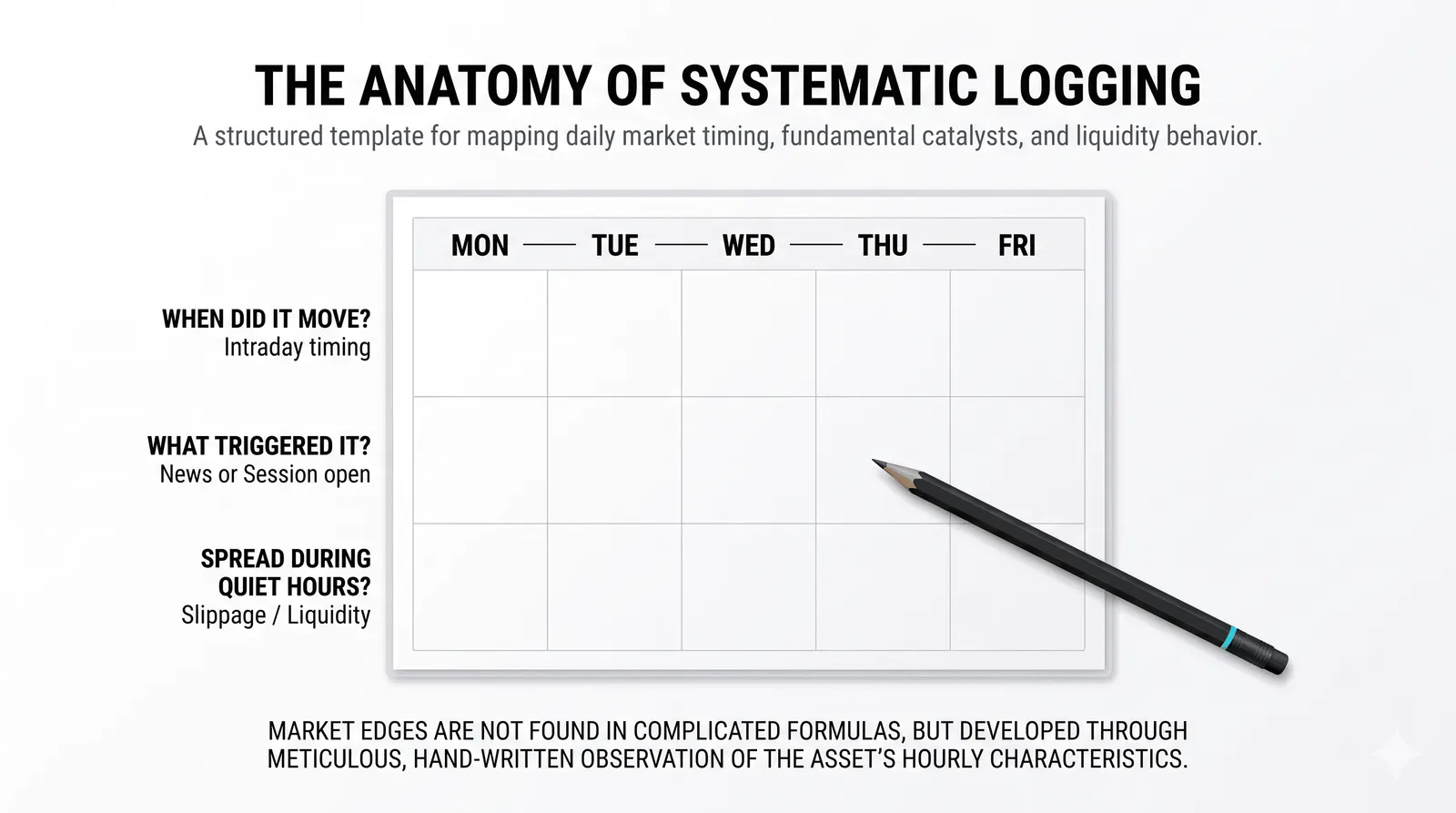
Filter One: Hours You Can Actually Trade
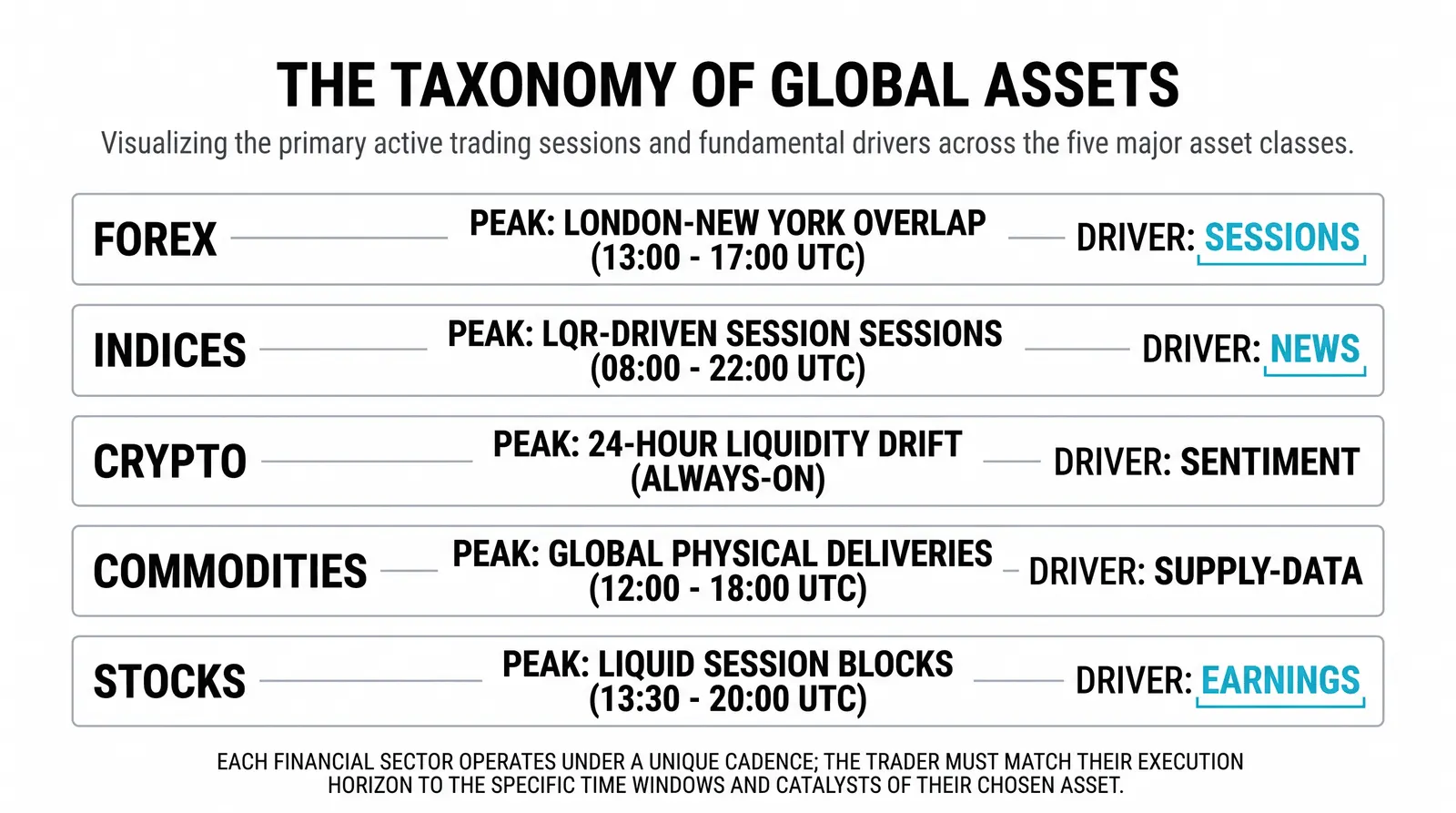
You already know from the sessions lesson that every market has windows of real activity and long stretches of dead time. The first filter is simple: can you be at your screen, alert, during this market's active window?
Be honest here. Not "I could wake up early sometimes." Consistent presence, most days, for months. If your job runs 9 to 5 in New York, the London open is not your session no matter how good the setups look on someone else's chart.
- Forex trades around the clock, but each pair has two or three hours that matter.
- Stocks concentrate their movement in the first and last hour of the exchange session.
- Futures have defined sessions with a daily close.
- Crypto never closes, which sounds like freedom and behaves like a trap.
A market you can only half-watch is a market you should not trade.
Filter Two: What It Costs You
Every trade pays a toll before it can profit. Spread, commission, and fees add up to your cost per round trip. Measure that cost against your typical target, not against your dreams.
If your average winning trade targets 20 ticks and the spread costs you 2, you give up 10 percent of every winner to the toll. If the spread costs 10 ticks on that same target, you give up half. No strategy survives giving up half.
Costs also scale with frequency. A scalper paying a wide spread is bleeding on every trade, dozens of times a day. A position trader paying the same spread once a month barely notices it. Your style from the earlier lessons determines how much this filter weighs.
Filter Three: Enough Movement to Matter
A market must move enough to pay its costs and still leave you something. Range is the raw material of profit. Too little range and your winners cannot cover the toll. Too much range relative to your account and your stops get hit by noise.
Look at the average daily range of any market you are considering. Compare it to the round-trip cost. A healthy ratio gives you room for error. A thin ratio means you need to be right almost immediately, every time.
Big movement is not automatically good. A market that swings 5 percent a day feels full of opportunity until you size a position correctly and realize one normal swing against you is a large loss. Movement must match your account size and your stop placement, not your appetite.
Filter Four: Can You Explain What Moves It
Here is the test. In one sentence, can you say what usually moves this market?
EUR/USD moves on the interest rate gap between the Fed and the ECB, and on relative economic data. A large-cap stock moves on earnings, guidance, and sector sentiment. Gold moves on real yields and fear. If you cannot produce a sentence like that, you are trading a chart you do not understand, and every surprise will feel random.
Comprehension is a filter, not a bonus. You will hold through drawdowns better in a market whose behavior you can explain, because you can tell the difference between noise and a real change in conditions.
Matching the Market to Your Style
Your trading style from the earlier lessons sets the requirements. The market either meets them or it does not.
- Day traders need intraday range plus tight spreads. You close everything by the end of the session, so overnight risk is irrelevant, but the toll is paid many times a day. Liquid forex majors, index futures, and high-volume large-caps fit.
- Swing traders need trending character plus survivable overnight gaps. You hold for days, so you need markets that trend cleanly and do not routinely open 4 percent against you. Earnings dates become events you plan around.
- Position traders benefit from markets with long histories and clear macro drivers. You hold for months, so you want instruments whose big moves are tied to forces you can study: rates, cycles, supply and demand.
Notice what is absent from that list: excitement. Excitement is not a requirement. It is usually a warning.
A Worked Example With Round Numbers
Here is a hypothetical. One trader, a 5,000 account, 2 percent risk per trade, so 100 at risk each time. They test three markets for one month each with the same simple approach.
Market A: a forex major. Spread of one pip, which costs about 1 per trade at that size. Average daily range is modest. Winners average 60, losers cost 100. The toll is nearly invisible. After a month of ordinary trading she is roughly breakeven, and every mistake she made was hers, not the market's.
Market B: a large-cap stock. Wider effective spread, about 5 per round trip at her size, but the stock trends cleanly for days. Her winners average 150. The cost is a small tax on a real edge. This market finishes the month up modestly.
Market C: a small-cap. It moves 5 percent a day. Thrilling. But the spread and slippage cost about 1 percent of the position per round trip, roughly 50 at that size. Winners average 120, losers cost 150 once the toll is added. The exciting range was almost exactly the size of the cost of accessing it. She loses steadily all month and cannot tell if her strategy works, because the math killed it before skill entered the picture.
Same trader, same account, same risk. The market made the difference. That is why this decision comes before strategy refinement, not after.
One Market First
Pick one market and stay with it until you know its rhythm cold. How it behaves at the open. How it reacts to news. What a normal pullback looks like versus a real reversal.
Depth beats breadth at this stage. Every extra market splits your attention and multiplies what you must track: different sessions, different costs, different drivers, different news calendars. Two markets studied halfway teach you less than one market studied fully.
Add a second market only after the first one is boring to you. Boring means you have seen its tricks.
The Four Filters at a Glance
| Filter | The question it asks | What disqualifies a market |
|---|---|---|
| Hours | Can I be present during its active window, most days? | Its real movement happens while you work or sleep |
| Costs | Is the round-trip toll small against my typical target? | Spread and fees eat a large share of an average winner |
| Movement | Does it range enough to pay costs and leave profit? | Range too thin to cover the toll, or too wild for your account |
| Comprehension | Can I name what moves it in one sentence? | You cannot explain its behavior, so surprises feel random |
Questions About Choosing a Market
Can I trade more than one market?
Yes, but not yet. Start with one, trade it until its behavior feels familiar, then consider adding a second. Most struggling traders are spread across too many markets, not too few.
Which market is best for beginners?
The one that passes all four filters for your specific life. In practice, liquid forex majors and large-cap stocks are common starting points because their costs are low, their movement is manageable, and their drivers are well documented. But a market that fits your schedule beats a market that fits a generic recommendation.
Does market choice affect risk?
Directly. The same 2 percent risk rule produces very different experiences in a quiet market versus a volatile one. Wide spreads, overnight gaps, and thin liquidity all change how often your stop gets hit and how much slippage you pay. Risk per trade is a number; the market decides what that number buys you.
How long should I test a market before committing?
At least a month of active observation or small-size trading, like the trader in the example. You want to see the market across different conditions: quiet days, news days, trending weeks. A single good week tells you nothing.
Once you have chosen your market, the next step is learning its specific mechanics in detail: contract sizes, margin requirements, trading hours, and the data releases that move it. That is where the next lessons pick up.