Fibonacci Extensions for Profit Targets
Fibonacci extensions turn profit-taking into a plan rather than a guess: the old high or low sets the first objective, the 127.2 and 161.8 percent projections set the runner targets beyond it, and a winning trade gets scaled out in stages instead of settled by one anxious exit. The retracement side of the tool finds the entry. The extension side answers the harder question, which is where to get paid.

Think of it as a harvest taken in passes, the crop's edge first, the deeper rows as the season proves itself, never everything taken at once. A trader who exits the whole position at the first target leaves the trend's best case unclaimed. A trader who holds everything for the furthest projection gives back open profit every time the move stalls early. The extension plan exists so neither mistake has to be made.
Targets Are an Exit Decision
The first rule is the one most often broken. Extensions define exits, never entries. The entry belongs to the retracement side of the tool, to the pullback into a level and the reaction that confirms it. Extending a projection outward and buying there, hoping to catch the far target from the top, inverts the tool. The projections measure where a move may run out of fuel. Buying at the destination is paying full price for the last mile.
The second rule ranks the objectives. The old extreme, the prior high in an uptrend or the prior low in a downtrend, is the first target, and it is the one that pays for the trade. The earlier lesson ranked the 127.2, the 161.8, and the 261.8 by what each is worth; this lesson turns that ranking into a sequence of exits, which fraction comes off where and why. The old high comes first because the break of it is not yet proven. Price can stall exactly there, and often does.
The arithmetic underneath all of this is simple. A single exit forces a single bet: either the trader sells everything early and misses continuation, or holds everything and risks the give-back. Scaling splits that bet across the levels. Part of the position is paid at the old high, another part at the 127.2, and the remainder rides toward the deeper projections with the trade's costs already covered. The trader is right in stages, and each stage reduces what the final stage can lose.
The cluster method rests on exactly these projections, running the same extensions from the same swings and treating the cluster of levels as the decision map for the whole trade. The levels are not decoration on a chart. They are the schedule the exit plan hangs on.
The Scaling Plan
The plan has three moves, in a fixed order.
- The first fraction comes off just under the old high. Not at it, since orders cluster at the obvious level and fills there compete with everyone else's. A shade below, a third of the position, banking the gain that pays for the trade.
- The second fraction comes off at the 127.2 extension. This is the realistic runner target, close enough to be reached by ordinary continuation and far enough to change the trade's arithmetic. Another third exits here.
- The final fraction trails toward the 161.8 and beyond. This is trail territory, held only while the trend keeps proving itself. Each higher level demands fresh evidence: new highs on strong closes, pullbacks that stay shallow, volume that still supports the move. When the evidence fades, the trail stop does the exiting.
The price action canon states the discipline from the other direction: scale out of winners, never scale into losers. The extension plan is the structured version of that rule. Each scale-out is pre-committed at a level chosen before the trade was entered, which removes the in-the-moment negotiation that turns winning trades into round trips.
One caution belongs here. The 161.8 and anything deeper are the least certain targets in the family. Treating them as promises rather than possibilities is how traders hold the final third through a full reversal. The trail exists because nobody knows which trend will extend and which will die at the 127.2.
When the Break Fails
Most breakouts fail quietly. Price reaches the old high, hesitates, and closes back inside the prior range. No dramatic reversal, no obvious signal, just a slow leak of the move that looked certain an hour earlier.
The trader with no scaling plan faces a binary choice at that moment, and usually chooses wrong. Holding everything means watching a winning trade dissolve into a scratch or a loss. Dumping everything in relief means exiting at the worst price of the day, after the stall has already begun.
The first scale changes what failure costs. A third of the position already came off just under the high at the best prices of the move. The remaining two-thirds may still be scratched, but the trade as a whole closes paid. The scaling plan did not predict the failure. It priced the possibility of failure in advance, which is the only honest way to handle a level that breaks as often as it holds.
That is the blunt truth about extensions: the deepest targets are the least likely to be reached, so the plan collects the most where certainty is highest.
The Scales at 30.80 and 32.63
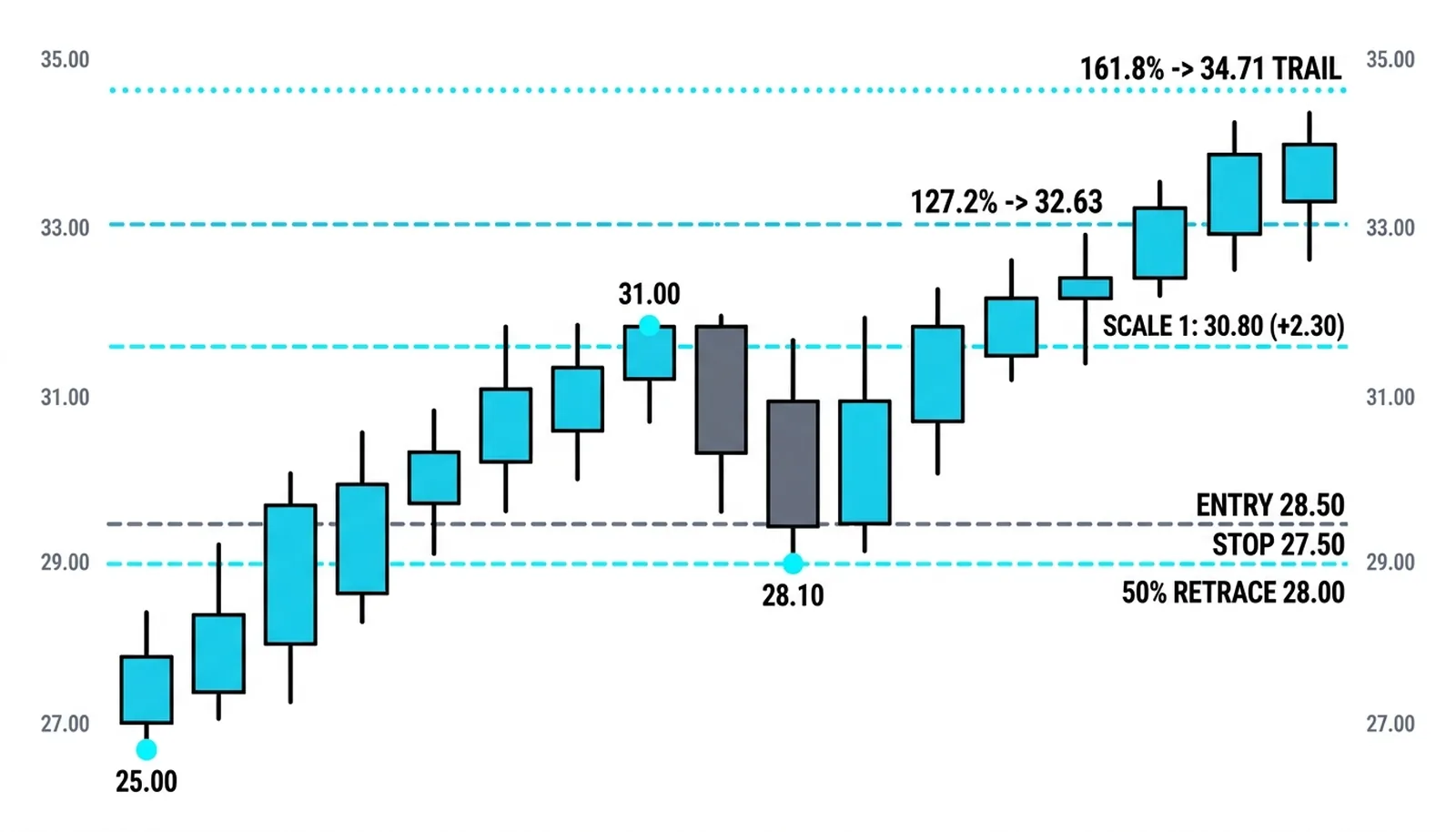
A hypothetical trade, all numbers invented and round. A leg runs 6.00 points, from 25.00 up to 31.00. From that leg, the 50 percent retracement sits at 28.00, the 127.2 percent extension projects to 32.63, and the 161.8 percent extension projects to 34.71.
Price pulls back to 28.10, holds above the midpoint at 28.00, and turns. The long is taken at 28.50 on the turn, with the stop at 27.50, risking 1.00 per unit. The exit plan is set before the order goes in.
| Target | Price | Action | Reason |
|---|---|---|---|
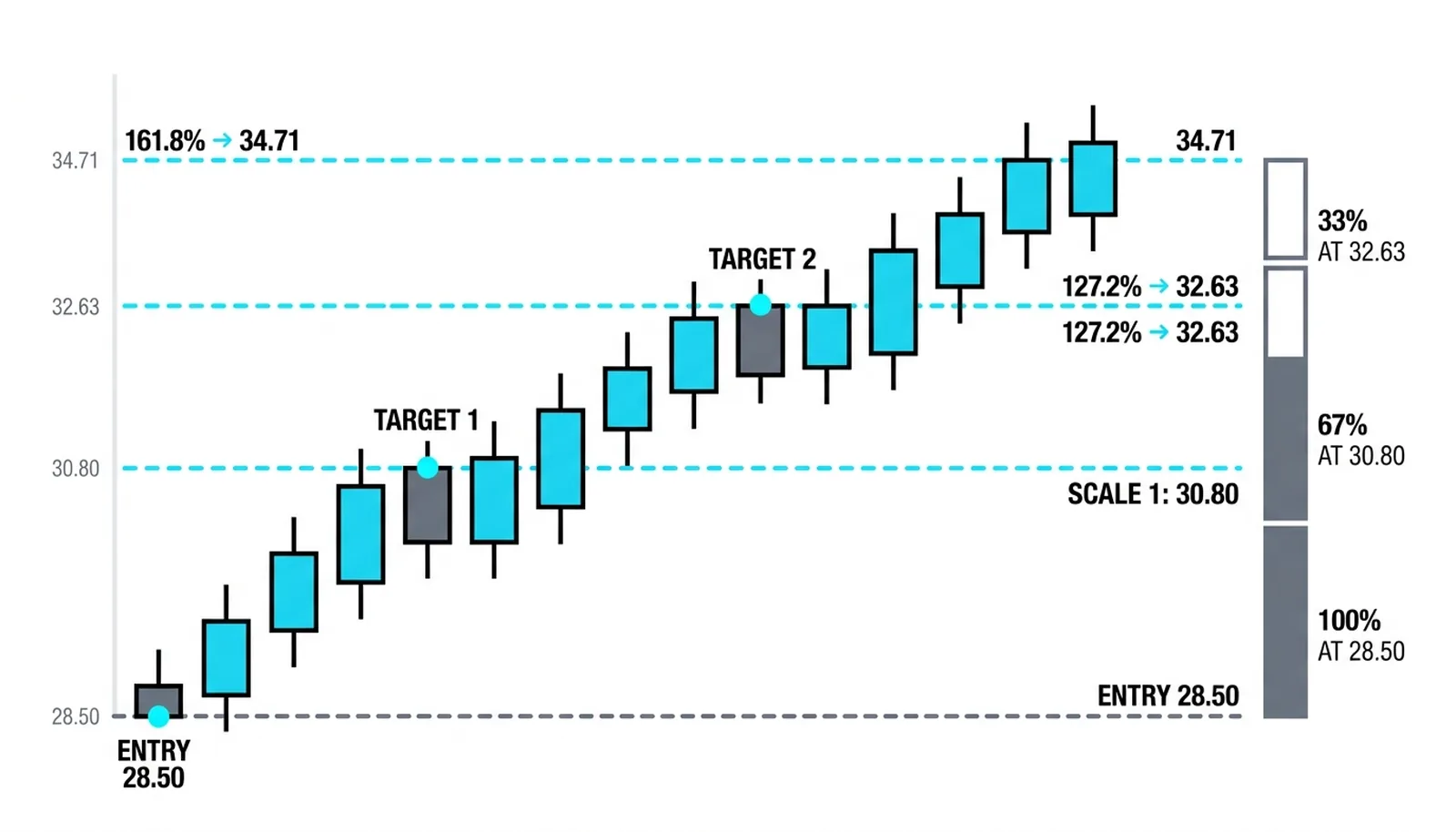
| Old high | 30.80 | Sell one third | Bank 2.30 just under the level; the break may still fail |
| 127.2 extension | 32.63 | Sell one third | Bank 4.13, about 4.1 times the risk; realistic runner target |
| 161.8 extension | 34.71 | Trail the final third | Trend territory; held only while evidence supports it |
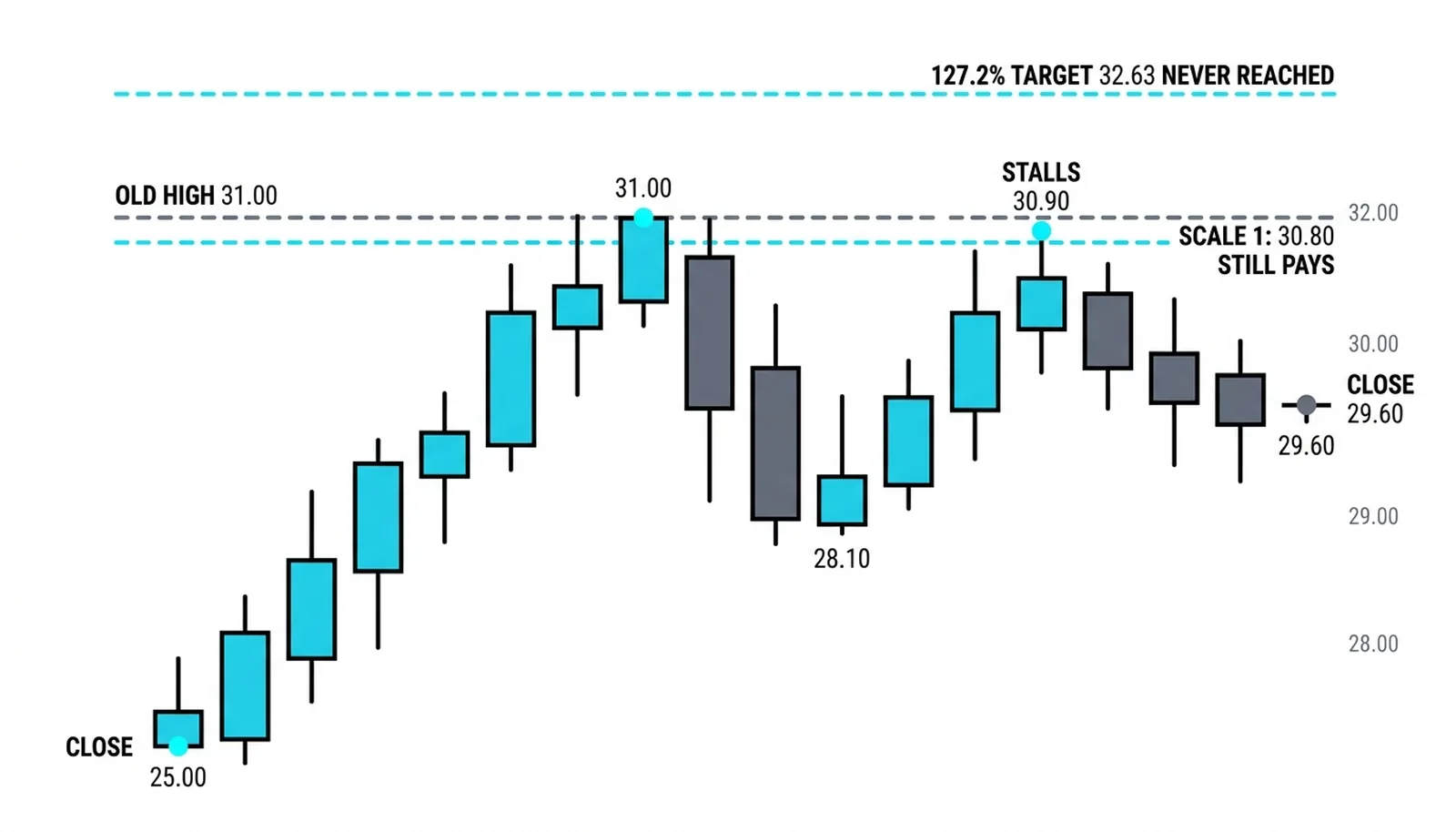
| Failed break | 30.90 stall, close 29.60 | Scratch the remainder | The first scale already paid; the trade closes net positive |
In the winning version, the first third pays 2.30 at 30.80, the second third pays 4.13 at 32.63, and the final third trails toward 34.71 with a stop that now sits above breakeven. The blended result beats any single exit the trader could have chosen in advance, because no single exit captures both the safe target and the stretch.
In the failed version, price stalls at 30.90, never reaches the extension, and closes back at 29.60. The trader who skipped the first scale watches a 2.40 open gain shrink toward nothing. The trader who took the crop's edge at 30.80 has 2.30 banked on a third of the position and scratches the rest. The extensions owed nothing. The plan worked precisely because it never assumed they would pay.
Extension Target Questions, Answered
How do you use fibonacci extensions for profit targets?
Draw the tool on the completed impulse leg, then treat the projections as an exit schedule rather than a single number. The old extreme is the first objective, the 127.2 is the realistic runner target, and the 161.8 and deeper levels are trail territory for the final fraction. Entries always come from the retracement side, never from the extensions.
Where should you take profits after a breakout?
The first scale belongs just under the old high, not at it, because orders cluster at the obvious level and the break can still fail. A fraction of the position comes off there before the breakout has proven anything. What happens after the break is confirmed belongs to the deeper projections.
How do you scale out of a winning trade?
Decide the fractions and the levels before entering, then execute mechanically: a third just under the old extreme, a third at the 127.2 extension, and the final third trailed toward the 161.8 while the trend keeps proving itself. Pre-committing the exits removes the in-the-moment negotiation that turns winners into round trips.
What if price never reaches the extension target?
That is the normal case for the deeper levels, and the plan already accounts for it. The early scales collect where certainty is highest, so a stall under the old high still closes the trade paid, and the trailing stop on the final fraction handles the exits the projections never get to. Extensions frame possibilities, not promises, and the scaling exists because the furthest targets are the least certain.
With the exit side of the tool in place, the next lesson covers the expansion, the cousin measurement that reads the next impulse from the same swing, and how it differs from the extension this lesson scaled.