Absorption: When Size Stops a Move
Absorption is what happens when a large player soaks up incoming market orders with hidden resting limits, so that heavy aggression produces no price movement at all. The tape screams in one direction, sellers or buyers hammering away, and price simply refuses to go anywhere. That refusal is the information.

The earlier lessons in this block gave you the tools: delta as the net score of aggression, cumulative delta across a session, and the per-bar charts that read every transaction. This lesson is about the phenomenon those tools exist to expose. Think of a goaltender facing a barrage, shot after shot absorbed, nothing getting through, and the shooters tiring while the rebounds start turning the other way. That is absorption in one picture.
Price that will not fall under record selling is a louder signal than any falling price.
The Mechanics of Soaking Size
A large buyer who wants 2,000 contracts cannot post a 2,000-lot bid. The moment that size shows on the book, every fast participant in the market steps in front of it, buying one tick higher and forcing the buyer to chase. Displaying size is donating information to the competition.
So the size hides. The resting order sits at the level as small chunks, perhaps 50 or 100 lots at a time, and each chunk replenishes automatically the moment it gets filled. Sellers hit the bid, the bid fills, and a fresh piece appears at the same price a fraction of a second later. The visible book looks thin. The actual capacity at that level is enormous.
The standard vocabulary for this is the iceberg order: a small visible tip with most of the volume submerged. Every major execution platform offers the order type natively, because every institution needs it.
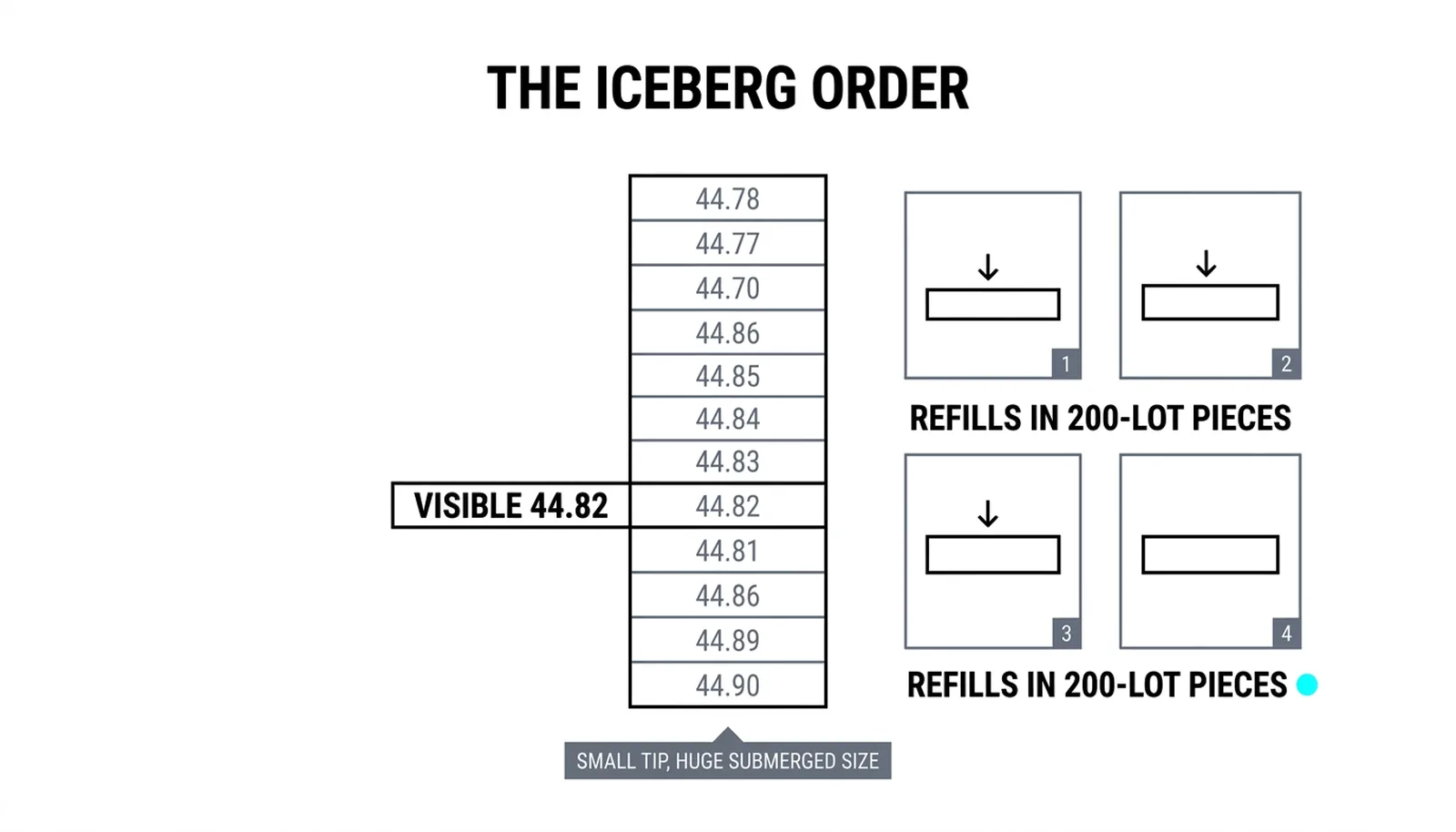
Order flow analysis calls absorption the most common form of market manipulation, and the label fits the structure. The absorbing player is deliberately showing the market a false picture, a level that looks like it should break, precisely so that aggressive traders keep feeding orders into it. The manipulation is not illegal in most implementations. It is simply size using camouflage, which is what size has always done.
The practical takeaway: you will rarely see absorption directly in the order book. You see it in the result, in the mismatch between effort and outcome. Heavy effort, no outcome. That mismatch is the entire signal.
The Signature on the Tape
The signature has three parts, and you want all three before you believe it.
First, heavy one-sided market orders. Sellers hitting the bid in size, bar after bar, with no pause. This shows up as strongly negative delta on each bar and a cumulative delta line falling hard.
Second, price that refuses to move. This is the core of the pattern. If 6,000 contracts of market selling cannot push price down more than a few ticks, someone is standing there taking every single one. Normal thin bids get chewed through in seconds. A bid that absorbs everything and holds is not a normal bid.
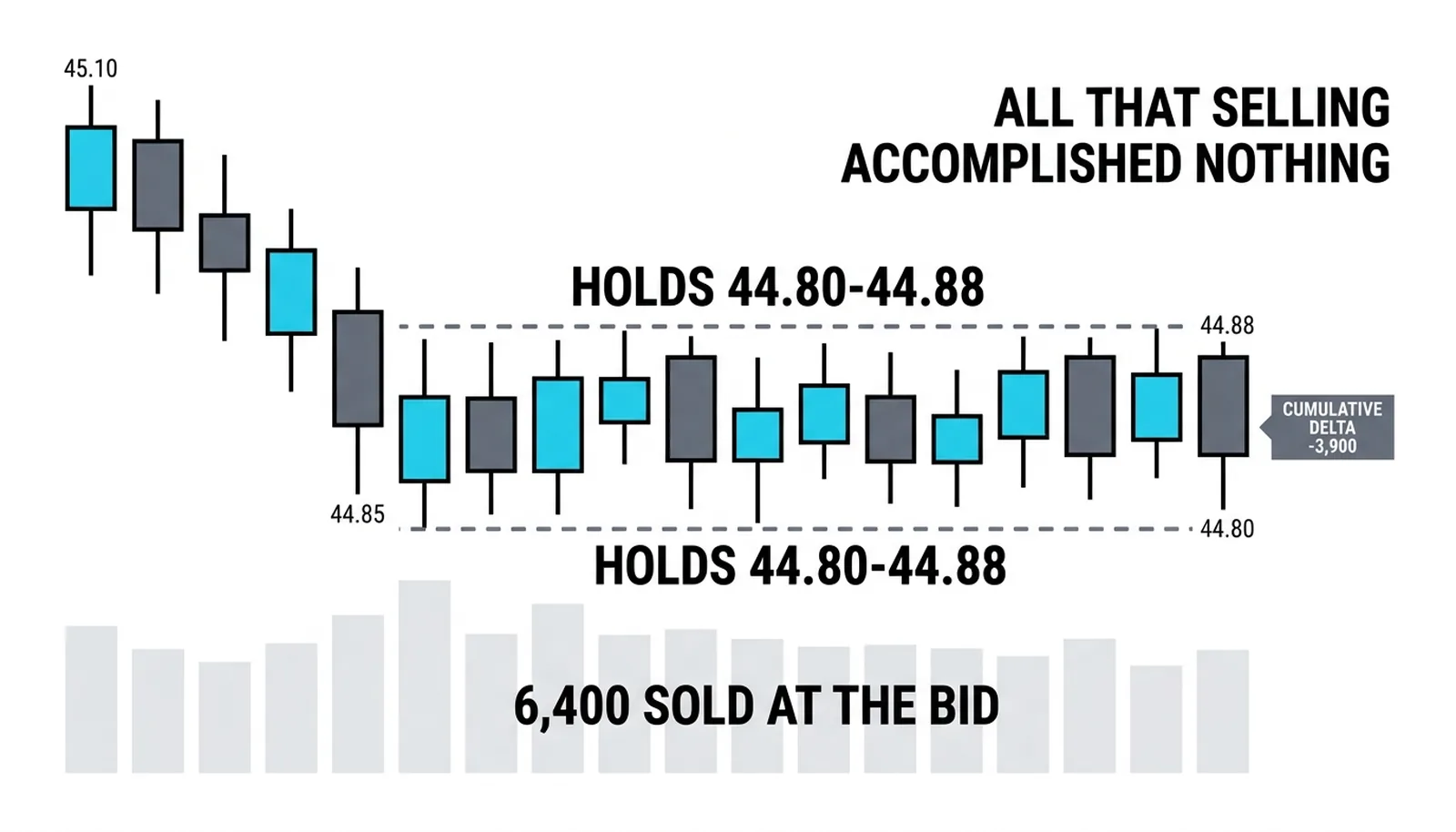
Third, the divergence at the extreme. Cumulative delta prints a new session low, often a record low for the day, while price holds above its own low or barely tags it. Retail traders look at the collapsing delta and see weakness to sell. The experienced read is the opposite: all that selling accomplished nothing, which means the sellers are the fuel, not the driver.
The mirror version works identically at highs. Aggressive market buying, cumulative delta at a record high, price pinned under a level that keeps refilling with offers. Every buyer running into a hidden wall of supply.
One caution that belongs in every discussion of this signature: flat price under heavy aggression can also just be slow, balanced trade. The wall you are crediting may not exist. Absorption is proven in hindsight more often than in the moment, which is why the disciplined read waits for the third act before committing.
Resolution and the Mirror Image
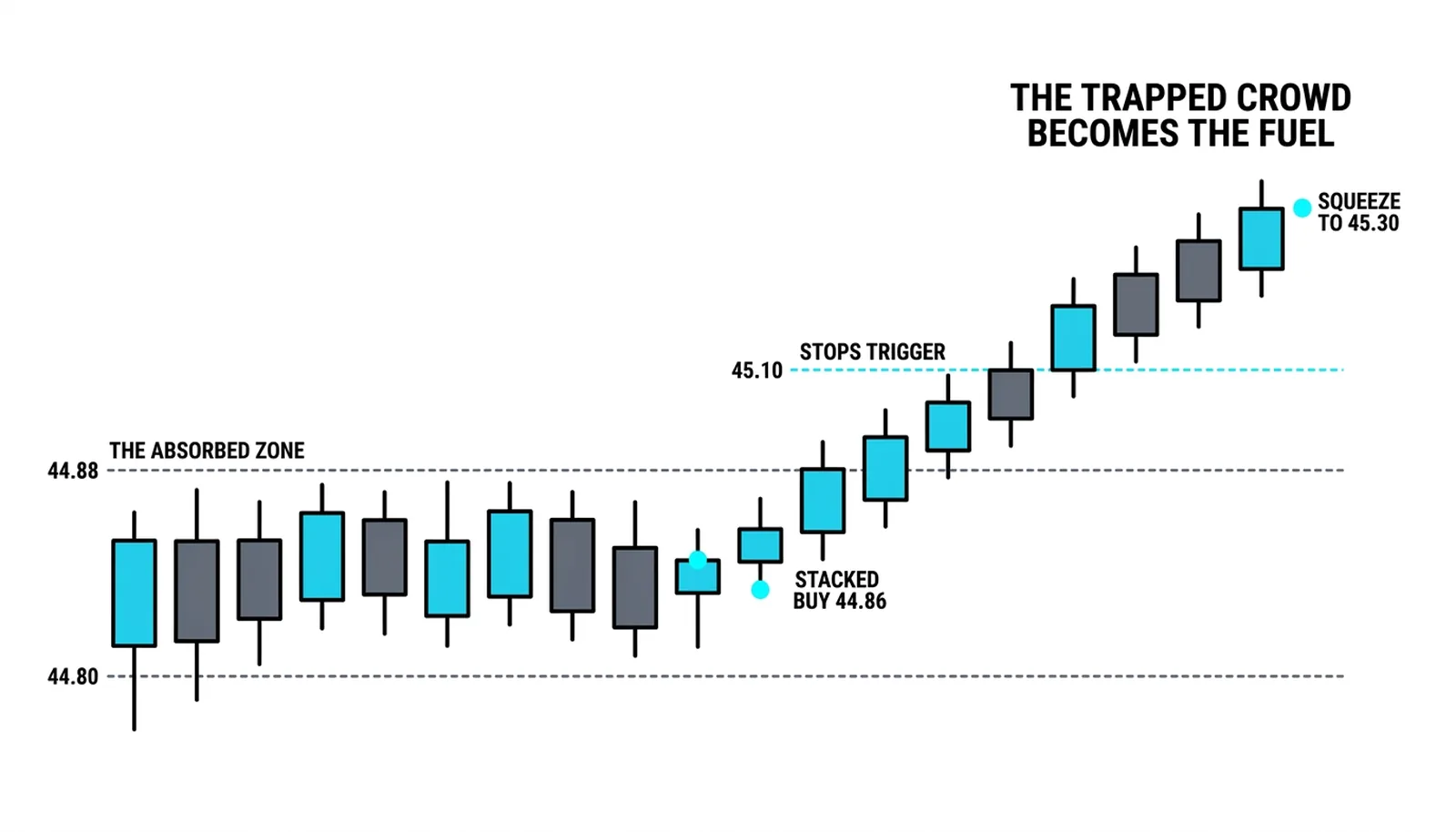
Absorption is a coiling event, and coils resolve. The aggressors eventually tire. They have sold thousands of contracts into a bid that never moved, their positions are underwater or flat, and the marginal seller runs out. At that point the side that was absorbing takes control, and the move often starts with a specific print: a stacked imbalance, several consecutive price levels showing lopsided buying on the bid-ask footprint, appearing right at the defended level.
Then the fuel ignites. The late sellers are short from the absorbed zone. As price lifts through the level they could not break, their stops trigger, and stop orders are market orders, fresh buying stacked on top of the absorber's own accumulation. The reversal moves fast precisely because the failed aggression leaves a crowd trapped on the wrong side.
One nuance most order flow material skips: absorption has a mirror image, distribution into strength. The same mechanics, opposite jersey. A large seller rests hidden offers at a high, eager buyers hit the ask with everything they have, cumulative delta screams to a record, and price goes nowhere. When the buyers tire, the hidden seller walks price down. The question on any given day is not whether absorption exists but who is absorbing whom.
This is why the full pattern matters more than any single element. Heavy aggression alone is noise. Flat price alone is boredom. Aggression plus flat price plus a resolution in the absorbed direction is the tradeable sequence. Two of three is a hypothesis. Three of three is a read.
The Sell-Off That Went Nowhere
The following numbers are invented, round, and purely illustrative.
A stock fades from 45.10 to 44.85 in the first hour of the session on ordinary selling. Nothing unusual. Then the barrage begins.
Over the next twenty minutes, 6,400 contracts sell at the bid. Cumulative delta falls to negative 3,900, a session extreme. And price trades between 44.80 and 44.88, refusing to break. On the footprint, a resting bid near 44.82 keeps refilling in 200-lot pieces no matter how often it gets hit.
Then a stacked buying imbalance prints at 44.86. Price lifts through 45.10, the level the whole fade started from, and the squeeze carries it to 45.30 as the late sellers' stops trigger in waves.
| Phase | The tape | Cumulative Delta | The read |
|---|---|---|---|
| Initial fade | 45.10 to 44.85, orderly selling | Drifting negative | Normal two-way trade, no signal |
| The barrage | 6,400 contracts sold at the bid, price pinned 44.80-44.88 | Falls to −3,900 | Maximum effort, zero result; hidden size at work |
| The refill | 200-lot bid at 44.82 replenishes after every hit | Flat at the lows | Iceberg behavior; the wall is real, not luck |
| The turn | Stacked buying imbalance at 44.86, price through 45.10 to 45.30 | Reverses sharply higher | Absorber takes control; trapped sellers fuel the squeeze |
Read each stage on its own terms. The flat price against record selling said the sellers were being absorbed, not accommodated. The refill pattern said the defense was deliberate and sized, because random resting bids do not replenish identically for twenty minutes. The stacked imbalance was the confirmation, the moment the absorbing side stepped out of defense and into attack.
Notice what the example did not require. No prediction during the barrage. No front-running the wall. The tradeable information arrived in sequence, and the confirmation arrived before the bulk of the move, not after it.
Absorption, Answered
What is absorption in order flow?
Absorption is a large player quietly filling incoming market orders with hidden resting limit orders, so heavy buying or selling produces little or no price movement. The aggression is real, the size absorbing it is real, and only the flat price reveals both.
What are iceberg orders?
Iceberg orders are large resting orders that display only a small slice of their total size and automatically refresh that slice each time it fills. They exist so institutions can work big positions without showing the market a target to front-run.
How do you spot absorption on the tape?
Look for the three-part signature: heavy one-sided market orders, price that refuses to move in the direction of that aggression, and cumulative delta printing an extreme while price holds. A refilling bid or offer at one level strengthens the read, and a stacked imbalance resolving in the absorbed direction confirms it.
Does absorption always reverse the move?
No. Sometimes the wall eventually breaks, and when it does the break is often violent because the absorbing side pulls its orders. Absorption tilts the odds toward reversal; it never guarantees one, which is why the confirmation stage matters more than the suspicion stage.
The next lesson in this block steps from single-level events to the wider session: how exhaustion, unfinished auctions, and failed moves at extremes complete the order flow picture you have been building since delta.