The ABCD: Foundation of All Harmonics
The abcd pattern is the foundation the whole harmonic family stands on: four points and two legs, with one rule and one rule only, symmetry. Point A starts the first leg, B ends it, C is the pullback, and D completes the second leg, which repeats the first. Every named pattern a trader will ever measure, from the bat to the gartley, contains this shape inside it, and the measuring habits the family demands begin here.

Think of the drum's two-beat: the first stroke and the second matching, the simplest rhythm every longer rhythm is built on top of. That is the idea. The pattern lessons earlier in this level used five labeled points and a zone; this lesson strips the shape down to four points, counted without an X, measured with one rule instead of three. What changes is not the geometry but the strictness, and the strictness is the story.
Four Points, One Rule
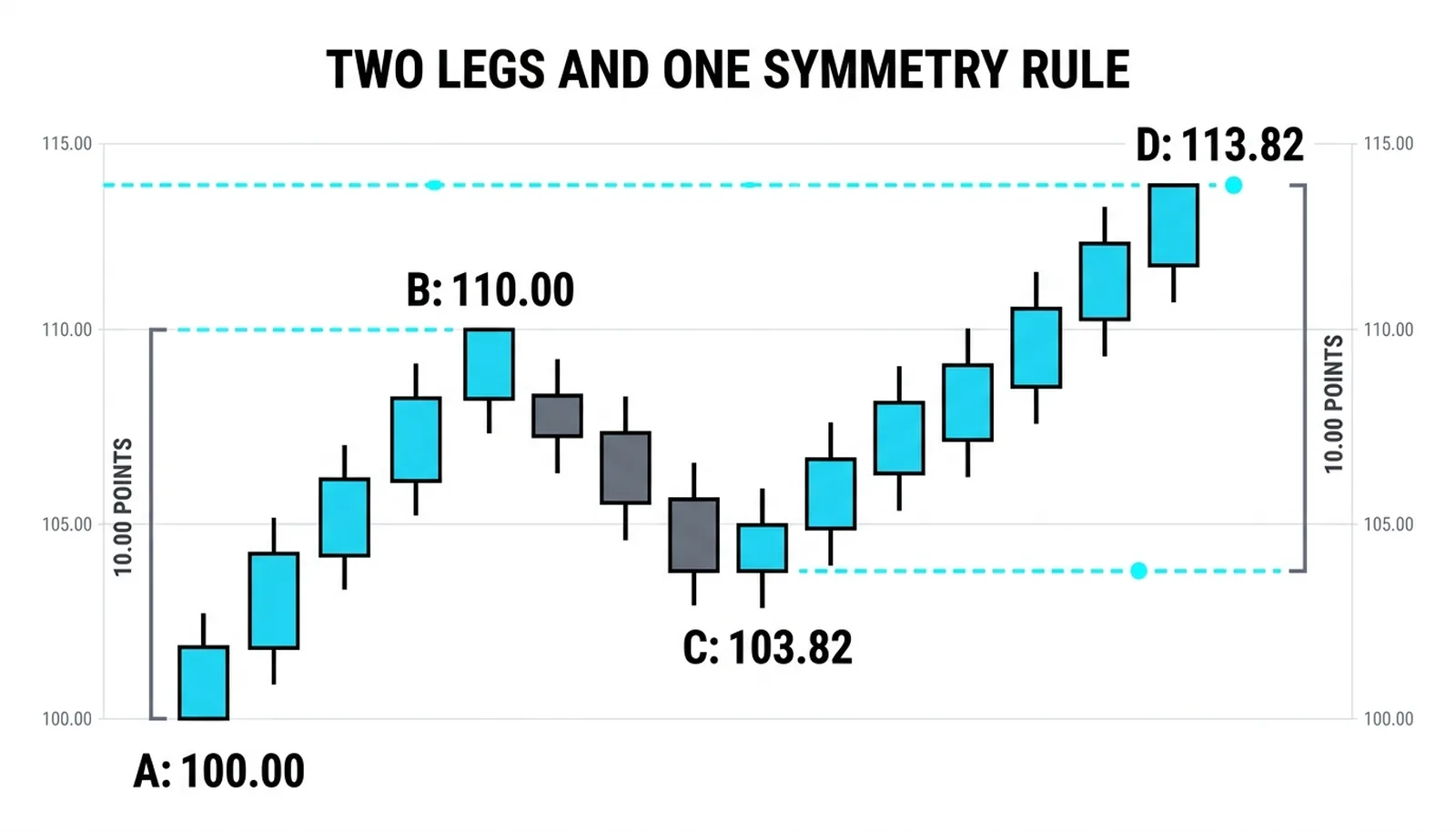
A to B is the first leg. It can point up or down; the logic is identical in both directions. What matters is that it is a clean, committed move, the kind of leg that reads as one decision by the market rather than a drift.
B to C is the pullback. Price retraces part of the first leg, commonly between 38.2 and 88.6 percent of AB, with 61.8 percent the classic reading. A shallow pullback suggests the first leg still has force behind it. A deep one suggests the counter-move is serious. Both can still complete the shape; the depth changes the quality, not the label.
C to D is the second leg, and here sits the one rule: symmetry. In the basic form, CD equals AB in price. If A to B traveled 10.00 points, C to D should travel 10.00 points. In the stronger form, CD extends AB by the 1.272 projection, which marks a second leg that has outrun the first and is completing into exhaustion. Either reading gives the trader a specific price where the pattern finishes, and that specificity is the entire value of the shape.
The trade is the completion at D, entered on the reversal the symmetry argues for. A trader does not buy because the shape looks pleasant. A trader buys at D because the second leg has matched the first, the move is mathematically spent, and the risk can be placed a short distance beyond the completion point. Small risk, defined location, measurable target. That is the appeal.
One blunt sentence belongs here: without the symmetry measurement, this is not a pattern, it is a doodle.
Why Every Pattern Contains It
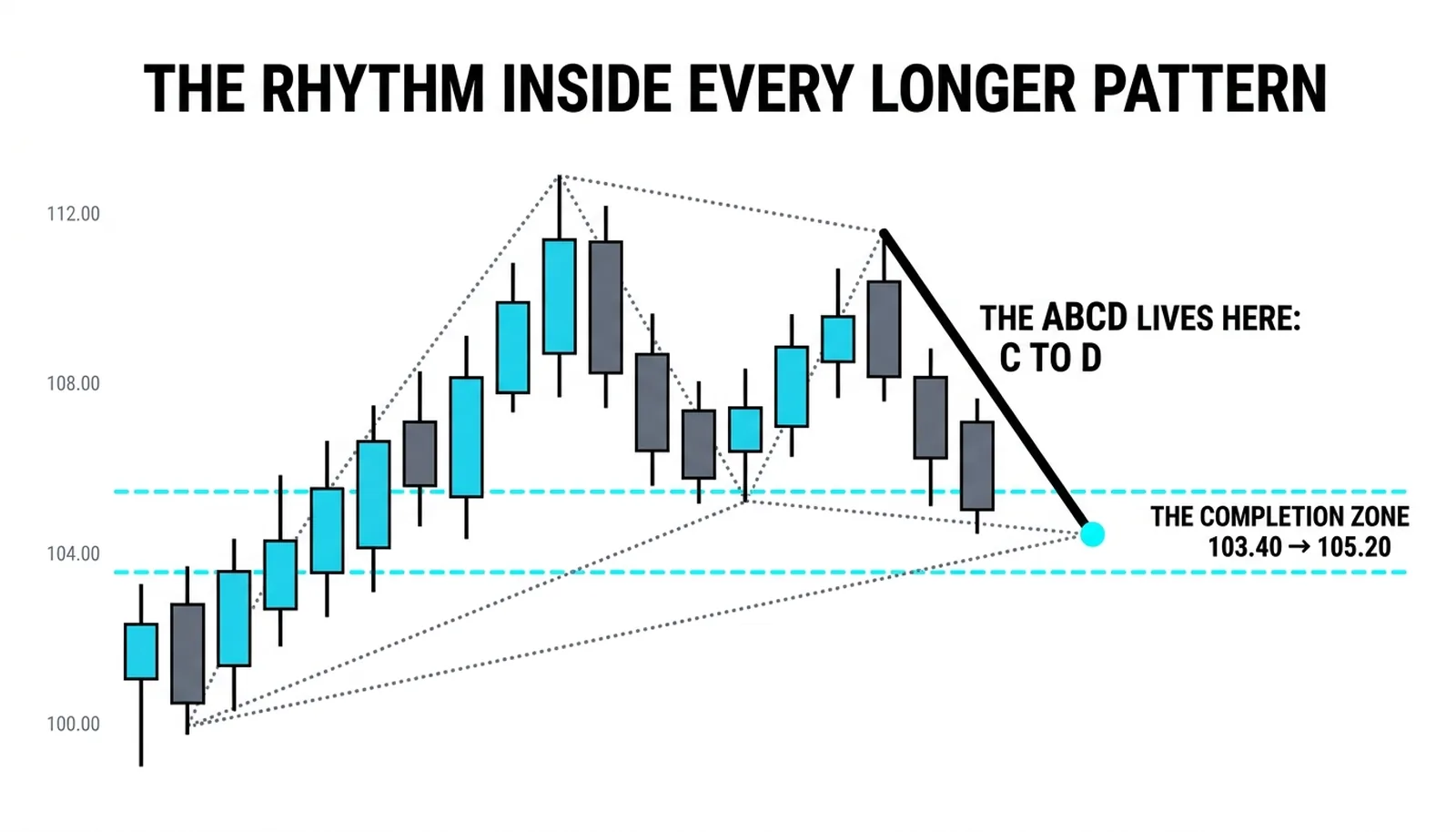
Open any five-point harmonic and look at its final leg. The C-to-D leg of a bat is an ABCD completing at the zone. The same holds for the gartley, the crab, and every other named shape in the family. The five-point patterns are four-point patterns wearing an extra point at the front, with ratios layered over the top to filter which completions deserve attention.
This is where the habit of measuring projections begins. The five-point patterns ask the trader to project one leg against another, to check whether a completion lands where several measurements agree. That skill is learned on the ABCD first, where there is only one projection to make and one number to check. Harmonic trading doctrine built much of its framework on this discipline of precise measurement, and it has been consistent that the measuring is what separates a pattern from a drawing.
Now the honesty, because it matters more than the geometry. The four-point shape has no gate of its own. Any pullback between the classic marks can be drawn as an ABCD, which means a trader can find one on almost any chart, in almost any leg, at almost any time. A shape that appears everywhere predicts nothing by itself.
That looseness is exactly why the named patterns added gates. The bat demands specific retracements at specific points. The gartley demands its own ratios. Each gate throws away drawings that technically fit the four-point shape but fail the stricter test. The shape gives structure to the eye; the gates give it an edge. A trader who understands the ABCD understands what the gates are protecting against, which is the over-eager pencil of the person holding the ruler.
So the working rule is this: the ABCD is the vocabulary, the named patterns are the grammar. Learn the vocabulary perfectly, then let the grammar decide which sentences are worth trading.
The Symmetry at 113.82
A hypothetical illustration, round numbers, no real instrument. Suppose A stands at 100.00 and B at 110.00. The first leg is 10.00 points of clean advance.
C pulls back to 103.82. That is a retracement of 6.18 points against a 10.00 leg, the classic 61.8 percent reading. The pullback is orderly, the candles are smaller than the advance, and the structure of the first leg is intact. This is a quality C.
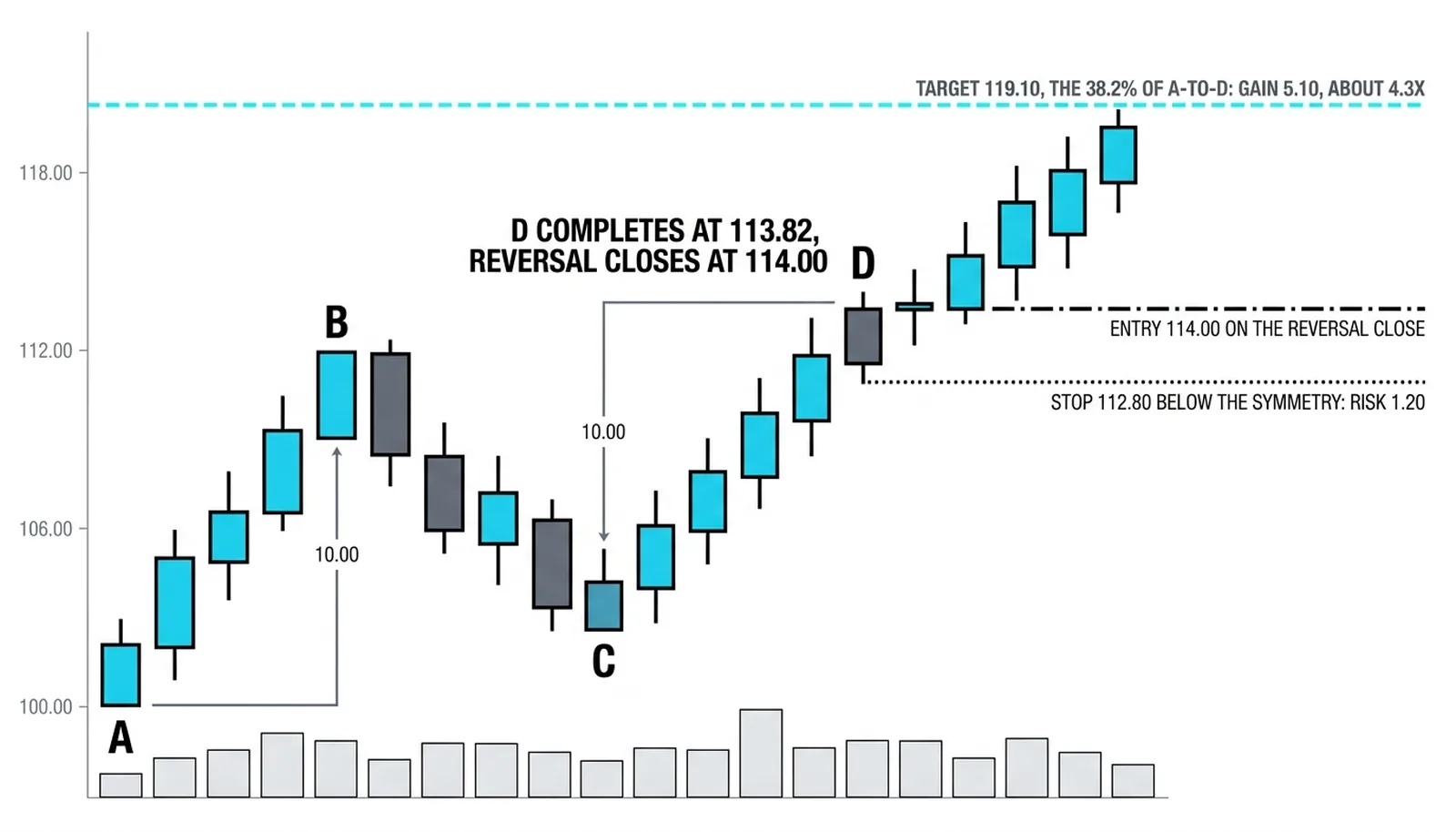
D completes the symmetry at 113.82: from 103.82, a second leg of exactly 10.00 points, matching AB to the tick. Now the trade has a location. A reversal candle forms and closes at 114.00, confirming the completion is holding. The long is taken at 114.00.
The stop sits at 112.80, just below the completion point, risking 1.20. The reasoning is mechanical: if price trades through D by any real margin, the symmetry is broken and the reason for the trade is gone. There is nothing to hold.
The first target is 119.10, the 38.2 percent retracement of the full A-to-D leg. From the entry at 114.00, that is a gain of 5.10 against a risk of 1.20, roughly 4.3 times the risk. The asymmetry comes from the geometry: the trader is buying the exact point where the measured move ends, so the stop can be tight while the reaction has room.
Now the failed version, because it teaches more than the winner. Suppose instead that price closes at 112.50, below the symmetry. The second leg has overrun the first. The pattern is dead, and the correct response is no trade, or an immediate exit if one was taken early. The failure is cheap precisely because D was defined.
The deeper honesty: on that same chart, a trader could have drawn the pullback differently, placing C at 104.20 instead of 103.82, producing a different D entirely. Both drawings would look plausible. The shape alone does not decide anything. The retracement quality of C and the completion quality of D are what make one drawing tradable and the other a guess. Measure carefully, demand the reversal confirmation, and let the stop do its job when the symmetry breaks.
| Point | Leg It Ends | Ratio That Defines It | Example Price |
|---|---|---|---|
| A | Start of leg one | The anchor of the measurement | 100.00 |
| B | First leg (A to B) | The leg every projection copies | 110.00 |
| C | Pullback (B to C) | 38.2 to 88.6 percent of AB, 61.8 classic | 103.82 |
| D | Second leg (C to D) | CD equals AB, or 1.272 of AB | 113.82 |
ABCD Questions, Answered
What is the abcd pattern?
It is a four-point, two-leg structure where the second leg repeats the first. A to B is the initial move, B to C is the pullback, and C to D completes the pattern by matching the first leg in price. It is the simplest harmonic shape and the one every other pattern in the family is built around.
What is the symmetry rule?
The rule is that leg CD equals leg AB in price, or in the stronger form extends it by the 1.272 projection. Symmetry gives the trader a specific completion price for D, which is what makes the pattern tradable: a defined entry area, a tight stop just beyond it, and a measured reaction to target.
How is the abcd different from other harmonics?
It has four points instead of five and one rule instead of several. The named patterns add a fifth point and strict ratio gates at every leg, filtering out weak drawings. The ABCD accepts any pullback within the classic retracement band, which makes it more common and less selective. It is the structure underneath the stricter shapes, not a replacement for them.
When does the abcd fail?
It fails when price closes beyond the completion point, breaking the symmetry. A close below D in a bullish setup means the second leg has overrun the first and the measured move is wrong. The failure is cheap when the stop sits just past D, which is why the completion point must be measured precisely and never estimated by eye.
Next in this level, the four-point shape grows its fifth point: the gartley, where the ABCD becomes the final leg of something stricter, and the gates the family was built on finally show their teeth.