PSY, BC, AR, ST: The Distribution Events
Distribution opens with four named events, and they arrive in order: preliminary supply, the buying climax, the automatic reaction, and the secondary test. These are the checkpoints that open a Wyckoff distribution range, and together they ask one question four different ways: has the buying actually ended. A trend does not end on a single bar. It ends in stages, and each stage leaves a signature in price and volume that you can read if you know the sequence.

Think of a wedding toast at the best moment of the night. The room is at its loudest for the first toast, there is a strange quiet right after it, and the second toast never matches the first. Tops behave the same way. The excitement peaks, the energy drains, and the attempted comeback tells you whether anything is left.
The previous lessons covered the full distribution schematic and the bottom-side sequence, where the selling climax, automatic rally, and secondary test mirror everything you are about to read upside down. This lesson zooms into phase A of the distribution range alone. No re-teaching of the five phases or the spring: just the four events, in order, with the shape, the volume, and the proof each one carries.
Preliminary Supply: The First No
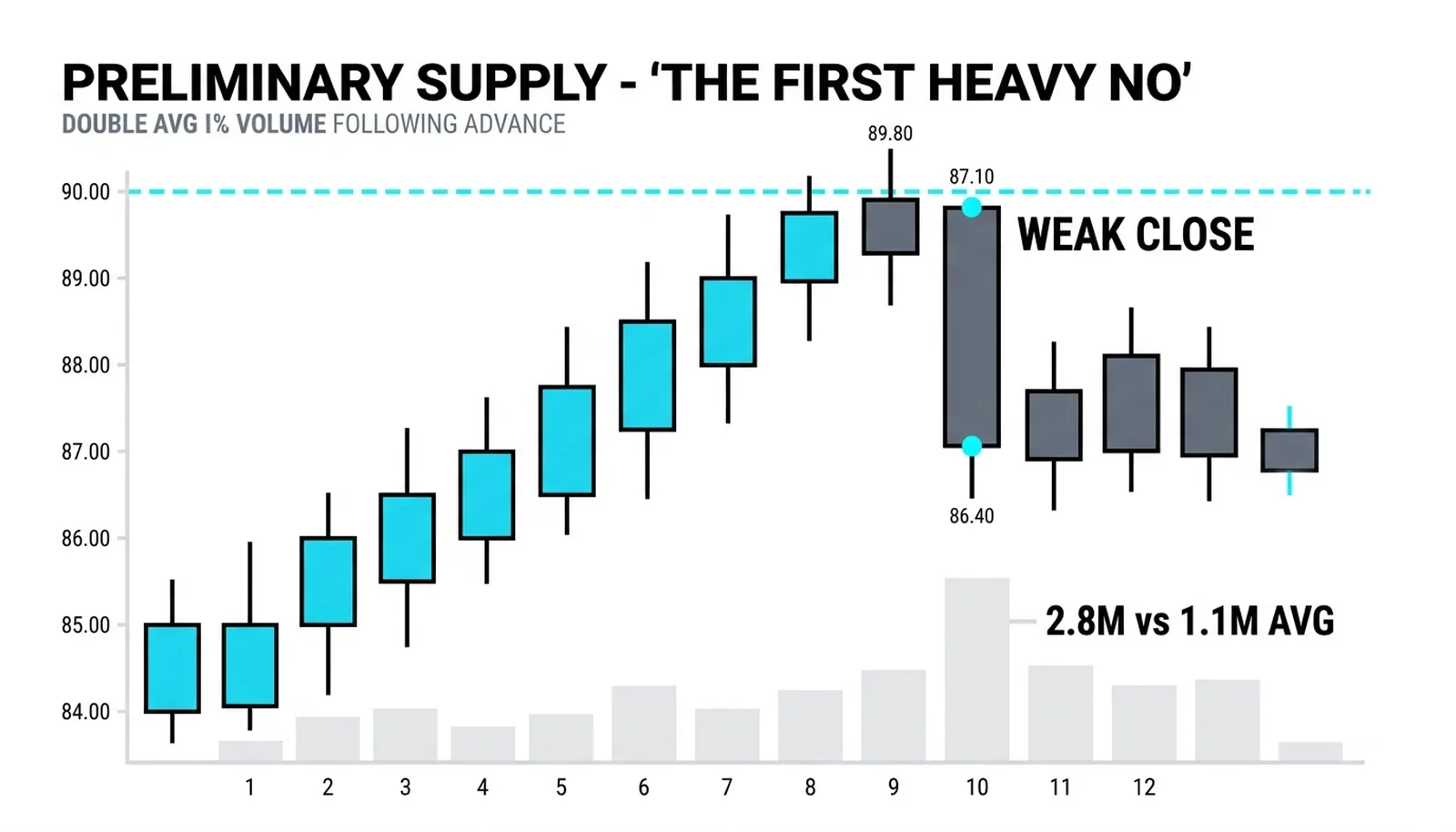
Preliminary supply is the first sign the advance is being met. It shows up as a heavy down bar, or a short cluster of them, on expanding volume, right in the middle of a healthy markup. Price was rising comfortably, and then it was not.
What you are seeing is someone large unloading into strength. The rally gives them liquidity. Eager buyers are everywhere, so a big seller can distribute shares without pushing the price down too far, until the size of the selling briefly overwhelms the demand. The bar closes weak, the volume is the heaviest in weeks, and the advance stalls.
Call it the first no.
But the no is only tentative. One heavy down bar does not end an uptrend. Strong trends absorb single supply shocks and carry on to new highs all the time. The classic accumulation and distribution framework treats preliminary supply as a warning shot, not a confirmed top. It tells you to stop assuming the trend is safe and start watching for what comes next. If nothing follows, the trend resumes; if a climax follows, the sequence has begun.
The Buying Climax: Euphoria Spent
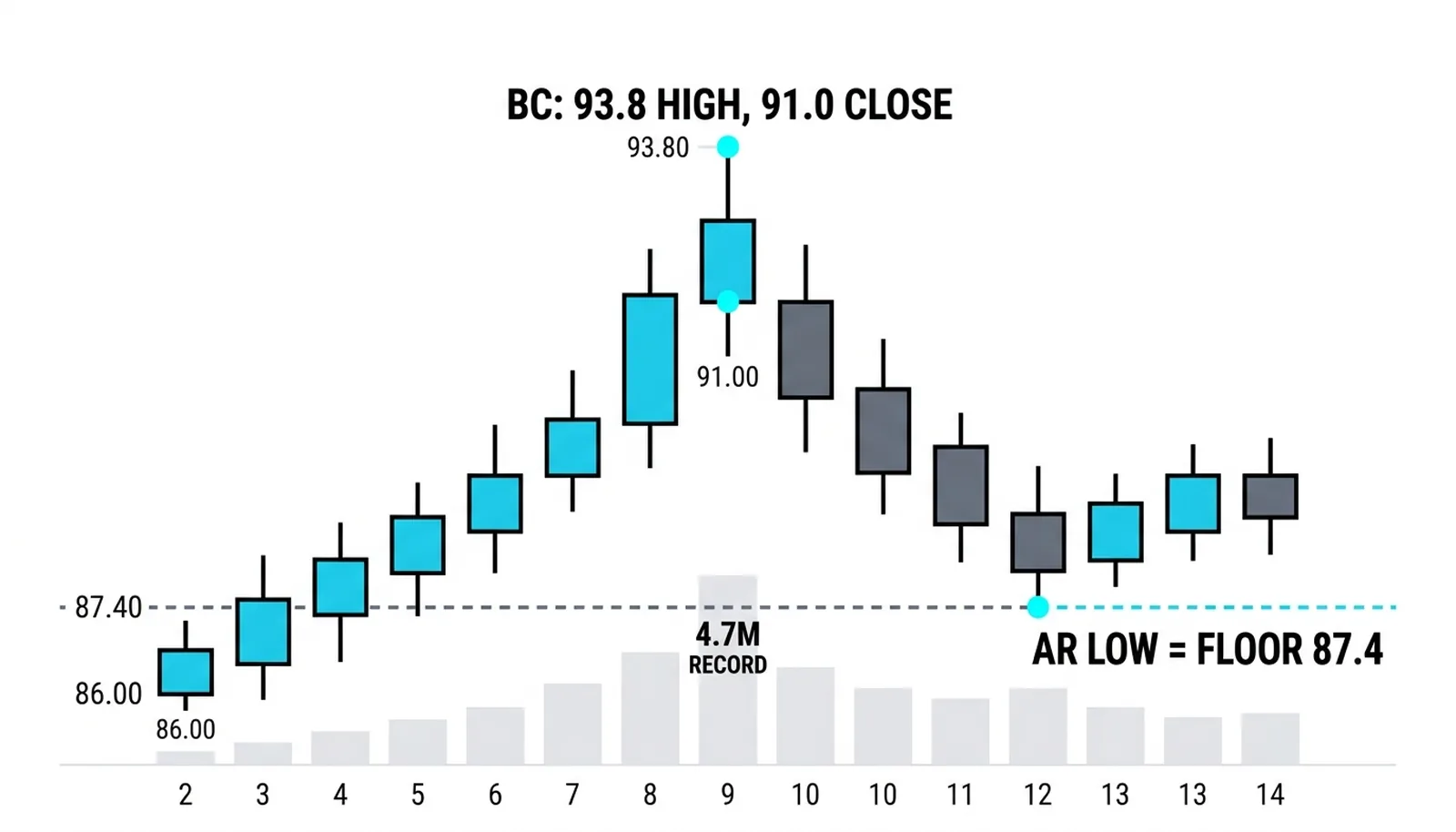
The buying climax is the euphoric flush upward. Price makes a wide-spread push to a new high on the heaviest volume of the entire advance, then closes back near its open, leaving a deep upper wick. The bar looks like a celebration and reads like exhaustion.
The anatomy matters. The wide spread up shows how far the crowd chased. The record volume shows how many of them chased at once. The close near the open shows that by the end of the session, every one of those late buyers was underwater, because supply hit the bid hard enough to erase the whole gain. The upper wick is the signature of professional selling into public buying.
It takes a crowd to print one of these bars; a quiet market cannot produce record volume at new highs. The climax requires maximum public participation, the moment everyone who wanted to buy has finally bought. That is why it marks exhaustion: once the last buyers are in, nobody is left to push price higher.
One naming note before you go further. Some volume-price authors, volume price analysis among them, name climaxes from the insiders' side, so a selling climax in those books is this same euphoric top bar. The mechanics are identical and only the labels differ. The full naming trap was covered in the accumulation sequence lesson.
The Automatic Reaction: Setting the Floor
The automatic reaction is the slide off the climax high. Price falls for one or several sessions, and the fall needs no fresh selling conviction. It happens because demand vanishes. The buyers spent themselves at the climax, and with no bids underneath, price drifts down under its own weight.
That is why the Wyckoff method calls it automatic. A ball thrown straight up comes down on its own; nobody has to pull it, and after a buying climax, neither does the decline. Gravity, not aggression.
The low of this slide becomes the floor of the new range. From this point forward, the automatic reaction low is the line you watch. Everything that follows in the distribution, the tests, the rallies, the eventual breakdown, is measured against that floor and the climax high above it. The trading range now has both boundaries, and the rest of phase A confirms them.
The Secondary Test: Measuring the Buyers
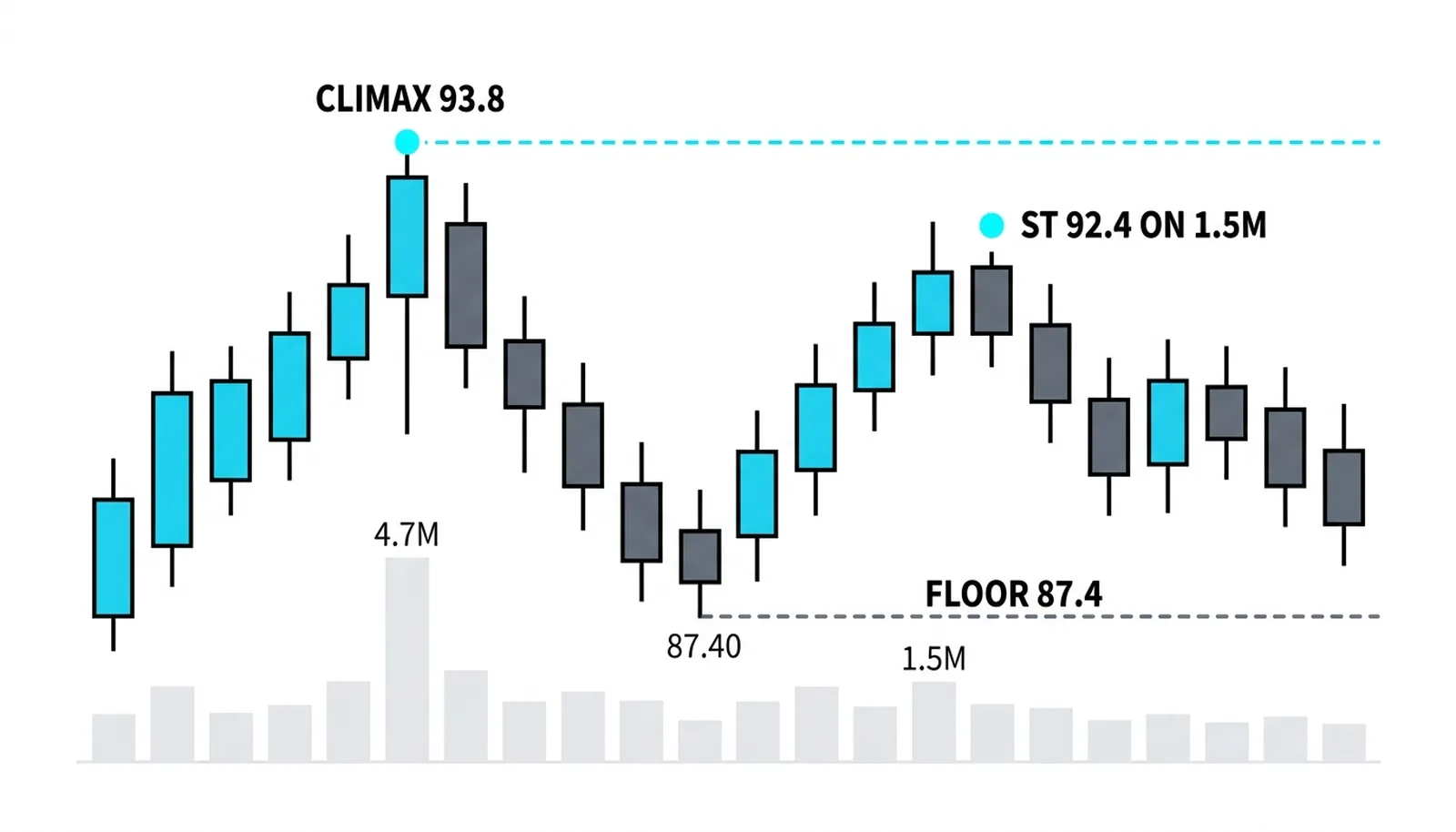
The secondary test is the quiet recovery toward the climax high. Price climbs back up from the reaction low, but on clearly lower volume than the climax carried. This is the market asking its question for the fourth time: are the buyers still here.
A test that stalls under the high confirms they are gone. Price approaches the old peak, hesitates, and rolls over on thin volume. The crowd that chased the climax does not return with the same force, because the late buyers are trapped and the fresh buyers saw what happened last time. The lower-volume failure under the high is the proof that demand has genuinely dried up rather than paused.
Now consider the opposite. If price reclaims the climax high on heavy volume and holds it, the whole distribution read collapses. A strong reclaim means the supply at the top was absorbed and demand is still in control. The top needs rebuilding, and the campaign is delayed. This is why the secondary test is a measurement, not a prophecy: you wait for the result instead of assuming it.
Be honest about the messiness too. Real tops shuffle these events, skip them, or repeat them. Sometimes two buying climaxes print before the reaction; sometimes the secondary test never happens and price breaks the floor directly. The sequence describes how tops tend to open. It is not a form to fill in.
Reading the Four Together
Each event asks the same question from a different angle. Preliminary supply asks whether anyone is selling into the strength. The buying climax asks whether the crowd has spent itself. The automatic reaction asks whether demand can hold price up without effort. The secondary test asks whether the buyers can come back at all.
Four checkpoints, four pieces of evidence, one conclusion building. By the end of the secondary test, you have watched supply appear, demand exhaust itself, price fall on nothing, and the recovery fail on nothing. That is a coherent story told by four independent checkpoints, which is exactly why the Wyckoff sequence has survived for a century.
One Top, Four Readings
A hypothetical stock climbs from 60 to 90 over three months on 1.1 million shares a day. The trend is clean until it is not.
At 90, the advance prints a down bar from an 89.8 open to an 86.4 low, closing at 87.1 on 2.8 million shares. That is preliminary supply: volume more than double the average, a weak close, the first heavy no. What would invalidate it? A quick recovery to new highs on strong volume within a few sessions.
The recovery comes, and then some. Price pushes to a 93.8 high on 4.7 million shares but closes at 91.0, just above the 90.6 open. The 2.8-point upper wick tells the story: the crowd chased, the sellers fed them, and the gain evaporated by the close. That is the buying climax. A close near the high instead of the open would have invalidated it.
Then the automatic reaction. Price slides to 87.4 over two sessions on 2.0 million shares, demand simply absent, and that 87.4 print becomes the range floor. Eleven sessions later, the secondary test reaches 92.4 on only 1.5 million shares and stalls under the 93.8 high. Buyers gone. The range from 87 to 94 is born, and the distribution has begun.
| Event | Price and Volume Signature | What It Proves | What Would Invalidate It |
|---|---|---|---|
| Preliminary Supply | Down bar 89.8 to 87.1 close, low 86.4, on 2.8M vs 1.1M average | Supply is actively meeting the advance | Fast recovery to new highs on strong volume |
| Buying Climax | High 93.8, close 91.0 near the 90.6 open, on 4.7M record volume | Public buying is exhausted; professionals sold into it | A close near the high with follow-through |
| Automatic Reaction | Slide to 87.4 over two sessions on 2.0M | Demand has vanished; the range floor is set at 87.4 | Heavy-volume decline, which signals aggressive new selling instead |
| Secondary Test | Rally to 92.4 on 1.5M, stalling under the 93.8 high | Buyers cannot return with force; distribution confirmed | Reclaim of 93.8 on heavy volume, held |
The Distribution Events, Answered
What is preliminary supply in Wyckoff analysis?
Preliminary supply is the first heavy down bar, or short cluster of them, on expanding volume during an advance. It shows large sellers unloading into strength, and it serves as the opening warning that the uptrend is being met, not proof the trend is over.
What is a buying climax in trading?
A buying climax is a wide-spread push to a new high on the heaviest volume of the advance that closes back near its open, leaving a deep upper wick. It marks the moment maximum public buying meets maximum professional selling, and the crowd's demand is spent.
What is an automatic reaction at a market top?
The automatic reaction is the decline that follows the buying climax, caused by the absence of buyers rather than fresh selling pressure. Its low sets the floor of the new trading range, the boundary everything after is measured against.
What does a secondary test show after a buying climax?
The secondary test is a lower-volume rally back toward the climax high. A stall under the high confirms demand is gone and the distribution is underway, while a heavy-volume reclaim of the high invalidates the top read entirely.
Once the secondary test confirms the range, the story moves into its middle stretch, and its sharpest event waits there: the upthrust after distribution, one final trip above the highs to trap the last believers. That is where the next lesson picks up.