Trading With VWAP as a Dynamic Level
For a large slice of professional money, the trading day gets graded against one line. Beat the session's volume weighted average price on your fills and the desk did its job; miss it and the desk bled the fund's return, whatever the chart looked like. That grading habit is the first reason VWAP matters. The second reason is what the line does on a chart, because a price that holds the day's fair value also acts as a level.

Both jobs come from the same construction covered in the VWAP breakdown: cumulative typical price times volume, divided by cumulative volume, reset each session. This lesson is about using the line, not building it, and the session context matters, so keep the trading sessions in mind as you read.
The Benchmark Job: Grading the Fills
Execution desks slice big orders across the day precisely so they can measure themselves against VWAP. The arithmetic is simple. If a fund's average purchase price for the day is 101.10 and the session closed with VWAP at 101.40, the desk bought 0.30 below where the market's volume-weighted business actually happened, on two million shares. That is 600,000 dollars of value added before the position even moves. The same calculation runs in reverse for sellers.
The anchored VWAP method documents how the same logic extends beyond a single day: fund managers benchmark their year against the VWAP anchored to the first trading day of January, and a manager who owns stocks below the year-to-date anchored line has beaten the fair value of the market so far. That is why the year-to-date anchored VWAP often acts as support for strong stocks. Institutions waiting to add do their waiting at the line where their own grade gets computed.
The grading works for self-directed traders too, and a concrete pair of trades shows it. Two traders buy the same stock on the same day. The first buys the gap open at 102.50. The second waits and buys the reclaim of VWAP at 100.20. Both sell the close at 101.80. The first trader loses 0.70 a share. The second makes 1.60 on identical entries in identical direction, and the whole difference is where each fill sat relative to the day's weighted fair price. Multiply either result by a few hundred shares a week and the benchmark stops being an institutional nicety.
It also explains a pattern worth noticing in your own results. Entries taken far from VWAP on impulse tend to carry worse risk positions than entries taken at the line, because the line is where the market itself has agreed to do business. The benchmark and the level are the same fact seen from two sides.
The Level Job: Three Day Types, Three Behaviors
On an intraday chart the line's behavior sorts sessions into readable types, and each type has its own playbook.
| Day type | VWAP behavior | The read |
|---|---|---|
| Trend up | Price rides above the line; pullbacks land on it and hold | Buyers in control; dips to the line are watched for entries |
| Trend down | Price rides below; rallies die at the line | Sellers in control; bounces to the line are watched for exits or shorts |
| Balance | Price crosses the line repeatedly, orbiting it | No control; the line is fair value, not a launchpad |
The trend-up case is the one worth studying frame by frame, because the first pullback to VWAP is where the patient money waits.
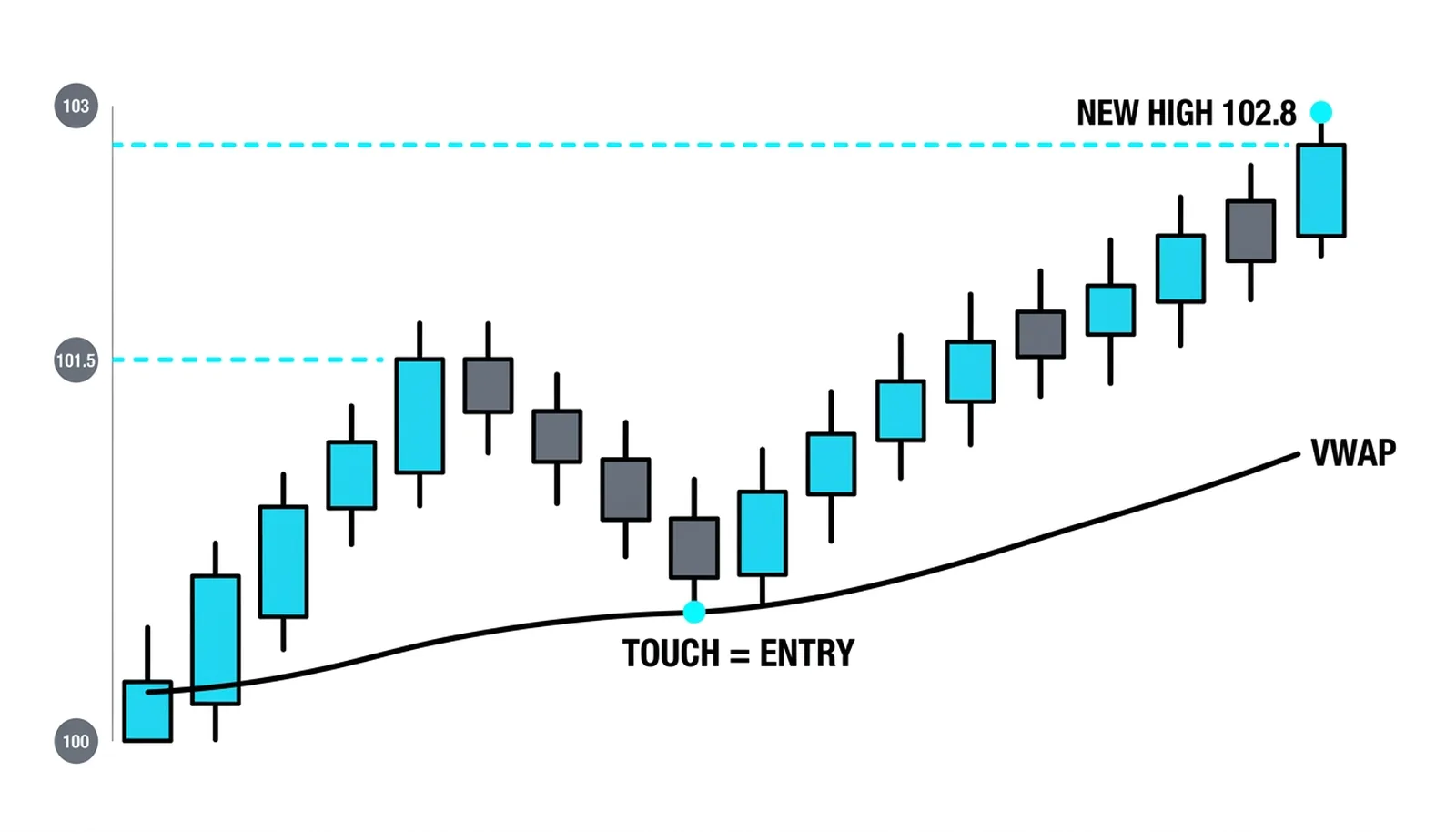
Price opened, pushed, and then handed back part of the gain. The pullback low landed within a few cents of the line, and the next leg carried on to new highs. Traders who bought the open paid up and sat through the giveback. Traders who waited for the touch entered where the day's own weighted average said fair value was, with a stop that only needs the line to fail.
The mirror image runs on down days, and it is where sellers use the line as a ceiling.
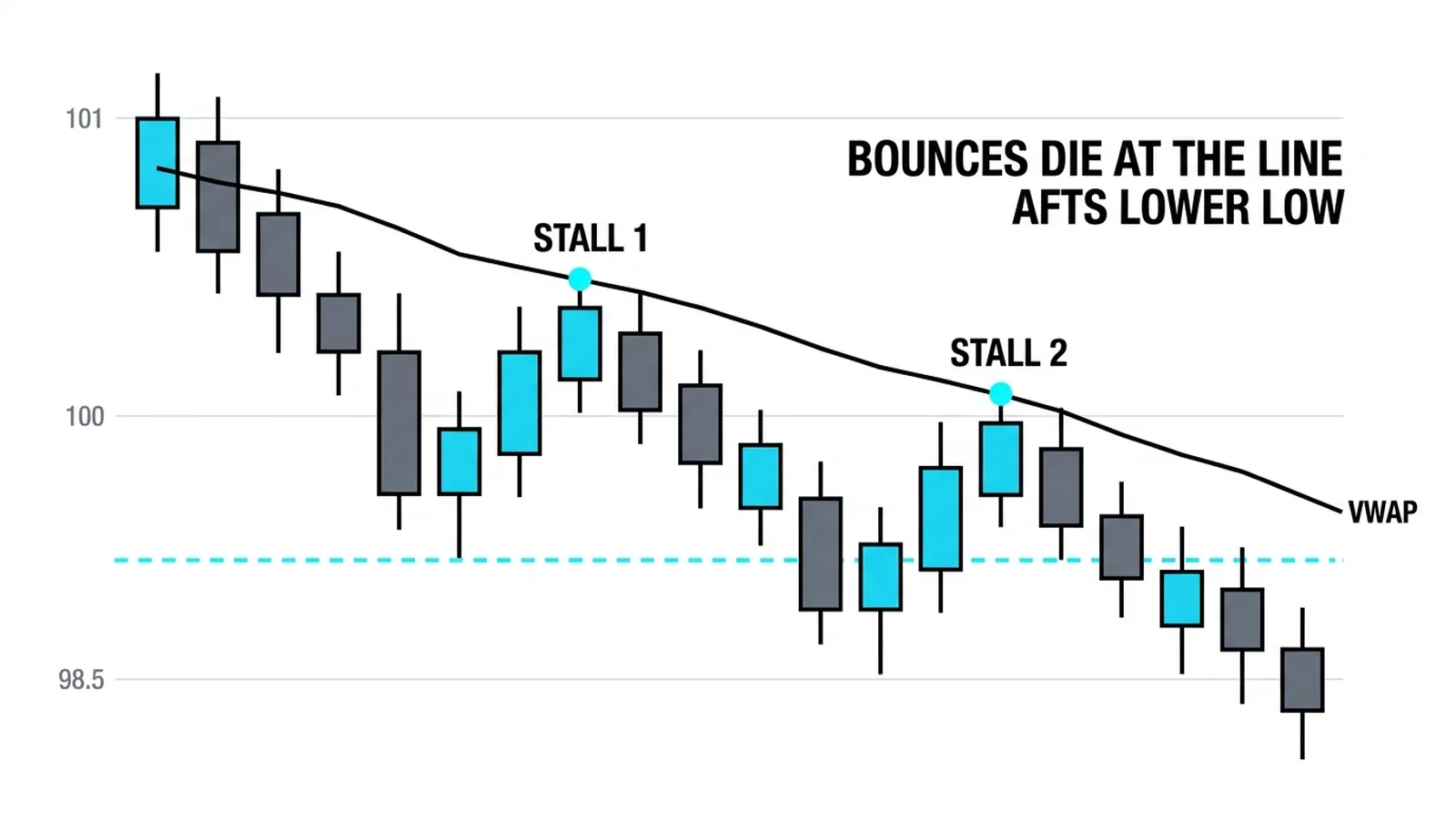
Two rallies, two stalls at the same line, and lower lows after each. Under the magnet picture, the iron filings gather at the line and get pushed back by whatever force is running the day. On a session like this the force is supply, and every bounce that dies at VWAP confirms it. A balance day shows the third behavior from the table: repeated crossings, no control, and the line as a fair-value pivot rather than a barrier.
The Gap Playbook: Chase or Wait
Gapped opens are where the benchmark discipline pays for itself. A well-known treatment of the subject framed the choice cleanly: when a stock gaps, you can chase the open, or wait for price to trade relative to VWAP and take the entry the line offers. The chart below is the wait case.
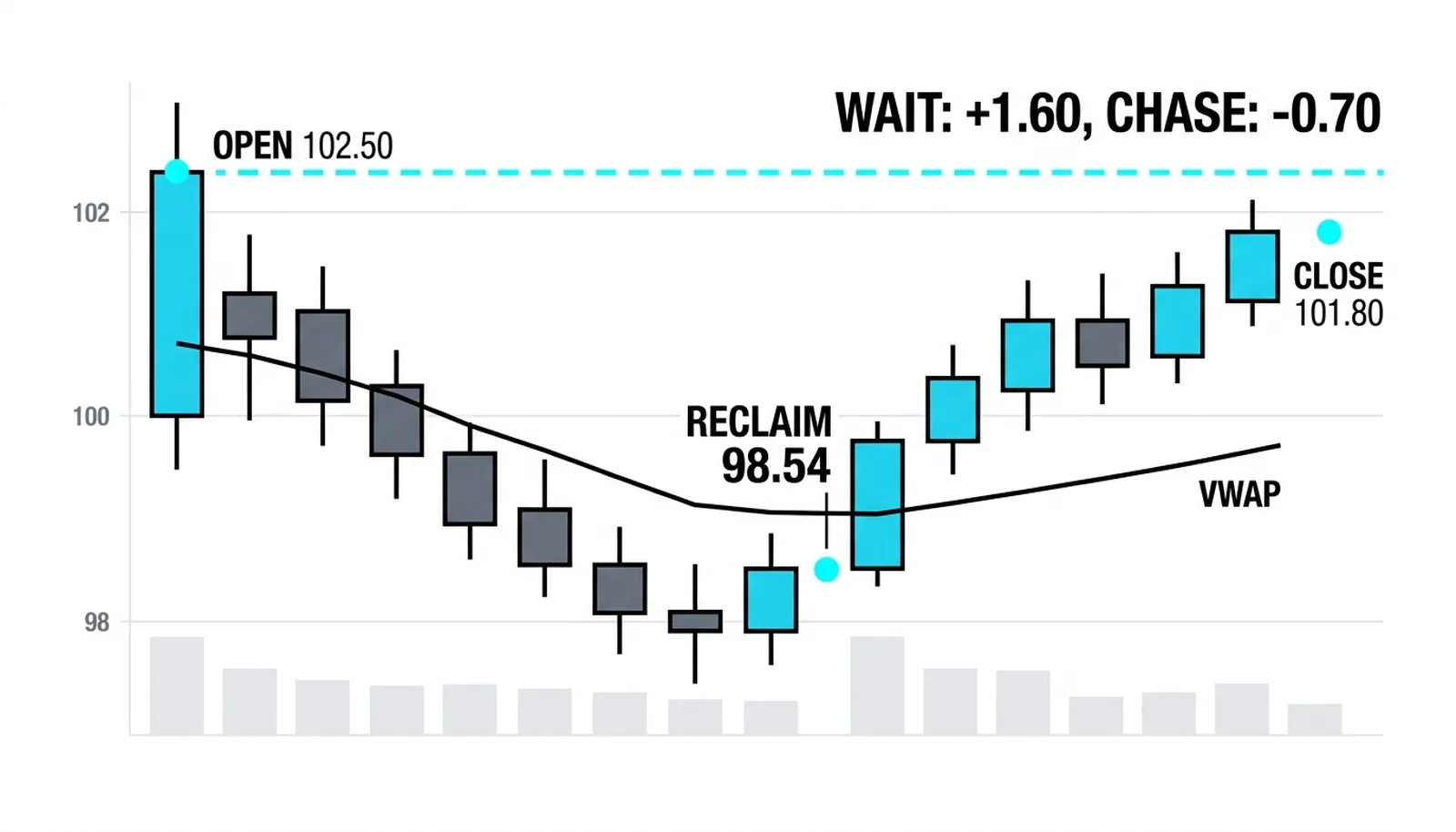
The numbers in the chart tell the whole story. The open printed 102.50. Chasing there meant riding a fade that ran below the session's weighted average. The reclaim of VWAP printed at 98.54, which is 3.9 percent cheaper than the open, and the rally that followed made the patient entry the profitable one. Nothing about the fade was knowable at 9:31. What was knowable was the rule: on a gap, the line tells you when buyers have actually taken control, and the opening print tells you nothing.
The same logic runs on gap-down days in reverse. Let the first bounce fail, wait for price to lose the line, and the entry comes with the day's high as a defined risk point rather than a hope.
Using the Line Without Overusing It
Three cautions keep the tool honest. First, regime comes first: the pullback buy works on trend days and fails on balance days, so classify the day before you trust the level. Second, the early-session line carries little information, because a handful of bars own the average; the open is exactly when session opening range methods do the work instead. Third, the line is a reference, and the reference works because institutions reference it. The behavior is real, though the mechanism is order flow, not magic.
VWAP as a Level, Answered
Should you buy every touch of VWAP?
No. The touch is a level of interest, and the day type decides what it means. On a trend day the first pullback holding the line is a continuation setup. On a balance day the same touch is fair value, not a signal, and the crossing behavior of the session tells you which regime you are in.
Does VWAP matter before lunch?
Less than people hope. The cumulative average is owned by a handful of bars early in the session, so the line moves sharply on light data. The opening period belongs to opening-range methods, and the line becomes trustworthy as volume accumulates behind it.
How do you trade VWAP on a gap day?
By the reclaim rule: let the first move off the gap play out, wait for price to lose or reclaim the line, and enter when the line confirms which side controls the session. The gap chart above is the template, and the reclaim entry beat the open by nearly 4 percent in that example.
When the level fails, it fails informatively. A pullback that slices through VWAP and closes well below it has flipped the regime call: what looked like a trend day is behaving like a balance day, and the playbook changes with it. Treat every test of the line as a question with three possible answers, hold, bounce, or break, and let the close, not the wick, give the verdict.
For the construction details and the formula behind all of this, go back to the full VWAP breakdown. For the version of the tool that starts from any bar you choose instead of the session open, continue to the anchored VWAP lesson.