Triple-Candle Patterns: Stars and Soldiers
Triple-candle patterns build their case over three sessions, and the four classics are the morning star, the evening star, the three white soldiers, and the three black crows. Three candles carry more evidence than one or two, because you get to watch conviction, hesitation, and resolution play out in sequence. The cost is time. A three-candle signal takes longer to form, so you enter later than the single-candle traders do. That is the trade-off, and it is usually worth making.

Think of these patterns like a three-panel comic strip. The first panel sets the scene, the second delivers the turn, and the third pays it off.
The Morning Star
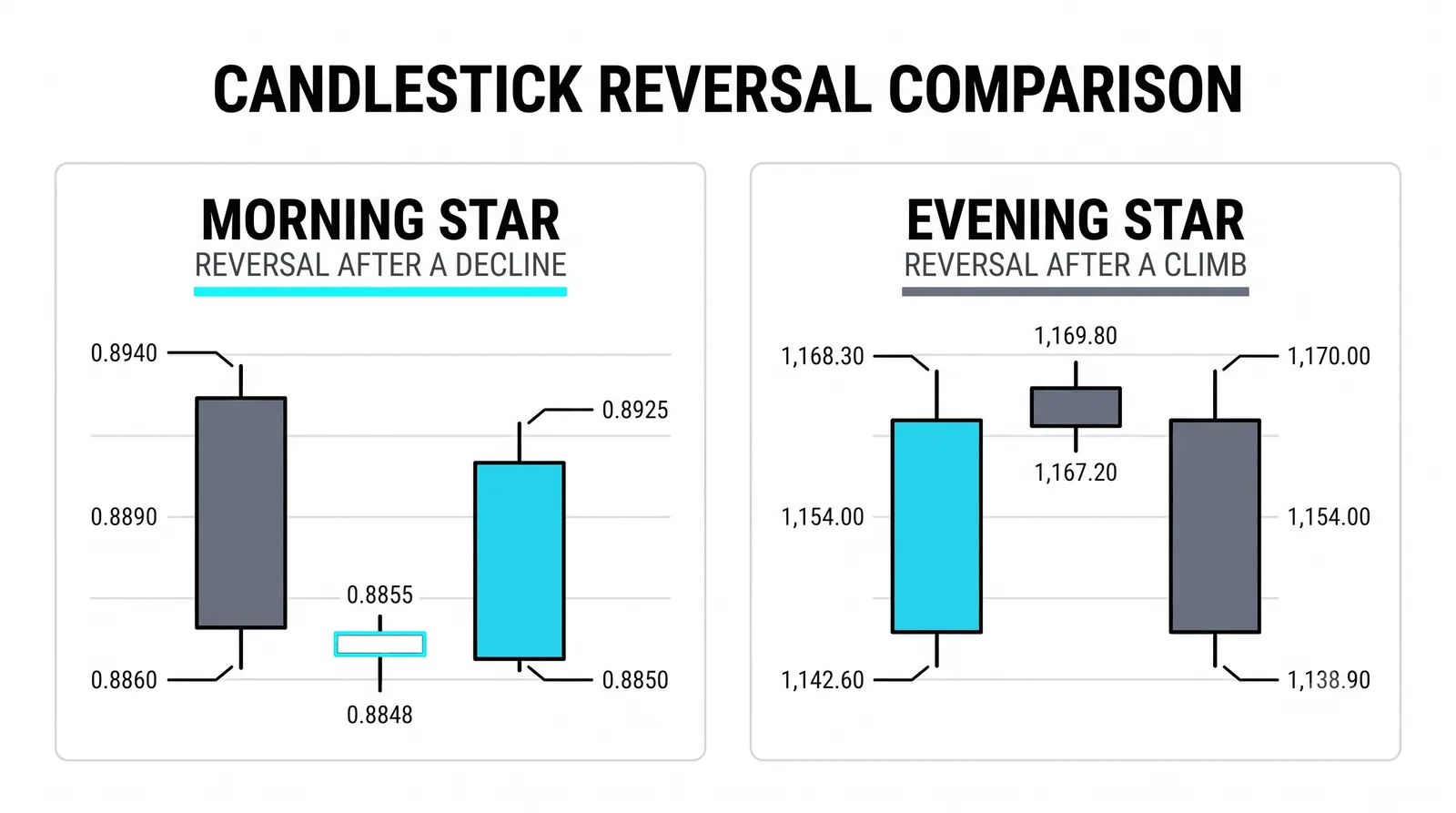
The morning star is a bottoming pattern. It appears after a decline and suggests sellers are losing control.
The first candle is a strong bearish candle. Sellers are confident, the close is near the low, and the body is long. Nothing about it hints at a reversal.
The second candle is small. It can be a tiny body of either color, and it often gaps down from the first candle's close. Its message is doubt. Sellers pushed and the price barely moved. That small body tells you the selling pressure dried up.
The third candle is a strong bullish candle that closes well into the body of the first candle. The deeper it closes into that first body, the stronger the signal. A close above the first candle's midpoint is the common threshold traders use.
Read the psychology session by session. Session one: conviction from the bears. Session two: doubt, because neither side can move price. Session three: conviction the other way, from the bulls. That arc is why the pattern works. You watched control change hands in real time.
A morning star forming at a known support level carries more weight than one floating in the middle of nowhere. Location still matters more than shape.
The Evening Star
The evening star is the same story told at a top, in reverse.
The first candle is a strong bullish candle. Buyers are confident, the rally looks healthy, and nobody sees a problem.
The second candle is small again. It often gaps up, then goes nowhere. Buyers pushed and got nothing for it. That hesitation candle is the warning, and most traders ignore it because the trend still looks fine.
The third candle is a strong bearish candle that closes deep into the first candle's body. Same midpoint rule applies. A close below the first candle's midpoint confirms the sellers have taken over.
The psychology mirrors the morning star exactly. Conviction, doubt, conviction the other way. The only difference is direction.
Evening stars after a long, extended rally deserve more respect than evening stars after a two-day bounce. The more stretched the prior move, the more fuel a reversal has.
The Three White Soldiers
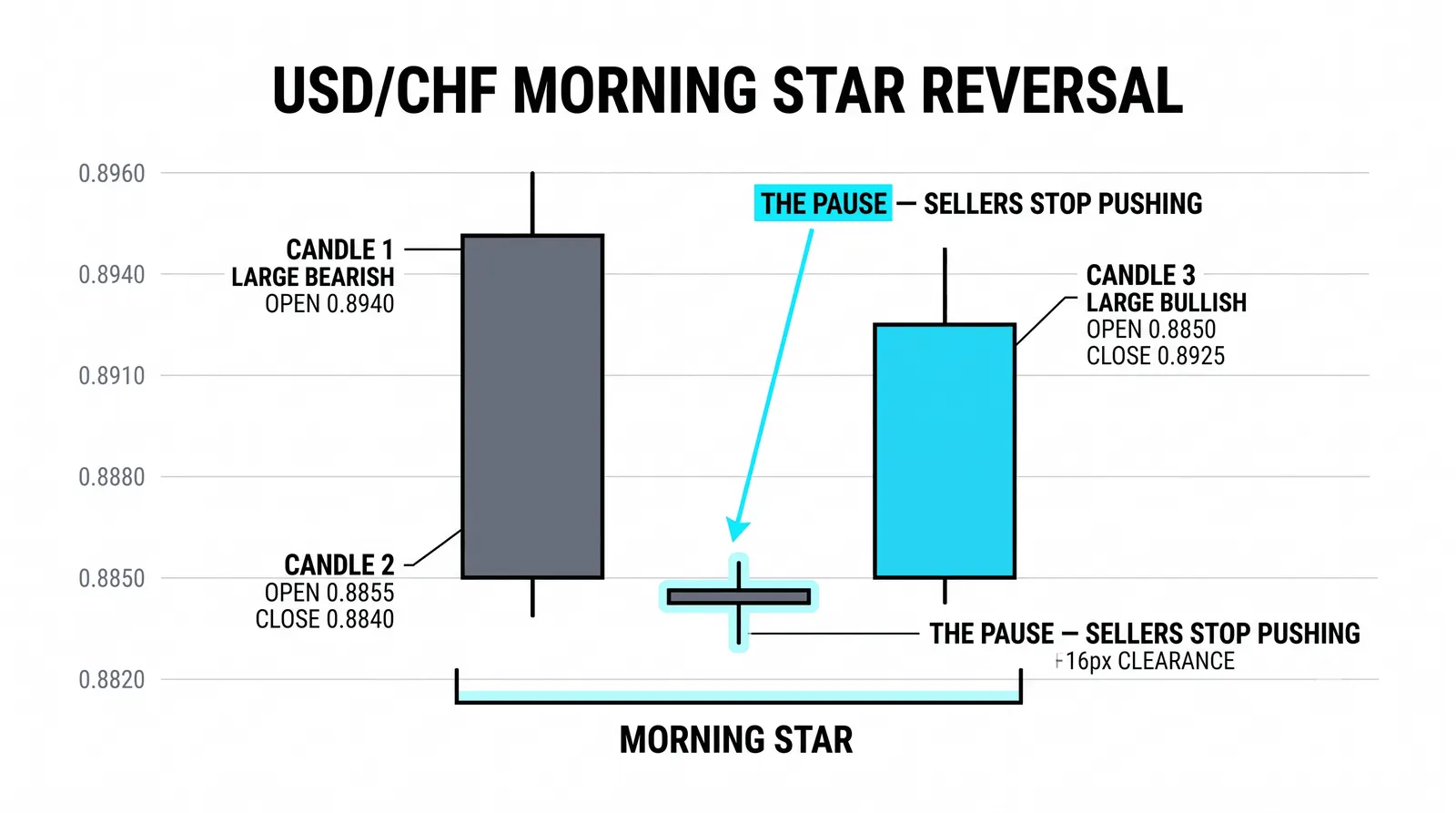
Three white soldiers is a different kind of pattern. No hesitation candle, no turn. Just three consecutive strong bullish candles, each closing near its high, each opening within or near the prior candle's body.
The pattern shows steady, persistent buying after a decline or a period of flat price action. Each session, buyers show up again and finish the job. Three sessions of that behavior is harder to fake than one big candle.
What separates a real three white soldiers from an overextended sprint is proportion. In a healthy version, each candle has a solid body with small upper wicks, and the candles are roughly similar in size. The advance looks controlled.
In the weak version, the third candle is huge and stretched far above the other two, or the candles get progressively bigger with long upper wicks. That is a sprint, and sprints exhaust themselves. A pattern that has already traveled too far leaves you buying the top of the move it was supposed to predict.
Also watch where the soldiers march into. Three white soldiers that run straight into a major resistance level above are walking into a wall. The pattern says buyers are strong. The level says someone is waiting to sell to them.
The Three Black Crows
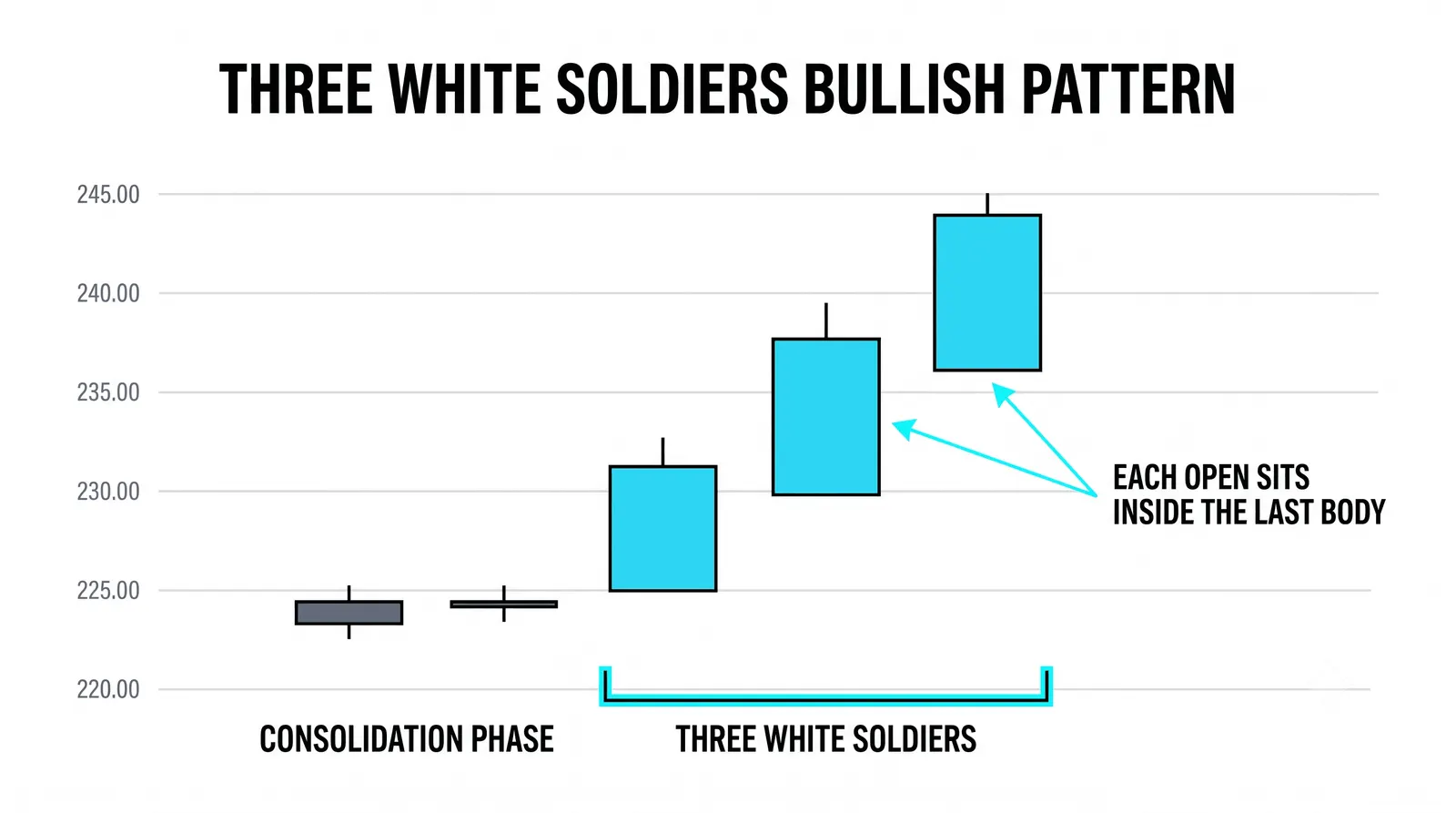
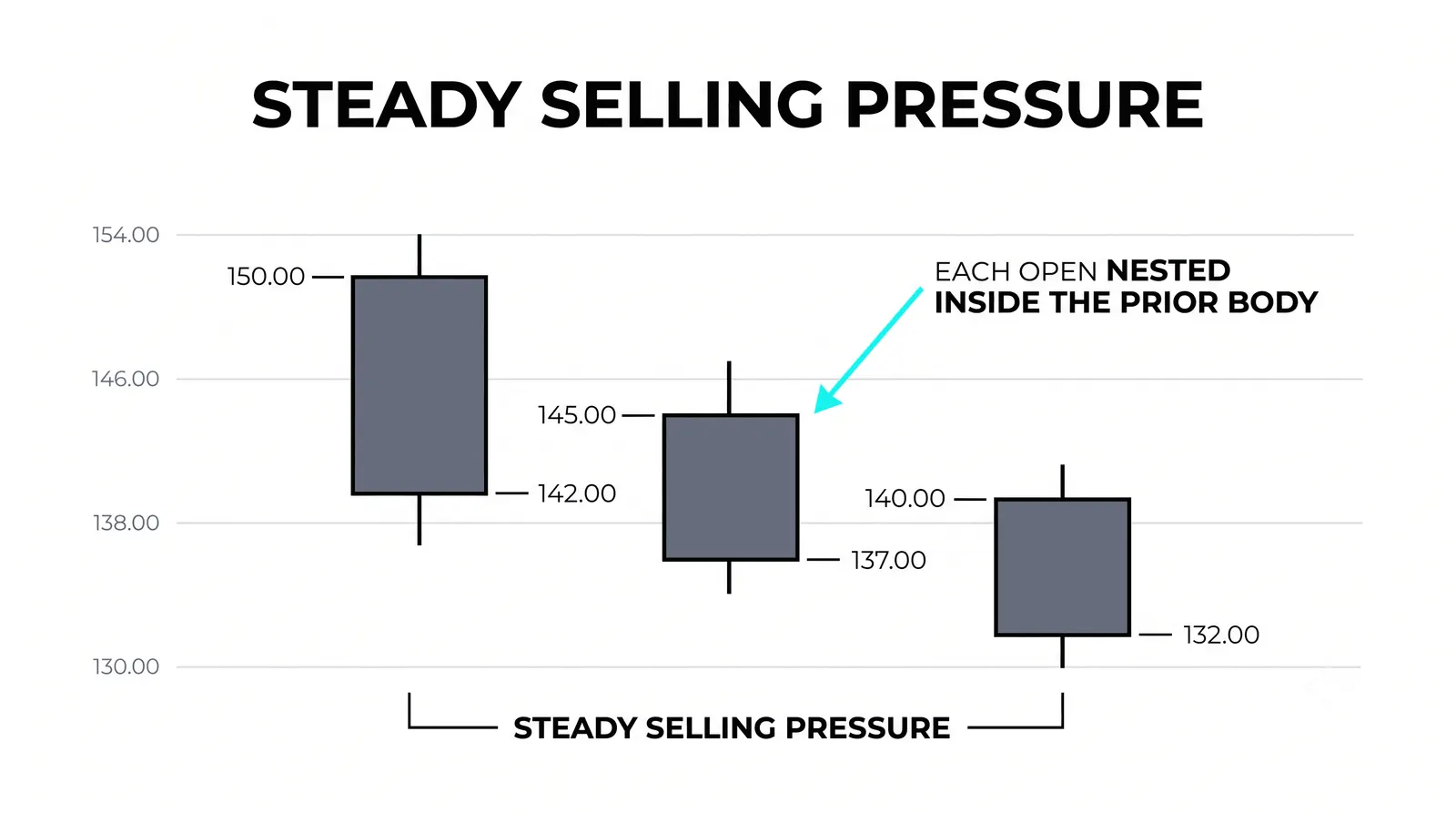
Three black crows is the mirror. Three consecutive bearish candles after a top, each closing near its low, each opening within or near the prior body.
Steady is the operative word. Each candle is a firm, controlled decline. Sellers are methodical, not panicked. That persistence is what makes the pattern meaningful, because it shows sustained distribution rather than a single burst of fear.
One gap-heavy plunge is a different event entirely. A single violent drop with gaps can be panic, news shock, or a stop cascade, and those often retrace. Three black crows is the opposite texture: no drama, just relentless selling session after session. Do not confuse the two. The crow pattern earns its meaning from repetition.
The same caution about extension applies. If the three crows have already carried price far below any nearby support, the easy part of the move may be done. The pattern confirms what happened. It does not promise what happens next.
The Third Candle Is the Verdict
Here is a hypothetical example with round numbers. A stock falls from 88 to 81 over two weeks. You are watching for a possible bottom.
Candle one opens at 82.60 and closes at 81.20. A strong bearish candle. Sellers still in charge.
Candle two is the star. It opens at 81.10 and closes at 81.35. A tiny body. Price went nowhere. The selling stalled.
Candle three opens at 81.50 and closes at 83.40. Now check the math. The first candle's body runs from 82.60 down to 81.20, so its midpoint is 81.90. Candle three closed at 83.40, well above that midpoint. That close above the midpoint is what turns three candles into a morning star. Without it, you have two strong candles and a pause, which is not a signal.
The stop logic sits under the star's low. The star candle's low is the point where sellers made their last stand. If price trades below it, the reversal idea is wrong, and you want to be out. In this example, the stop goes just under the low of that small second candle, with a small buffer for noise.
Notice what the third candle did for you. It confirmed the pattern, but it also moved your entry higher than an aggressive trader's entry on candle two. You paid for confirmation with a worse price. Accept that cost. It is the price of evidence.
Questions About Triple Candlestick Patterns
Do the three candles need gaps between them?
No. Gaps make star patterns look textbook, but they are not required, especially in markets that trade nearly around the clock like forex and crypto, where gaps are rare. What matters is the body structure: strong candle, small candle, strong candle closing past the midpoint. In stocks, a gap on the star candle adds emphasis, but its absence does not invalidate the pattern.
What if the third candle closes below the first one's midpoint?
Then the pattern is unconfirmed and you treat it as no signal. The midpoint rule exists because a shallow third candle means the counter-move is weak. Some traders act on a weaker close anyway, but they are trading a hope, not a morning star. Wait for the close to do its job.
Are three white soldiers a buy signal on their own?
No. They are evidence of strong buying, but they need context. Check what level price is approaching, how far the move has already traveled, and whether the candles look steady or stretched. Soldiers marching into resistance after a long run are a late entry, not an opportunity.
Which matters more, the pattern or where it forms?
Where it forms. A morning star at a well-tested support level after a real decline is a meaningful event. The same three candles in the middle of a range are noise. The pattern tells you what traders did over three sessions. The location tells you whether it matters.
Once these four patterns are familiar, the next step is reading them across timeframes. A morning star on the hourly chart sitting inside a daily support zone is a very different proposition from one floating on its own. That is where structure reading starts to pay.