Trading Crypto
Crypto trading means buying and selling digital currencies such as bitcoin or ether on exchanges that run around the clock, every day of the year. It is the same chart analysis you already learned, applied to a market that never closes and moves faster than almost any other. If you finished the styles lessons, you already know the mechanics of entries, stops, and targets. What changes here is the environment those skills operate in.

Think of crypto as a market that never turns the lights off, so there is no closing bell to protect you from yourself. That single fact shapes everything below.
What You Are Actually Trading
Crypto assets are digital tokens that live on public networks. Bitcoin and ether are the two largest examples, and they are the only ones this lesson will name, because the thousands of smaller coins carry a different risk profile entirely.
You trade them in pairs. The most common pairs price a coin against the dollar or a dollar-pegged token, but you can also trade coins against each other. When you buy bitcoin with dollars and sell it later at a higher price, the mechanics are identical to any other market you have studied.
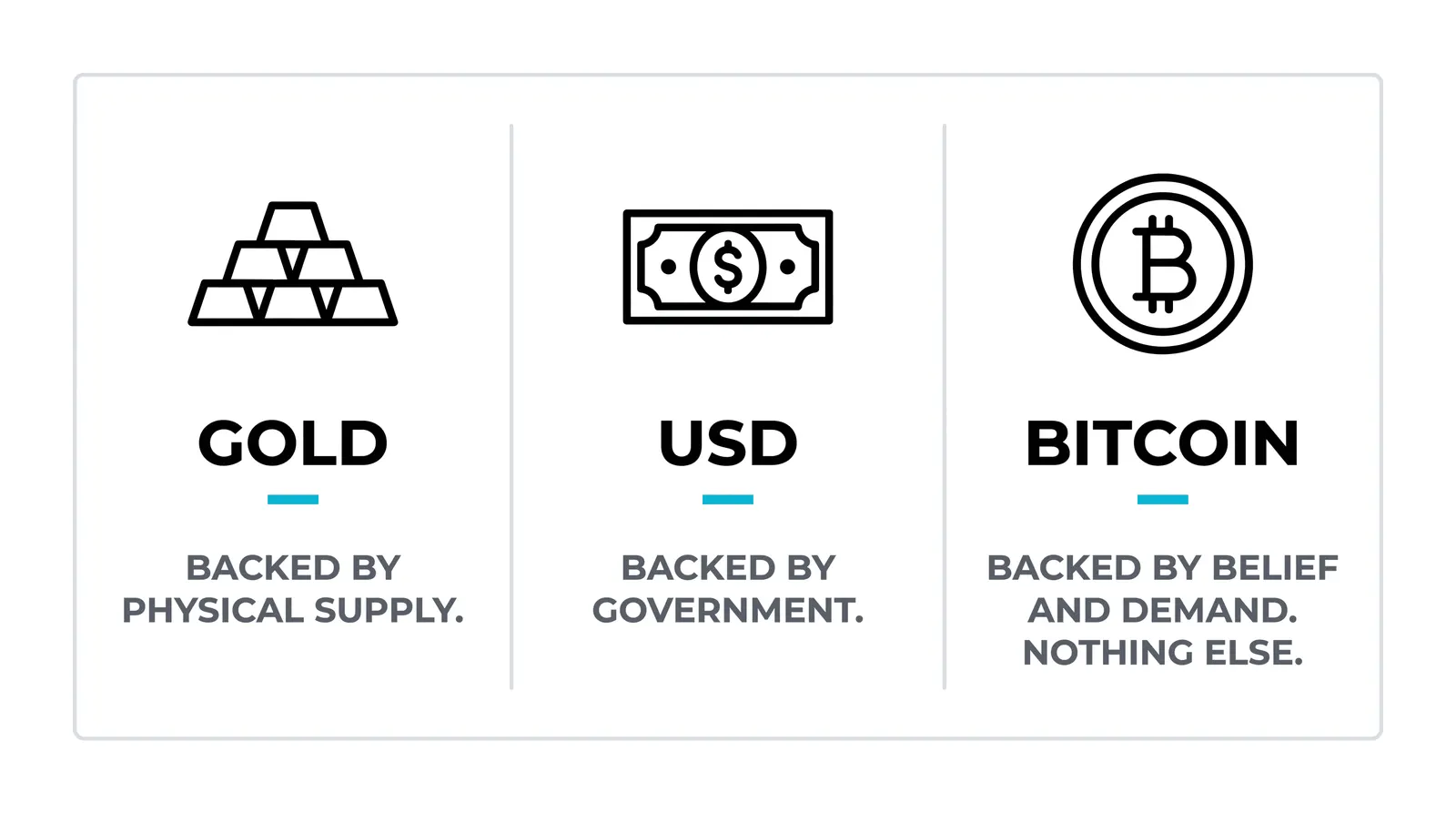
One topic sits underneath all of this: custody. Your coins sit either on the exchange where you trade or in a wallet you control yourself. That choice has real consequences, and the custody lesson covers it in full. For now, just know that where the coins sit is a decision, not a default.
A Market With No Closing Bell
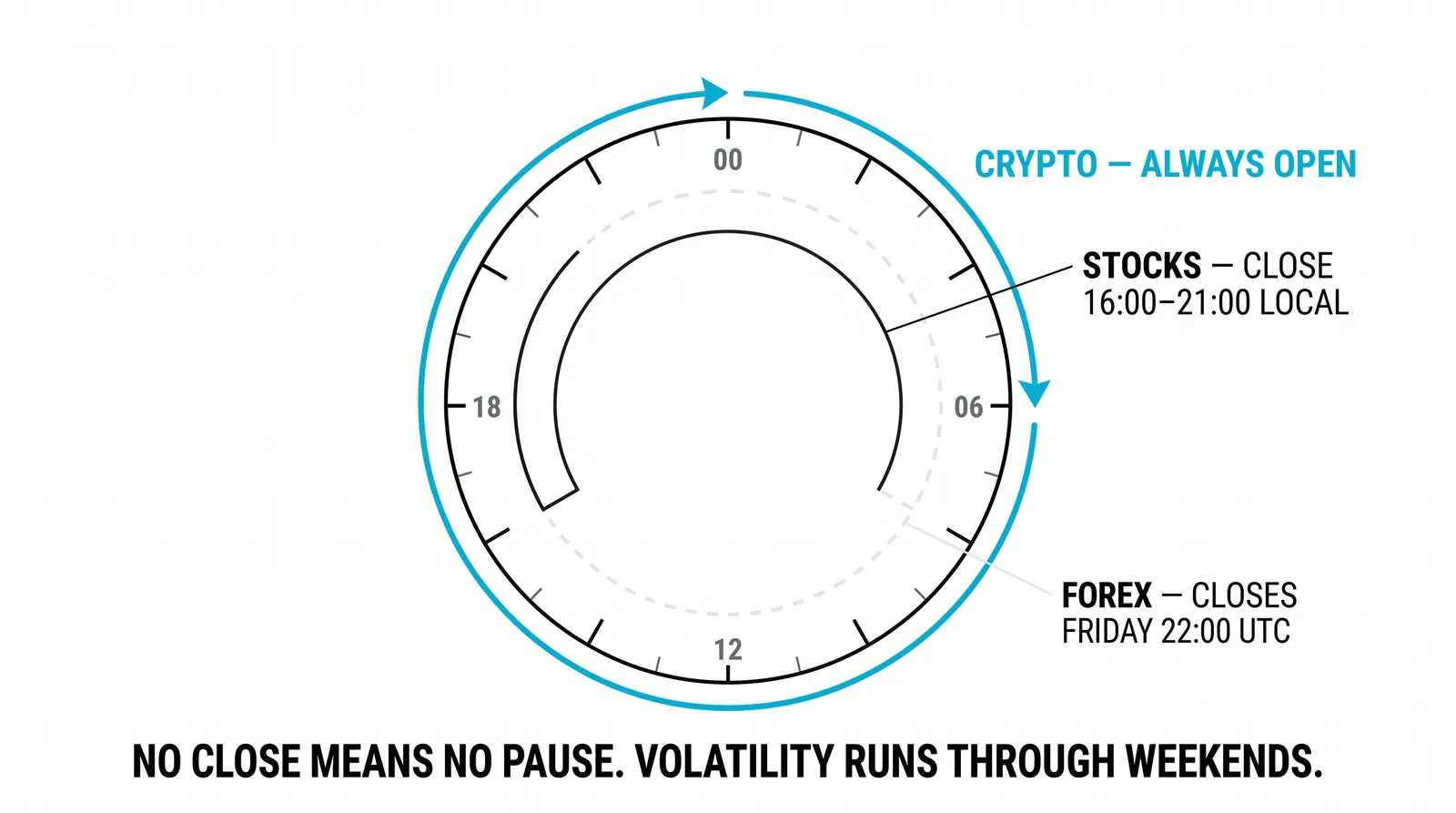
Crypto trades 24 hours a day, 365 days a year. There is no open, no close, no circuit breaker pause, and no holiday schedule.
Prices are also set exchange by exchange. There is no single official tape the way there is for a listed stock. Most of the time the major exchanges agree closely, but in fast moves they can drift apart for minutes at a time.
Liquidity changes through the week. Weekends run thinner, because the large institutional desks are mostly offline. Thinner liquidity means the same size order moves the price further, which is why some of the sharpest moves in crypto happen on Saturday nights.
What Moves Crypto Prices
Four forces do most of the work.
- Adoption and sentiment cycles. Crypto moves in long waves of enthusiasm and despair. These cycles can last years and produce trends larger than almost anything in traditional markets.
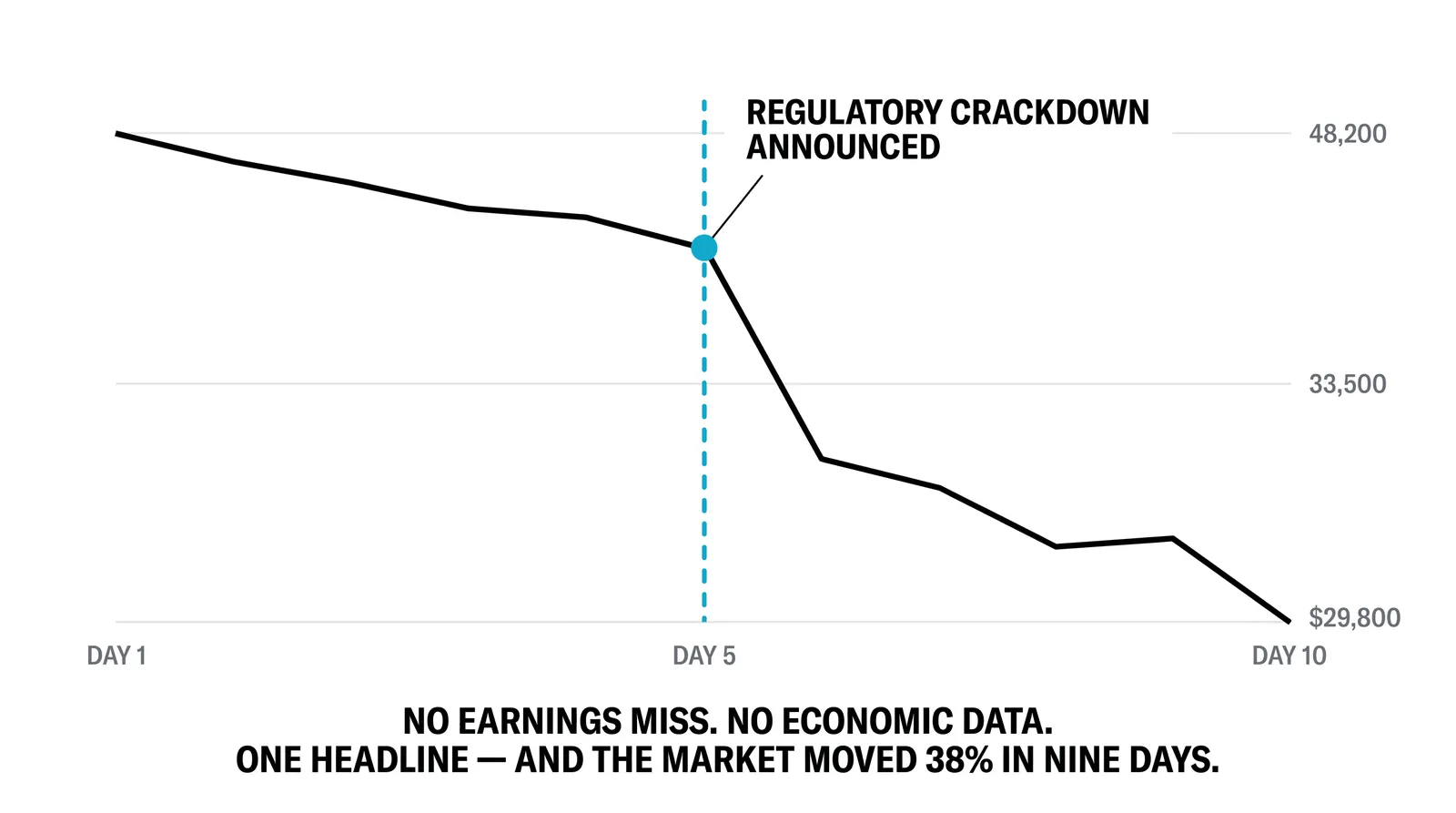
- Regulation headlines. A single government announcement can move the whole market in minutes, in either direction.
- Broad risk appetite. Despite the marketing, crypto often trades like a high-beta risk asset. When stock investors get nervous, crypto usually falls harder.
- Supply schedules. Some coins have fixed or programmed issuance. Bitcoin's supply growth is coded and predictable, which is a genuine structural difference from currencies a central bank can expand at will.
Notice what is missing from that list: earnings reports, economic calendars, and central bank meetings as direct drivers. The news rhythm you learned for other markets only partly transfers.
The Appeal, Stated Plainly
The access is real. Anyone with an internet connection can open an account, and fractional sizing means you can take a meaningful position with a few hundred dollars. There is no minimum account threshold set by a broker.
The hours fit any schedule. If your free time is evenings or weekends, crypto is the one major market fully open during all of it. For people whose work blocks out the stock market session, this alone settles the question.
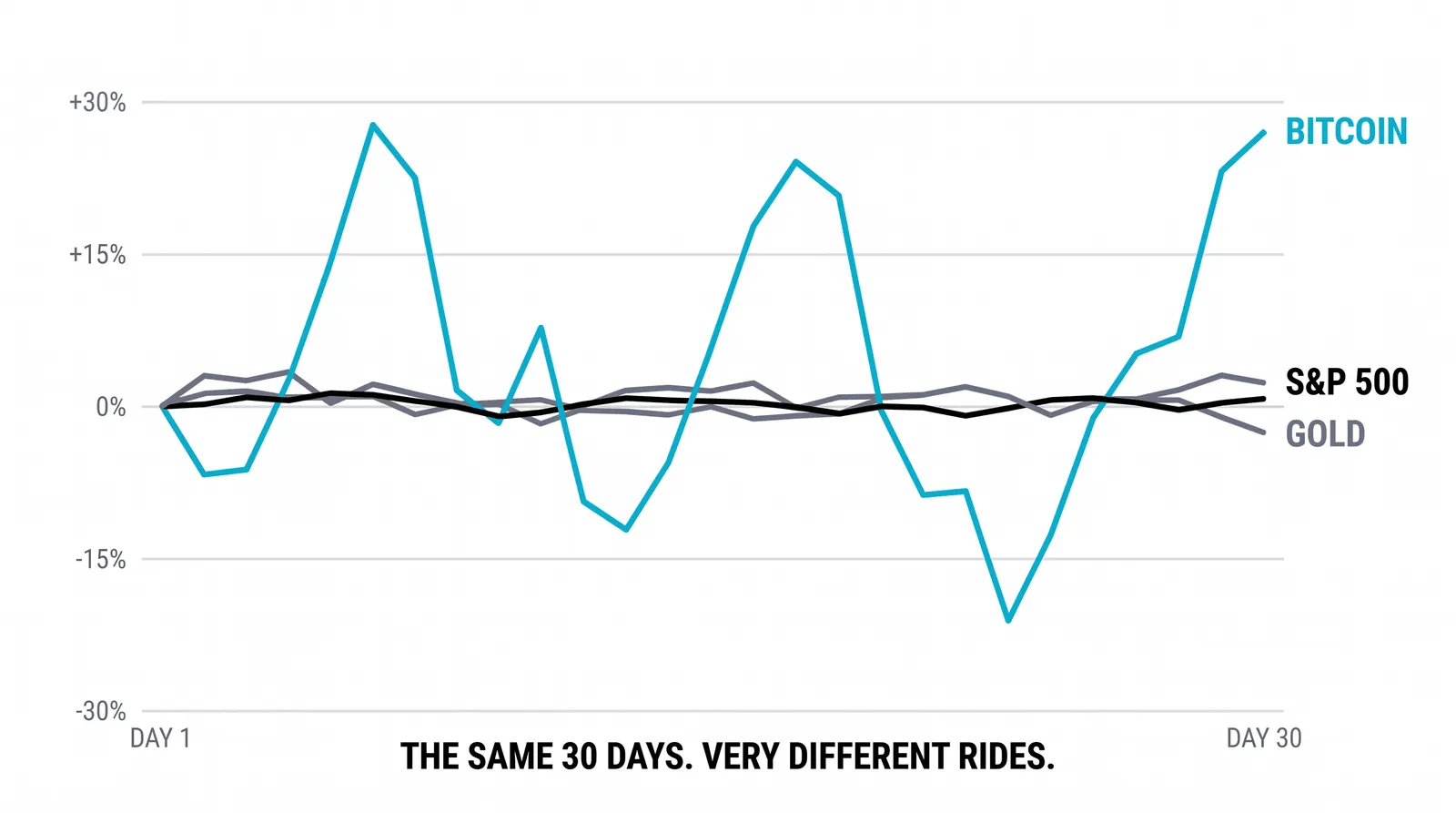
And the trends are large enough to matter. Multi-hundred-percent runs and eighty-percent drawdowns both happen. A swing trader who catches even part of a major trend can do well with patience and ordinary position sizing.
What Makes It Demanding
Volatility cuts both ways. A double-digit daily move in bitcoin is normal, not exceptional. Your stop placement and position sizing have to account for that, or normal noise will take you out of good trades.
Thin weekend liquidity produces flash moves. Price can drop ten percent in minutes on a Sunday and recover by Monday. If your stop sits inside that range, you get filled at the bottom of a move that did not last.
Exchange and custody risk is real. Exchanges have been hacked, frozen withdrawals, and failed outright. This is a risk category that simply does not exist in the same form when you trade stocks through a regulated broker.
Small coins add hype cycles and manipulation on top. Thin order books, coordinated promotion, and sudden collapses are common outside the largest assets. Treat anything beyond the biggest names as speculation, not trading.
Finally, the market can demand attention at 3 a.m. forever. There is no bell that lets you fully switch off. Traders who cannot set boundaries with a market that never closes tend to burn out or overtrade. That is not a small thing.
A Worked Example
Here is a hypothetical with round numbers. Bitcoin trades at 60,000. You buy with a stop at 57,000, which is a 5 percent risk on the position.
Over the weekend, thin trading pushes price down in a fast wick to 54,000. Your stop fills near 54,800 because there were no buyers at 57,000 when the move hit. By Monday morning, price has recovered to 63,000.
Two things happened there. First, slippage: your 5 percent planned loss became roughly an 8.7 percent actual loss, because stops fill at the available price, not your chosen price. Second, the recovery: the idea was right and the market still took you out.
A stock trader with the same setup would likely have slept through the wick, because stock markets were closed, and kept the position. The crypto trader lived every tick of it. Neither scenario is rare. This is the cost of a market that never pauses, and your sizing has to assume it will happen to you.
How Crypto Compares to the Other Markets
| Crypto | Forex | Stocks | |
|---|---|---|---|
| Hours | 24/7, every day | 24 hours, weekdays only | Exchange sessions, weekdays |
| Typical volatility | Very high; double-digit daily moves are normal | Low; major pairs often move under 1 percent a day | Moderate; a few percent daily for most large stocks |
| Where held | On an exchange or in a personal wallet | Broker account, no asset delivered | Broker custody under regulation |
The pattern in that table is a trade. Crypto gives you total access and large movement, and charges you for it in volatility, custody responsibility, and weaker protections.
Who Crypto Fits
It fits traders who are genuinely comfortable with volatility, not traders who think they are. The test is whether a ten percent overnight move against you changes your behavior. If it does, size down or choose a calmer market.
It fits people whose free hours fall outside traditional sessions. Evening and weekend traders get a fully live market here and a closed one almost everywhere else.
And it fits people willing to take custody seriously. If learning wallet security sounds tedious rather than interesting, keep your exposure small and on established venues while you decide.
Questions About Crypto
Is crypto a good first market?
It can be, if you respect the volatility. The low capital requirements and constant access make it easy to practice with real but tiny positions. The danger is that the same volatility teaches bad habits fast, so start smaller than you think you need to.
How much capital do I need to start?
Technically, a few dollars, because fractional sizing lets you buy small slices of any coin. Practically, enough that your position sizes are meaningful but your losses are painless. For most beginners that means a few hundred dollars treated as tuition, not investment.
Can I trade crypto part-time?
Yes, and the 24/7 schedule actually helps, because your free hours always overlap with a live market. The catch is the reverse: the market is also live while you sleep, so swing traders need wider stops, smaller size, or alerts they are willing to ignore.
Should I trade the smaller coins?
Not as a beginner. Small coins combine thin liquidity, manipulation, and hype cycles into a product that punishes inexperience. Learn on the largest, most liquid markets first, where the chart behavior you studied actually applies.
Once you know which market fits your hours and temperament, the next step is the practical one: how exchanges, wallets, and custody actually work, and how to set up safely before your first trade.